Mahogany Decking Pros and Cons (Real Cost + 40-Year Lifespan)
Mahogany decking costs $6 to $28 per square foot and resists rot and insects well enough to last up to 40 years — but it needs resealing every two years and is one of the priciest hardwood decking options sold today. If your budget allows the upfront cost and you’re willing to keep up a simple maintenance routine, that trade pays off in a deck that outlasts cedar, pine, and most composite boards. This guide covers real cost numbers, how mahogany compares to cedar, ipe, and composite, and the maintenance schedule that gets you the full 40-year lifespan.
Note: Insert your Affiliate Disclosure reusable block here.
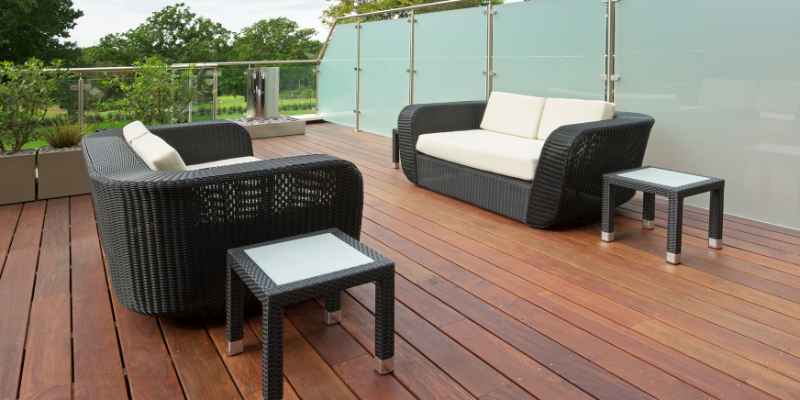
Mahogany Decking Pros: What You Gain
Mahogany is a dense tropical hardwood, and that density is what gives it a lifespan competitors can’t match at the same price point. Properly maintained, a genuine mahogany deck can last up to 40 years — well ahead of cedar (15-20 years) or pressure-treated pine (10-15 years).
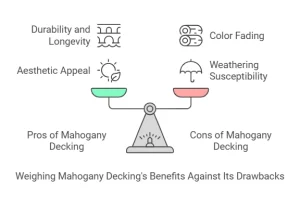
- Rot and insect resistance: Mahogany’s natural oils make it inhospitable to termites and fungal decay without chemical treatment, unlike pine, which relies on pressure-applied preservatives.
- Deep, stable color: The reddish-brown tone runs through the entire board, not just a surface stain, so scratches and wear don’t expose lighter wood underneath.
- Workability for a hardwood: Mahogany is less hard and more flexible than ipe, so it’s easier to cut, drill, and fasten without pre-drilling every hole or burning through carbide blades as fast.
- Dimensional stability: It resists cupping and warping better than most softwoods once it’s acclimated to your climate before installation.
Mahogany Decking Cons: What You Give Up
The tradeoffs are real, and they’re mostly about money and upkeep rather than performance.
- Price: Mahogany decking runs $6 to $28 per square foot for material alone, depending on grade and species (genuine vs. “Philippine” mahogany), compared to $2-$6 for pressure-treated pine and $3-$7 for cedar.
- Rarity drives the price up: Genuine mahogany is a slower-growing, more limited species than cedar or pine, which is the main reason it costs more and why sourcing FSC-certified boards takes more effort.
- Maintenance schedule: To hit that 40-year lifespan, mahogany needs a fresh coat of UV-protective oil or sealer roughly every two years. Skip it and the wood will still function, but it will gray and check faster.
- Installation difficulty: The tight, interlocking grain that gives mahogany its durability also dulls standard blades quickly and often calls for carbide-tipped or specialty blades plus pre-drilled pilot holes near board ends to prevent splitting.
- UV fading: Left unsealed, mahogany’s rich color fades to gray within a year or two of sun exposure — the same UV damage that eventually affects every unsealed hardwood, just more visible against mahogany’s deeper starting color.
Genuine Mahogany vs. “Philippine Mahogany”: Know What You’re Buying
Not every board sold as “mahogany” is the same species, and this is where a lot of buyers get surprised on price and performance. Genuine mahogany (Swietenia species, sometimes called Honduran or American mahogany) is the true hardwood with the density and rot-resistance described above. “Philippine mahogany” is a common trade name for shorea species — a real, usable decking wood, but a different tree entirely, typically softer and shorter-lived than genuine mahogany. Ask your supplier for the actual botanical species before buying, since the name alone doesn’t guarantee which wood you’re getting or which price tier it should fall into.
Best Mahogany Deck Sealer Pick
 |
Penofin Natural Exotic Hardwood Penetrating Wood Finish (1 Gal) Formulated specifically for dense exotic hardwoods — mahogany, ipe, and teak — rather than a general-purpose deck stain.
|
As an Amazon Associate we earn from qualifying purchases.
Mahogany vs. Cedar, Ipe, and Composite: How the Costs Compare
Mahogany sits in the middle of the hardwood decking price range — pricier than cedar, generally cheaper than ipe, and higher-maintenance than composite but longer-lived than either softwood option.
| Material | Cost per Sq Ft | Typical Lifespan | Resealing Interval |
|---|---|---|---|
| Mahogany | $6-$28 | Up to 40 years | Every 2 years |
| Ipe | $9-$30+ | 40-75 years | Every 1-2 years (optional if left to gray) |
| Cedar | $3-$7 | 15-20 years | Every 1-2 years |
| Composite | $4-$12 | 25-30 years | None required |
If long-term durability matters more than upfront cost, see our full breakdown of cedar vs. mahogany decking or how mahogany stacks up in our composite vs. wood decking cost comparison.
How to Maintain Mahogany Decking for a 40-Year Lifespan
Mahogany’s longevity claims assume a real maintenance routine — skip it and you’ll still get a usable deck, just not the full 40 years.
- Clean before sealing: Sweep off debris, then wash the deck with a wood-safe deck cleaner and a stiff (not wire) brush to lift dirt and old finish residue.
- Let it dry fully: Give the boards 24-48 hours of dry weather before applying any sealer — trapped moisture under a fresh coat causes blotching.
- Apply a penetrating oil sealer: Use a formula made for dense exotic hardwoods (not a generic deck stain) so it soaks into the tight grain instead of sitting on the surface.
- Wipe excess after 20-30 minutes: Penetrating oils that aren’t wiped down can leave a tacky, uneven film once cured.
- Repeat every two years: Mark a calendar reminder — this interval is what separates a mahogany deck that grays out in five years from one that’s still rich red-brown after two decades.
Mahogany decking is a tropical hardwood decking material that’s oil-rich enough to resist rot and insects on its own, which is why it doesn’t need the chemical pressure-treatment that pine relies on. It’s typically installed with stainless or hot-dip galvanized fasteners to avoid the dark staining reaction some hardwoods have with standard steel screws.
“The homeowners who get the full 20-plus years out of a mahogany deck are almost always the ones who reseal on a fixed schedule instead of waiting until the wood visibly grays — by the time fading is obvious, the UV damage underneath is already done.”
Is Mahogany Decking Environmentally Sustainable?
Genuine mahogany is a slow-growing tropical species, and that scarcity is part of what drives its higher price. Look specifically for FSC (Forest Stewardship Council) certification on any mahogany decking purchase — it confirms the wood was harvested from a managed, legally verified forestry operation rather than illegal or unmanaged logging, which remains a documented problem in parts of the mahogany trade. If FSC certification isn’t available from your supplier, that’s a legitimate reason to consider a plantation-grown alternative like cedar or a composite product instead.
Frequently Asked Questions
What are the advantages of mahogany decking?
Mahogany resists decay, moisture, and insects on its own, without chemical treatment, and can last up to 40 years with proper maintenance. Its color runs through the entire board rather than sitting on the surface, so wear doesn’t expose lighter wood, and it’s easier to cut and install than denser exotics like ipe.
What are the disadvantages of mahogany decking?
The main disadvantage is cost — $6 to $28 per square foot, well above cedar or pressure-treated pine. It also needs resealing roughly every two years to prevent UV fading, and its tight interlocking grain requires carbide-tipped blades and pre-drilled holes during installation.
How long does mahogany decking last?
With a penetrating oil sealer reapplied every two years, genuine mahogany decking can last up to 40 years. Skipping regular resealing shortens that significantly, since UV exposure causes the wood to gray and check faster without protection.
Is mahogany decking environmentally friendly?
It can be, if it’s FSC-certified. Genuine mahogany is a slow-growing tropical hardwood, and sourcing without certification risks supporting illegal or unmanaged logging. Ask any supplier for FSC documentation before buying.
Is mahogany decking worth the cost compared to composite?
If you want zero maintenance, composite decking ($4-$12/sq ft, no resealing) wins on convenience. If you want the specific look and feel of real hardwood and don’t mind resealing every two years, mahogany’s higher price buys a longer lifespan (up to 40 years vs. 25-30 for composite) and a deck that can be sanded and refinished rather than replaced.
Conclusion: Is Mahogany Decking Right for Your Project?
Mahogany decking makes sense if you want a real hardwood deck that can last up to 40 years and you’re willing to reseal it every two years to get there. It costs more upfront than cedar, pine, or composite, but for homeowners who value the deep, stable color and don’t want to replace a deck in 15-20 years, that tradeoff holds up. Check for FSC certification when you buy, budget for a penetrating exotic-hardwood sealer, and set a two-year resealing reminder — that’s the difference between a mahogany deck that fades in a few years and one that’s still worth showing off two decades from now.
Sponsored / affiliate links. As an Amazon Associate I earn from qualifying purchases. I may earn additional commission from eligible campaigns.