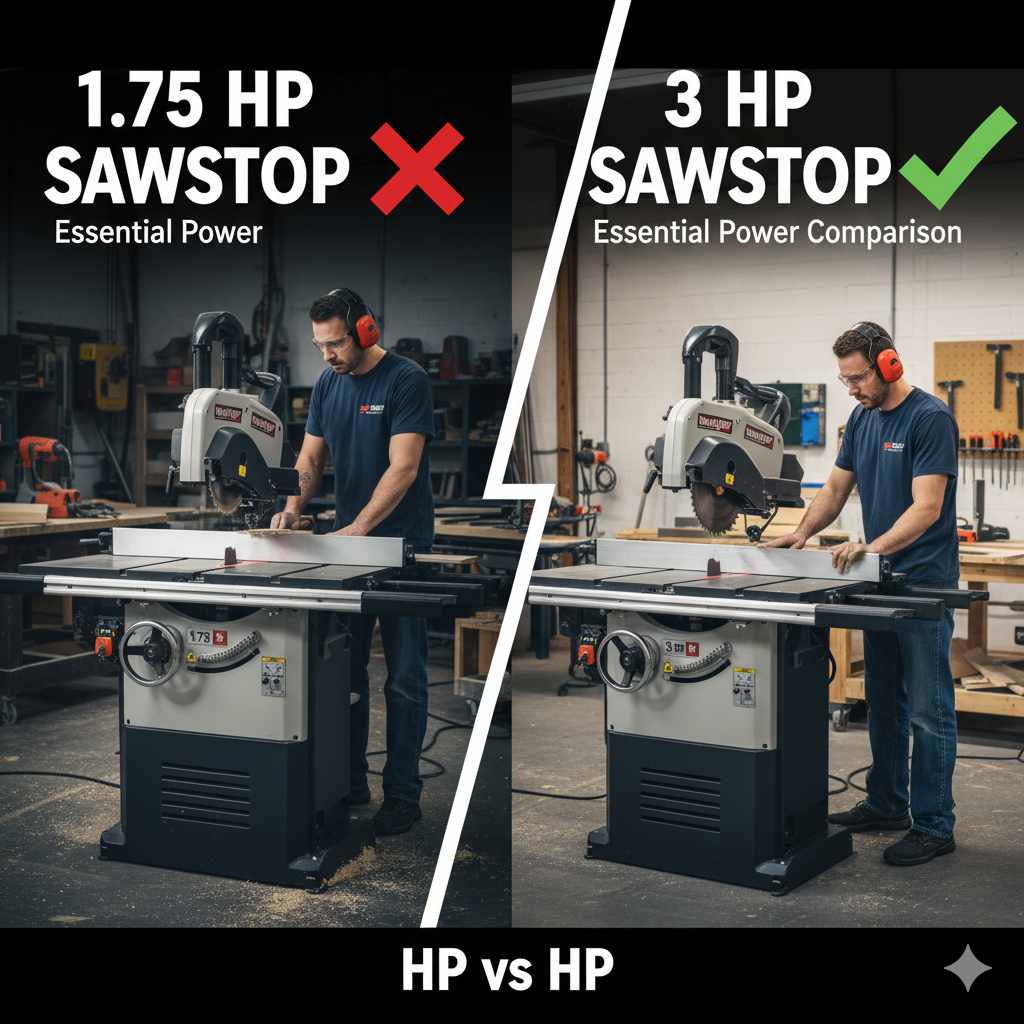
1.75 HP vs 3 HP SawStop: Essential Power Comparison
For most DIYers and homeowners, a 1.75 HP SawStop is plenty powerful for everyday projects. A 3 HP motor offers a significant boost for tougher tasks, denser woods, and faster cuts, making it ideal for serious woodworkers.
Choosing the right SawStop is a big step for any woodworker, whether you’re just starting out or looking to upgrade your workshop. One of the most common questions that comes up is about the motor power: specifically, the difference between a 1.75 HP and a 3 HP SawStop. It’s easy to feel a bit lost with all the technical specs, but don’t worry! I’m here to break down exactly what that horsepower difference means for your woodworking projects. Understanding this will help you make a smart choice that fits your needs and budget, ensuring you get the best performance and safety from your saw. Let’s dive in and find out which power level is right for you!
Understanding Horsepower (HP) in Saws
Horsepower, or HP, is a measure of the power an electric motor can produce. Think of it like the engine size in a car – more horsepower generally means more strength and capability. For a table saw like a SawStop, this translates directly to how easily and quickly the saw can cut through wood.
A higher HP motor can maintain its cutting speed better, especially when you’re working with thicker or denser materials. It’s less likely to bog down or stall. For beginners, this might not seem crucial, but as you tackle more ambitious projects, or when you encounter hardwoods like oak or maple, that extra power makes a noticeable difference in the cutting experience and the quality of your results.
1.75 HP SawStop: The Workhorse for Most Home Shops
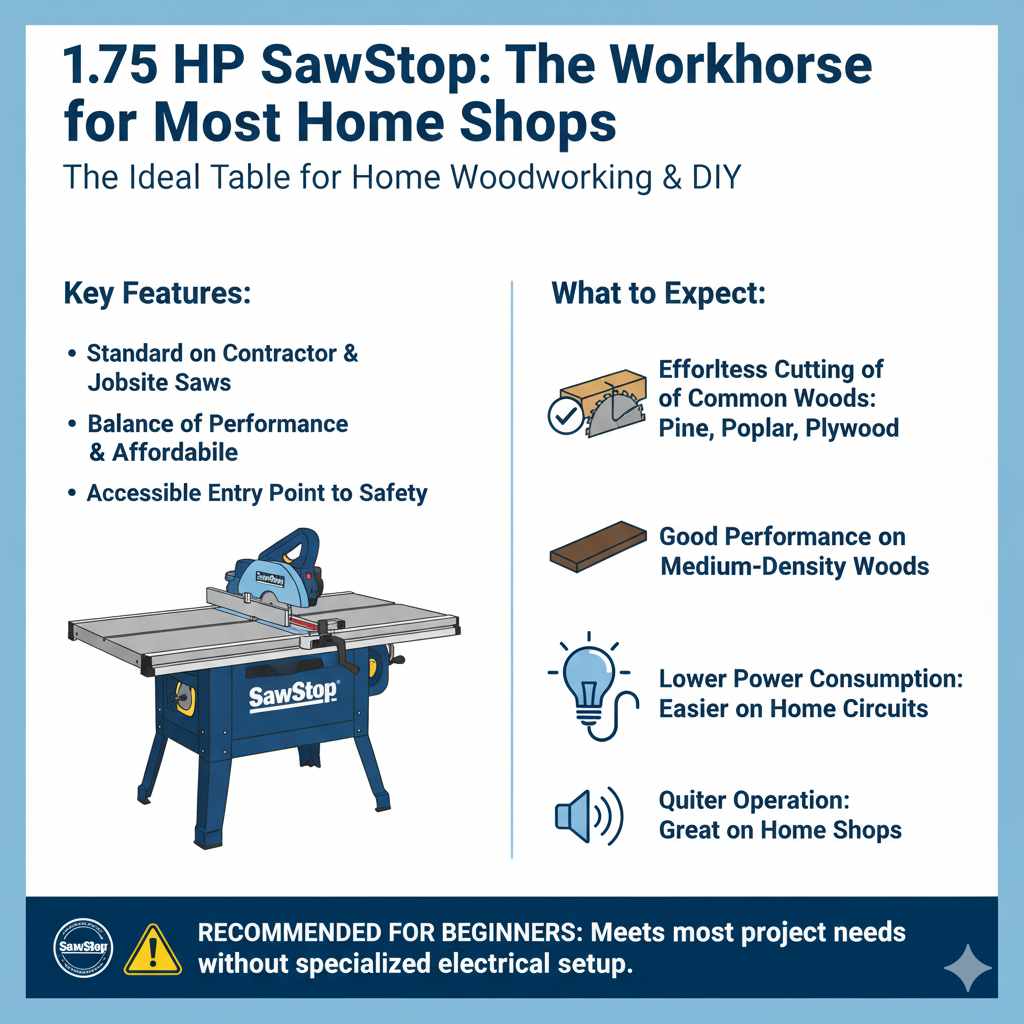
The 1.75 HP motor is a fantastic option for the vast majority of home woodworking enthusiasts and DIYers. It’s the standard power plant for many of SawStop’s popular contractor saws and some of their jobsite models. This motor size offers a great balance of performance and affordability, making it an accessible entry point into the world of SawStop safety.
What can you expect from a 1.75 HP SawStop?
- Effortless Cutting of Common Woods: Pine, poplar, and plywood are no match for a 1.75 HP motor. It will slice through these materials with ease, providing smooth, clean cuts.
- Good Performance on Medium-Density Woods: You’ll find it handles woods like cherry and walnut quite well, as long as you’re not pushing too hard or making extremely deep cuts.
- Reliable for Everyday Tasks: Whether you’re building shelves, making simple furniture, or working on home improvement projects, this motor size will serve you reliably.
- Quieter Operation (Often): Generally, lower horsepower motors tend to run a bit quieter than their higher-powered counterparts, which can be a plus in a home workshop environment.
- Lower Power Consumption: A 1.75 HP motor typically draws less amperage, meaning it’s easier on your home’s electrical circuit and potentially more efficient.
For beginners, the 1.75 HP SawStop is often the recommended choice because it meets the needs of most starter projects without overwhelming the user or requiring specialized electrical setups in a typical home garage or basement.
3 HP SawStop: Serious Power for Serious Woodworking
If you’re looking to push the boundaries of your woodworking, frequently work with hardwoods, or want the smoothest, fastest cuts possible, the 3 HP motor is where you’ll find that extra capability. This is the motor you’ll typically find on SawStop’s professional cabinet saws.
When is the 3 HP motor the better choice?
- Heavy-Duty Cutting: This motor excels at ripping thick hardwoods like maple, oak, or even exotic woods. It maintains speed and power through tough cuts, reducing the chance of blade stall.
- Faster Production: If you’re making a lot of cuts or working on larger projects, the increased power allows for faster feed rates, meaning you can get through your work more quickly.
- Dado Stacks and Resawing: Using a dado blade set for cutting wide grooves, or resawing thick lumber (cutting it into thinner pieces lengthwise on a bandsaw, but some also ask about it for table saws), requires significant power. A 3 HP motor handles these demanding operations much better.
- Improved Blade Performance: A stronger motor allows your saw blade to spin at its intended speed under load, which leads to cleaner cuts and less burning.
- Longevity and Durability: While all SawStops are built to last, higher-powered motors often have more robust components designed for sustained, heavy use.
It’s worth noting that a 3 HP motor will draw more amperage. This could mean you need a dedicated circuit or a heavier-gauge extension cord if you’re not plugging directly into a properly rated outlet. Always consult your electrical panel and local building codes to ensure safe operation.
Key Differences at a Glance: 1.75 HP vs. 3 HP SawStop
To make the comparison even clearer, let’s put the main differences side-by-side. This table highlights the core distinctions that will influence your decision.
| Feature | 1.75 HP SawStop | 3 HP SawStop |
|---|---|---|
| Motor Power | Provides ample power for most tasks. | Offers significantly more torque and sustained power. |
| Ideal Wood Types | Softwoods, plywood, medium-density hardwoods (e.g., cherry, walnut). | All hardwoods, dense exotics, thick lumber. |
| Cutting Speed & Ease | Good; handles common tasks efficiently. | Excellent; faster, smoother cuts, especially under load. |
| Demanding Operations | Can struggle with very thick materials or frequent dado use. | Excels at ripping thick stock and using dado sets. |
| Amperage Draw | Lower; generally easier on home circuits. | Higher; may require dedicated circuit or heavier-duty wiring. |
| Typical Saw Models | Contractor Saws, some Jobsite Saws. | Professional Cabinet Saws. |
| Price Point | More affordable entry point. | Higher initial investment. |
| Noise Level | Generally quieter. | Can be louder under heavy load. |
When Does the Extra Power Really Matter?
While a 1.75 HP motor is robust, there are specific scenarios where the 3 HP motor truly shines. Understanding these can help you avoid frustration down the line.
- Cutting Thick Stock: If you envision yourself ripping boards that are 3 inches or thicker, a 3 HP motor will make the job much smoother. The 1.75 HP can do it, but it will require slower feed rates and might struggle more. The SawStop Safety System works with either motor, but a smoother cut helps keep the wood from binding.
- Working with Dense Hardwoods: Materials like hard maple, white oak, or even some exotic hardwoods have tighter grain structures. A 3 HP motor has the torque to power through these woods without slowing down, resulting in cleaner, more precise cuts and reducing the risk of burning.
- Frequent Use of Dado Blades: Dado blades are wider than standard saw blades, creating a much larger surface area for the wood to encounter. This significantly increases the load on the motor. If you plan on frequently cutting dadoes or rabbets for joinery, the 3 HP motor provides the necessary power reserve.
- Production Woodworking: If you’re a hobbyist who turns out a lot of projects, or if you’re considering selling your work, the speed and efficiency gained from a 3 HP motor can be a significant advantage. Less time spent waiting for the saw to power through cuts means more time for other aspects of your projects.
- Resawing (with Caution): While primarily a bandsaw operation, some users might attempt resawing with a thick blade on a table saw. This is a demanding task that absolutely requires the extra grunt of a 3 HP motor. For accurate resawing, a dedicated bandsaw is usually recommended, but if you must on a table saw, the 3 HP is essential.
For many DIYers, these demanding operations might be infrequent. If your projects are mostly smaller boxes, simple furniture frames, or basic shop jigs, the 1.75 HP will likely serve you perfectly well. The key is to match the saw’s capability to your typical workflow.
Electrical Considerations: A Quick Guide
When choosing between SawStop models, especially concerning motor power, it’s crucial to think about your workshop’s electrical setup. This is a key part of OSHA’s safety standards for woodworking machinery relative to power requirements.
1.75 HP Motors
- Voltage: Typically runs on 110/120V power, which is standard in most North American homes.
- Amperage: Usually draws around 10-15 amps during a cut.
- Circuit Requirements: Can often run on a standard 15-amp or 20-amp household circuit. It’s a good idea to dedicate the circuit if possible, but it might share with other moderate loads.
- Extension Cords: If an extension cord is necessary, it must be heavy-gauge (e.g., 12-gauge or thicker) and as short as possible to prevent voltage drop.
3 HP Motors
- Voltage: Can be configured for 110/120V or 220/240V. The 220/240V configuration is highly recommended for optimal performance and reduced amperage draw per leg.
- Amperage:
- On 110/120V, it draws significantly more amps, often around 20-25+ amps, requiring a dedicated 30-amp circuit.
- On 220/240V, it draws roughly half the amperage per leg, typically around 12-15 amps, making it more manageable on a standard 30-amp 240V circuit.
- Circuit Requirements: A dedicated 30-amp circuit is almost always required, particularly for 240V setup. A 110/120V setup at 3 HP can be problematic for typical home wiring.
- Dedicated Circuit: For a 3 HP motor, a dedicated circuit with appropriate breaker size is essential for safe and efficient operation.
Important Note: Always check the specific requirements for the SawStop model you are considering. Consult a qualified electrician if you are unsure about your home’s wiring capabilities. Using undersized wiring or incorrect circuits can be a fire hazard and will impact the saw’s performance.
SawStop’s Safety System: Power Agnostic
One of the biggest selling points of any SawStop is its revolutionary safety system. It’s important to know that this amazing technology works the same way, regardless of the motor size.
The SawStop safety system uses a special sensor that detects if the blade contacts a conductive material like skin. When it detects contact, it instantly retracts the blade below the table in milliseconds. This system is designed to activate in the same amount of time whether you have a 1.75 HP motor or a 3 HP motor. This means you get the ultimate protection with either power option, which is fantastic news for beginners and experienced woodworkers alike.
The motor’s power primarily affects how the saw cuts, not its ability to safely stop the blade in an emergency. This consistency in safety across their product line is a testament to SawStop’s commitment to woodworker well-being.
Cost and Value Proposition
When comparing the 1.75 HP and 3 HP SawStop saws, the price difference is a significant factor for many hobbyists.
- 1.75 HP Models: These are generally more affordable. They are often found on SawStop’s Contractor Saw line, which offers professional-grade safety and quality at a more accessible price point for home use. This makes them an excellent value for the features and safety offered.
- 3 HP Models: These are typically found on SawStop’s Professional Cabinet Saws. These saws represent a higher investment. The increased cost reflects the more powerful motor, often more robust cabinet construction, larger tilting fences, and other upgraded features geared towards heavy-duty use.
The Value Question:
- For the Beginner/Casual User: The 1.75 HP model offers exceptional value. You get top-tier safety and good performance for a wide range of projects without breaking the bank or needing extensive electrical upgrades.
- For the Serious Hobbyist/Professional: If your woodworking involves frequent ripping of hardwoods, large panels, or production-level work, the 3 HP model’s increased efficiency, smoother operation, and capability with tougher tasks justify the higher cost. The investment pays off in productivity and a better user experience for demanding jobs.
Consider how many hours per week you anticipate spending at the saw and the types of wood you’ll be cutting the most. For many, the 1.75 HP provides all the grunt needed, offering tremendous value. For those who consistently push their tools, the 3 HP is a worthwhile investment in performance and efficiency.
Making the Right Choice for Your Workshop
Deciding between a 1.75 HP and a 3 HP SawStop really comes down to understanding your current and future woodworking needs.
Ask yourself these questions:
- What types of wood do I use most often?
- How often will I be cutting thick lumber (over 2 inches)?
- Do I plan on using dado blades or other specialized attachments frequently?
- What is my budget for the saw and any potential electrical upgrades?
- How much space do I have, and what are the limitations of my current electrical system?
Here’s a simple recommendation:
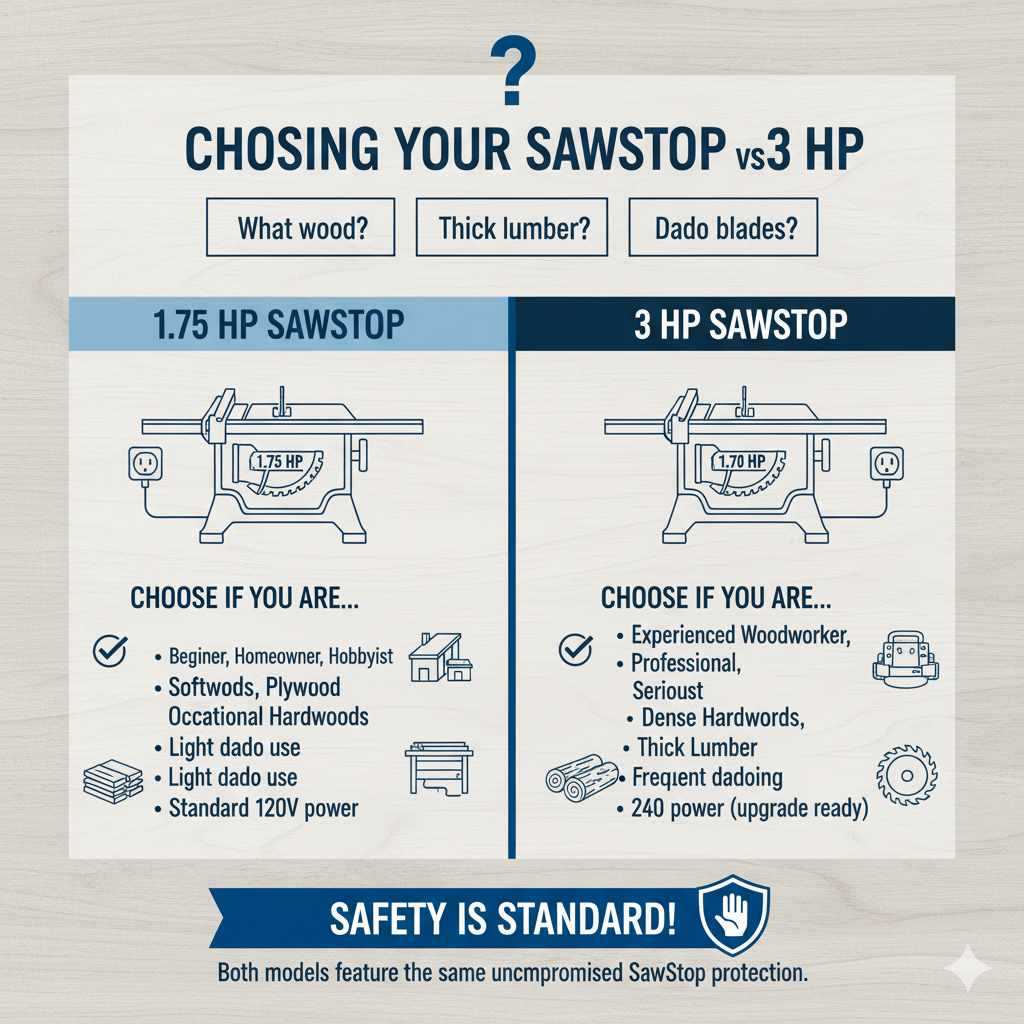
- Choose the 1.75 HP if: You are a beginner, a homeowner, or a hobbyist whose projects primarily involve softwoods, plywood, and occasional medium-density hardwoods. You don’t plan on extensive use of dadoes or ripping very thick stock. Your workshop has standard 120V outlets.
- Choose the 3 HP if: You are an experienced woodworker, a professional cabinet maker, or a serious hobbyist who regularly works with dense hardwoods, thick lumber, or needs to perform demanding tasks like frequent dadoing. You have the electrical capacity (or are willing to upgrade) for a 240V circuit. You prioritize the fastest, smoothest cuts and maximum efficiency.
Remember, both options come with the unparalleled safety of the SawStop system. It’s a no-compromise feature that makes any SawStop a wise investment. The power difference is about optimizing the cutting experience and capability for your specific woodworking journey.
Frequently Asked Questions (FAQ)
Q1: Will a 1.75 HP SawStop slow down too much on oak?
A: A 1.75 HP SawStop will work on oak, especially if it’s not extremely thick (say, 2 inches or less) and you feed it at a moderate pace. If you’re ripping a lot of thick oak or cutting it very quickly, you might notice it bogging down a bit more than a 3 HP saw. For occasional oak projects, it’s usually sufficient.
Q2: Can I run a 3 HP SawStop on a standard 120V outlet?
A: Yes, 3 HP SawStops can often be configured to run on 120V power. However, this requires drawing a much higher amperage (around 20-25 amps) and will almost certainly necessitate a dedicated 30-amp circuit. Running a 3 HP motor on 120V is generally less efficient and can put a strain on typical home wiring compared to running it on 240V, which is the preferred setup.
Q3: Is the SawStop safety feature affected by motor power?
A: No, the SawStop safety system’s speed and effectiveness are independent of the motor’s horsepower. The brake mechanism engages and retracts the blade in milliseconds to stop contact with the blade, ensuring your safety regardless of whether you have a 1.75 HP or 3 HP motor.