Ash Wood Coffee Table: Real Janka Numbers Before You Buy
Ash is a genuinely good coffee table wood: hard enough for daily use, straight-grained, pale and easy to match to almost any decor, and usually cheaper than oak or walnut of similar quality. The one thing most buying guides skip is the actual hardness numbers and what “open grain” really means for how the table feels and finishes — both covered below, along with why solid ash availability is quietly getting more expensive.
How Hard Is Ash, Really? The Numbers
Best Conditioner for Open-Grain Woods Like Ash
 |
Howard Feed-N-Wax Wood Polish & Conditioner – $11.48 A beeswax-and-orange-oil conditioner made for exactly the kind of periodic conditioning open-grain ash needs to keep its finish from drying out at the edges.
|
“Ash is a hardwood” doesn’t tell you much on its own — hardwood just means the tree is deciduous, not that the wood is actually hard. What matters is the Janka hardness rating (how much force it takes to embed a steel ball halfway into the wood), and by that measure ash sits right in the middle of the common coffee-table hardwoods:
| Wood | Janka Hardness (lbf) |
|---|---|
| Hard Maple | ~1,450 |
| White Oak | ~1,360 |
| White Ash | ~1,320 |
| Red Oak | ~1,290 |
| Black Walnut | ~1,010 |
| Soft Maple | ~950 |
In practice: ash is close enough to white oak that you won’t notice a real-world difference in dent resistance, and it’s actually a touch harder than red oak, not just “similar” the way a lot of furniture copy claims. It’s noticeably harder than walnut, which is one reason ash costs less — walnut’s softness isn’t a flaw, but the market pays a premium for its color, not its durability.
What “Open Grain” Actually Means for the Tabletop
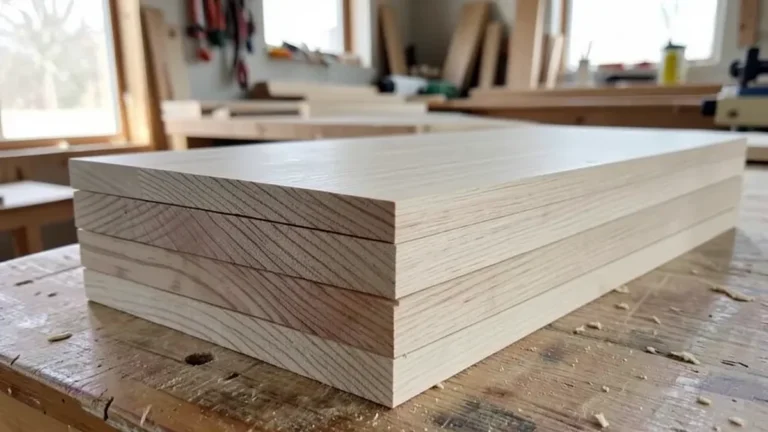
Ash, like oak, is a ring-porous wood — it has visibly larger vessels (pores) running through the grain, which is exactly what gives it that bold, straight grain pattern people like. The practical effect: a clear-coated ash table has tiny texture you can feel with a fingernail if the pores weren’t filled before finishing. Furniture makers deal with this by applying a paste wood grain filler (tinted or natural) before the topcoat, which levels the surface into a smooth, glassy finish. If you’re buying rather than building, this is a legitimate quality check — run a hand across the surface. A filled, well-finished ash table feels perfectly smooth; an unfilled one has a faint washboard texture you’ll notice within the first week of owning it, even though it won’t affect durability.
Why Solid Ash Is Getting Harder to Find
The emerald ash borer (Agrilus planipennis), an invasive beetle first confirmed in Michigan in 2002, has since killed hundreds of millions of ash trees across North America and continues to spread. It doesn’t affect wood that’s already milled and in a finished table, but it’s steadily reducing the supply of live ash timber, which is part of why solid ash furniture prices have crept up rather than down over the past decade — the opposite trend from what you’d expect from a “budget hardwood.” If long-term value matters to you, that’s worth factoring in: a well-made solid ash piece today is arguably a better hedge than it looked five years ago.
Solid Ash vs. Ash Veneer
- Solid ash: full boards throughout. Heaviest, most repairable (you can sand out real damage and refinish), and shows the grain on every edge, not just the top.
- Ash veneer: a thin layer of real ash over MDF or particleboard core. Lighter, usually cheaper, and looks identical from the top — but a deep scratch or gouge can go through the veneer into the core, and it can’t be sanded and refinished more than once or twice before you’re through the veneer layer entirely.
For a coffee table specifically — low to the ground, frequent contact from feet, shoes, and dropped remotes — that repairability difference matters more than it would on, say, a bookshelf. If budget allows, solid ash is the more forgiving long-term choice for this particular piece of furniture.
Care and Maintenance
- Daily: dry, soft cloth. Skip anything abrasive.
- Spills: blot immediately, don’t wipe or rub. A damp cloth with a drop of mild dish soap handles most residue; dry it right after.
- Heat and sun: use coasters and trivets — the finish, not the wood itself, is what heat damages. Keep the table out of direct sun long-term or the color will visibly fade unevenly compared to areas covered by a rug or décor.
- Periodic conditioning: an oil-and-wax polish every few months keeps an open-grain wood like ash from drying out at the finish edges and helps hide the fine surface scuffs that accumulate on any low, frequently-touched table.
Sizing It to Your Room
- Clearance: 14–18 inches between the table and the sofa — enough for legs, close enough to actually use.
- Height: match your sofa’s seat height, or sit 1–2 inches lower.
- Length: roughly two-thirds the length of the sofa it sits in front of.
Frequently Asked Questions
Is ash wood good for a coffee table?
Yes. Its Janka hardness (~1,320 lbf) is close to white oak and higher than red oak, so it holds up well to daily use, and its straight, pale grain suits most decor styles.
Is ash harder than oak?
It’s slightly softer than white oak (1,320 vs. 1,360 lbf) but slightly harder than red oak (1,320 vs. 1,290 lbf). In practical, everyday use the difference between all three is not something you’d notice.
Why is ash furniture getting more expensive?
The emerald ash borer, an invasive beetle spreading across North America since 2002, has killed a large share of the continent’s ash trees, tightening the supply of ash lumber even as demand for the wood stays steady.
Can I put hot mugs directly on an ash wood coffee table?
No — the finish, not the wood itself, is vulnerable to heat damage. Use a coaster or trivet.
Solid ash or ash veneer — which should I buy?
Solid ash costs more but can be sanded and refinished repeatedly, which matters on a low table that takes a lot of daily contact. Veneer is lighter and cheaper but can only be lightly refinished once or twice before you reach the core material underneath.
Sponsored / affiliate links. As an Amazon Associate I earn from qualifying purchases. I may earn additional commission from eligible campaigns.