Bamboo Flooring Vs Hardwood For Pets: Which Is Better?
For pets, bamboo is usually better for scratch resistance, while hardwood is better if you need easier spot repairs after accidents. Pick by your main problem, not Janka hardness alone. Choose wrong, and you may see claw marks, stained boards, or floors that cost more to refinish. This guide compares scratches, urine and water damage, repairability, and maintenance for dogs, cats, puppies, senior pets, and multi-pet homes.
Gear Picks and Decision Factor Comparison


| Decision factor | Bamboo Flooring | Hardwood | Winner |
|---|---|---|---|
| Scratch resistance | Strand-woven bamboo can reach 3,000–5,800 lbf on the Janka scale. | Species vary; red oak is around 1,290 lbf. | Bamboo Flooring |
| Urine and moisture tolerance | Moderate to high moisture sensitivity; finish and seam care matter a lot. | High moisture sensitivity; porous wood can stain and move after urine exposure. | Tie |
| Refinishing potential | Only 1–2 times max. | Up to 5–7 times. | Hardwood |
| Long-term lifespan under pet use | 20–30 years with care. | 25–100+ years. | Hardwood |
| Safety and indoor air quality | Best if CARB Phase 2 compliant or formaldehyde-free. | Depends on finish and adhesives used in the product build. | Tie |
Scratch resistance
Bamboo wins here when you compare strand-woven products with common hardwoods. Hardness does not make a floor scratch-proof, but it does affect how easily claw pressure dents or marks the surface film and fibers.
That advantage shrinks if the finish wears through, because pets scratch the finish first and the substrate second. A well-cured urethane or aluminum oxide finish matters as much as the species.
Urine and moisture tolerance
Neither flooring is fully waterproof. Hardwood is more porous, so urine can stain faster and penetrate deeper, while bamboo may be less forgiving at seams and edges if liquid sits there.
In practice, the floor that survives accidents best is the one cleaned fastest and maintained best. If accidents are frequent, finish integrity and prompt blotting matter more than a higher Janka number.
Refinishing and lifespan
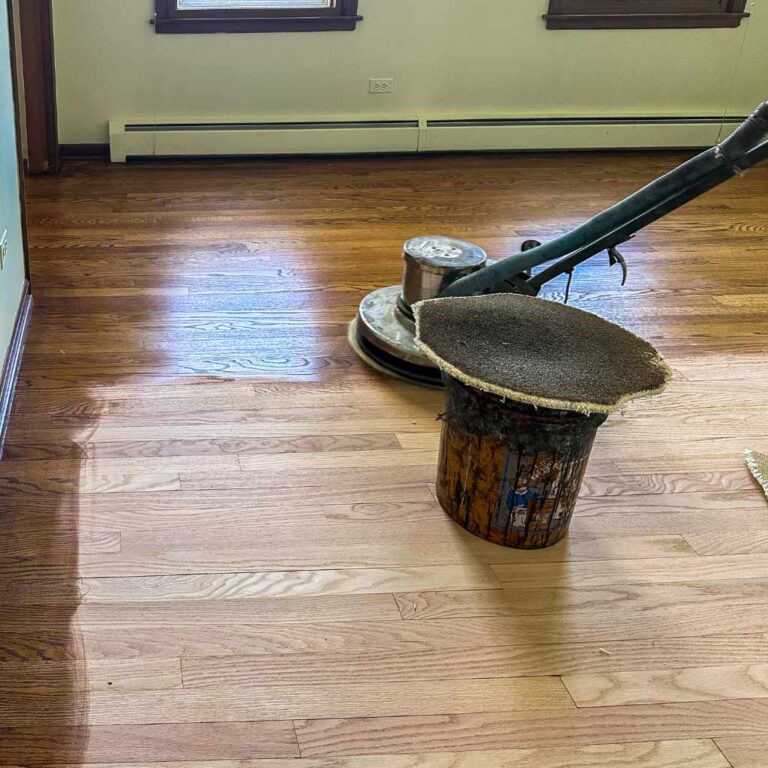
Hardwood is the stronger long-term repair candidate because it can usually be sanded and refinished several times. Bamboo has much less sanding headroom, especially strand-woven boards with a thin wear layer.
That makes hardwood the better choice when you expect repeated damage and want a floor that can be renewed instead of replaced. Bamboo often wins the first few years, then loses if the damage becomes cumulative.
📊 The article recommends CARB Phase 2 compliant or formaldehyde-free bamboo. Source: Bamboo Flooring Vs Hardwood Which Withstands Pet Accidents Better.
Which floor scratches less from pet claws, bamboo or hardwood?
Strand-woven bamboo often resists pet-claw scratches better than some common hardwoods because it is very hard. But hardness is only one part of scratch performance; finish durability, grit on paws, and daily traffic all change the result.
Janka hardness scale, explained in lbf
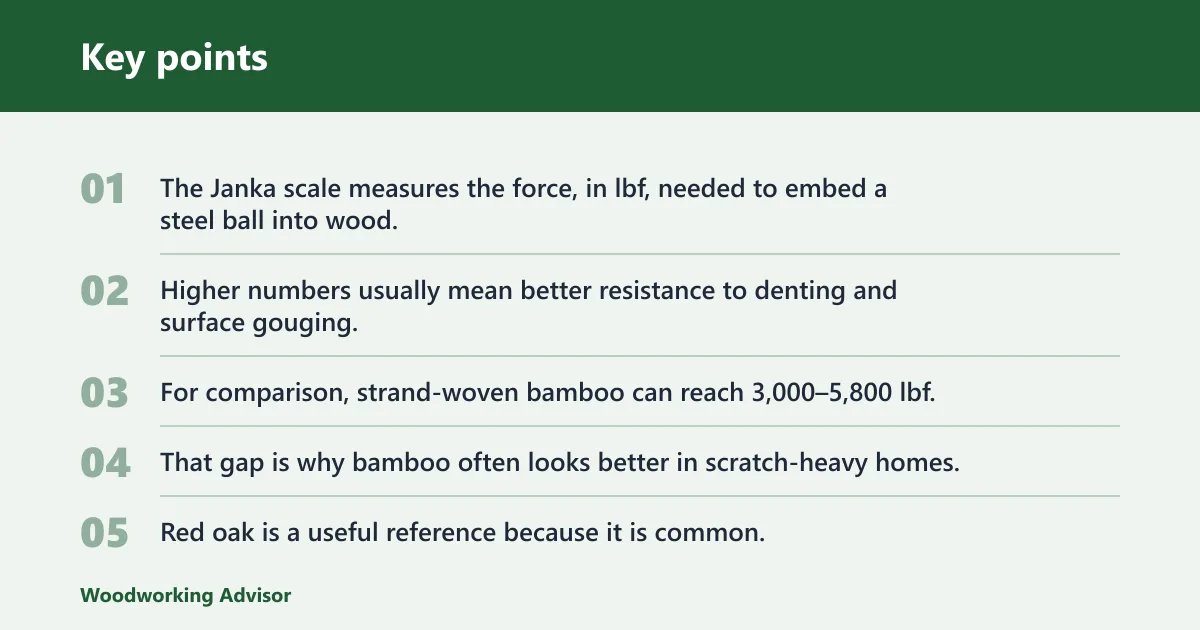
The Janka scale measures the force, in lbf, needed to embed a steel ball into wood. Higher numbers usually mean better resistance to denting and surface gouging, though they do not guarantee better wear in real homes.
For comparison, strand-woven bamboo can reach 3,000–5,800 lbf, while red oak is around 1,290 lbf. That gap is why bamboo often looks better in scratch-heavy homes, at least until the finish fails.
Strand-woven bamboo versus common hardwood species
Red oak is a useful reference because it is common, but hardwood performance varies widely by species. Softer woods scratch and dent more easily than harder ones, so a maple floor will not behave exactly like oak, and an oak floor will not behave like hickory.
Bamboo’s top layer and resin structure give it a strong scratch-resistance advantage in many pet homes. Still, a hard surface with a weak finish can show claw traffic faster than a slightly softer surface with a durable coating.
How finish wear changes scratch resistance over time
Once the finish thins, pet claws reach the floor faster and leave more visible marks. Urethane and aluminum oxide finishes help by protecting the surface, but they protect best when seams stay closed and edges stay dry.
Suppose a medium-large dog runs a hallway regularly, then turns sharply near the kitchen. The entry path near the turn will lose gloss first, and that worn spot will start showing scratches long before the rest of the room.
Does bamboo or hardwood handle dog urine better?
Hardwood usually handles repeated urine exposure worse because its porosity and movement make staining, cupping, and warping more likely. Bamboo is not immune, though, because liquid that reaches seams or edges can still cause swelling and finish failure. Quick cleanup matters more than either material label.
How pet urine affects seams, edges, and subfloor risk
Pet urine is acidic and contains enzymes that can attack finishes and stain wood fibers. If liquid reaches a seam or edge, it can wick downward, then swell the board edge or discolor the joint line.
Tracked-in moisture creates a similar problem around water bowls, crates, and exterior doors. Repeated wetting in the same spot is how small stains turn into board replacement jobs.
Why cleanup speed matters more than surface hardness
Blotting pet accidents right away rather than wiping gives you a better chance of stopping penetration before it reaches the finish line and seams. Wiping spreads liquid across more grain and can push contamination into joints.
Cleanup speed matters because finish systems are only the first barrier. If urine sits, even a harder floor can end up with a dark spot, a raised edge, or a permanent odor in the wood fibers below the finish.
What urethane or aluminum oxide finish can and cannot do
Urethane or aluminum oxide finish helps resist surface wear and buys time during minor accidents. It also slows moisture entry at the board face, but it cannot make the floor waterproof, especially at edges and cut ends.
That means seams and perimeter gaps matter. If a finish is chipped at a doorway or worn thin around a water bowl, the base material is exposed and the risk rises fast.
Can you refinish bamboo flooring after pet damage?
Yes, but only a limited number of times. Strand-woven bamboo generally allows only 1–2 refinishes max, while solid hardwood can usually be refinished up to 5–7 times, which makes hardwood the better repairable choice after repeated pet damage.
Refinishing limits for strand-woven bamboo
Strand-woven bamboo is dense, but that does not give you endless sanding room. Once the wear layer is gone or damage reaches deep into the plank, refinishing may not remove stains or the damaged texture.
At that point, spot repairs can become patchy, and board replacement may be the only clean fix. That is why bamboo can be a short- to mid-term winner, then a long-term replacement candidate.
Refinishing potential for solid hardwood
Hardwood’s main advantage is repair depth. If the species and plank construction allow it, sanding can remove scratches, urine staining, and finish failure, then restore the floor instead of replacing sections.
That repairability matters in homes with large dogs, recurring accidents, or multiple pets. A hardwood floor can often absorb years of abuse and still come back after a refinish.
When board replacement beats sanding
Replace boards instead of sanding when the damage is localized but deep, the edges are swollen, or repeated accidents have already darkened the same area. Once bamboo delaminates, cups, or loses too much wear layer, refinishing stops being cost-effective.
In a hallway near a back door, for example, a handful of stained boards may be cheaper to swap than to strip, feather, and refinish an entire section. The same logic applies to hardwood if the damage has reached the tongue-and-groove.
Which flooring lasts longer in a home with pets?
Hardwood usually lasts longer in a pet home because it can be refinished many more times. Bamboo can last well too, but its shorter refinishing life means repeated scratches or accidents can push it toward replacement sooner.
Lifecycle cost: refinishing versus replacement
The long-term cost question is not just purchase price. It is whether you can restore the surface after pet damage or whether you will need board replacement earlier, especially in hotspots near doors, bowls, and litter areas.
Hardwood’s up to 5–7 refinishes spread its cost over decades. Bamboo’s 1–2 refinishes can be enough for a calm home, but not for a house where claws and accidents hit the same boards again and again.
Failure modes that shorten lifespan
For bamboo, moisture sensitivity is the main weak point. Repeated edge wetting can lead to swelling, seam failure, and irreversible board damage once the finish no longer blocks liquid effectively.
For hardwood, repeated urine exposure can stain, cup, or warp boards and may leave permanent dark spots even after cleaning. The damage often starts at the same doorways or feeding zones.
Scenario examples
Say your home has one 85-pound dog that skids on hardwood twice a day but never has accidents. Strand-woven bamboo is usually the better fit because the main problem is scratch pressure, not deep moisture damage.
Suppose a two-cat, one-puppy household has a crate pad, litter area, and bowl station near the same doorway. Hardwood is usually the safer long-term choice because you can refinish after repeated spots and replace boards more selectively.
Choose Bamboo Flooring if… / Choose Hardwood if…
Choose bamboo if scratches are the main problem and accidents are rare or cleaned immediately. Choose hardwood if urine, tracked-in moisture, and repeat repair cycles matter more than first-pass scratch resistance. The right floor depends on the failure mode you expect most often.
Best fit for scratch-heavy dogs
Choose bamboo if you have a large, active dog, sharp claws, or a traffic pattern that keeps wearing the same lanes. Strand-woven bamboo’s higher Janka range gives it a clear edge in resisting visible claw marking.
This is the better call when the floor is exposed to daily running, but accidents are infrequent and cleanup is prompt.
Best fit for accident-prone pets
Choose hardwood if you expect frequent urine exposure, senior-pet incontinence, or repeat wet spots near bowls and doors. Its refinishing potential is the stronger insurance policy when stains and edge damage keep returning.
If you need the floor to be renewed more than once, hardwood gives you more sanding margin and a longer repair runway.
Best fit for multi-pet homes
Choose bamboo only if the home has strong cleanup habits, protected seams, and a durable finish that is kept in good condition. Multiple animals multiply both claws and moisture, which makes maintenance discipline a bigger factor than the material label.
Choose hardwood if you want the highest odds of repairing, rather than replacing, the floor after years of mixed pet wear.
How finish care, cleaners, and indoor air quality change the result
Finish quality, cleaner choice, and product safety matter almost as much as the floor species. A good finish slows claw wear and moisture intrusion; a poor maintenance routine shortens the life of both bamboo and hardwood.
CARB Phase 2 compliant bamboo and VOC concerns
For bamboo, choose CARB Phase 2 compliant or formaldehyde-free product lines. That matters for indoor air quality because pets spend time close to the floor, where off-gassing and dust exposure matter more than they do in many other rooms.
Good labeling does not fix scratches or urine stains, but it can reduce concern about volatile emissions in a closed home with animals.
Why pH-neutral cleaners beat vinegar-based cleaners
Use a pH-neutral cleaner because it is more compatible with wood floor finishes. Vinegar-based cleaners are a poor fit for many finishes and can dull or stress the protective layer over time.
That matters after pet accidents, when people are tempted to clean aggressively. The safer method is to blot, then clean with a finish-safe product rather than stripping protection with acidic solutions.
Finish maintenance triggers and spot-repair timing
Watch for dull traffic lanes, edge darkening, and finish wear around doors, bowls, and litter areas. Those are the signals that a spot repair or recoating should happen before moisture starts reaching the substrate.
Once finish failure and moisture exposure happen together, bamboo damage can become effectively irreversible faster than hardwood damage. Hardwood usually gives you more time, but it still needs quick intervention when accidents repeat.
Frequently asked questions
Is bamboo flooring better than hardwood for dogs?
For dogs that scratch but rarely have accidents, bamboo is usually the better fit because strand-woven boards are harder and more resistant to claw marks. For dogs with frequent accidents, hardwood often wins because it can be refinished more times after stains, edge damage, or finish wear.
Is strand-woven bamboo safe for pets?
It can be, especially if you choose CARB Phase 2 compliant or formaldehyde-free bamboo. That helps address indoor air quality concerns, which matter in homes where pets spend long periods close to the floor and may be more exposed to low-level emissions and dust.
How fast do you need to clean pet urine off wood flooring?
As fast as possible. Blotting pet accidents immediately rather than wiping gives you the best chance to stop liquid from reaching seams, edges, or the subfloor. The longer urine sits, the more likely it is to stain, swell boards, and compromise the finish.
Sponsored / affiliate links. As an Amazon Associate I earn from qualifying purchases. I may earn additional commission from eligible campaigns.