Solid Hardwood Vs Engineered Hardwood: Which Lasts Longer?
In dry, stable homes, solid hardwood usually lasts longer, often well over a lifetime, while engineered hardwood is often closer to a few decades. In basements, humid houses, or over concrete, engineered often stays in service longer. Pick wrong, and you can end up with cupping, gaps, failed glue lines, or a full replacement years early. This guide compares lifespan by moisture, subfloor, traffic, refinishing limits, repairs, and long-term cost.
| Factor | Solid Hardwood | Engineered Hardwood: Which Lasts Longer | Winner |
|---|---|---|---|
| Lifespan in dry, stable homes | Usually lasts longer, often well over a lifetime; usually the longest-lived option because it can be sanded and refinished multiple times. | Often closer to a few decades; service life depends heavily on wear layer thickness and whether sanding is possible before the veneer is spent. | Solid Hardwood |
| Moisture stability in humid houses and over concrete slabs | More vulnerable to humidity-related gaps and buckling when conditions swing or moisture comes from below. | Handles humid climates better and is commonly approved for installation directly over concrete slabs. | Engineered Hardwood: Which Lasts Longer |
| Refinishing runway / maintenance after wear | Can be sanded and refinished multiple times, stretching usable life after scratches, finish wear, and sun fading. | Some planks can be refinished, but the number of times varies, and some cannot really be refinished. | Solid Hardwood |
| Basements, concrete subfloors, and radiant heat | Usually a poor fit where slab moisture or heat cycling drives movement. | Can be installed onto concrete, over radiant heat systems, and sometimes in basements. | Engineered Hardwood: Which Lasts Longer |
| Factory finish durability out of the box | Varies by product and site finish choice. | Usually has an aluminum oxide finish, which wears hard and buys time before the first refinish. | Engineered Hardwood: Which Lasts Longer |
| Installed cost range | Commonly runs about $8 to $15 per square foot, with nail-down labor, subfloor prep, and species choice often pushing the total toward the upper end. | Costs anywhere from $3 to $14 per square foot. | Engineered Hardwood: Which Lasts Longer |
| Best-fit use by home type | Better for a dry main floor over wood framing, with plywood or board subfloors, controlled indoor humidity, and where future sanding matters. | Often has the longer real run in slab-on-grade houses, basements, homes with large seasonal humidity swings, and rooms where movement would be the main killer. | Tie |
| Main failure risk / long-term performance | More likely to lose years from moisture movement such as gaps, cupping, crowning, or buckling when house conditions are wrong. | Often lasts longer where movement is the main threat because it moves less and is less likely to fail from moisture-related stress, though long life still depends on correct installation and moisture control. | Engineered Hardwood: Which Lasts Longer |
| Thickness and repair options | Extra wood gives more sanding margin and more repair runway; more wood above the tongue usually means more future repair choices. | Lifespan rises or falls with wear-layer thickness; a thin wear layer may allow only a light screening or none at all once the finish is worn through. | Solid Hardwood |
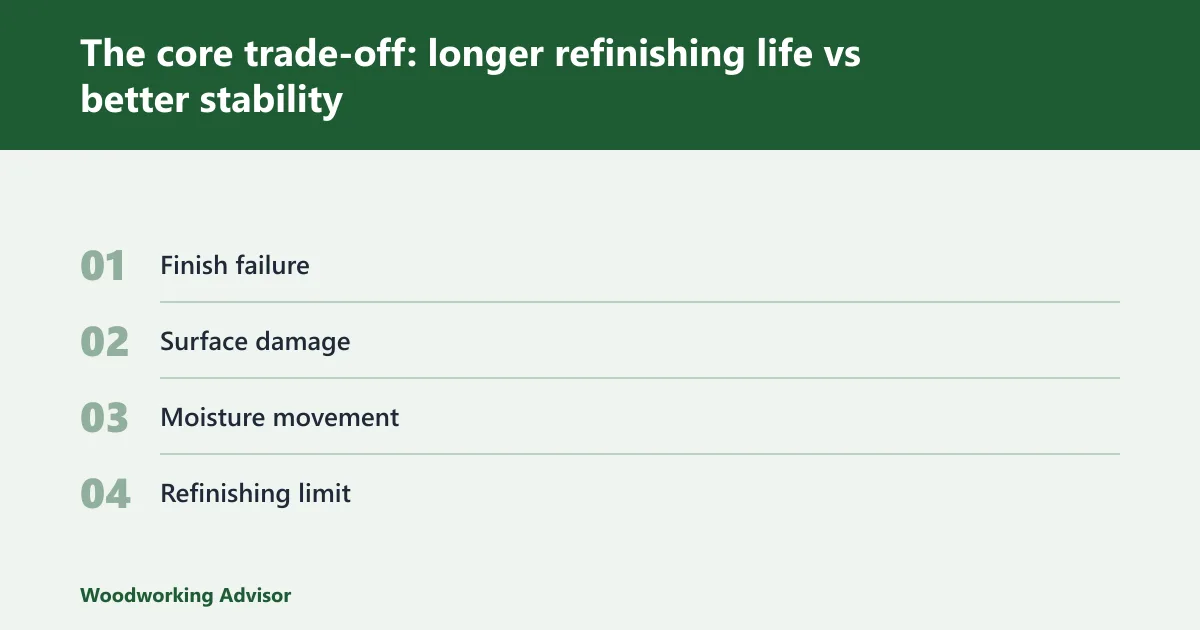
The core trade-off: longer refinishing life vs better stability


What “lasting longer” means in this guide
Lifespan is not one number. A floor can still be structurally sound while looking worn, or it can look fine on top while moisture ruins it from below.
This comparison separates surface wear, denting, finish breakdown, moisture movement, cupping, gaps, buckling, delamination, and the point where replacement makes more sense than repair.
Why the opening table resolves the way it does
Solid wins the long game in stable houses because its thickness gives owners more chances to erase damage. That matters in a forever home, where traffic patterns, pet scratches, and finish wear stack up over decades.
Engineered wins where movement is the main threat. In real rooms, I see floors die from moisture stress before they die from foot traffic.
The four ways hardwood floors usually fail
- Finish failure: the topcoat wears through, dulls, or starts holding dirt and moisture.
- Surface damage: dents, scratches, and pet wear make the floor look spent even when the boards are still sound.
- Moisture movement: boards gap, cup, crown, or buckle as indoor humidity swings or moisture rises from below.
- Refinishing limit: there is no safe wood left to sand, or the veneer is too thin, so replacement becomes the repair.
Which lasts longer: solid hardwood or engineered hardwood?
Solid hardwood usually lasts longer in dry, stable homes because it offers the longest refinishing runway. Engineered hardwood often lasts longer in basements, humid houses, over concrete subfloors, and above radiant heat systems because it moves less and is less likely to fail from moisture-related stress.
The short answer by home type
For a dry main floor over wood framing, solid hardwood flooring usually stays serviceable longer. For a slab-on-grade house, a basement, or a home with large seasonal humidity swings, engineered flooring often has the longer real run because it avoids the movement problems that shorten solid-floor life.
When solid hardwood usually stays in service longer
Solid is the better bet when the subfloor is plywood or boards, indoor humidity is controlled, and future sanding matters. That setup turns scratches, traffic lanes, and finish wear into maintenance work instead of replacement triggers.
This is where common species such as oak and maple fit well. Oak and maple are the most common hardwoods used, and both bring a familiar mix of repairability and wear resistance for long ownership.
When engineered hardwood usually stays in service longer
Engineered pulls ahead when movement would be the main killer. I trust it more over concrete, over radiant heat systems, and sometimes in basements, because those are the places where board stability often decides how long the floor lasts.
Those installation options matter because the floor that stays flat usually outlasts the floor that could be refinished more often but keeps reacting to the house.
When the wrong installation cuts years off either one
Bad prep shortens the life of both products. A moisture problem under a slab, skipped acclimation, the wrong fastener pattern, a missing moisture barrier, or an unsuitable adhesive can age a new floor fast.
The safest buying question is not “Which is tougher?” It is “What failure mode is most likely in this room?”
How do wear layer, board thickness, and wood species change lifespan?
Thickness decides repair options, while species hardness affects dents and wear. Solid planks usually offer the most sanding margin, engineered lifespan rises or falls with wear-layer thickness, and harder species resist dents better, though hardness does little to stop moisture movement, glue failure, or slab-related trouble.
Solid plank thickness and why it matters for future sanding
Solid hardwood flooring is real solid wood planks, and that extra wood gives a floor manager more choices later. Deep scratches, old stain, traffic lanes, and finish breakdown can often be removed without reaching the end of the board’s useful life.
In practice, refinishing limits come from board condition, prior sanding, edge profile, and damage around vents or thresholds. The main point is simple: more wood above the tongue usually means more repair runway.
Engineered wear layer thickness and the real refinishing limit
Engineered hardwood flooring uses a real-wood veneer over a layered core. Whether it lasts 25 years or much longer often comes down to the top veneer.
A thin wear layer may allow only a light screening or none at all once the finish is worn through. A thicker wear layer can support sanding, but owners still have to preserve enough veneer above the core to avoid sanding into trouble.
Janka hardness test: what it predicts and what it does not
The Janka hardness test rates hardwood species by hardness. It is useful for comparing dent resistance, especially in hallways, family rooms, and homes with large dogs or dropped toys.
It does not predict how a floor handles slab moisture, humidity beneath the planks, or seasonal movement. A hard species can still gap, cup, or buckle if the house conditions are wrong.
Oak, maple, and species choices for high-traffic rooms
Oak and maple are common because they are familiar, available, and proven in everyday rooms. For longevity, the better question is not which species is strongest in theory, but which species is paired with the right construction for the room.
For example, a hard maple solid floor in a damp slab house may still lose to a good engineered oak floor because stability outranks dent resistance there.
What moisture damage risks shorten hardwood floor life?
Moisture shortens hardwood life fastest by causing movement, finish failure, and board distortion. Surface spills, pet accidents, damp mopping, wet slabs, crawlspace moisture, and indoor humidity swings each damage floors differently, and the shortest-lived floor is usually the one exposed to the wrong kind of moisture stress.
Seasonal humidity swings: gaps, cupping, and movement
Humidity beneath hardwood planks can lead to gaps and buckling, and room air swings can also open seams or push edges upward. Solid hardwood is more vulnerable here because each board moves more across its width as the season changes.
That does not mean engineered ignores humidity. It means the layered core usually holds shape better when the house goes from dry winter heat to sticky summer air.
Moisture from below: slabs, basements, and crawlspace issues
Moisture from below is often the hidden life-shortener. A basement or slab can look dry on top while still driving vapor into the flooring system.
This is why concrete subfloor compatibility matters so much. Engineered hardwood can go onto concrete, but long life still depends on testing the slab, using the right installation method, and keeping moisture within the flooring maker’s limits.
Spills, pet accidents, and wet mopping as separate risks
Water damage is one of the biggest concerns for both floor types. Still, these hazards are not the same.
Short spills mostly threaten finish and board edges if they are wiped up late. Pet accidents add staining and repeated seam exposure. Wet mopping drives water into joints over and over, which can age either floor before traffic ever does.
Why engineered hardwood handles some moisture stress better
Engineered hardwood handles humid climates better because the layered build limits expansion and contraction compared with a full solid plank. I have seen that stability pay off most in wide-plank layouts, slab homes, and rooms near exterior doors.
It is not waterproof. A flooded floor or long-term leak can still ruin it, and failed glue lines can end the floor even when the surface veneer still looks acceptable.
Can engineered hardwood be refinished like solid hardwood?
Sometimes, but not in the same reliable way. Solid hardwood can be sanded and refinished multiple times, while engineered flooring may allow no sanding, one sanding, or several, depending mainly on wear-layer thickness, board quality, and how much previous work has already been done.
How many times solid hardwood can usually be sanded and refinished
Solid hardwood can be sanded and refinished multiple times. That is the biggest lifespan advantage solid has in a stable house.
The practical limit depends on how much wood remains, how deep the damage runs, and whether previous sanding already reduced the board too far. A floor with repeated pet gouges or old water stains may reach its limit sooner than a gently used one.
When engineered can be refinished once, several times, or not at all
Engineered floors live on a sliding scale. Some are basically replace-when-worn products. Others have enough veneer to survive one real sanding, and a few thicker versions can take more.
The replacement threshold comes fast once the top veneer gets thin. If the next sanding risks exposing the core or changing edge detail too much, refinishing stops being a sensible repair.
How aluminum oxide finish affects wear and future sanding
Engineered hardwood usually has an aluminum oxide finish. That factory coating tends to wear hard, which can delay the first refinish in busy houses.
The tradeoff is that hard factory finishes can make future sanding more demanding. A floor may look good longer before refinishing, but once the veneer is near its limit, the hard finish no longer matters because the floor has little wood left to spend.
The point where replacement makes more sense than another refinish
Replacement is usually smarter when movement problems are recurring, the veneer is nearly spent, boards are delaminating, or stains run too deep for safe sanding. At that stage, another finish job treats the symptom, not the reason the floor is aging out.
Where does each floor last longer by room and subfloor?
Engineered lasts longer in basements, over concrete, and above radiant heat because stability is the limiting factor there. Solid lasts longer in dry main floors, bedrooms, and long-hold homes where future sanding matters more than slab compatibility or humidity resistance.
Basements and concrete slabs
Basements and slabs strongly favor engineered. Engineered hardwood can be installed directly onto concrete and can sometimes be installed in basements, while solid hardwood is a riskier choice where moisture can move upward into the flooring system.
Even here, installation decides lifespan. Slab testing, adhesive choice, vapor control, and flatness work all matter.
Main floors, family rooms, and high-traffic hallways
On framed main floors, the answer splits by ownership plan. In a forever home, solid often wins because traffic wear can be erased more than once.
In a busy family room with kids and pets, species hardness matters too. A harder species will resist dents better, but the floor still needs the right construction for the subfloor and indoor climate.
Bedrooms, low-traffic rooms, and rentals
Bedrooms are forgiving. Either floor can look good for years.
For rentals, engineered often makes more financial sense if turnover, quick installation, and lower starting cost matter more than multiple future refinishes. In an owner-occupied low-traffic room, solid can outlast it simply because there is more repair margin to use later.
Radiant heat systems and wide-plank installs
Engineered hardwood can be installed over radiant heat systems, and that alone puts it ahead in many heated-floor projects. Wide planks also tend to behave better in engineered form because movement is better controlled across the board width.
Room-by-room longevity matrix
How the matrix scores humidity, traffic, concrete, and refinishing potential
The matrix below uses a simple 1 to 5 score. A higher score means better expected lifespan under that condition, with 5 as strongest and 1 as weakest. The recommendation column points to the floor more likely to stay serviceable longer, not simply the floor with the harder surface.
Matrix: solid hardwood vs engineered hardwood by room type
| Room or use case | Humidity stress | Concrete or below-grade issue | Traffic level | Future refinishing need | Solid Hardwood score | Engineered Hardwood score | Recommendation |
|---|---|---|---|---|---|---|---|
| Basement family room | High | High | Medium | Low to medium | 1 | 5 | Engineered hardwood |
| Slab-on-grade living room | Medium | High | Medium | Medium | 2 | 5 | Engineered hardwood |
| Main-floor hallway over plywood | Low to medium | Low | High | High | 5 | 3 | Solid hardwood |
| Family room in a dry, climate-controlled house | Low | Low | High | High | 5 | 4 | Solid hardwood |
| Bedroom on upper floor | Low | Low | Low | Medium | 4 | 4 | Tie; choose by subfloor and ownership plan |
| Kitchen-adjacent dining area | Medium | Low | Medium | Medium | 3 | 4 | Engineered hardwood if spills are frequent |
| Rental property common area | Medium | Varies | High | Low | 3 | 4 | Engineered hardwood |
| Forever-home great room | Low and controlled | Low | High | Very high | 5 | 3 | Solid hardwood |
| Radiant-heat primary suite | Medium | Low | Low to medium | Medium | 2 | 5 | Engineered hardwood |
How to use the recommendation column for your house
Match your room to its main failure risk. If the recommendation flips because of concrete, humidity, or radiant heat, trust the condition more than the material preference.
If two rooms in the same project need opposite answers, that is normal. I run into that often. Many houses have one area where solid is the long-life choice and another where engineered is the safer bet.
How much does solid hardwood cost compared with engineered hardwood over its full life?
Engineered costs less up front in many cases, at $3 to $14 per square foot, while solid hardwood installation usually costs between $8 and $15 per square foot. Over a full life, though, the cheaper floor is the one that avoids early replacement and matches the room’s moisture and refinishing demands.
Material and labor cost per square foot
Engineered has the wider low-end entry point. That makes it attractive for large projects, rentals, and slab homes where it also fits the subfloor better.
Solid often costs more to put in, especially when nail-down installation and site finishing are part of the plan.Yet that higher starting cost can pay back in long ownership if the floor gets refinished instead of replaced.
Moisture testing, underlayment, and subfloor prep costs
The life-cost comparison changes when prep is added. Concrete moisture testing, vapor control products, slab grinding, underlayment, and flatness correction can shift the budget before a single plank goes down.
These are not optional details when longevity is the goal. Skipping them is one of the easiest ways to turn a reasonable floor choice into a short-lived one.
Refinishing cycles vs earlier replacement risk
Solid usually wins when owners expect to sand away wear over time. Engineered usually wins when it avoids a moisture-related failure that would force solid out early.
That is the real cost frame: refinishing cycles on one side, earlier replacement risk on the other.
Best long-term value for starter homes, rentals, and forever homes
Starter homes often lean engineered if the ownership timeline is shorter or the house sits on a slab. Rentals also lean engineered when a durable factory finish and lower entry cost matter most.
Forever homes usually lean solid on dry framed floors because long service life depends on repair margin more than low first cost.
Choose solid hardwood if… / Choose engineered hardwood if…
Choose solid hardwood if you want the longest refinishing runway
- The floor will go over a dry wood subfloor, not a slab.
- Indoor humidity stays fairly stable through the year.
- High traffic, pets, and future cosmetic repairs are expected.
- The house is a long-term hold where multiple refinishes matter.
Choose engineered hardwood if your house puts stability first
- The project is over concrete, in a basement, or on slab-on-grade construction.
- The home has higher humidity or bigger seasonal swings.
- The floor must work over radiant heat systems.
- A hard factory finish and lower starting cost matter more than maximum sanding life.
Tie-breakers: concrete, humidity, pets, kids, and resale timeline
If there is concrete below, the tie usually goes to engineered. If the home is dry and ownership is measured in decades, the tie usually goes to solid.
Pets and kids push the choice in two directions at once: harder species help with dents, but stable construction helps with spills and seasonal movement. For short resale timelines, engineered often makes the cleaner financial case. For a forever-home remodel in controlled conditions, solid usually offers the longer runway.
Frequently asked questions
Which lasts longer: solid hardwood or engineered hardwood?
Solid hardwood usually lasts longer in dry, stable homes because it can be sanded and refinished multiple times. Engineered hardwood often lasts longer in humid houses, basements, over concrete, and above radiant heat, where movement and moisture stress would shorten the life of a solid floor.
Can engineered hardwood be refinished like solid hardwood?
Sometimes, but it depends on the veneer thickness. Some engineered floors can take one real sanding, some several, and some are poor candidates for sanding at all. Solid is still the safer choice when long-term refinishing is part of the plan.
How many times can solid hardwood be sanded and refinished?
Solid hardwood can be sanded and refinished multiple times. The practical limit depends on how much wood remains, how deep past damage runs, and how aggressively the floor was sanded before. The floor reaches replacement territory when another sanding would remove too much usable wood.
Is engineered hardwood better in humid climates?
Yes, engineered hardwood handles humid climates better because the layered core usually moves less with seasonal moisture changes. That makes it less prone to large gaps, cupping, and buckling than solid hardwood, though leaks and standing water can still ruin it.
Which flooring is better for basements or concrete slabs?
Engineered hardwood is usually the better choice for basements or concrete slabs. It can be installed directly onto concrete and can sometimes be installed in basements, while solid hardwood is more likely to react badly to slab moisture and below-grade humidity pressure.
How does wood species hardness affect floor durability?
The Janka hardness test helps compare how well a species resists dents and compression in busy rooms. Hardness matters for traffic, pets, and dropped objects, but it does not solve moisture problems. A harder floor can still fail early if humidity, slab moisture, or installation conditions are wrong.
Sponsored / affiliate links. As an Amazon Associate I earn from qualifying purchases. I may earn additional commission from eligible campaigns.