Screening vs Full Sanding: Which Refinishing Method Costs Less?
Screening and recoating usually costs about half as much as a full sand and refinish, but only when the finish is sound and the floor has no deep damage. Skip that check and you can pay twice, because peeling finish, stain bleed, and repair work force a do-over. This guide compares quote ranges, hidden add-ons, and the signs that full sanding is the better value.
| Decision factor | Screening | Full Sanding | Winner |
|---|---|---|---|
| Typical cost | $1.50 to $3.50 per sq ft | $3.50 to $8.00 per sq ft | Screening |
| Surface removal | Light abrasion of the existing finish; does not remove wood | Sands to bare wood and resets the surface | Full Sanding |
| Best floor condition | Intact finish, dull sheen, light scuffs | Deep scratches, bare wood, stains, color changes | Tie |
| Dust and disruption | Usually faster and less dusty | More labor-intensive and disruptive, even with dust containment | Screening |
| Risk of quote add-ons | Lower if the floor is clean and the finish bonds well | Higher when repairs, stain changes, or containment are needed | Screening |
| Ability to correct damage | Limited | Broad | Full Sanding |
Screening vs full sanding at a glance
Screening is the lower-cost option when the finish is still intact and you only need to dull the topcoat before adding a new one. Full sanding costs more because it strips the old finish to bare wood, which is the right fix for deep damage, stain changes, or a floor that will not take a new coat cleanly. (Thisoldhouse)
Cost
Screen and recoat typically runs $1.50 to $3.50 per square foot. Full sand and refinish typically runs $3.50 to $8.00 per square foot. On a 1,000 square foot floor, that is roughly $1,500 to $3,500 for screening versus $3,500 to $8,000 for full sanding.
Surface work
Screening lightly abrades the existing finish. It does not remove wood. Full sanding removes the finish and a thin layer of wood so the new stain or clear coat can start from bare wood.
Disruption
Screen and recoat can often be done in a day and creates less dust. Full sanding uses a drum sander, edger, and buffer, so it is a bigger project for occupied homes. Dustless sanding cuts down the mess, but it still makes dust and may add a premium.
Screening cost table
This table compares the five homeowner scenarios that most often decide the quote. The key question is whether the floor still has intact finish and enough wear layer for a safe recoat, or whether hidden damage makes the cheaper quote a false economy.
| Scenario | Likely method | Typical per-sq-ft range | Extra cost drivers | False economy warning |
|---|---|---|---|---|
| Dull finish only | Screening | $1.50 to $3.50 | Furniture moving, cleaning, basic recoating system | Do not pay for sanding if the finish is sound and only the sheen is tired. |
| Light scratches | Screening | $1.50 to $3.50 | Extra prep for minor scuffs, finish compatibility check | If the scratches catch a fingernail, a recoat may only hide them briefly. |
| Bare wood spots | Full Sanding | $3.50 to $8.00 | Patch repair, stain matching, extra finish coats | Screening over bare wood can leave uneven color and weak adhesion. |
| Color change | Full Sanding | $3.50 to $8.00 | Stain removal, test samples, stain system change | A screening quote is not a real color-change quote; the old color will still show through. |
| Engineered hardwood with limited wear layer | Screening, or limited refinishing only if wear layer allows | $1.50 to $3.50 for screening; full sanding may not be allowed | Wear-layer check, manufacturer limits, possible spot repair only | Under 2 mm wear layer, screening may be the only safe option. |
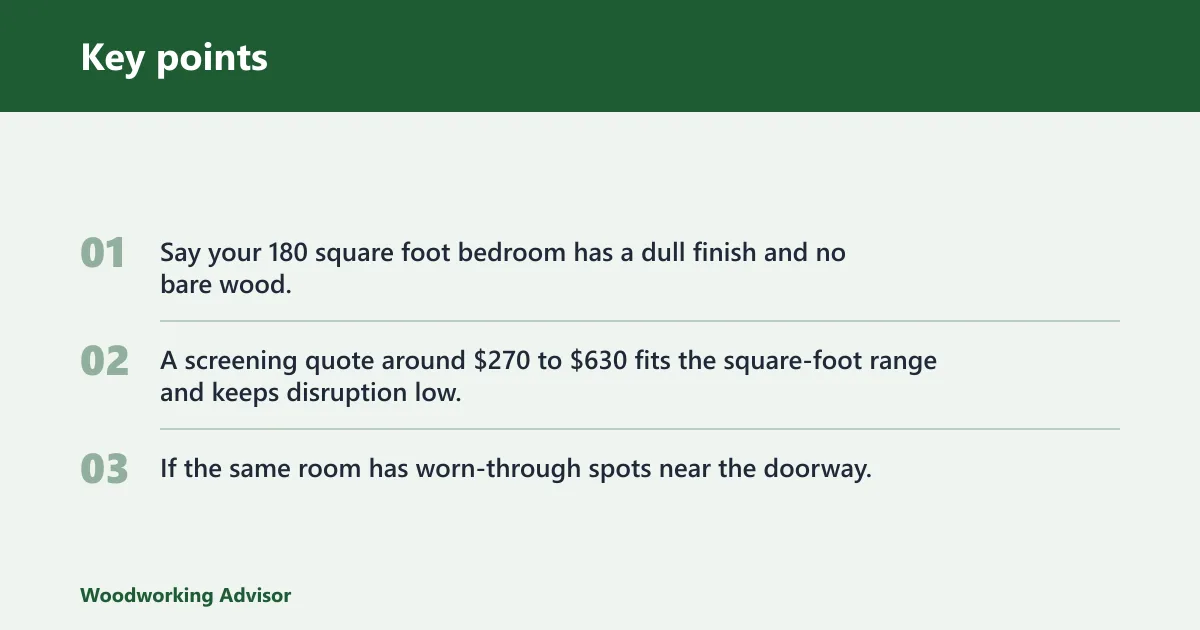
Say your 180 square foot bedroom has a dull finish and no bare wood. A screening quote around $270 to $630 fits the square-foot range and keeps disruption low. If the same room has worn-through spots near the doorway, the cheaper quote is not the real bargain, because the floor needs bare-wood repair and a full refinish.
When is screening enough for hardwood floors?
Screening is enough when the floor still has intact finish, the wear is mostly cosmetic, and the wood itself has not been exposed. That usually means dull sheen, scuffs, and light scratches that sit in the topcoat rather than through it. It also depends on finish compatibility and clean adhesion.
Signs the finish is still sound
Look for a dull or scuffed surface with no bare wood showing. If the floor has an even sheen, no deep gouges, and no water stains that have reached the wood, screening may be the right quote to compare. Screening is typically needed every 3–7 years on floors that still hold up well.
When a recoating system can work
Screening works best with a clear coat system when the old finish is clean and well bonded. Oil-based polyurethane, water-based finish, and hardwax oil all affect cure time and compatibility, so the contractor should specify the exact product family in the estimate. That matters because a weak bond can turn a low-cost job into a peeling one.
When the floor is a poor candidate
If the floor has wax contamination, heavy prior recoats, or finish failure, screening becomes risky. Adhesion problems are the main failure case. A floor that has been screened too many times, or one with worn-through traffic lanes, often needs sanding instead of another topcoat.
When do you need full sanding and refinish instead?
You need full sanding when the damage goes below the finish or when the floor needs a reset in color or surface condition. Deep scratches, dents, stains, and worn-through areas cannot be corrected with a screen and recoat alone. If the floor is uneven, the quote should also account for repair work.
Deep scratches and bare wood
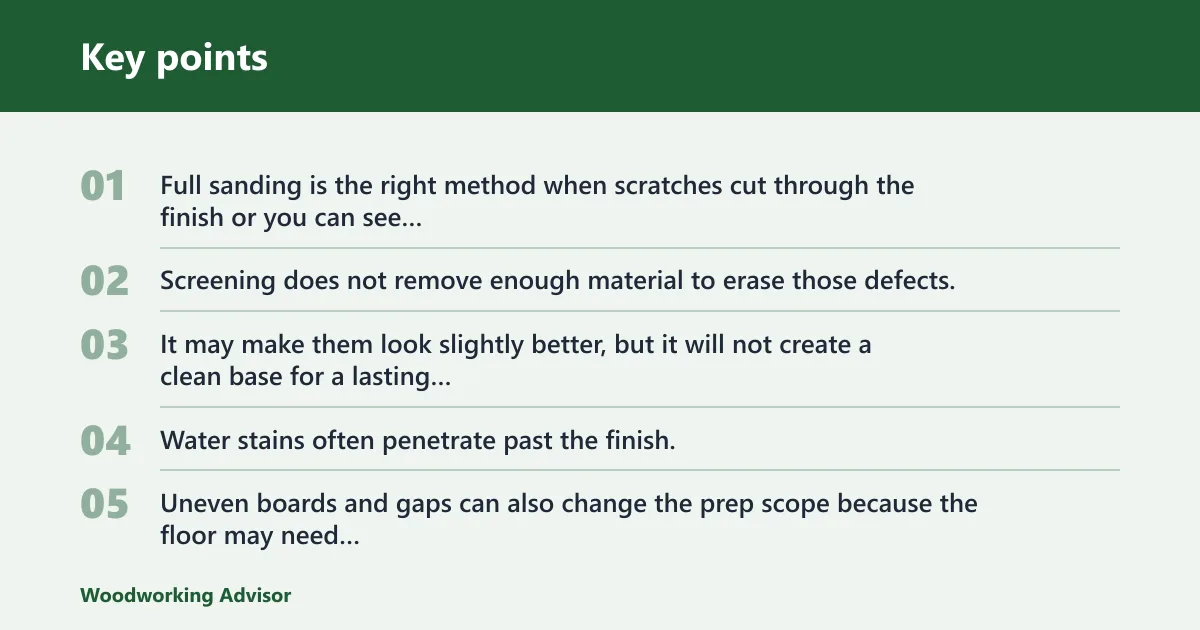
Full sanding is the right method when scratches cut through the finish or you can see bare wood. Screening does not remove enough material to erase those defects. It may make them look slightly better, but it will not create a clean base for a lasting finish.
Water stains, wear-through, or uneven boards
Water stains often penetrate past the finish, and worn-through traffic paths usually mean the protective layer is gone. Uneven boards and gaps can also change the prep scope because the floor may need patching or board repair before finishing. That extra work often erases the price gap between the two methods.
Stain changes and finish resets
If you want a different color, full sanding is the practical choice. The old finish and stain have to come off first, or the new color will sit on top of the old one and read unevenly. A full reset also helps when you want to switch finish chemistry, such as moving to a different clear coat system.
Picture a 900 square foot living area with dark water marks near a patio door and a lighter traffic path in the center. A screening quote may look attractive until the contractor adds stain removal, patching, and a full-color refinish. At that point, the full sand quote is usually the lower-risk buy.
Choose Screening if… / Choose Full Sanding if…
Screening wins when the floor still has intact finish, the wear is light, and you want the lowest-cost way to refresh appearance with less mess and downtime. Full sanding wins when the floor needs repair, color change, or a true surface reset. That is where the cheaper quote stops being the better value.
Choose Screening if…
- The finish is dull or lightly scuffed, but still intact.
- You see only light scratches, not bare wood.
- The floor has no wax contamination or obvious adhesion issues.
- You want the lower-disruption option for an occupied home.
Choose full sanding if…
- You see bare wood, deep scratches, dents, or water stains.
- You want a stain change or a different finish system.
- The floor has prior recoats, weak adhesion, or uneven boards.
- The wear layer on engineered hardwood is too thin for anything beyond recoating.


How do room size and repairs change refinishing cost?
Square footage pricing makes the comparison simple, but small jobs usually cost more per square foot than large ones because setup time and minimum labor do not shrink with the room. Repairs, patching, furniture moving, and containment also move the quote. The floor condition can matter more than the room size.
Furniture moving and prep
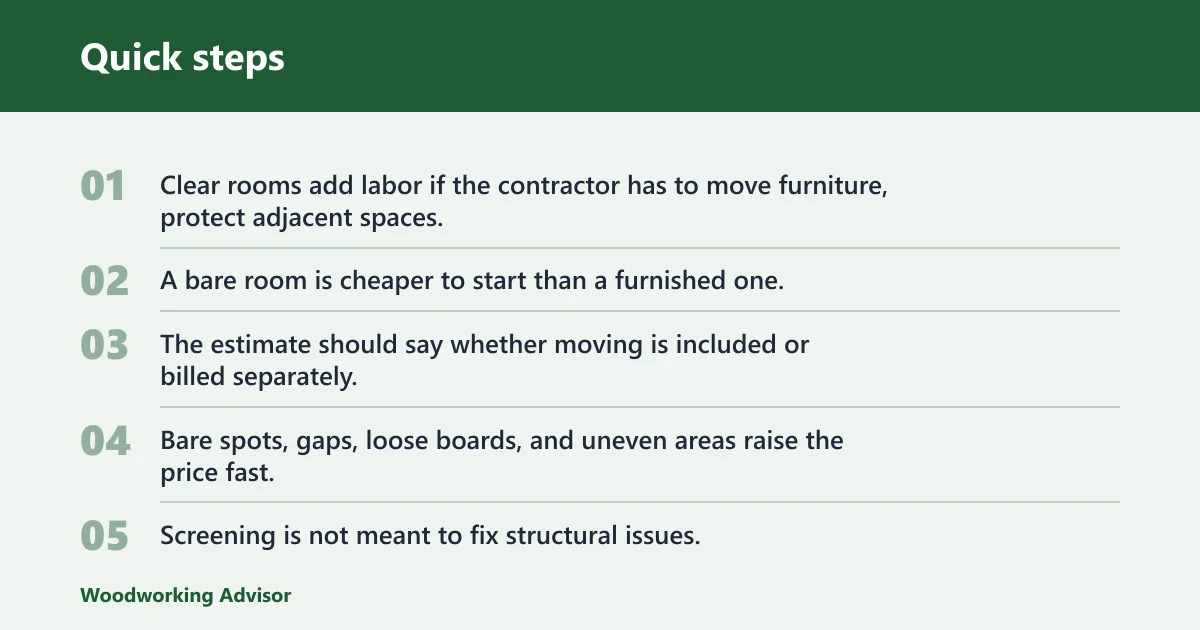
Clear rooms add labor if the contractor has to move furniture, protect adjacent spaces, or remove baseboard shoe molding. A bare room is cheaper to start than a furnished one. The estimate should say whether moving is included or billed separately.
Repairs and patching
Bare spots, gaps, loose boards, and uneven areas raise the price fast. Screening is not meant to fix structural issues, so a quote that assumes only a topcoat may miss repair costs. Full sanding often needs the repairs anyway, which is why the “cheap” option can end up costing more after add-ons.
Dust containment and room access
Dust containment matters most in occupied homes, homes with HVAC returns nearby, or projects where nearby rooms stay in use. Dustless sanding helps, but it is still a sanding project and may carry a premium. Tight access, stairs, and many transitions also slow the job.
Finish chemistry and cure time
Oil-based polyurethane, water-based finish, and hardwax oil cure differently, which affects downtime and sometimes labor cost. Faster cure time can reduce disruption, but the contractor still has to match the new coat to the old system. Mismatched chemistry can cause adhesion failure or an uneven sheen.
For a 150 square foot room, screening may run $225 to $525, while full sanding may run $525 to $1,200. That gap is real, but it narrows quickly if the room needs repairs or stain work. For a whole 1,000 square foot floor, the difference becomes much larger, and containment or access issues have a bigger effect on the final quote.
Can you screen and recoat yourself?
You can handle a simple screen-and-recoat yourself only when the floor is clean, the finish is sound, and you understand the product compatibility risks. DIY is more realistic for small, open areas than for complex rooms with repairs, wax contamination, or unknown finish history. Once the floor may need sanding, stop and bring in a pro.
Where DIY screening can work
DIY screening can make sense for a space of roughly 300 square feet when the floor is in good shape and the goal is a fresh topcoat rather than a repair. A common first-timer mistake is assuming screening fixes stains or bare spots. It does not.
Tools and materials you still need
You still need the right screen pads, a buffer, vacuuming and cleaning supplies, and the correct finish system. You also need a way to test adhesion in a small area before coating the whole room. Full sanding, by contrast, means renting a drum sander, edger, and buffer.
When to stop and get a pro
Stop if the floor has wax, peeling finish, deep scratches, bare wood, or engineered hardwood with a thin wear layer. Under 2 mm, engineered floors may be screen-and-recoat only. A wear layer of 2–5 mm may allow limited refinishing, but the exact limit depends on the product and the floor construction.
Frequently asked questions
Which costs less: screen and recoat or full sanding?
Screening costs less in almost every normal case. The usual range is $1.50 to $3.50 per square foot, while full sanding runs $3.50 to $8.00 per square foot. The cheaper method stops being the better value when hidden repairs, finish failure, or a stain change force a redo.
How much does screen and recoat cost per square foot?
Screen and recoat typically costs $1.50 to $3.50 per square foot. Furniture moving, repairs, and finish choice can push the final quote higher.
How much does full sanding cost per square foot?
Full sand and refinish typically costs $3.50 to $8.00 per square foot. Dust containment, stain changes, and patching can add to that total.
What damage makes screening a bad option?
Deep scratches, bare wood, water stains, wax contamination, peeling finish, and visible wear-through make screening a bad bet. Screening also fails when the floor has been recoated too many times or the new finish cannot bond well. In those cases, full sanding is the safer quote to compare.
Is full sanding worth it if the finish is worn but wood is still sound?
Yes, if the goal is more than a cosmetic refresh. A sound floor with worn finish can still justify full sanding when you want a color change, a reset of the surface, or a more durable refinish cycle. If the damage is only dullness, screening is usually the better value.
Can I do a screen and recoat myself?
Yes, but only on a small, sound floor with a known finish system and no contamination issues. DIY screening is not a good substitute for inspection when bare wood, stains, or adhesion problems are present. If the floor needs real repairs, full sanding is the job for a pro, not a screen pad.
Sponsored / affiliate links. As an Amazon Associate I earn from qualifying purchases. I may earn additional commission from eligible campaigns.