Bookshelf Height Between Shelves: Your Essential Genius Guide
For the perfect bookshelf height between shelves, aim for 8 to 12 inches for a standard collection. This accommodates most paperbacks and hardcovers. For a more tailored fit, measure your tallest book and add 1 to 2 inches of clearance. This simple rule ensures your books fit comfortably without wasting space.
Hello there! Md Meraj here. Welcome to the workshop. If you’ve ever built or organized a bookshelf, you know the frustration. You finish your project, step back to admire your work, and then try to slide in your favorite novel… only to find it doesn’t fit. Or, you end up with huge, awkward gaps above your books that just look wrong.
You’re not alone! Getting the bookshelf height between shelves just right is a classic puzzle for DIYers. It feels like a small detail, but it makes a huge difference in how your bookshelf looks and functions. But don’t worry, this is an easy problem to solve once you know the secrets.
Today, I’m going to walk you through everything you need to know. We’ll cover standard measurements, how to customize for your own collection, and a few pro tips to make your project a success. Let’s build something beautiful and perfectly practical together!
Why Your Shelf Spacing Matters More Than You Think
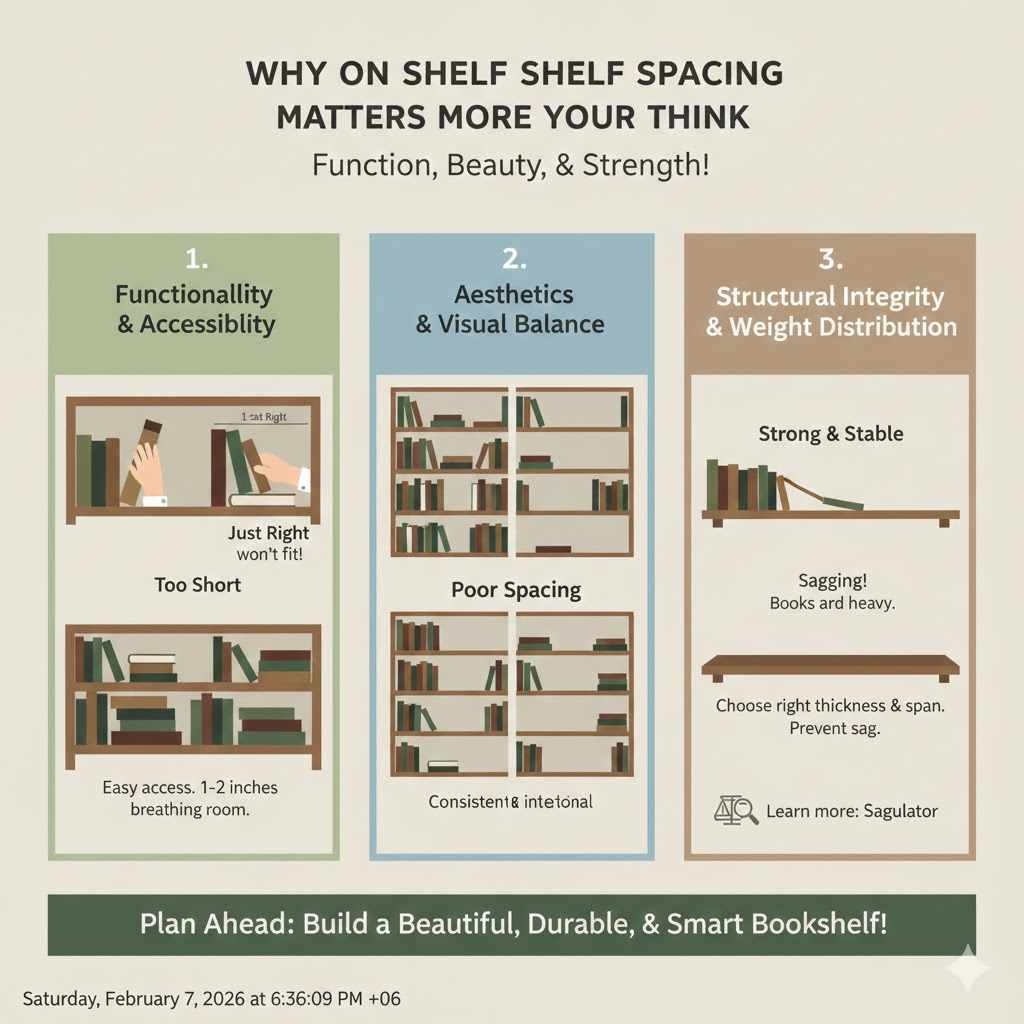
Before we grab the tape measure, let’s quickly talk about why this seemingly small detail is so important. Getting the vertical spacing right on your bookshelf isn’t just about making it look nice—it impacts three key areas.
1. Functionality and Accessibility
The most basic job of a bookshelf is to hold books. If the space is too short, your taller books won’t fit at all. If it’s too tall, you create wasted space. The perfect height gives you just enough room to easily slide a book in and out with one hand. You want about 1 to 2 inches of “breathing room” above your tallest book. This makes your collection accessible, not a frustrating game of Tetris.
2. Aesthetics and Visual Balance
A well-proportioned bookshelf is a beautiful piece of furniture. Inconsistent or poorly planned spacing can make the whole unit look cluttered and disorganized, even if the books are tidy. Consistent spacing creates clean, horizontal lines that are pleasing to the eye. It gives your collection a sense of order and intentionality, turning a simple storage unit into a true display piece.
3. Structural Integrity and Weight Distribution
While shelf height doesn’t directly determine strength, it’s related. Extremely tall shelves might tempt you to stack items, adding unexpected weight. More importantly, understanding the load your shelves will carry helps you choose the right material thickness and span. Proper planning for what you’ll store ensures your shelves won’t sag or fail over time. Books are surprisingly heavy!
Standard Bookshelf Dimensions: The “Golden Rules”
If you’re looking for a quick and reliable starting point, you can’t go wrong with standard measurements. These dimensions are tried and true, designed to accommodate the vast majority of books found in a typical home library. Think of them as your golden rules.
Here’s a simple table with common book types and the ideal shelf spacing for each:
| Book Type | Typical Book Height | Recommended Shelf Height (Space Between Shelves) |
|---|---|---|
| Mass-Market Paperbacks | 6.5 – 7 inches | 8 – 9 inches |
| Trade Paperbacks & Standard Hardcovers | 8 – 9.5 inches | 10 – 12 inches |
| Large Hardcovers & Textbooks | 10 – 11 inches | 12 – 13 inches |
| Oversized Books (Art Books, Atlases) | 12 – 15 inches | 14 – 16 inches |
For a general-purpose bookshelf that will hold a mix of everything, a spacing of 10 to 12 inches is a safe and versatile choice. It’s the sweet spot that fits most standard hardcovers while not leaving too much empty space above smaller paperbacks.
What About Shelf Depth?
While we’re focused on height, depth is just as important! A shelf that’s too deep makes it hard to reach books at the back, while a shelf that’s too shallow won’t support your books properly.
- Standard Books: A depth of 10 to 12 inches is perfect for most books. It fully supports hardcovers without letting smaller paperbacks get lost.
- Oversized Art Books or Binders: You may need a deeper shelf, around 12 to 15 inches, to keep them from hanging over the edge.
Always aim for the front of your books to be flush with the front of the shelf for a clean, library-like look.
Measure Your Own Collection: The 3-Step Custom Fit Method
Standard dimensions are great, but the absolute best bookshelf is one tailored to your specific collection. Do you have a lot of tall art books? Or maybe a huge paperback collection? Taking a few minutes to measure will guarantee a perfect fit. It’s easy, I promise!
Step 1: Gather and Sort Your Books
First, pull out the books you plan to store. Don’t just grab a few—try to get a representative sample. Group them into categories based on their height.
- Small Paperbacks: Your classic pocket-sized novels.
- Standard Books: Most of your hardcovers and larger paperbacks will fall in this group.
- Tall Books: Textbooks, cookbooks, and some hardcover fiction.
- Oversized Giants: These are your coffee table books, art books, and binders.
Don’t worry about being perfect. Just create a few distinct piles. This helps you see what you’re working with.
Step 2: Measure the Tallest Book in Each Group
Now, grab your tape measure. For each group you made, find the tallest book and measure its height. For example, your tallest standard hardcover might be 9.5 inches tall. Your tallest art book might be 14 inches.
Jot down these numbers. These are your baseline measurements. They represent the absolute minimum space you need for each category.
Step 3: Add “Breathing Room”
This is the most important step! You need to add a little extra space above each book. Without this clearance, it’s a struggle to get books in and out. It also improves air circulation, which helps preserve your books.
The Rule of Thumb: Add 1 to 2 inches to the height of your tallest book in each group.
Let’s put it together. If your tallest standard hardcover is 9.5 inches, your ideal shelf height for that section would be:
9.5 inches (book height) + 1.5 inches (breathing room) = 11 inches (shelf spacing)
If your tallest art book is 14 inches, your spacing would be:
14 inches (book height) + 2 inches (breathing room) = 16 inches (shelf spacing)
Now you have custom measurements that are guaranteed to work for your collection!
Fixed vs. Adjustable Shelves: Which Is Right for Your Project?
Once you know your ideal spacing, you have a big decision to make: should you build your shelves with fixed spacing, or should you make them adjustable? Both have their pros and cons, and the right choice depends on your needs and skill level.
Fixed Shelves
Fixed shelves are built directly into the bookcase frame. They are attached with glue, screws, or joinery like dados. This creates a very strong, stable, and permanent structure.
When to Choose Fixed Shelves:
- You want maximum strength and stability, especially for long or heavy shelves.
- You prefer a clean, seamless look with no visible holes for shelf pins.
- You have a very uniform book collection that isn’t likely to change.
Adjustable Shelves
Adjustable shelves rest on small pins or clips that fit into a series of holes drilled into the sides of the bookcase. This allows you to move the shelves up or down as your collection changes over time.
When to Choose Adjustable Shelves:
- You want maximum flexibility to accommodate future purchases of different sizes.
- You plan to store a variety of items, not just books (like photo frames, decor, or storage boxes).
- You are a beginner looking for a more forgiving building process. Drilling pinholes is often easier than cutting perfect dados.
Here is a quick comparison to help you decide:
| Feature | Fixed Shelves | Adjustable Shelves |
|---|---|---|
| Strength | Very strong and rigid. Helps prevent racking. | Strong, but the overall unit has less rigidity. |
| Flexibility | None. Spacing is permanent. | Excellent. Can be rearranged at any time. |
| Appearance | Clean, seamless, and built-in look. | Visible pinholes along the sides. |
| Best For | Heavy loads, libraries, built-in units. | Mixed media, kids’ rooms, general storage. |
For most beginners, I highly recommend starting with adjustable shelves. The flexibility is priceless, and a good shelf pin jig makes drilling straight, evenly spaced holes incredibly simple.
Beyond Books: Spacing for Other Common Items
Bookshelves aren’t just for books anymore! Many of us use them to store and display all sorts of things. If you plan to store more than just novels, here are some helpful spacing guidelines for other common items.
- Vinyl Records: A standard 12-inch LP record sleeve is about 12.5 inches tall. You’ll want a shelf height of at least 13 to 14 inches to store them vertically without damage.
- Binders and Office Files: A standard 3-ring binder is about 11.5 inches tall. A spacing of 12.5 to 13 inches gives you enough room to grab them easily.
- CDs and DVDs: If you store them upright in their cases, a shelf height of 8 to 9 inches is usually more than enough for DVD cases, and 6 to 7 inches works for CD jewel cases.
- Photo Albums: These vary wildly. Measure your largest album and add 1 to 2 inches, just like you would for a book.
- Decorative Objects: For vases, sculptures, or framed photos, the sky’s the limit. A good visual trick is to leave significant headroom—sometimes 50-100% of the object’s height—to make it feel like a curated display.
The beauty of a custom bookshelf is mixing and matching. You might have several shelves with 11-inch spacing for books and one taller 15-inch shelf at the bottom for photo albums and records.
My Pro-Tips for a Perfect and Professional Finish
You’ve got the measurements and you’ve chosen your shelf type. Before you start cutting wood, let me share a few extra tips I’ve learned over the years. These will help you avoid common mistakes and give your project that professional touch.
Tip 1: The “Top and Bottom” Shelf Spacing Trick
For a more balanced look, consider making the spacing for the bottom and top shelves slightly different. A taller bottom shelf (maybe 14-16 inches) is visually grounding and a perfect spot for your heaviest, oversized books. The top shelf is often best for smaller books or decorative items, so you might not need as much space there.
Tip 2: Think About Shelf Sag (It’s Real!)
A long shelf loaded with heavy hardcovers can start to droop in the middle over time. This is called sag, and it’s the enemy of a good bookshelf. Shelf height doesn’t cause sag, but the contents do! To prevent it:
- Keep Spans Reasonable: For 3/4-inch thick plywood or solid wood, a shelf span of 32-36 inches is the maximum I’d recommend without extra support. For particle board, stick to 24 inches or less.
- Add Support: If you need a longer span, add a vertical divider in the middle or attach a 1×2 hardwood cleat along the front or back edge of the shelf. This dramatically increases its stiffness.
- Choose the Right Material: Hardwood and quality plywood are much more resistant to sagging than MDF or particle board.
For a fantastic and easy-to-use tool to calculate shelf sag, check out The Sagulator. It’s a resource I trust to help visualize how different materials and dimensions will behave under load.
Tip 3: Use a “Story Stick” for Perfect Repeatability
When you’re building a bookshelf with fixed shelves or drilling holes for adjustable pins, you need to make sure your marks are identical on both sides of the bookcase. Even being off by 1/16 of an inch can result in a wobbly shelf!
Instead of measuring each location over and over with a tape measure, use a story stick. A story stick is simply a scrap piece of wood where you mark out all your important measurements just once.
- Take a straight, thin piece of scrap wood (like a 1×2).
- Lay it against your project plan and carefully mark the exact location for the top and bottom of each shelf or each shelf pin hole.
- Now, instead of measuring on your project pieces, you just hold the story stick up to the bookcase sides and transfer the marks directly.
This simple trick eliminates measurement errors and guarantees that your left and right sides are perfect mirror images. It’s a classic woodworking technique for a reason—it works every time.
Frequently Asked Questions (FAQ)
What is the standard height between shelves on a bookshelf?
The standard height is between 10 and 12 inches. This versatile spacing accommodates most common book sizes, from trade paperbacks to standard hardcovers, making it a safe choice for a general-purpose bookshelf.
How much space should be above a book on a shelf?
You should leave 1 to 2 inches of space above your tallest book on a shelf. This clearance, often called “breathing room,” makes it easy to take books out and put them back without a struggle and gives a less crowded, more organized appearance.
Can shelves be too far apart?
Yes, absolutely. Shelves that are too far apart create a lot of wasted vertical space, which can make your bookshelf look sparse and inefficient. It can also tempt you to stack books horizontally, which is bad for their spines.
How do I make my bookshelf shelves adjustable?
To make shelves adjustable, you drill a series of evenly spaced holes (typically 1 to 2 inches apart) along the inside walls of the bookcase. You then insert small metal or plastic shelf pins into these holes at the desired height to support the shelf.
What about bookshelf depth? How deep should shelves be?
For most books, a shelf depth of 10 to 12 inches is ideal. This provides full support for hardcovers without being so deep that smaller paperbacks get lost. For oversized items like art books or binders, you may want a depth of 12 to 15 inches.
How far can a 3/4 inch shelf span without sagging?
For a 3/4 inch thick plywood or solid wood shelf holding books, a safe maximum span is about 32 to 36 inches. For particle board or MDF, you should keep the span under 24 inches. Any longer, and you’ll need to add a center support or a reinforcing cleat.
Is it better to have fixed or adjustable shelves?
It depends on your needs. Fixed shelves offer maximum strength and a clean, built-in look. Adjustable shelves offer incredible flexibility, allowing you to reconfigure your storage as your collection changes. For beginners and most general use cases, adjustable shelves are often the more practical choice.
Conclusion: You’re Ready to Build with Confidence
And there you have it! The mystery of getting the perfect bookshelf height between shelves is officially solved. It’s not about finding one magic number; it’s about understanding your own needs and making a plan.
Whether you choose to go with the tried-and-true standard of 10-12 inches, or you take a few extra minutes to measure your personal library for a truly custom fit, you now have the knowledge to do it right. You know why it matters, how to measure, and how to choose between fixed and adjustable shelves.
Remember, building furniture is about creating something that works for you. Don’t be afraid to mix and match shelf heights to create a piece that is not only functional but also a beautiful reflection of your life and your stories. So grab your tools, trust your measurements, and get ready to build a bookshelf you can be proud of for years to come.
Happy building!