How to Drill Straight Holes Without a Drill Press (4 Methods)
A shop-made guide block, a $9–$20 drill guide jig, or a self-centering doweling jig gets a hand drill just as perpendicular as a drill press, no bulky machine needed. Skip the alignment step and a 3/8-inch bit can wander 5-10 degrees over two inches, enough to blow through a workpiece’s face or snap a dowel joint. This guide covers the free two-square trick, the best drill guide jigs, doweling jigs for edge holes, and fixing a hole that’s already crooked.
Quick Answer
Sight the drill against two squares set 90° apart, clamp on a $9–$20 handheld drill guide jig, or build a free scrap-wood guide block squared with a carpenter’s square. For dowel and edge joinery holes, a self-centering doweling jig is more accurate than any of the three. Always start with a punched divot so the bit can’t skate off-mark.
Tools You Actually Need
Best Drill Guide Pick
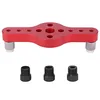
Aluminum Alloy Woodworking Punch Locator Drill Guide
A handheld aluminum punch locator with three swappable drill sleeves for straight, perpendicular holes in stock up to 1.8 inches thick.
- Best for: Handheld straight-hole drilling with swappable 6/8/10mm sleeves
- Why we picked it: Three bushings in one aluminum body cover most common bit sizes without buying a jig per size
- Main drawback: Sleeves are metric only, so US-gauge bits need the closest matching sleeve
Compare more drill guide options
 Option 1 Milescraft 1333 Self-Centering Dowel Jig Kit
|
 Option 2 JINPIAOPIAO Straight Hole Drill Guide
|
 Option 3 Tyenaza 8-Pc Handheld Dowel Jig Kit
|
As an Amazon Associate we earn from qualifying purchases.
A drill press replaces exactly one thing: a rigid column that keeps the chuck square to the table. Everything below replaces that column with something cheaper and more portable — and if you decide you’d rather build that column instead, see our drill press stand solutions for workshop spaces. For more on bit selection and pilot holes, browse our full drilling guides hub.
The starter divot in the steps below is not the same thing as a pilot hole. A divot just stops the bit from skating before it bites; a pilot hole for a wood screw is a separate, deliberately undersized hole drilled after your guide hole is already straight.
- A cordless drill/driver in the 18V-20V class for most wood tasks — see our impact vs. hammer drill breakdown if you’re also buying the tool
- Sharp twist bits sized to the material — a stepped drill bit covers several hole sizes with one bit change
- Two identical speed squares, or one guide jig, or a scrap-wood guide block (pick one method below)
- An awl or a nail set to punch a starter divot
- A bar clamp or two to keep the workpiece from spinning or walking
- Safety glasses — sawdust and metal shavings both come off at eye level
The Two-Square Trick (Free, No Tools to Buy)
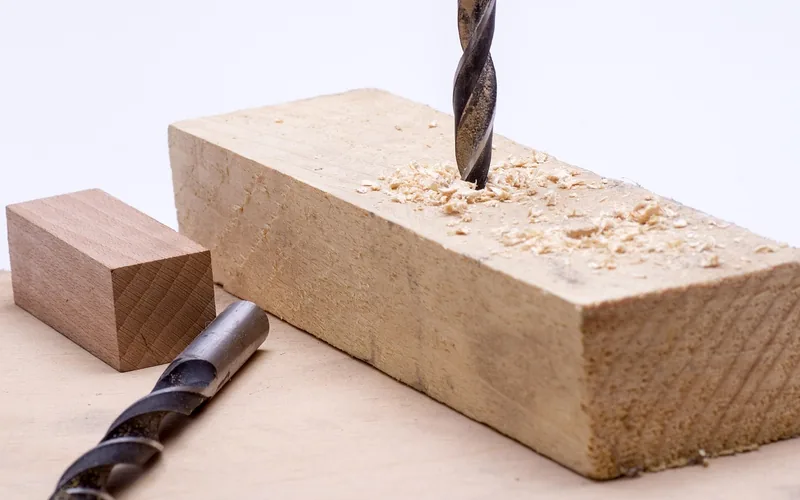
This is the oldest trick in the shop, and job-site carpenters still use it because it costs nothing and takes ten seconds to set up. Stand one speed square upright against the workpiece so its edge runs vertical in your left-right field of view, and set a second one 90 degrees around it so its edge runs vertical in your front-back field of view. Line the drill body up parallel to both blades before you pull the trigger.
The trick only works because you’re checking two planes instead of one. A bubble level built into a drill only reads one axis at a time, which is exactly why so many “straight” holes still lean. Punch a starter divot first, sight against both squares, and take the first quarter-inch slow — that’s the only part where the bit can still wander off the mark.
Buy a Drill Guide Jig (Fastest, Most Consistent)
A handheld drill guide jig is a small block with a bushing that the bit rides through, so the guide itself does the squaring instead of your eye. Commercial versions run $8 to $20 for a basic aluminum or polymer block with two or three bushing sizes, which is cheaper than most single power tool accessories. Set the jig over the punched divot, hold or clamp it flat against the surface, and drill through the bushing — the hole comes out perpendicular because the bushing physically can’t tilt.
Build Your Own Guide Block (Zero Cost)
Cut a piece of scrap hardwood about 1.5 inches wide and 10 inches long, then cut a 2-inch block off one end, keeping the cut perfectly square. Glue and clamp that 2-inch block against the long piece using a carpenter’s square to hold a true 90-degree angle while the glue sets — give it a few hours before you trust it. To use it, butt the L-shaped corner against your drilling spot and line the bit up with the inside corner; the block does the squaring, you just keep the bit tight against both faces.
For repeat holes at one bit size, glue a short length of brass or aluminum tube — inside diameter matched to your bit — into the block with hot-melt adhesive. That turns the block into a real bushing guide, and it costs less than a tube of wood glue.
Self-Centering Doweling Jigs for Edge and Joinery Holes
Everything above drills straight down into a flat face. Dowel joinery is different — the hole has to land exactly in the center of the board’s edge, on two mating pieces, or the joint won’t line up. A self-centering doweling jig clamps onto the edge of the stock and automatically finds the middle, so there’s no measuring or marking before you drill. Once you know how to cut a dowel to length, a self-centering jig is what keeps the holes it goes into actually aligned.
These jigs clamp, drill, unclamp, and reposition for each hole, which is slower than a drill press for a large panel glue-up but is the more accurate choice specifically for edge-drilled dowel holes — a plain guide block or drill guide jig isn’t built to find the center of a board’s thickness on its own.
Laser-Guided Drill Attachments (The Newer Option)
A newer category of magnetic laser attachments, such as the BullseyeBore Core, clips onto the drill body and projects a laser line or circle onto the work surface to show whether the bit is tracking straight, even at odd angles a bubble level can’t read. They run roughly $40 to $90, cost more than a mechanical guide, and need a charged battery to work, but they’re the only option here that helps with angled holes, not just 90-degree ones, and they work on job sites where clamping a bulky jig isn’t practical.
Compare All Five Methods
| Method | Approx. Cost | Best For |
|---|---|---|
| Two-square sighting trick | Free | One-off holes, job-site work |
| DIY guide block | Free (scrap wood) | Repeated holes at one bit size |
| Handheld drill guide jig | $8–$20 | General shop use, swappable bit sizes |
| Self-centering doweling jig | $15–$35 | Edge and dowel joinery holes |
| Laser-guided attachment | $40–$90 | Angled holes, low-light or job-site work |
Step-by-Step: Drilling a Straight Hole With Any Guide
- Mark and punch the spot: Mark the hole center with a pencil, then tap a starter divot with an awl or nail set so the bit can’t wander before it bites.
- Set up your guide: Clamp a drill guide jig over the divot, position a glued-up guide block against the corner, or set two speed squares 90 degrees apart.
- Sight both directions: Check the drill body against each square or guide face from the front and the side — a bit that looks straight from one angle can still be off in the other.
- Start slow: Begin at low speed with light pressure until the bit is fully seated; ramping up too fast is what makes a bit skate off-mark.
- Drill to depth, checking as you go: On deep holes, pause every inch or so to re-sight the angle, especially freehand with no guide.
- Clear and deburr: Back the bit out slowly, brush out the dust, and file the exit-side burr so hardware or dowels seat flush.
Fixing a Hole That’s Already Crooked
A hole that’s only a couple degrees off usually still works — test-fit the screw or dowel before you assume it’s ruined. For a hole that’s visibly off, glue in a matching dowel plug, let it cure fully, sand it flush, and redrill through the plug with a guide this time; wood glue holds a dowel plug at least as strong as the surrounding wood. For a hole that’s only slightly oversized rather than crooked, wood filler or an epoxy fill-and-redrill gets a clean second attempt without wasting the board. If the hole is structural — a joint, a hinge mortise, a load-bearing point — don’t try to save it; move the hole location instead of forcing hardware into a weak repair.
That fix is for solid wood. A crooked or oversized hole in drywall is a different repair — see our guide to fixing wall anchor holes that are too big if that’s what you’re dealing with.
Frequently Asked Questions
How do you drill a straight hole with a hand drill?
Punch a starter divot with an awl, then sight the drill against a guide — two squares set 90 degrees apart, a drill guide jig, or a shop-made guide block. Start at low speed until the bit is fully seated, then drill to depth without changing the angle.
What can I use instead of a drill press?
A handheld drill guide jig, a self-centering doweling jig for edge holes, a free scrap-wood guide block, or the two-square sighting trick all get a hand drill close to drill-press accuracy for most woodworking tasks.
Is a self-centering doweling jig the same as a drill guide?
No. A drill guide squares a bit to a flat face for a straight vertical hole. A self-centering doweling jig clamps onto a board’s edge and finds the center of its thickness automatically, which is what dowel joinery actually needs.
Do laser drill guides actually work?
Yes — magnetic laser attachments like the BullseyeBore Core project a line or circle onto the work so you can see the bit’s angle in real time, including on angled or sloped surfaces a bubble level can’t read. They cost more ($40–$90) than a mechanical guide and need a charged battery.
Why does my hole come out crooked even when I’m careful?
Usually the bit skated during the first quarter-inch before it seated, often from starting at full speed with no starter divot, or from sighting the drill in only one plane instead of two. Punch a divot first and check the angle from both the front and the side, not just one.
How much does a drill guide jig cost?
A basic handheld drill guide jig runs about $8 to $20. Self-centering doweling jigs run $15 to $35. A free scrap-wood guide block or the two-square trick cost nothing beyond tools most woodworkers already own.
Conclusion
A drill press is convenient, but it isn’t what makes a hole straight — alignment is. The two-square trick costs nothing and works today; a guide block or drill guide jig makes repeat holes faster; a self-centering doweling jig is the right call specifically for dowel joinery. Pick the one that matches the job in front of you, punch a starter divot, and sight the angle before the bit ever touches the wood.
Sponsored / affiliate links. As an Amazon Associate I earn from qualifying purchases. I may earn additional commission from eligible campaigns.