Best Wax Remover for Wood Floors: 5 Picks Compared (2026)
The best all-around wax remover for wood floors is Bona Floor Polish Remover — it’s one of only two ready-to-use products in this comparison whose own label actually names “hardwood” as an approved surface, it covers 200 sq ft per 32 oz bottle ($7.62 per 100 sq ft), and it needs no rinse step. Four other wax strippers that show up constantly on “best for wood floors” lists elsewhere don’t share that hardwood approval — see the correction table below before you buy one.
The 5 Wax Removers Compared
Every price below is a live Amazon buy-box price pulled the day this page was last updated. “Cost per use” is computed from each product’s own disclosed coverage or dilution ratio, not estimated — see the formula noted under the table.
| Product | Price | Size | Format | Wood-Floor Approved? | Dwell Time | Cost Per Use |
|---|---|---|---|---|---|---|
| Bona Floor Polish Remover | $15.23 | 32 fl oz | Ready-to-use | Yes — “hardwood” named on label | 5–10 min | $7.62 / 100 sq ft |
| Quick Shine Multi Surface Deep Cleaner & Wax Remover | $17.89 | 27 fl oz concentrate | Concentrate (1:16 heavy dilution) | Yes — “hardwood” named on label | Not published | ~$5.30 / gallon of solution |
| Mohawk Wax Wash Remover | $28.99 | 13 fl oz | Ready-to-use | Not floor-specific — labeled for furniture/woodwork | Not published | $2.23 / fl oz |
| Klean-Strip Odorless Mineral Spirits | $22.99 | 1 gallon (128 fl oz) | Solvent (manual method) | Not a labeled floor product — traditional refinisher’s solvent | 3–5 min | $0.18 / fl oz |
| Sunnyside VM&P Naphtha | $17.99 | 1 quart (32 fl oz) | Solvent (manual method) | Not a labeled floor product — traditional refinisher’s solvent | Under 1 min (fast-evaporating) | $0.56 / fl oz |
Cost-per-use formulas: Bona’s coverage (200 sq ft/bottle) is stated on its own label. Quick Shine’s 27 oz concentrate divided by its own disclosed heavy-buildup dilution (1 cup/8 fl oz per gallon of water) yields about 3.4 gallons of ready-to-use solution, so $17.89 ÷ 3.4 ≈ $5.30/gallon. Mohawk, mineral spirits and naphtha don’t publish a floor-coverage figure, so those are shown as raw cost per fluid ounce instead of being forced into a false per-sq-ft number.
Best Wax Removers for Wood Floors
1. Bona Floor Polish Remover — #1 Best Overall
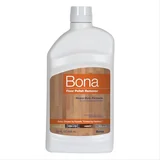
Price: $15.23 for 32 fl oz | Check current price on Amazon
- Label explicitly names hardwood among approved surfaces (also stone, tile, LVT, vinyl and laminate)
- Ready to use — no dilution math, just squirt, spread and scrub
- 200 sq ft of coverage per bottle, the only pick in this comparison with a disclosed floor-coverage number
- 5–10 minute dwell time before scrubbing with a non-abrasive pad
- $0.48 per fluid ounce — mid-pack on raw price, cheapest per-100-sq-ft once coverage is factored in
Bona is the product most likely to already be in a flooring pro’s van, and it’s the only one of the five picks here that both names hardwood directly on the label and discloses a real coverage figure, which is what lets it win the cost-per-100-sq-ft comparison even though its per-ounce price isn’t the lowest. It’s formulated to break down polish and finish buildup, not just surface dust, so it’s suited to a floor that’s gone cloudy or sticky from repeated coats of wax or polish.
Main drawback: it’s a polish/finish remover, not an industrial stripper — on decades-old, heavily built-up paste wax it may need two or three passes rather than removing everything in one application.
2. Quick Shine Multi Surface Deep Cleaner & Wax Remover — Best for Multi-Surface Homes
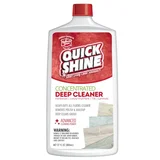
Price: $17.89 for 27 fl oz concentrate | Check current price on Amazon
- Label explicitly lists hardwood, laminate, LVT, LVP, tile and stone as approved surfaces
- Ammonia-free — the label calls this out directly as a contrast to “most wax strippers”
- Two dilution strengths: 1 cup per gallon of hot water for heavy wax buildup, ½ cup per gallon for general cleaning
- Also functions as a grout cleaner on tile transitions, useful in mixed-flooring homes
- 27 oz concentrate makes roughly 3.4 gallons of heavy-duty solution (see formula above)
If your home has hardwood flowing into tile or LVT in the kitchen or bath, Quick Shine is the one pick here that’s explicitly labeled to cross all of those surfaces without a product switch. Being ammonia-free also matters if you’re working in a closed room without much ventilation — it’s a meaningfully different chemistry than the ammonia-based industrial strippers covered in the correction section below.
Main drawback: Quick Shine doesn’t publish a floor-coverage figure the way Bona does, so you’re estimating gallons-per-room rather than reading it off the bottle.
3. Mohawk Wax Wash Remover — Best for Refinishing Prep
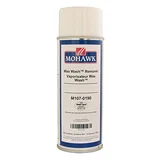
Price: $28.99 for 13 fl oz | Check current price on Amazon
- Made by Mohawk Finishing Products, a name most professional wood refinishers already stock
- Removes oil, wax and other surface contaminants specifically to prep for a new coat of finish
- Ready to use, no dilution
- Not available for sale in 16 states (CA, CT, DC, DE, MA, MD, ME, NH, NJ, NY, PA, RI, VA, VT) under current VOC rules
- Most expensive pick per fluid ounce at $2.23/oz
Worth an honest caveat: Mohawk’s own listing names “furniture, appliances, woodwork and any other finished surface” — it doesn’t use the word “floor” any more than Trewax’s listing uses the word “wood” (see the correction section next). The reason it’s still included as a real pick rather than filed alongside Trewax and Zep is that its job — stripping wax and contaminants from a finished wood surface before a new coat goes on — is chemically the same job a wood floor needs before recoating, and it’s a name professional finishers already use on trim, cabinets and floor-adjacent millwork. If you want a product whose own label says “floor,” pair Bona or Quick Shine with this one for stubborn spots rather than relying on Mohawk alone.
Main drawback: the 16-state sales restriction and the highest per-ounce price of the five picks.
4. Klean-Strip Odorless Mineral Spirits — Best Budget Method
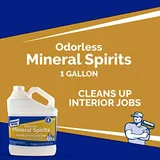
Price: $22.99 for 1 gallon | Check current price on Amazon
- Cheapest option per fluid ounce by a wide margin at $0.18/oz
- The traditional method flooring refinishers use on paste wax specifically, per professional-refinisher sources like WoodFloorDoctor.com
- Dissolves wax without attacking the wood or the stain underneath it, unlike some alkaline industrial strippers
- Method: apply to a small section, dwell 3–5 minutes, agitate with a white pad or fine steel wool, wipe up with a clean rag before it re-deposits the dissolved wax
- “Odorless” is relative — this is still a petroleum solvent and needs real ventilation
Mineral spirits isn’t a branded “wood floor wax remover” — it’s a general solvent, and it’s the same solvent behind the manual method in our step-by-step guide to removing wax from a wood floor. It’s included here for a specific reason: it’s the method that predates every commercial product on this page, and it’s still the one professional refinishers reach for on old paste wax because it won’t touch the stain or raise the grain the way a water-based stripper can. The tradeoff is labor: there’s no spray-and-walk-away step, and you’re working it in by hand, section by section.
Main drawback: pure elbow grease — no dwell-and-rinse convenience, and it must be removed completely (see the FAQ below) or a new finish coat won’t bond.
5. Sunnyside VM&P Naphtha — Best Fast-Evaporating Solvent for Light Wax Film
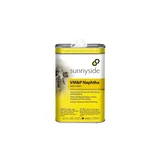
Price: $17.99 for 1 quart | Check current price on Amazon
- Evaporates significantly faster than mineral spirits, which shortens the wipe-up window before residue starts to redeposit
- $0.56 per fluid ounce — cheaper than every branded product here except mineral spirits
- Better suited to a light wax film or a quick spot-clean than a thick, decades-old buildup
- More flammable and stronger-smelling than the odorless mineral spirits option — work in a ventilated space, no open flames or pilot lights nearby
Naphtha does the same basic job as mineral spirits — dissolving wax so it can be wiped away — but the fast evaporation cuts both ways: less working time per section, but also less time for the room to smell like solvent. It’s the better choice for a once-a-year maintenance-level wax film rather than a full strip-to-bare-wood job before refinishing.
Main drawback: the fast evaporation that makes it convenient also means less margin for error on a large area — it can flash off before you’ve fully agitated a section on a hot day or in a well-ventilated room.
4 “Wood Floor” Wax Strippers That Aren’t Actually Labeled for Wood
This is the part most “best wax remover for wood floors” roundups skip, because checking it means reading past the marketing headline into the actual directions panel. We pulled the manufacturer-published “for use on” surface lists for the four products that show up most often on competing wood-floor wax remover lists — and none of their own approved-surface lists include genuine hardwood.
| Product | Manufacturer’s Own “For Use On” List | Explicitly Excludes | Price |
|---|---|---|---|
| Trewax Gold Label Heavy-Duty Floor Stripper | Vinyl, composition, rubber, asphalt-tile, terrazzo, concrete, “no-wax” vinyl | Cork, unfinished wood, laminate, marble | $20.77 (1 gal) |
| Lundmark High Power Wax Remover | Resilient linoleum, VCT, vinyl tile, asphalt tile, asbestos tile, laminate flooring, LVT | Hardwood isn’t on the approved list at all | $14.15 (32 oz) |
| Zep Heavy-Duty Floor Stripper | VCT, rubber tile, asphalt tile, terrazzo, ceramic tile | Marble, natural stone and wood floors, per Zep’s own product documentation | $13.56 (1 gal) |
| Lundmark Super Strip | Resilient linoleum, VCT, vinyl tile, asphalt tile, asbestos tile — “okay to use on hardwood laminate, floating laminate floors” | States outright: “do not use on true genuine hardwood floors” | $31.13 (1 gal) |
The Lundmark Super Strip line is the clearest evidence of where the confusion probably comes from: its own listing says it’s fine for hardwood-look laminate, then explicitly warns against “true genuine hardwood floors” in the very next clause. It’s an easy mix-up for anyone skimming a product title for the word “hardwood” rather than reading the actual use directions — and it’s exactly the kind of mix-up that ends up baked into a roundup article. Two of these four products (Trewax and Lundmark High Power) appear as top-rated picks on other “I tested the best wood floor wax remover” articles currently ranking for this keyword.
None of this means these four products are bad — they’re serious, professional-grade strippers for resilient commercial flooring (VCT, linoleum, laminate). It means they’re the wrong tool for genuine solid or engineered hardwood, where an aggressive alkaline stripper can lift stain, dull the wood fibers, or leave a residue that keeps a new finish coat from bonding.
How We Picked These
We haven’t physically stripped wax with all five products on this page ourselves, so we’re not going to write this as an “I tested” roundup the way some competing pages do — several of those pages claim testing hours that don’t survive basic arithmetic against a wax product’s real dwell and dry times. Instead, this comparison is built from primary sources we could actually verify this session:
- Every price and every “for use on” surface claim came directly from each product’s live Amazon listing, pulled via Amazon’s Creators API on the date this page was last updated — not copied from a competitor’s article
- The mineral-spirits removal method is the one described by professional wood-floor refinishing sources (WoodFloorDoctor.com) rather than a generic “try vinegar” DIY tip
- The wood-floor-approval correction table came from reading each product’s own directions panel against what other “best of” pages were recommending it for
- Cost-per-use figures are computed from each product’s own disclosed coverage or dilution ratio, with the formula shown, not estimated
Where we couldn’t verify a number — floor coverage for Quick Shine, Mohawk, mineral spirits or naphtha, for instance — the table says so instead of guessing.
What to Consider When Buying a Wax Remover for Wood Floors
Wax, Oil, or Polyurethane Finish?
A wax remover is only the right product if your floor actually has wax on it. Drop a little water on an inconspicuous spot: if it beads up and sits on the surface, you almost certainly have a polyurethane finish and don’t need a wax stripper at all. If the water soaks in slowly, the floor likely has a wax, oil, or shellac finish — including a beeswax finish, which behaves the same way for removal purposes — and that’s the situation these five products are for.
Genuine Hardwood vs. Laminate or LVT
As the correction table above shows, this is the single most-skipped check. Several strippers marketed around the word “hardwood” are actually approved only for hardwood-look laminate, not solid or engineered wood. Read the manufacturer’s own “for use on” list, not just the product title, before buying.
Ready-to-Use vs. Concentrate
Bona and Mohawk are ready to use out of the bottle. Quick Shine is a concentrate you dilute yourself — cheaper per gallon of finished solution once mixed, but it adds a measuring step. Mineral spirits and naphtha are used undiluted but require you to supply your own applicator, pads, and rags.
Dwell (Contact) Time
Bona calls for 5–10 minutes before scrubbing. The solvent method (mineral spirits) works faster, 3–5 minutes per section, but only if you’re actively working a small area at a time. Naphtha evaporates so quickly it barely gives you a true dwell window on a warm day — work in smaller sections than you think you need.
Rinse Required or Not
Bona and Quick Shine are wipe-clean, not rinse-required, per their own directions. The solvent methods (mineral spirits, naphtha) are also wipe-only — you’re removing dissolved wax with a dry rag, not water. None of the five picks here require a water rinse step, which matters on solid hardwood where standing water is always a risk.
Ventilation and State Restrictions
Mohawk Wax Wash Remover isn’t sold in 16 states under current VOC regulations (see the full list in the comparison table). Mineral spirits and naphtha are both petroleum solvents — “odorless” mineral spirits is a lower-odor formulation, not a fume-free one. Open windows and run a fan regardless of which product you use.
Cost Per Use
Mineral spirits wins by a wide margin at $0.18 per fluid ounce, with Bona the cheapest ready-to-use, no-dilution option once its 200 sq ft/bottle coverage is factored in. Mohawk is the most expensive at $2.23 per fluid ounce, which fits its role as a targeted refinishing-prep product rather than a whole-floor stripper.
Mechanical Agitation
Bona’s own directions call for an 18-inch non-abrasive scrubbing pad. The solvent methods need a white pad or fine steel wool worked with the grain. None of these five products is a spray-and-walk-away product on real wax buildup — every one of them still needs some scrubbing.
Compatibility With Your Next Finish Coat
This is the step a lot of DIY wax removal guides skip entirely: any wax residue left behind, even a trace amount, can keep a new polyurethane or oil finish from bonding to the wood. Complete removal matters more than which product you use to get there; once the floor is fully stripped, our guide to refinishing hardwood floors yourself covers the recoating process.
How to Remove Wax from a Wood Floor
This is the general sequence behind all five picks above, adapted from professional refinisher guidance rather than a single product’s instructions. Always check your chosen product’s own label first — this is a framework, not a substitute for the directions panel.
- Confirm you actually have a wax finish. Do the water-drop test: water that beads on the surface means polyurethane (skip this whole process); water that soaks in slowly means wax, oil, or shellac.
- Identify wax specifically with the mineral-spirits rag test. Rub a small area with a white cloth dampened in mineral spirits. A yellow-brown, crayon-like residue transferring to the cloth confirms paste wax.
- Test your chosen remover in an inconspicuous corner first — a closet or under a rug — before treating the whole room.
- Clear the room and vacuum or dust-mop to remove loose grit that would otherwise get ground into the finish while you scrub.
- Apply the remover in small, manageable sections (a few square feet at a time for the solvent methods, larger for ready-to-use sprays) rather than flooding the whole floor at once.
- Let it dwell for the time your product calls for — 5–10 minutes for Bona, 3–5 minutes per section for mineral spirits, almost no wait for fast-evaporating naphtha.
- Agitate with a non-abrasive pad or fine steel wool, working with the grain, not across it.
- Wipe up the dissolved wax with a clean, dry rag before it dries back onto the floor — this is the step most likely to get rushed, and rushing it just redeposits the wax you were trying to remove.
- Repeat on heavy buildup. Old, decades-built-up paste wax often needs two or three passes. If you’d rather maintain a wax finish than strip it permanently, see our guide to how to wax hardwood floors the right way so it doesn’t build up unevenly in the first place.
- Re-check with the rag test before you recoat. If a clean white cloth dampened with mineral spirits still picks up a waxy residue, the floor isn’t ready for a new finish yet — any leftover wax will keep the new coat from bonding.
Frequently Asked Questions
Will mineral spirits damage my wood floor’s finish or stain?
No — that’s specifically why professional refinishers reach for it on paste wax. Mineral spirits dissolves wax without attacking the stain or the wood fibers underneath the way a strong alkaline stripper can. It’s still a solvent, so test in an inconspicuous spot first and keep the room ventilated.
How do I know if my wood floor even has wax on it?
Do the water-drop test first: water that beads and sits on the surface means polyurethane, not wax. If it soaks in slowly, follow up with the mineral-spirits rag test — rub a white cloth dampened with mineral spirits on the floor, and a yellow-brown, crayon-like residue on the cloth confirms paste wax.
Are Lundmark or Zep floor strippers safe for genuine hardwood floors?
Not according to their own manufacturer documentation. Lundmark High Power Wax Remover’s approved-surface list covers linoleum, VCT, vinyl tile and laminate but not hardwood, and Zep Heavy-Duty Floor Stripper’s own product documentation states it’s not for use on wood floors. Lundmark’s separate Super Strip product explicitly allows hardwood-look laminate while explicitly excluding “true genuine hardwood floors.” Bona Floor Polish Remover and Quick Shine Multi Surface Deep Cleaner both name hardwood directly on their own labels instead.
Do I need to remove every trace of old wax before refinishing?
Yes. Even a thin residual film of wax left in the wood grain can keep a new polyurethane or oil finish from bonding properly, leading to a finish that never fully cures or peels shortly after application. Re-test with a clean mineral-spirits rag before you recoat, not just a visual check.
Can I use a wood floor wax remover on laminate or LVT flooring instead?
Check the product first — it varies. Quick Shine and Bona are both labeled for laminate and LVT as well as hardwood. Trewax, Lundmark High Power and Zep are formulated primarily for resilient flooring (vinyl, VCT, laminate) and are a better match for those surfaces than for solid hardwood.
What’s the difference between mineral spirits and naphtha for wax removal?
Both are petroleum solvents that dissolve wax the same way. Naphtha evaporates much faster, which shortens your working window per section but also cuts down on lingering solvent smell. Mineral spirits, especially the odorless formulation, gives more time to work the solvent in and wipe it up before it flashes off, which makes it easier to control on a larger area.
Do I need to rinse the floor with water after using a wax remover?
Not with any of the five products in this comparison. Bona and Quick Shine are wipe-clean by their own directions, and the solvent methods (mineral spirits, naphtha) are removed with a dry rag, not water. Standing water on solid hardwood risks cupping and staining, so a rinse-free product or method is generally preferable on real wood floors.
Final Thoughts
For most wood floors with a wax or polish buildup problem, Bona Floor Polish Remover is the safest starting point: it’s one of only two products in this comparison whose own label names hardwood directly, it’s ready to use with no dilution, and at $7.62 per 100 sq ft it’s the cheapest option once its disclosed 200 sq ft/bottle coverage is factored in. If your home mixes hardwood with tile or LVT, Quick Shine covers all three surfaces with one bottle — and once the floor is stripped, our roundup of the best cleaning supplies for wood floors covers ongoing maintenance so wax and polish don’t build back up as quickly. And before you reach for any stripper with “heavy duty” or “commercial strength” on the label, check the actual directions panel first — as the correction table above shows, all four of the most commonly recommended “wood floor” strippers aren’t approved for genuine hardwood on their own manufacturer’s surface list.
Related Guides
- Best Thing to Clean Hardwood Floors: 4 Methods Compared
- How to Care for Waxed Wood Floors the Safe and Easy Way
- Cleaning and Waxing Hardwood Floors
- How Can I Refinish Hardwood Floors?
Sponsored / affiliate links. As an Amazon Associate I earn from qualifying purchases. I may earn additional commission from eligible campaigns.