Can a Hammer Drill Be Used as a Regular Drill?
Yes, a hammer drill can be used as a regular drill. In standard drilling mode it works exactly like any other drill/driver. The hammer function is an extra, switchable setting for masonry and other hard materials – you simply leave it off for everyday wood, metal, or screw-driving work.
For a broader look at when the hammer mode is worth having, see our full hammer drill vs drill comparison.
Understanding Your Hammer Drill
Best Hammer Drill for Everyday Use
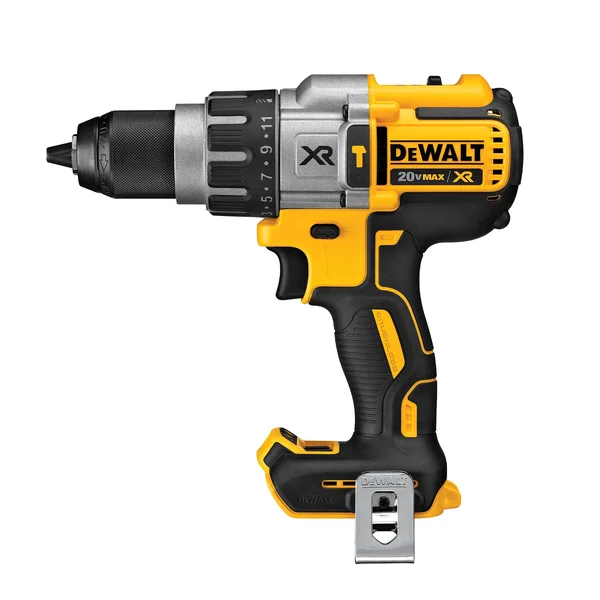 |
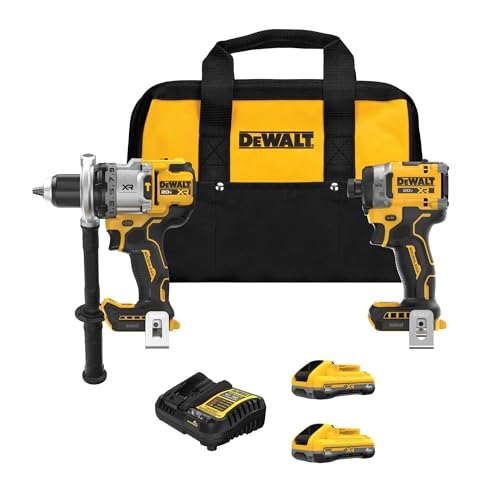
DeWalt DCD996B 20V MAX XR Hammer Drill – $229.00 A 3-speed brushless hammer drill that covers everyday wood and metal drilling, plus masonry when you switch the mode selector on.
|
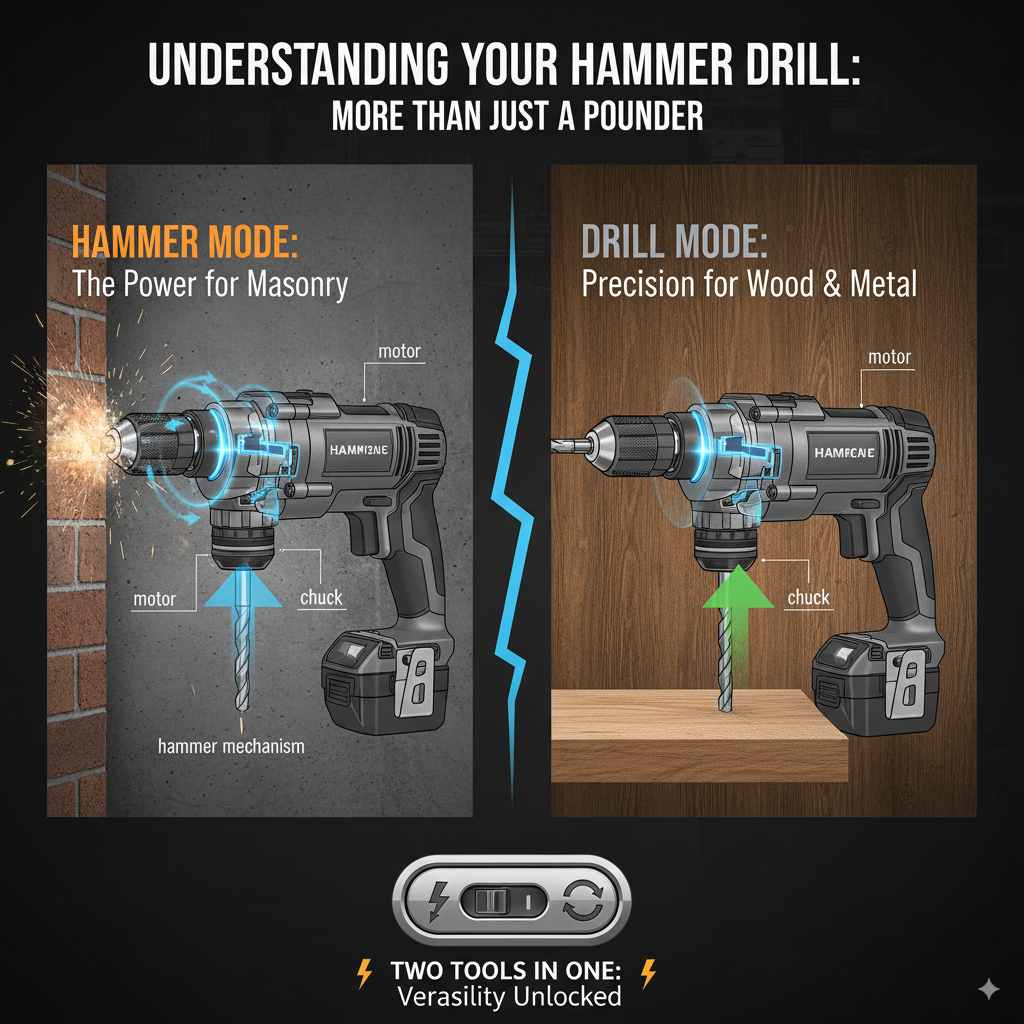
The “hammer” in hammer drill leads people to assume it’s a demolition-only tool, but it’s really two tools in one. At its core, a hammer drill is a standard power drill: a motor spins a chuck, the chuck holds a bit, and the spinning bit bores into material. That’s identical to how any regular drill/driver works.
The hammer mechanism is the added feature. When engaged, it layers rapid, short forward impacts on top of the spinning motion – effectively a small jackhammer action riding along the drill’s rotation. That combination is what lets it break through concrete, brick, and stone that a plain rotating bit can’t penetrate efficiently. Critically, that hammer action is optional: switch it off, and the tool behaves exactly like a standard drill for the rest of your project.
The Three Modes Explained
- Drill mode (standard drilling): Consistent spinning motion with no hammer action – identical to a regular drill/driver. Use this for wood, metal, plastic, and driving screws. This is the mode for the vast majority of DIY tasks.
- Hammer drill mode: The bit spins while the tool also delivers rapid pulsing blows forward, letting it break through masonry. Never use this mode on wood or metal – it will chew up the material and can damage the bit.
- Hammer-only mode (less common): Found on some higher-end models, this delivers the hammering action without rotation, functioning as a light chisel for chipping or scraping. It’s rarely used for actual drilling.
The mode selector is usually a ring or switch near the chuck, marked with a plain circle or drill-bit icon for standard mode, a drill-bit-with-radiating-lines icon for hammer mode, and sometimes a chisel icon for hammer-only. To drill normally, set the selector to the plain drill-bit symbol, load your bit, and go.
Hammer Drill vs. a True Rotary Hammer (SDS)
This is the distinction most guides skip, and it matters if you’re shopping for a tool: a “hammer drill” and a “rotary hammer” (often called an SDS or SDS-plus drill) are not the same thing, even though both handle masonry.
- Hammer drill: Uses a mechanical cam-and-ball mechanism to create the hammering action, delivers lower impact energy, and holds bits in a standard keyless or keyed chuck. This is the tool this article is about, and it works fine as a full-time regular drill.
- Rotary hammer (SDS): Uses an electro-pneumatic piston mechanism for much higher impact energy, holds bits in a spline-shaped SDS chuck (no standard round-shank bits), and can usually run in hammer-only mode for chiseling. It’s built for heavy, repeated concrete drilling and demolition, not general woodworking or metal work.
If your masonry work is occasional – mounting a shelf bracket or a TV mount into brick – a standard hammer drill covers it and doubles as your everyday drill. If you’re drilling dozens of anchor holes in concrete regularly, a dedicated SDS rotary hammer will be faster and easier on your wrists, but it’s a poor substitute for a regular drill on wood and metal.
Hammer Drills vs. Standard Drills: What’s the Difference?
Key Components
Both tools share the same basic parts: a motor, a chuck, a gearbox, and a trigger that controls speed. A hammer drill adds a hammer mechanism – typically a set of cams or ridged discs that, when engaged, create the rapid forward impacts – plus the mode selector switch that turns that mechanism on or off.
Power and Torque
Hammer drills are usually built with more powerful motors than comparable basic drill/drivers, since they need enough force to drive the hammering action. That means even with the hammer function switched off, a hammer drill often delivers more torque and higher RPM than an entry-level drill/driver – a real advantage for large-diameter holes or dense hardwood.
When You Actually Need the Hammer Function
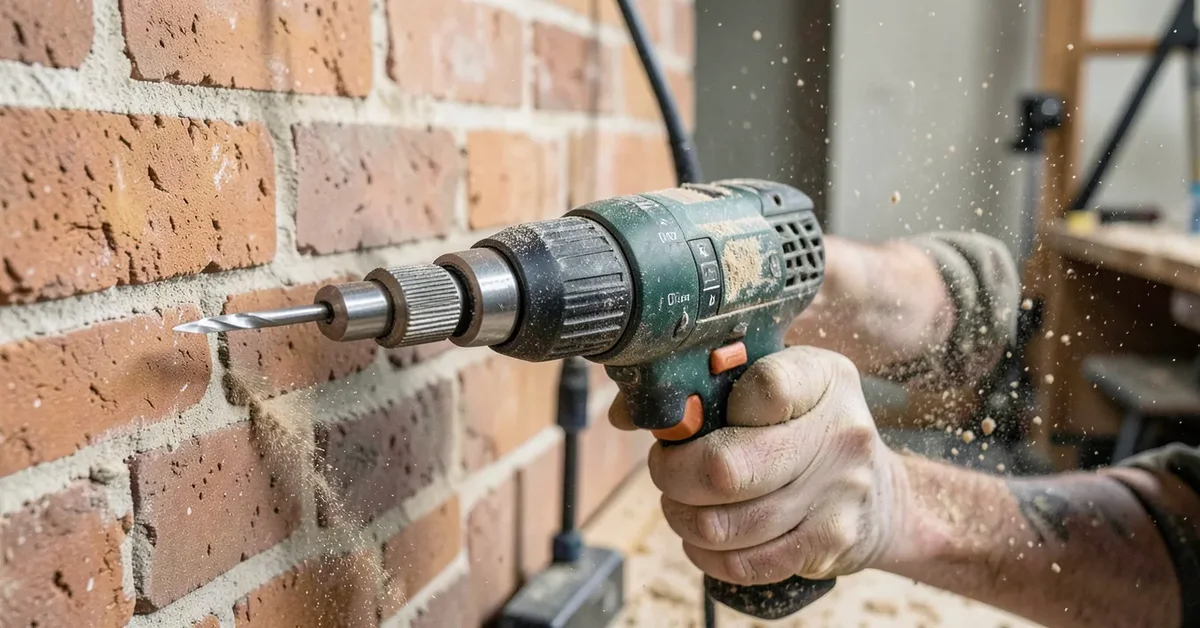
The hammer setting earns its keep on concrete, brick, stone, and concrete block. A standard drill’s spinning action alone won’t break these materials down efficiently, if at all. The rapid hammering pulverizes the material so the spinning bit can clear the debris. Always pair hammer mode with a carbide-tipped masonry bit rated for hammer drills.
Using Your Hammer Drill for Regular Drilling
Step-by-Step
- Pick the right bit: HSS (high-speed steel) for metal, a brad-point or spade bit for wood, or a screwdriver bit for fastening.
- Confirm the hammer function is off: set the mode selector to the plain circle or drill-bit icon. This is the step that actually matters – skip it and you risk tearing up your material.
- Load the bit: twist the chuck open, seat the bit’s shank fully, then close the chuck until it’s snug with no wobble.
- Set your speed: low speed for metal and for driving screws (more control), low-to-medium for wood, higher speed only for small holes in soft material.
- Drill: mark your spot, hold the drill perpendicular to the surface, apply steady pressure, and squeeze the trigger gradually rather than snapping to full speed.
- Driving screws: use the clutch ring (if your drill has one) to set torque and avoid stripping the screw head – start on a low number and increase only if the screw isn’t seating.
Drill Settings Cheat Sheet
| Material | Mode | Bit Type | Speed | Clutch (for screws) |
|---|---|---|---|---|
| Wood | Standard drill | Brad-point, spade, or auger bit | Low to medium | N/A unless driving screws |
| Metal | Standard drill | HSS bit | Low | N/A |
| Plastic | Standard drill | Plastic-rated or HSS bit | Low to medium | N/A unless driving screws |
| Drywall | Standard drill | Phillips screwdriver bit | Medium | Low-to-medium clutch |
| Driving screws | Standard drill | Phillips/Torx bit | Low | Adjustable, start low |
| Concrete, brick, stone | Hammer drill mode | Carbide masonry bit | Low to start, then steady | N/A |
Icon labels vary by brand – always check your specific tool’s manual for its exact mode symbols.
Why Use a Hammer Drill as Your Everyday Drill
- More power for the price: the beefier motor means more torque and RPM headroom than a basic drill/driver, useful for large holes in dense hardwood.
- One tool covers two jobs: if you might ever need to anchor into brick or concrete block, a hammer drill removes the need to buy and store a second tool.
- More compact than a rotary hammer: you get masonry capability without the bulk and weight of a dedicated SDS rotary hammer.
What to Watch For
Accidental Hammer Mode
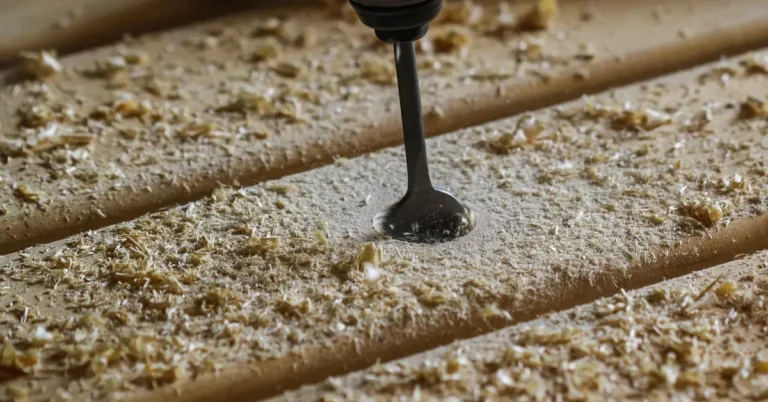
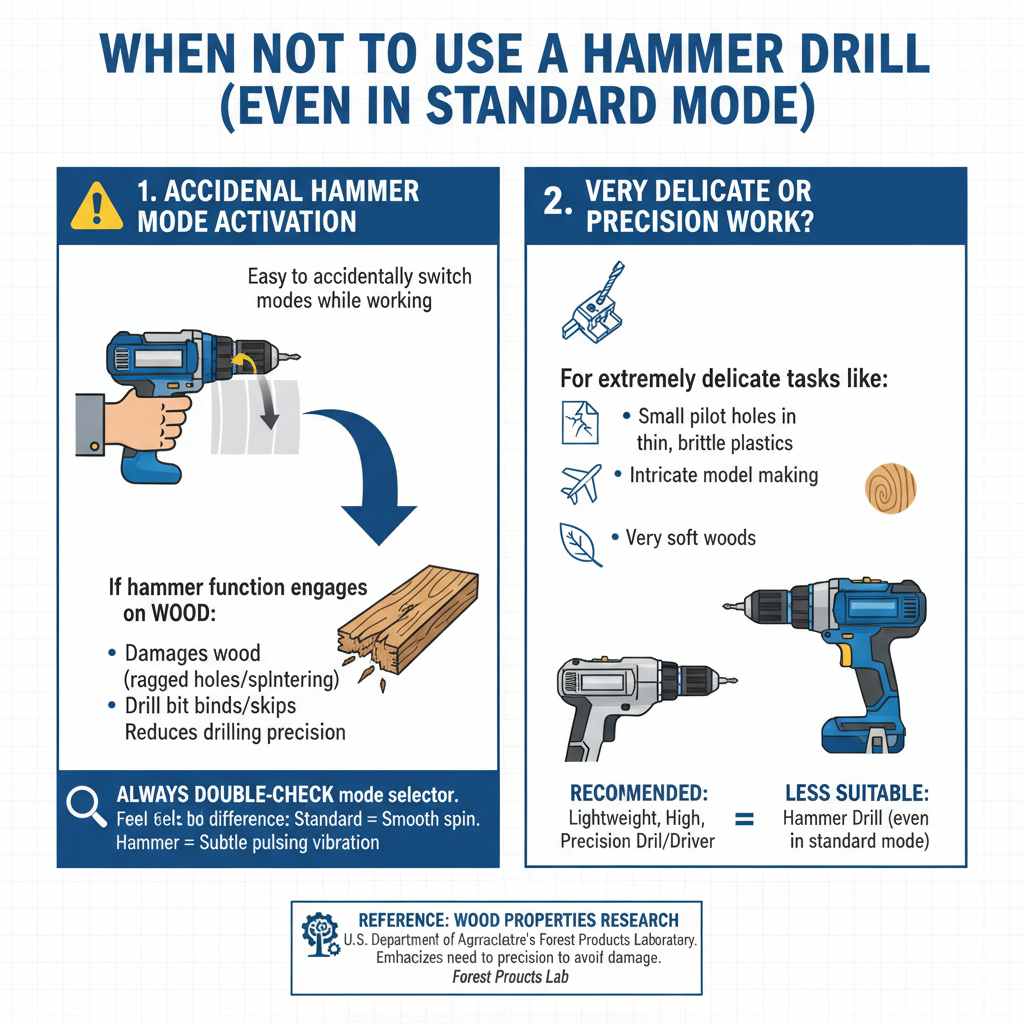
The most common beginner mistake is bumping the mode selector without noticing. If hammer mode is accidentally engaged while drilling wood, it will splinter the hole, cause the bit to bind or skip, and wreck the precision of the cut. Double-check the selector before you start, and if it’s not visible at a glance, you can usually feel the difference – hammer mode has a subtle pulsing vibration even before the bit contacts the material.
For Very Delicate Work
For very small pilot holes in thin, brittle plastic or fine model work, a lighter, lower-torque drill/driver can offer more finesse than a full-size hammer drill. For the large majority of home woodworking and repair tasks, though, a hammer drill in standard mode is just as capable as a dedicated drill/driver, and often more powerful.
Frequently Asked Questions
Is a hammer drill harder to use than a regular drill?
No. With the hammer function off, it operates exactly like a regular drill – same controls, same spinning action. The only extra step is confirming the mode selector is set correctly.
Can I use a hammer drill to drive screws?
Yes. In standard drill mode, a hammer drill drives screws exactly like a regular drill/driver, and most models include a clutch setting to help avoid stripping screw heads or over-driving.
Does using a hammer drill in standard mode wear it out faster?
No. Standard drilling is well within a hammer drill’s normal design limits. Its more powerful motor can actually hold up better under demanding everyday drilling than a lower-end basic drill/driver.
What happens if I accidentally use hammer mode on wood?
You’ll likely damage the material. The forceful impacts splinter the wood, tear the hole out unevenly, and leave a much messier result than standard drilling. Always confirm the hammer mode is off before drilling wood or metal.
Is a hammer drill the same as an SDS rotary hammer?
No. A hammer drill uses a mechanical cam mechanism and a standard chuck, and works well as an everyday drill. An SDS rotary hammer uses a much stronger electro-pneumatic piston and a spline-shaped bit chuck, built for heavy, repeated concrete work, and isn’t a good substitute for general wood or metal drilling.
Sponsored / affiliate links. As an Amazon Associate I earn from qualifying purchases. I may earn additional commission from eligible campaigns.