Toggle Bolts vs Wing Anchors: Which Holds More Weight?
Toggle bolts usually hold more weight than wing anchors in drywall, especially with loads that pull away from the wall or hang on a bracket. A bad choice can let brackets wallow out, tilt, or pull free. This guide compares pull-out strength, shear, load angle, and the load directions that decide which fastener is safer.
| Decision factor | Toggle Bolts | Wing Anchors | Winner |
|---|---|---|---|
| Holding power in drywall | Higher; standard toggles spread load behind the board | Lower typical load range | Toggle Bolts |
| Levered loads like TV mounts | Better choice when the listing allows it, but many mounts still require studs | Poor fit for leverage-heavy brackets | Toggle Bolts |
| Hole size tolerance | Needs the listed pre-drilled hole size; 5/8 inch is often listed for a 1/4-inch bolt | Also needs the correct hole, but the lower load margin leaves less room for error | Toggle Bolts |
| Light-duty hollow-wall work | Works, but may be more anchor than needed | Often the better fit for lighter items | Wing Anchors |
| Rental repair and removal risk | Can leave a larger opening if removed | Usually smaller hardware, so the wall damage can be less disruptive | Wing Anchors |
Toggle bolts vs wing anchors: the real weight difference
Toggle bolts use spring-loaded metal wings behind the wall, which is why they usually beat wing anchors on pure holding power. Wing anchors are also hollow-wall fasteners, but they do not carry the same typical load range. Wall thickness and load angle change the answer fast.
What each fastener
A toggle bolt uses a machine screw and folding metal wings that open behind drywall or another hollow wall. That spread-out contact area is the reason it can carry more than a basic anchor that bites only near the front face.
Wing anchors are also made for hollow walls, but they are not the same as toggle bolts. If you are hanging something simple, a wing anchor can be enough. If the item pulls forward, bounces, or sits on a bracket, toggle bolts are usually the safer starting point.
Why wall thickness and load direction change the answer
Drywall thickness affects how far the anchor can spread and how much material stays intact around the hole. Published ratings can vary with 3/8, 1/2, 5/8, and 3/4 inch board, so the same fastener may have very different numbers from one wall to the next.
Direction matters too. A flat picture frame loads the fastener differently than a shelf bracket or TV arm, because the bracket creates a moment that tries to peel the top fasteners out and compress the lower ones. That is why package weight claims alone can mislead you.
Comparison matrix for common hanging jobs
| Item type | Wall type | Estimated load behavior | Recommended fastener class | Red flags that rule out wing anchors |
|---|---|---|---|---|
| Small shelf or cabinet back | 1/2-inch drywall over open cavity | Mostly shear, with some pull-out at the top edge | Toggle Bolts | Deep shelf, heavy contents, or any bracket that will pry away from the wall |
| Mirror or framed art | Drywall in a hollow wall | Mostly static, low leverage | Wing Anchors | Oversized mirror, wire hanger that shifts, or repeated bumping in a hallway |
| TV mount | Drywall only | Leveraged load, not just static weight | Studs first; otherwise follow the mount maker’s exact instructions | Any mount manual that requires studs, any arm that extends from the wall, or any load that can move dynamically |
| Light wall hook | Drywall or plaster listed by the anchor | Low, mostly static | Wing Anchors | Cracked plaster, crumbly backing, or a wall that is not in the anchor’s listing |
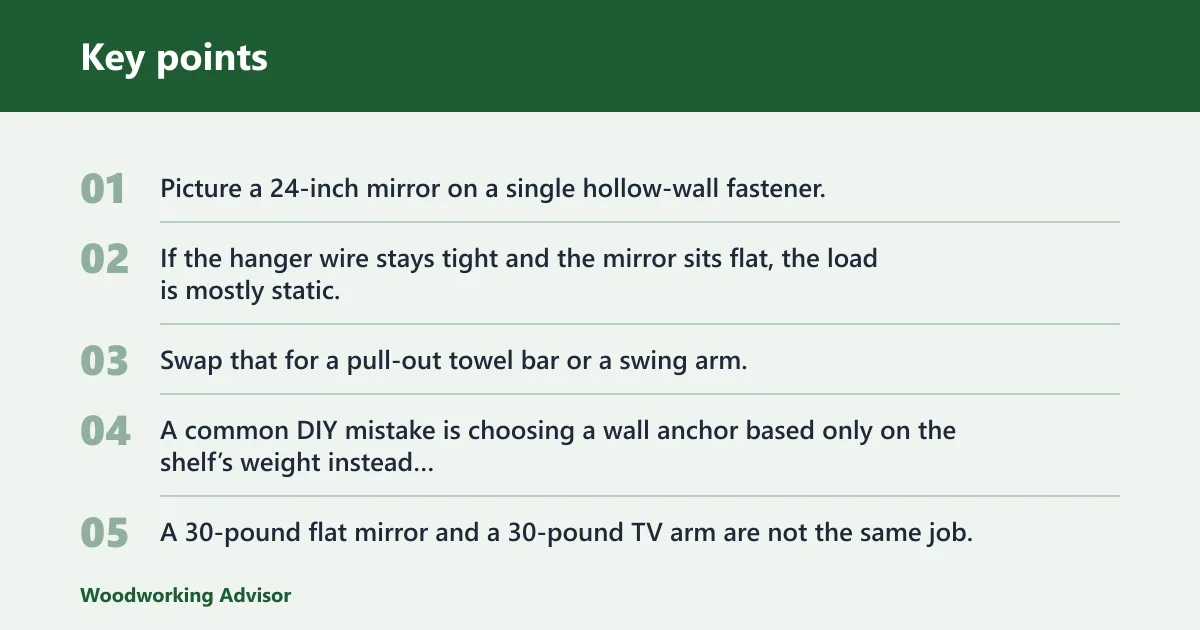
Picture a 24-inch mirror on a single hollow-wall fastener. If the hanger wire stays tight and the mirror sits flat, the load is mostly static. Swap that for a pull-out towel bar or a swing arm, and the fastener sees more pull and twist, which pushes the job toward a toggle bolt or a stud.
A common DIY mistake is choosing a wall anchor based only on the shelf’s weight instead of the drywall type and the load’s pull direction. A 30-pound flat mirror and a 30-pound TV arm are not the same job, because the arm creates a longer moment on the wall and can work the fastener loose.
Which holds more weight in drywall?
Toggle bolts usually hold more weight in drywall than wing anchors, but the exact figure depends on drywall thickness, bolt size, and the manufacturer’s listing. In 1/2-inch drywall, a 1/4-inch toggle can yield about 35-70 lbs allowable load. Those are not the same kind of number.
How drywall thickness affects ratings
Thicker drywall can change how the anchor spreads force behind the panel. That is why 3/8, 1/2, 5/8, and 3/4 inch board do not share one universal rating. A fastener that looks adequate on paper may lose margin once you move to thinner board or a damaged opening.
Use the wall thickness on the package or listing, not a guess. If the wall is unusual, damaged, layered, or patched, the published number is only a starting point.
Why package numbers are not directly comparable
One label may show allowable load, while another shows ultimate load. Those numbers are not interchangeable. A higher ultimate number does not mean you can safely hang that full amount as a working load.
Manufacturers also test differently, so even two 1/4-inch toggles can be rated in ways that are not directly comparable. Compare only like with like: same wall type, same thickness, same load direction, and the same kind of rating.
Load ratings explained
Published load ratings depend on manufacturer specs, wall thickness, and installation quality. The same anchor can behave very differently if the hole is off size, the board is damaged, or the load hangs on a bracket that adds extra pull. Good judgment starts with reading the rating correctly.
Tension vs. shear
Tension is a pull straight away from the wall. Shear is a load sliding down or across the wall face. A hook with a hanging bag may be closer to shear, while a bracket that tries to rip outward loads the anchor in tension.
| Term | Plain-English meaning |
|---|---|
| Tension | Pulling straight out from the wall |
| Shear | Load sliding along the wall surface |
| Ultimate load | The point where the anchor fails in a test, not the safe working number |
| Allowable load | The working load the manufacturer says to use |
| Safety factor | The extra margin between working load and failure so normal use has room for error |
Ultimate load vs. allowable load
Ultimate load is the failure point. Allowable load is the number you plan around in real use. If a spec sheet gives both, the allowable figure is the one that matters for choosing the fastener count and spacing.
That distinction matters even more with dynamic loads. A door slam, a bumped shelf, or a TV arm that gets moved side to side can push the fastener closer to failure than a still object of the same weight.
Hole size and installation fit
Toggle bolts need a hole that matches the package spec closely. Too small, and the wings may not open. Too large, and the anchor can spin or lose bearing.
What happens when the hole is too small or too large
If the opening is undersized, the wings can hang up before they fully deploy behind the wall. That leaves the fastener acting like an underseated anchor, which cuts holding power fast.
If the opening is oversized, the collar or wings may not grip cleanly. The fastener can spin while you tighten it, and the wall face may crumble around the opening. Once that happens, the published rating no longer means much.
- Measure the wall thickness and identify the wall material.
- Match the drill size to the package listing, not to a guess.
- Check that the anchor opens fully behind the wall.
- Stop if the hole is ragged, enlarged, or damaged.
- Rebuild the opening or move the fastener if the wall has failed around it.
Choose Toggle Bolts if… / Choose Wing Anchors if…
Choose Toggle Bolts if you need higher holding power in hollow walls, the item creates pull away from the wall, or the hardware will see real pull-out force. Choose Wing Anchors if the load is lighter, the wall callout fits the listing, and you want a smaller fastener for a simpler hole and easier cleanup.
Choose Toggle bolts if…
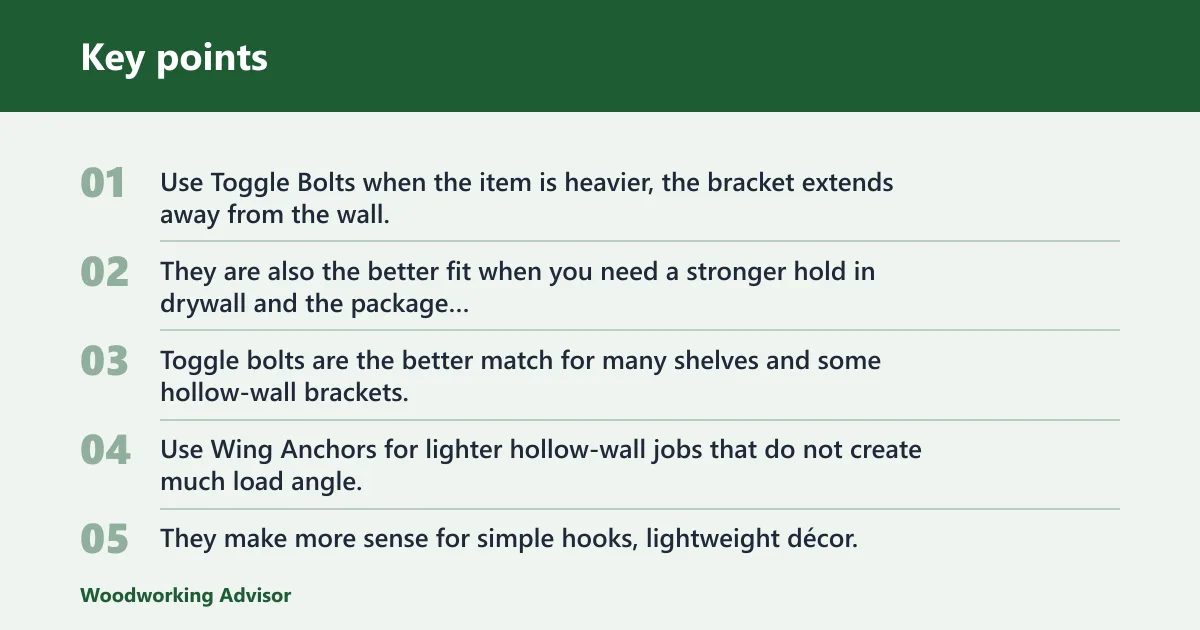
Use Toggle Bolts when the item is heavier, the bracket extends away from the wall, or the fastener must resist both shear and tension. They are also the better fit when you need a stronger hold in drywall and the package calls for a specific wall thickness that you can verify.
Toggle bolts are the better match for many shelves and some hollow-wall brackets, but they are not a substitute for a stud where the fixture maker requires one. Follow the fixture manual first.
Choose Wing Anchors if…
Use Wing Anchors for lighter hollow-wall jobs that do not create much load angle. They make more sense for simple hooks, lightweight décor, and situations where a smaller anchor is enough for the load and the wall type on the listing.
They stop making sense when the load gets heavier, the wall is questionable, or the item can swing, bump, or pull forward. At that point, a toggle bolt or a stud is the better choice.


Can you use them in plaster or hollow block?
Sometimes, but only if the exact anchor listing supports that wall material. Do not assume that a fastener made for drywall is automatically safe in plaster or hollow block. Suitability depends on the wall construction, the anchor design, and the manufacturer’s approved use.
When the wall material matters more than the fastener name
Plaster can crack, crumble, or separate from its backing, which changes how the anchor bears load. Hollow block and masonry units can also behave differently from drywall, so the wall cavity, face shell, and anchor type all matter.
Toggle bolts are presented as useful for wallboard, plaster, and concrete masonry units, but that does not erase the need to check the exact listing for your wall. If the package does not name your surface, do not guess.
Why you must check the exact listing
Brand and model matter. One heavy-duty hollow-wall fastener may be listed for drywall and concrete, while another only fits one wall type. The right answer is whatever the manufacturer says for that specific anchor, not what the family name suggests.
How to read manufacturer specs and product examples
Look for three things on the package or listing: the wall thickness, the load direction, and whether the number is allowable or ultimate. If those details are missing, treat the rating as incomplete and do not compare it against another product’s number as if the figures were equal.
How SNAPTOGGLE and TOGGLER are described in listings
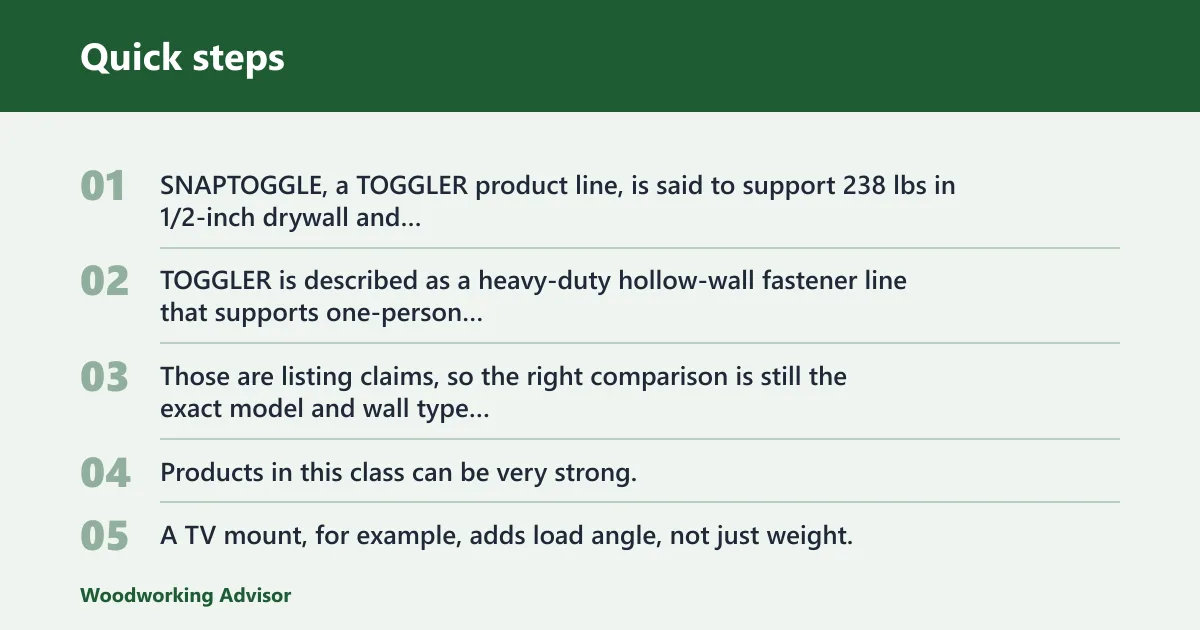
SNAPTOGGLE, a TOGGLER product line, is said to support 238 lbs in 1/2-inch drywall and 802 lbs in concrete. TOGGLER is described as a heavy-duty hollow-wall fastener line that supports one-person installation and is listed for drywall and concrete use. Those are listing claims, so the right comparison is still the exact model and wall type on the package.
Products in this class can be very strong, but the number only matters if it matches your wall and your fixture. A TV mount, for example, adds load angle, not just weight, so the mount maker’s instructions may require studs even when the anchor rating looks high enough.
How to compare specs safely
Start by matching wall type, then wall thickness, then load direction. If one product gives ultimate load and another gives allowable load, do not place them side by side as equal working numbers. Use the lower, clearly stated working rating when you are deciding how many fasteners to use.
Keep this in mind for repair work too. If you may need to remove the hardware later, a larger toggle hole can be more disruptive than a lighter wing anchor. In rentals, that removal tradeoff matters.
Say your mirror weighs about 18 pounds and hangs flat on a 1/2-inch drywall wall. A wing anchor may be enough if the listing supports that wall and the hanger stays static. For a shelf that sits about 8 inches off the wall, the added pull often points to a toggle bolt or, if the shelf design allows it, a stud.
Frequently asked questions
Which holds more weight, toggle bolts or wing anchors?
Toggle bolts usually hold more weight than wing anchors in drywall, especially when the load pulls away from the wall or sits on a bracket. Compare only the same wall thickness and the same kind of rating, because allowable and ultimate loads are not the same.
How much weight can a toggle bolt hold in drywall?
It depends on the bolt size, drywall thickness, and the manufacturer’s listing. One cited example is a 1/4-inch toggle in 1/2-inch drywall with about 35-70 lbs allowable load.
Are wing anchors strong enough for a TV mount?
Usually not the first choice. TV mounts create load angle, not just static weight, and many mount makers require studs or a listed alternative. If the mount manual allows hollow-wall use, follow that exact instruction. Do not rely on a wing anchor just because the TV itself is not very heavy.
What size toggle bolt should I use for drywall?
Match the bolt size and hole size to the package listing for your wall thickness and fixture. Bigger is not always better; a hole that is too large can make the anchor spin and lose grip.
Do I need a stud or can I use a toggle bolt?
Use a stud when the fixture maker requires one, especially for TVs and other loaded brackets. A toggle bolt is a strong hollow-wall option, but it does not replace a stud when the mount manual says studs are required. The manual beats the anchor’s rating every time.
What hole size do toggle bolts need?
The hole must match the package instructions exactly. If the hole is too small, the wings may not open; if it is too large, the anchor can spin or fail to seat properly.
Can toggle bolts be used in plaster or hollow block?
Only if the exact product listing includes that wall material. Toggle bolts are presented as useful for wallboard, plaster, and concrete masonry units, but that is not a blanket rule for every brand or model. Check the specific listing before you drill.
What is the difference between toggle bolts and wing toggles?
Toggle bolts use spring-loaded metal wings and a machine screw, and they are generally the stronger hollow-wall choice. Wing toggles are another wing-style hollow-wall anchor used in hollow walls. They are related, but you should follow the exact product listing, because the names are often used inconsistently.
Sponsored / affiliate links. As an Amazon Associate I earn from qualifying purchases. I may earn additional commission from eligible campaigns.