Carpenter Gloves for Winter
Choose carpenter gloves for winter by the job you do: light insulated gloves for dry indoor shop work, waterproof insulated gloves for wet exterior jobs, and thin grip gloves with liner options for fine-detail framing. Start with temperature band, moisture level, and task type. Pick the warmest pair only after you confirm you can still grip fasteners and operate a tape, knife, or nailer. This guide compares insulation, grip, water resistance, cuff style, and dexterity so you can match gloves to the work you actually do.
Top pick for winter carpentry
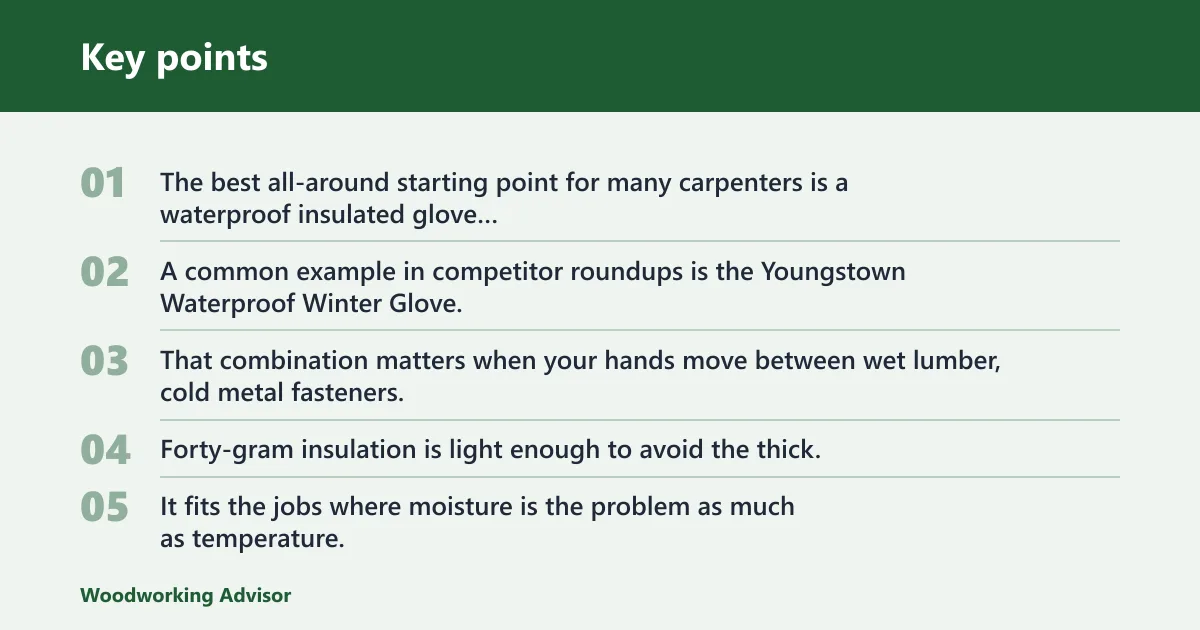


The best all-around starting point for many carpenters is a waterproof insulated glove with a low-bulk lining, because it covers cold, damp exterior work without shutting down grip or finger control. A common example in competitor roundups is the Youngstown Waterproof Winter Glove, which uses 40g 3M Thinsulate insulation and is described as waterproof and weatherproof.
Why this pick fits the use case
That combination matters when your hands move between wet lumber, cold metal fasteners, and brief tool handling. Forty-gram insulation is light enough to avoid the thick, mitten-like feel that slows nail setting, measuring, and knife work.
What it does well
It fits the jobs where moisture is the problem as much as temperature. Rain, sleet, snow, and damp material can soak a glove far faster than cold dry air can.
Where it falls short
It is not the warmest path for prolonged deep-cold work. If you need maximum heat retention and can tolerate less dexterity, heavier insulated options make more sense.
Quick picks by job and weather
- Dry indoor shop work: light insulated gloves or thin leather gloves with breathable backs. You get enough warmth for a cold shop without trapping sweat.
- Wet exterior work: fully waterproof insulated gloves with a longer cuff. This is the safest choice for rain, sleet, snow, and wet lumber.
- Fine-detail framing: thin grip gloves or open-finger framer gloves. You keep better fingertip feel for nails, pencils, and small fasteners.
- Mild cold with high dexterity: low-bulk insulated gloves, or liner-plus-shell systems when the shell is roomy enough to preserve movement.
Suppose you are framing in 28°F weather with dry studs and only occasional wind. A low-bulk insulated glove may be enough. If those same studs are wet from sleet, waterproofing moves to the top of the list.
Carpenter glove decision table
| Temperature band | Moisture level | Task type | Matched glove features |
|---|---|---|---|
| Above freezing to mid-30s F | Dry | Shop joinery, measuring, light fastening | Thin insulated glove, breathable back, snug cuff, strong fingertip feel |
| 20s F to low-30s F | Light dampness | Framing, layout, tool handling | Low-bulk insulation such as 40g Thinsulate, reinforced palm, secure wrist closure |
| Below freezing | Wet or snowy | Exterior siding, wet lumber, scaffold work | Fully waterproof shell, longer cuff, insulated lining, grip texture that still works when wet |
| Above freezing to low-40s F | Dry | Fine-detail framing, pencil marks, fasteners | Thin dexterity-first glove, minimal palm bulk, optional liner |
| Variable cold | Mixed | Short indoor-outdoor transitions | Breathable insulated glove with easy on-off cuff and enough room for a liner if needed |
What are the best carpenter gloves for winter?
The best winter carpenter gloves are the ones that match the job: waterproof insulated gloves for wet exterior work, low-bulk insulated gloves for framing, and thinner grip gloves for shop tasks. Glove Magazine’s point is worth keeping in mind here: carpentry gloves are not always the warmest gloves, so the right choice depends on dexterity as much as insulation.
Best for framing
Framing asks for quick fingertip work, nail control, pencil use, and hammer handling. EDC Magazine lists Mechanix Wear Leather M-Pact Framer Gloves as Top 1, and open fingertips are specifically called out as a dexterity feature for carpentry. That style helps in mild cold, but it is a poor answer for deep winter.
Best for exterior work
For wet jobs, choose a fully waterproof glove rather than a merely water-resistant one. Handy Manners highlights Toolant 100% Waterproof Gloves for wet cold environments, which is the right category when snow, sleet, wet framing lumber, or soaked tools are part of the day.
Best for shop tasks
For indoor winter shop work, a light insulated glove often beats a heavy winter glove. Dry conditions reduce the need for full waterproofing, and the goal shifts toward warmth without sweaty hands or lost tool feel.
How do you choose the right winter glove?
Start with temperature band, moisture level, and task type. Then check insulation, dexterity, grip, cuff length, and fit in that order. A glove that is warm enough but too stiff for nails or a knife will slow work and can be more frustrating than a thinner pair.
Insulation and warmth
Thinsulate is a common low-bulk insulation choice for winter work gloves. The 40g version used in the Youngstown glove is a lighter warmth option, while SLARMOR gloves use a 100-gram Thinsulate lining. Heavier insulation increases warmth, but it also tends to reduce feel and flexibility.
Dexterity and finger feel
Dexterity means you can still pick up fasteners, mark a board, and work a tape without pulling the glove off every few minutes. That matters most for framing, trim, and shop measurement. If the fingertips are so thick that you miss a nail head or fumble a pencil, the glove is too bulky for that task.
Grip, palm wear, and impact protection
Reinforced palms and palm patches help where hammering, tool handles, and repeated gripping wear through a glove first. Impact protection, often built with TPR or padding, helps during rough framing, but it adds bulk. That tradeoff is real: more protection usually means less fingertip control.
Wrist and cuff design
Longer cuffs block wind, debris, and some heat loss at the wrist. Secure closures help keep the glove in place without pinching. A snug fit should feel close, not tight; if the cuff or wrist band restricts circulation, the glove can feel colder even if the insulation is good.
Fit and liner layering
Can you wear liner gloves under carpenter gloves? Yes, but only if the outer glove has enough room to keep your fingers from compressing together. The system fails when the shell becomes too tight, which reduces circulation, cuts dexterity, and can make the hand feel colder instead of warmer.
Which materials work best in cold weather?
Full-grain cowhide is a strong choice for abrasion resistance, especially in carpenter and framer gloves. Toolant Winter Leather Work Gloves use full-grain cowhide and a warm Thinsulate lining, which is a useful combination when durability and moderate warmth both matter. The tradeoff is break-in time and reduced flexibility at first.
Leather shell pros and cons
Leather shells handle abrasion well and hold up to repeated tool contact. They can feel stiff in subfreezing weather, though, and stiff leather makes trigger work, fastener handling, and tape use harder. A leather glove that has not broken in may also feel tighter than its labeled size suggests.
Synthetic shells and membranes
Synthetic shells often dry faster and can be lighter than leather. When paired with a waterproof membrane or insert, they can do better in rain and sleet than untreated leather. SLARMOR gloves, for example, pair a 100-gram Thinsulate lining with a TPU waterproof layer.
Thinsulate and other low-bulk insulation
Thinsulate is useful because it adds warmth without the bulk of thick lofted linings. That is why it appears so often in winter carpenter gloves. The practical result is simple: you get better warmth than an unlined glove, but you keep more hand movement than you would with a heavily padded winter glove.
Palm patches and reinforcements
Palm patches matter when the glove sees repeated hammering, carrying, and ladder work. They improve grip and delay wear in the high-friction area of the hand. If your glove usually fails at the palm before the fingers, this feature should move up your list.
A common first-timer mistake is buying a glove for the coldest morning and ignoring the rest of the shift. A waterproof, insulated glove can feel perfect at 6:30 a.m., then sweaty and stiff by midday if the work moves indoors or becomes high-output framing.
Are insulated gloves too bulky for carpentry?
No. Some insulated gloves are too bulky, but low-bulk insulation can work well for carpentry. The key is choosing the lightest insulation that still covers your actual temperature band. Forty-gram Thinsulate is far easier to use for carpentry than a heavily padded glove designed mainly for stationary cold.
Bulk becomes a problem when you lose tactile control. If you cannot feel a screw head, can’t judge pencil pressure, or struggle to close your hand around a tape, the glove is overbuilt for the task. For many carpenters, moderate insulation is the better answer.
Do winter work gloves still give enough dexterity for carpentry?
Yes, if you choose for the task and not just for warmth. Winter work gloves can preserve enough dexterity for fastening, measuring, and tool handling when they use low-bulk insulation, a close fit, and a palm that bends easily. That said, no insulated glove feels as free as a bare hand.
For fine work, choose thinner shells, open-finger designs where weather allows, or liner-plus-shell systems. For rough framing in real cold, accept some dexterity loss in exchange for warmth and protection. The wrong glove is the one that forces constant removal.
Should carpenter gloves be waterproof or water-resistant in winter?
Choose waterproof gloves for rain, sleet, snow, wet lumber, and soaked surfaces. Choose water-resistant gloves only when moisture is occasional and brief. The difference matters because water-resistant gloves may shed light spray, but they will not hold up the same way once insulation gets saturated.
That is where breathable membranes or waterproof inserts help. They keep external moisture out while trying to limit internal sweat buildup. The limit is important: if your hands sweat heavily, even a waterproof glove can become cold from the inside.
Can I wear liner gloves under carpenter gloves?
Yes, but only when the shell is sized to accept the extra layer without choking circulation. Liner gloves work best in dry cold, mild moisture, or jobs with frequent glove removal. They are less useful when the shell already fits snugly or when tasks demand high fingertip accuracy.
If the outer glove is too tight over the liner, warmth drops. The hand cannot move blood as freely, and the liner may bunch at the fingertips. That is a fast route to cold hands and poor control.
How do you choose the right size for winter work gloves?
Choose the smallest size that still allows full finger extension, a closed fist, and easy thumb movement. The glove should feel close at the fingers and palm without pinching at the wrist. Winter gloves that are too tight reduce circulation; gloves that are too loose slip, rotate, and weaken grip.
- Put the glove on over any liner you plan to use.
- Open and close your hand several times.
- Check fingertip length with a pencil grip and a closed fist.
- Test wrist closure and cuff overlap with your jacket sleeve.
- Confirm you can still pick up a small fastener without overgripping.
What gloves work best for framing in cold weather?
Framing usually favors dexterity-first gloves with reinforced palms and only as much insulation as the temperature requires. Open-finger framer gloves can help with nails, pencils, and fasteners, but they are best in mild cold or indoor work. For colder exterior framing, move to a thin insulated glove instead.
Impact protection can help if hammer strikes and rough handling are constant. Just remember that TPR and padding add bulk. If the glove becomes too stiff to handle a nail or pencil cleanly, the protection is costing too much.
What is the warmest winter work glove for carpentry?
The warmest glove is not automatically the best carpentry glove. Heavier insulated winter gloves, including wool mitten-style options like the Ironclad cold-condition glove with four layers of 150 grams of insulation, will usually hold more heat than low-bulk carpenter gloves. But they often give up too much dexterity for actual carpentry.
Use that kind of glove for colder, slower work where hand precision matters less. For active carpentry, choose the warmest glove that still lets you grip, measure, and fasten without constant removal.
Are open-finger carpenter gloves usable in winter?
They are usable only in mild cold or indoor work. Open fingertips improve dexterity for carpentry, and that is why they remain popular for framing tasks. They are a poor choice for deep winter, wet weather, or prolonged outdoor exposure because exposed fingertips lose heat quickly.
If you want that style in winter, treat it as a specialty option. Use it when the job demands precision more than warmth, or when you can move between heated spaces and short outdoor tasks. For serious cold, cover the fingertips.
Frequently asked questions
What material is best for cold-weather carpenter gloves?
Full-grain cowhide is a strong choice for abrasion resistance, while synthetic shells can dry faster and work well with waterproof membranes. For cold weather, the best material is the one that fits your moisture level, grip need, and tolerance for break-in stiffness.
Sponsored / affiliate links. As an Amazon Associate I earn from qualifying purchases. I may earn additional commission from eligible campaigns.