Power Tool Batteries in a Cold Garage
Store cordless-tool batteries indoors, not in an unheated garage, and charge them only after they warm to at least about 40°F; if a pack is below freezing, let it sit inside until it reaches room temperature. Cold reduces runtime, can trigger charger lockouts, and adds wear that shortens pack life. This guide gives a simple winter workflow for storage, charging, warming, and first-use timing in a garage shop.
Power tool batteries decision table
Use the garage only when the cold spell is short and mild. For long storage, move packs to a temperature-controlled indoor space such as a basement or utility room. The rule is simple: the colder and longer the spell, the less the garage should be part of the workflow.
| Winter condition | Where to store batteries | When to charge them | When to warm them before use |
|---|---|---|---|
| Mild cold, above-freezing nights | Garage is acceptable for short stays if the space stays dry and above freezing most of the time; an insulated cabinet can help buffer swings. | Charge indoors at room temperature whenever possible, then return packs to the garage only after they are full and cool. | Warm only if the pack feels cold-soaked or the charger refuses it. |
| Freezing nights | Move packs indoors overnight. Do not leave them in an unheated garage through repeated freezes and thaws. | Charge in a temperature-controlled indoor space, not in the garage, if the pack has spent the night near freezing. | Warm to room temperature before charging or heavy use. |
| Prolonged subfreezing spells | Keep packs inside a basement or utility room for the whole spell. Do not rely on the garage for storage. | Charge only after the battery has warmed to about room temperature and is dry. | Always warm before use. A cold-start pack may run, but runtime and output drop fast. |
A practical setup is a winter bin near the basement stairs or in a utility room. Keep charged packs together, drained packs together, and wet gear somewhere else. That keeps the charging workflow clear when you need a saw, drill, or sander quickly.
What cold does to lithium-ion packs
Lithium-ion battery packs are the most common cordless-tool batteries, and cold slows the chemical reactions that deliver power. Runtime drops first, then output. Extreme cold below freezing can also reduce longevity, even when the pack seems to recover after warming.
Why runtime drops before damage is obvious
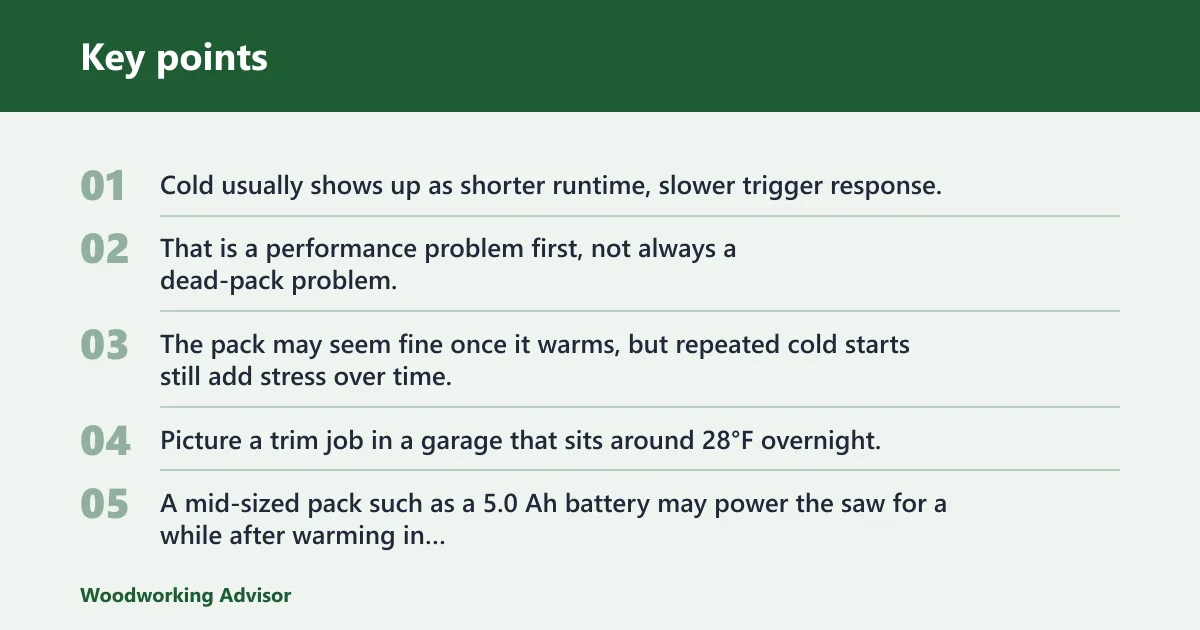
Cold usually shows up as shorter runtime, slower trigger response, and earlier low-power cutoff. That is a performance problem first, not always a dead-pack problem. The pack may seem fine once it warms, but repeated cold starts still add stress over time.
Picture a trim job in a garage that sits around 28°F overnight. A mid-sized pack such as a 5.0 Ah battery may power the saw for a while after warming in the tool, but a cold-start pack can feel weak within minutes. The issue is the cold chemical slowdown, not an instant failure.
Why charging a cold pack is the bigger risk
Charging should happen near room temperature, roughly 65°F to 75°F. Charging below 40°F is discouraged, and charging above 104°F is also discouraged. Manufacturer lockouts often stop a cold pack from accepting a charge, which is safer than forcing the issue.
That is why a cold garage is a poor charging location. A pack that just came in from freezing conditions should warm first, then charge on the manufacturer-approved charger. Do not leave it on the charger after it is full.
What temperature limits matter most
For storage, DeWalt recommends avoiding temperatures below 32°F for extended periods. Bob Vila lists about 50°F to 85°F as a best storage range, while ManMadeDIY puts temperature-controlled storage around 50°F to 80°F. Those ranges point in the same direction: cool, dry, and above freezing.
For long-term storage, a partial state of charge is best. The same source recommends about 50 percent charge, and ManMadeDIY gives a range of 40% to 60% charged. Avoid storing packs fully charged for long periods.
Can you leave batteries in a cold garage?
You can leave cordless-tool batteries in a cold garage for a short stretch if the space stays only mildly cold and dry, but that is not the best winter routine. Repeated freezing nights, moisture, and temperature swings make the garage a poor long-term storage spot.
Garage-safe conditions versus long freezes
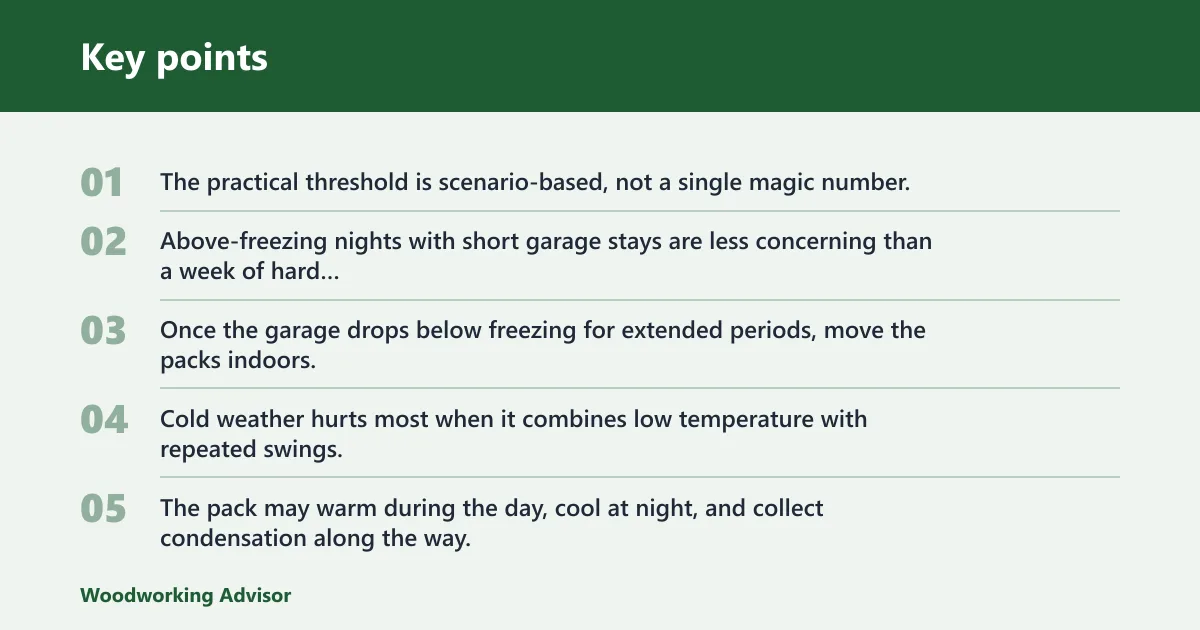
The practical threshold is scenario-based, not a single magic number. Above-freezing nights with short garage stays are less concerning than a week of hard freezes. Once the garage drops below freezing for extended periods, move the packs indoors.
Cold weather hurts most when it combines low temperature with repeated swings. The pack may warm during the day, cool at night, and collect condensation along the way. That cycle matters as much as the temperature itself.
When an insulated cabinet helps
An insulated storage box or cabinet can buffer a cold snap in a garage. It is useful when you need a little thermal moderation, but it is not climate control. Use it as a cushion, not as a replacement for indoor storage during extended freezes.
If your garage is only a few degrees below freezing for a night or two, an insulated cabinet may reduce the swing enough to protect the pack better than open shelving. It still should not be the default for a deep-freeze week.
When the pack should move indoors
Move batteries indoors when freezing nights become the pattern, not the exception. Bring them inside before the garage starts running below 32°F for long stretches. The safest long-term answer is a temperature-controlled indoor space such as a basement or utility room.
A common first-timer mistake is leaving a pair of 18V packs on a garage shelf through a winter cold snap, then grabbing one for a quick drill job. The pack may still work, but it starts the day cold, and the charger may refuse it later if you try to top it off too soon.
What is the best winter storage location?
The best place to store power tool batteries in winter is a stable indoor space, not an unheated garage. A basement or utility room is usually better because the temperature stays closer to the safe storage range and the packs avoid hard swings and moisture.
Basement and utility room advantages
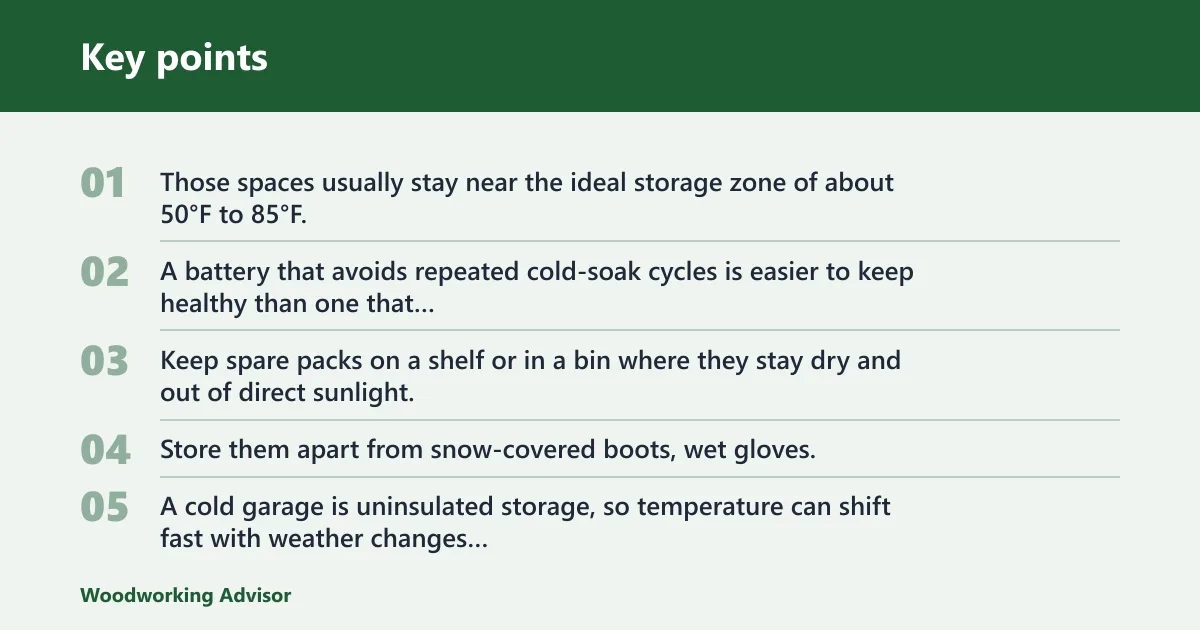
Those spaces usually stay near the ideal storage zone of about 50°F to 85°F, or at least above freezing. That stability matters. A battery that avoids repeated cold-soak cycles is easier to keep healthy than one that moves between freezing air and warm indoor air every day.
Keep spare packs on a shelf or in a bin where they stay dry and out of direct sunlight. Store them apart from snow-covered boots, wet gloves, or anything that can drip onto the terminals.
Why stable indoor temperatures beat garage swings
A cold garage is uninsulated storage, so temperature can shift fast with weather changes and door openings. Those swings create moisture risk, and moisture is bad news for terminals and circuitry. The pack does not need to be soaked to suffer; condensation is enough to cause trouble.
Stability also helps with charge planning. You know where the pack is, you know its temperature, and you can charge it safely before a job instead of waiting on a cold-start recovery.
Where to keep chargers and spare packs
Keep the charger with the batteries in the same indoor storage area if possible. That makes the winter routine cleaner: warm pack, approved charger, full charge, then tool use. Do not leave the charger plugged in with a battery sitting on it after the pack is full.
If the garage is your only work space, you can stage the charger there for active use, but the batteries themselves should spend the night indoors during freezing weather. That split setup keeps the workflow practical without treating the garage like climate control.
How cold is too cold?
For storage, below 32°F is the line where extended exposure becomes a problem. For charging, below 40°F is discouraged. In practice, that means a battery can be too cold to charge even if it is not yet damaged, and it should be warmed first.
Below-freezing storage versus below-freezing charging
Below-freezing storage is a long-term aging concern, especially when it repeats. Below-freezing charging is a short-term safety and performance concern. The first hurts longevity; the second can trigger lockouts or internal damage if you force it.
That distinction matters in winter shop routines. A pack left in a subfreezing garage overnight may still be usable after warming. It should not be charged right away while cold.
Practical thresholds for the garage workflow
If nights are just near freezing and the garage is dry, you can sometimes leave packs there for a short time. If the garage is below freezing most nights, move them inside. If the spell is deep and long, treat the garage as a tool storage area, not a battery storage area.
Moisture changes the calculation too. Wet batteries can degrade circuitry, and cold can make the battery casing brittle, so snow, rain, and slush are part of the problem, not side issues.
What to do during deep-freeze weeks
During prolonged subfreezing spells, keep batteries indoors, charge them indoors, and stage them near the work area only when needed. Warm them to room temperature before charging or heavy use. That is the cleanest winter routine for cordless tools.
Do not try to fix a cold pack by putting it straight on the charger in the garage. If the charger accepts it at all, charging while cold can create damage you do not see right away.
Charging cold batteries safely
Warm the pack before charging. That is the main rule. Use the manufacturer-approved charger only, charge near room temperature, and do not leave the battery on the charger after it reaches full charge.
Warm the pack before charging
Let a cold battery reach room temperature before use or charging. If it came from a freezing garage, bring it into a temperature-controlled indoor space and give it time to warm naturally. Do not use heat guns, ovens, or direct heaters.
If the pack feels cold to the touch, it is too cold for charging. A simple check is to wait until the pack no longer feels chilled and the surrounding air is in the normal indoor range.
Use the approved charger only
Wrong chargers can damage or rupture a pack. Use the charger that matches the battery system. That matters more in winter because a cold pack is already under stress, and the charger has to respect the battery-management limits built into the system.
Do not bypass a charger lockout by warming the pack unevenly or forcing contact. Let the battery warm properly, then charge it the normal way.
Avoid leaving a full pack on the charger
Once the pack is full, remove it. Leaving batteries on the charger is not a good storage plan, especially in winter when packs may cycle between charging, cooling, and being moved back into cold spaces.
Suppose you charge a pack at 7 p.m. in a warm utility room and do not need it until the next day. Remove it once full, then store it at partial charge in the same indoor space. That reduces unnecessary time at full charge.
Moisture, corrosion, and condensation
Dry batteries last longer. Snow, rain, puddles, and condensation can cause corrosion or electrical problems, especially at the terminals. A cold garage increases that risk because warm indoor air and cold pack surfaces can create moisture on contact.
Why wet terminals are a problem
Terminals carry current, so any moisture there is a problem. Wet contact points can corrode, confuse the charger, or create intermittent electrical issues. The pack does not have to be submerged for trouble to start.
Inspect the terminals before charging. If you see moisture, dry the pack first and let it warm in a dry indoor space. Never charge a damp battery.
How snow, puddles, and slush create risk
Winter floors add hidden risk. A pack set on a bench near slush from boots or on a concrete slab with puddles nearby can pick up moisture fast. That is one reason an elevated indoor shelf is better than a garage floor or a low shelf near the door.
Keep batteries away from the path where wet boots, snowblowers, and outside gear come in. A dry storage spot is part of battery care, not an extra step.
Drying and inspection before storage or charging
Before you store or charge a battery, check for visible water, condensation, or dirt at the terminals and seams. Wipe away moisture with a dry cloth and let the pack sit indoors until dry and warm. Do not seal a damp battery in a box.
If a pack was left in a cold garage overnight and then brought into a warm room, give it time to dry as it warms. That prevents condensation from sitting on the pack or collecting at the terminals.
Frequently asked questions
Can you leave power tool batteries in the cold?
You can leave them in a cold garage for a short time if the space stays only mildly cold and dry, but it is not the best winter practice. Repeated freezing nights, moisture, and swings make indoor storage the safer long-term choice for lithium-ion packs.
Is it bad to leave power tool batteries in the cold?
Yes, if the cold is repeated or prolonged. Below-freezing storage can reduce performance and longevity, and charging a cold pack is the bigger risk. Short exposure is less serious than long, repeated cold-soaks, but it still adds wear when it becomes a routine.
Can power tools be stored in a cold garage?
The tools themselves can usually sit in a cold garage, but the batteries need more care than the bare tool. Store the packs indoors when freezing weather lasts. A cold tool is inconvenient; a cold battery can lose runtime and resist charging until it warms.
How cold is too cold for power tool batteries?
For storage, below 32°F for extended periods is too cold. For charging, avoid below 40°F, and aim for charging around 65°F to 75°F. If a battery spent the night in freezing air, warm it before charging or heavy use.
Should I bring tool batteries inside overnight in winter?
Yes, if the garage drops below freezing or will do so repeatedly. An indoor space with steady winter temperatures is better for long-term storage. If nights are only mild and brief, short garage stays are less of a problem, but indoor storage is still the safer default.
Can I charge a cold lithium-ion battery in the garage?
No, not if it is cold-soaked. Charging should happen near room temperature, and charging below 40°F is discouraged. Bring the pack inside, let it warm, then use the manufacturer-approved charger. That avoids charger lockout and reduces the chance of internal damage.
Will freezing temperatures permanently damage cordless tool batteries?
Not always from a single cold night, but repeated freezing temperatures can reduce performance and longevity. The bigger danger is repeated cold exposure plus cold charging. If you warm the pack before use and charge it in a suitable temperature range, you lower the risk a lot.
What is the best place to store power tool batteries in winter?
A basement or utility room is usually the best choice because it stays more stable than an unheated garage. Keep batteries around 40% to 60% charged for long-term storage, dry, and away from direct sunlight. That gives lithium-ion packs the best winter conditions.
Sponsored / affiliate links. As an Amazon Associate I earn from qualifying purchases. I may earn additional commission from eligible campaigns.