Chicago Electric Miter Saw Parts: Model Number & Arbor Size Guide
A Chicago Electric miter saw from Harbor Freight is only as good as its weakest part. Whether the blade guard is cracked, the brushes are worn, or the motor has power but won’t spin the blade, most repairs come down to matching the right part to your exact model number. This guide covers where to actually find those parts, what arbor size your saw uses, when a universal part works and when it doesn’t, and how to troubleshoot the issues that send most people searching in the first place.
Start With Your Model Number, Not the Part Name
Harbor Freight has sold Chicago Electric miter saws under dozens of model numbers over the years – 10-inch and 12-inch, compound and sliding compound, single-bevel and double-bevel. Two saws that look identical from across the garage can use different blade guards, motor mounts, and arbor sizes. Before you order anything, find the model number on the nameplate, usually riveted or stamped near the base of the saw or on the motor housing. Harbor Freight’s own parts lookup tool uses that number to pull an exploded diagram with every component keyed to its own part code – which is why the part numbers people search for look like alphanumeric strings rather than plain English (a link plate listed as MK345605-2 is a real example of that format). That code is specific to one model’s diagram, so don’t assume it fits a different saw just because the parts look similar in a photo.
Universal Replacement Blade Pick
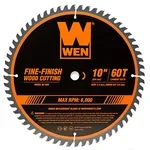 |
WEN BL1060 10″ 60-Tooth Carbide Blade – $18.54 A 5/8-inch arbor is the standard fit on most 10-inch Chicago Electric miter saws, which makes this blade a safe universal swap when the OEM blade is dull, chipped, or missing.
|
Common Parts That Wear Out First
Regardless of the exact model, the same handful of parts fail most often on a Chicago Electric miter saw:
- Blade: Dulls or chips faster when cutting hardwood, MDF, or anything with embedded nails. Most 10-inch models take a 5/8″ arbor blade; most 12-inch models take a 1″ arbor blade.
- Carbon brushes: These conduct current to the motor and are a wear item by design – they’re meant to be replaced, not repaired.
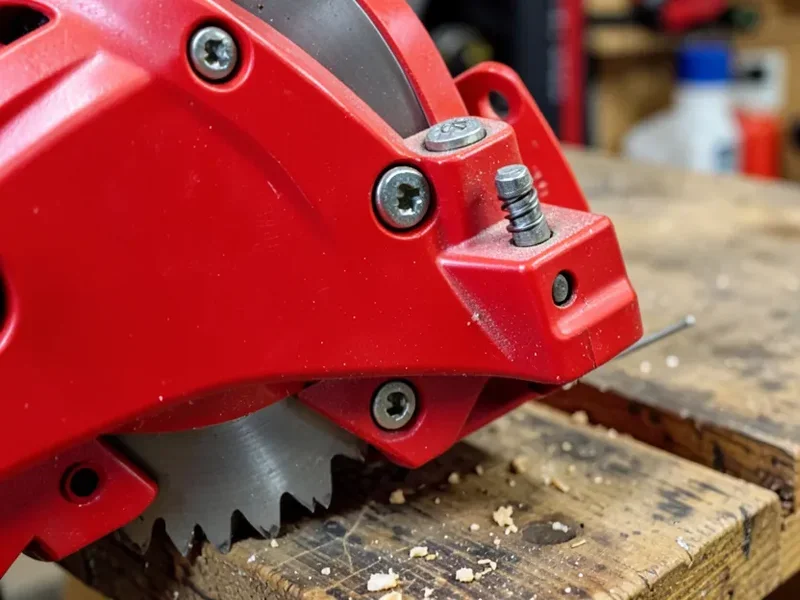
- Blade guard: The spring-loaded lower guard cracks or binds with sawdust buildup and repeated impacts.
- Drive belt (belt-driven models only): Stretches and glazes over with heavy use, causing slipping and inconsistent cut speed.
- Fence: Can warp or shift out of square, especially on saws stored in a hot garage or shed.
- Trigger switch and cord: Repeated flexing at the strain relief is the most common failure point on the cord.
| Part | Function | Signs It Needs Replacing |
|---|---|---|
| Blade | Cuts the material | Dull, chipped teeth, or burning the wood |
| Carbon brushes | Carries current to the motor | Losing power, motor stuttering, blue sparking |
| Blade guard | Covers the blade when not cutting | Cracked, binding, or won’t fully retract |
| Drive belt | Transfers motor power to the arbor | Squealing, slipping, uneven cut speed |
| Fence | Squares the workpiece to the blade | Out-of-square cuts, visible warping |
| Switch/cord | Controls and delivers power | Frayed insulation, intermittent power |
What Arbor Size Does a Chicago Electric Miter Saw Use?
This is one of the most common questions people search before buying a blade, and the honest answer is: it depends on the blade diameter, not the brand. Across the miter saw industry – Chicago Electric included – a 5/8-inch arbor is the standard on nearly every 10-inch corded miter saw, and a 1-inch arbor is standard on nearly every 12-inch model. That holds for most of the 619-70 series and similar 10-inch Chicago Electric saws people ask about. But “nearly every” isn’t “every” – before you order a blade, check the arbor size stamped on the blade guard’s inner plate or on the old blade itself, since a handful of older or imported models deviate from the standard. If you can’t find a stamp, measure the center hole of the blade currently installed rather than guessing from the saw’s model number alone.
Where to Actually Buy the Parts
Since Chicago Electric is Harbor Freight’s in-house brand, their own parts department is the first stop, not a last resort:
- Harbor Freight’s parts lookup: Search your exact model number on their site to pull the diagram and order OEM parts directly, or bring the model number to a store counter and have an associate check it.
- Amazon and eBay: Good for universal blades and generic brushes; always cross-check the listed arbor size and brush dimensions against your saw before buying, since “universal” doesn’t mean “guaranteed fit.”
- Aftermarket parts suppliers: Sites that specialize in power-tool parts often carry brushes, switches, and belts for discontinued Chicago Electric models that Harbor Freight no longer stocks.
- Local tool repair shops: Worth a call for belts, switches, or a blade guard hinge assembly that’s hard to source online – many shops keep a stock of common wear parts.
Replacing Carbon Brushes
- Unplug the saw before doing anything else.
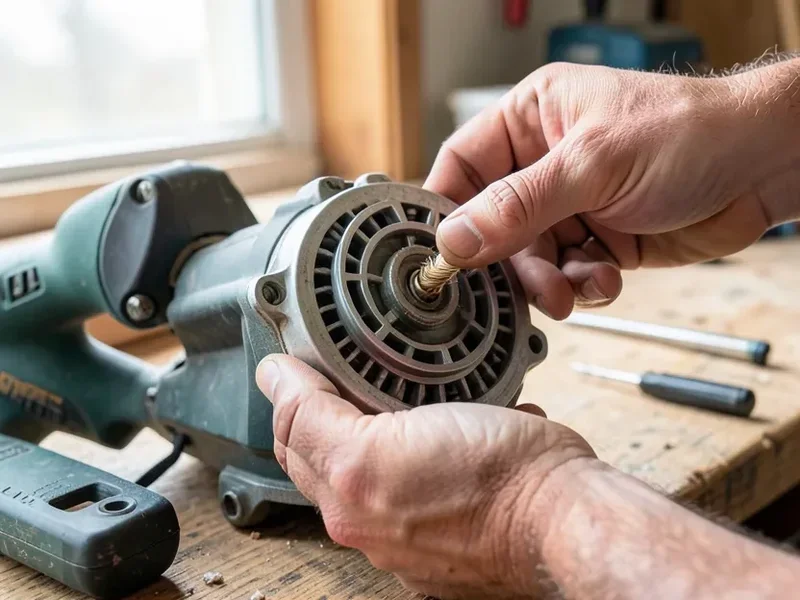
- Locate the brush caps on the motor housing – usually two round plastic caps opposite each other.
- Unscrew the caps by hand or with a flathead screwdriver.
- Pull out the old brushes; if either is worn down to less than a quarter-inch of carbon, replace both as a pair, even if only one looks worn.
- Insert the new brushes in the same orientation and thread the caps back in snugly – don’t overtighten the plastic caps.
- Plug in and test under no load before cutting anything.
Replacing the Blade Guard
- Unplug the saw and remove the blade if it’s easier to access the guard’s mounting bolts with it out.
- Remove the mounting bolts and the spring that returns the guard to its closed position – note how the spring is tensioned before you take it off.
- Align the new guard with the mounting holes and reinstall the spring in the same orientation.
- Tighten the mounting bolts, then cycle the guard by hand several times to confirm it opens and snaps closed on its own.
- Reinstall the blade and do a final check that the guard fully covers the teeth at rest.
If Harbor Freight’s parts page shows “no longer available” for your exact model’s guard – a real issue on some older, discontinued models – a few options still work: call Harbor Freight customer service directly, since some discontinued-part listings online aren’t fully current with what a store or warehouse still has in stock; check aftermarket power-tool parts suppliers, which sometimes carry guards for older Chicago Electric models after Harbor Freight stops; or source a guard from a nearly identical Chicago Electric model in the same size and bevel class, since Harbor Freight has reused housings and guard designs across several model numbers over the years. Don’t run the saw without a working guard while you wait – that’s not a corner worth cutting.
Are Universal or Aftermarket Parts a Good Option?
It depends on the part. For blades, a universal blade with the correct arbor size and diameter is genuinely a good option – blade geometry is standardized enough across brands that a quality aftermarket blade performs the same as OEM. For carbon brushes, aftermarket works fine as long as the dimensions (length, width, spring tension) match the original. Where universal parts get risky is anything load-bearing or safety-related: a blade guard, an arbor bolt, or a switch assembly that isn’t an exact match can create a fit or safety issue that isn’t obvious until the saw is running. When in doubt on a safety part, spend the extra few dollars on the OEM or a verified-fit replacement rather than a generic one.
Troubleshooting: Motor Has Power But the Blade Won’t Spin
This is a specific and fairly common complaint – the motor hums or runs, but the blade doesn’t turn, or turns weakly. A few likely causes, roughly in order of how often they show up:
- Worn carbon brushes not seating properly: a brush can be worn enough to lose consistent contact without being worn down completely – replace both brushes as a pair before assuming it’s something bigger.
- Tripped thermal overload: some motors have a built-in thermal cutout that lets the motor spin with reduced power (or cuts torque) after overheating, and resets once the motor cools for 15-30 minutes.
- Slipping or damaged drive belt: on belt-driven models, a glazed or loose belt lets the motor spin freely without turning the arbor.
- Stripped gear or worn coupling: on direct-drive models, internal gear wear can let the motor run without fully engaging the arbor – this usually needs a repair shop to confirm.
On the related question of swapping in a different brand’s motor, like a DeWalt motor, into a Chicago Electric saw: it’s not a straightforward bolt-in fix. Motor mounting bolt patterns, shaft diameter, gear housing shape, and the arbor coupling all vary between manufacturers, so a motor from a different brand typically won’t line up with the existing mounts and gear train even if the voltage and amperage specs look similar on paper. It’s not impossible for someone with machining or fabrication skills to make it work, but for most people it’s more practical – and safer – to source a replacement motor built for that exact saw, or have a repair shop assess whether the existing motor can be rebuilt. If a motor rebuild and other repairs are stacking up in cost, it’s worth comparing that total against a new saw – see our Chicago Electric vs. DeWalt miter saw comparison for what an upgrade actually buys you.
Maintenance That Prevents Most of These Failures
- Clear sawdust after every use: compressed air through the motor vents and around the blade guard hinge prevents the overheating and binding that causes half of these repairs.
- Inspect the blade before each project: a dull blade forces the motor to work harder, which accelerates brush wear.
- Lubricate the slide rails and pivot points every few months with a light machine oil.
- Store it dry and covered, and remove the blade for long-term storage to prevent rust on the arbor.
- Check the cord and switch periodically for fraying, especially near the strain relief where the cord exits the housing.
Safety Notes for Any Repair
- Always unplug the saw before opening the motor housing or touching the blade – don’t rely on the switch being off.
- Wear eye protection any time you’re handling the blade, even when it’s not spinning.
- Never operate the saw with the blade guard removed or disabled, even temporarily to “just make one cut.”
- After any repair, test the saw’s full range of motion and the guard’s return action by hand before plugging it back in.
Most Chicago Electric miter saw problems come down to a handful of wear parts, and most of those are cheap and straightforward to replace once you know your exact model number and arbor size. Start there, buy from a source that matches those specs, and the saw should be back to clean, square cuts the same day.
FAQs
Where can I find Chicago Electric miter saw parts?
Start with Harbor Freight’s own parts lookup using your saw’s exact model number – it pulls an exploded diagram with OEM part codes. Amazon and eBay carry universal blades and generic brushes, and aftermarket power-tool parts suppliers often stock parts for discontinued models. Local tool repair shops are a good backup for belts and switches.
What arbor size does a Chicago Electric miter saw use?
Most 10-inch Chicago Electric miter saws use a 5/8-inch arbor, and most 12-inch models use a 1-inch arbor – this follows the industry standard rather than being brand-specific. Confirm by checking the stamp on the blade guard’s inner plate or measuring your current blade’s center hole before ordering.
Can I put a DeWalt motor in a Chicago Electric miter saw?
Not as a direct bolt-in swap. Mounting bolt patterns, shaft diameter, and gear housing shape differ between brands, so a DeWalt motor generally won’t line up with a Chicago Electric saw’s existing mounts and gear train. It’s more practical to source a replacement motor built for your exact model or have a repair shop rebuild the original.
Why does my saw have power but the blade won’t spin?
The most common causes are worn carbon brushes not making full contact, a tripped thermal overload that needs time to cool and reset, a slipping or glazed drive belt on belt-driven models, or a stripped gear/coupling on direct-drive models. Start with the brushes, since they’re the cheapest and easiest to check.
Can I use universal or aftermarket parts on my Chicago Electric miter saw?
Yes for blades and brushes, as long as the dimensions match – blade geometry and brush sizing are standardized enough across brands. Be more cautious with safety-related parts like the blade guard, arbor bolt, or switch assembly, where an imperfect fit is riskier and OEM or a verified-fit replacement is worth the extra cost.
How do I find my saw’s model number?
Check the nameplate near the base of the saw or on the motor housing – it’s usually stamped or riveted on. Have this number ready before contacting Harbor Freight or searching for parts online, since saws that look identical can use different blade, guard, and motor specs.
Sponsored / affiliate links. As an Amazon Associate I earn from qualifying purchases. I may earn additional commission from eligible campaigns.