What Is a Miter Saw Machine? How It Cuts and Works
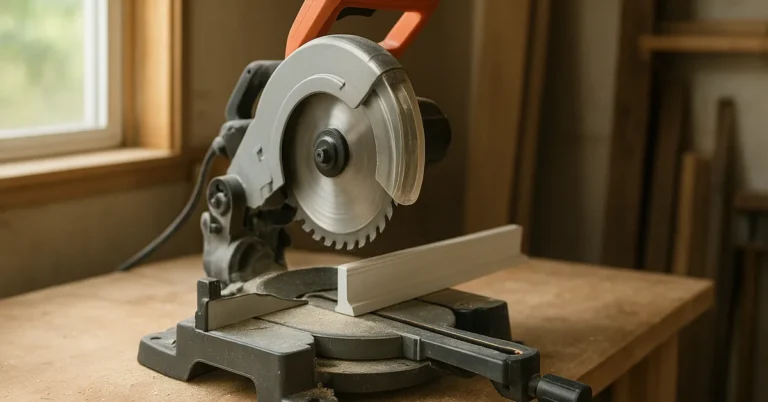
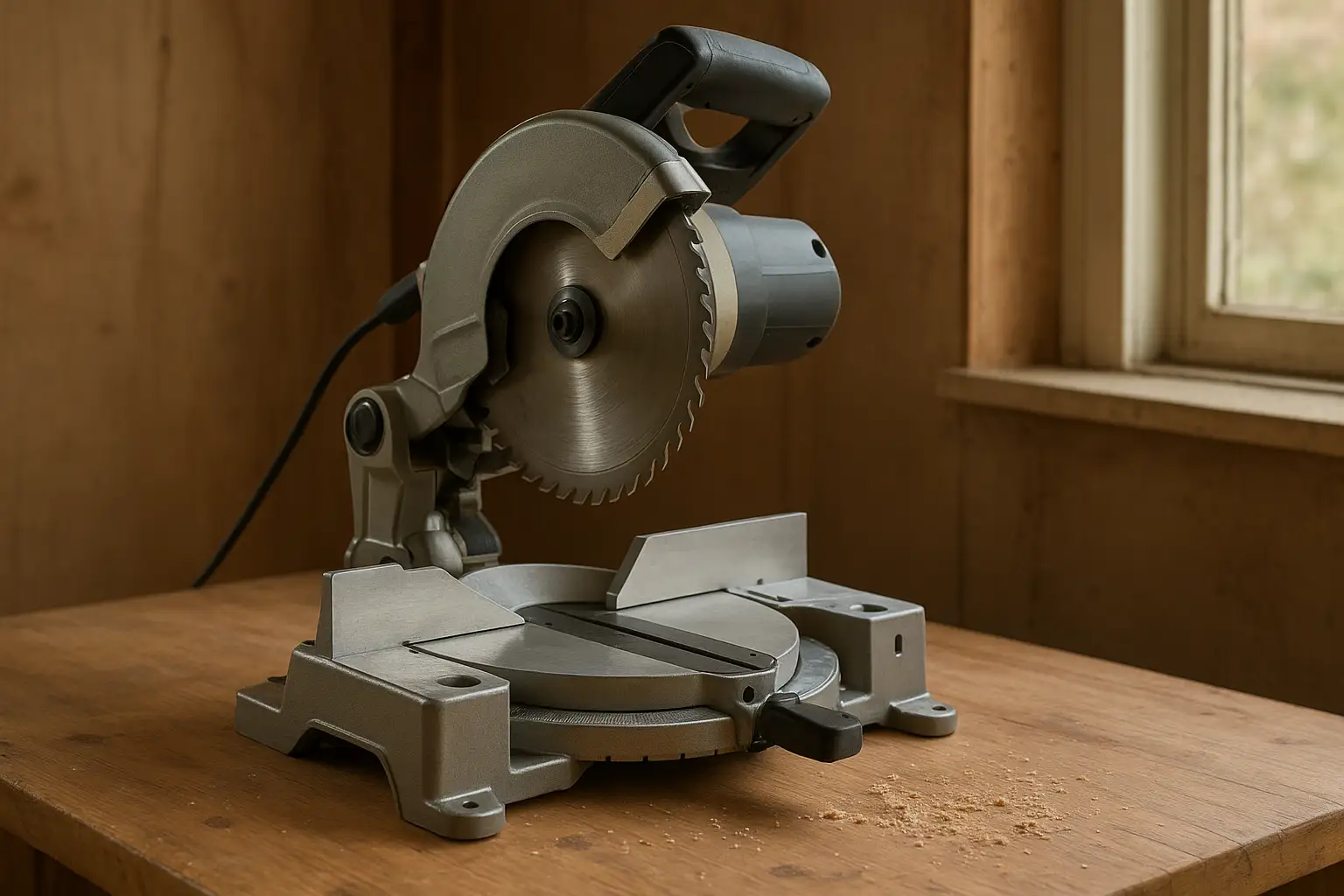
A miter saw machine is a power tool that swings a spinning circular blade down through a workpiece to make precise crosscuts, miter cuts, and bevel cuts at a fixed pivot point. The blade and motor sit on a hinged arm above a rotating turntable base; you set the base to the cutting angle, lower the arm through the wood in one controlled motion, and the fence holds the workpiece square to the blade. A miter saw is built for wood, not metal — see can you cut metal with a chop saw before ever mounting a metal-cutting blade on one. It replaces a hand miter box and backsaw with a motor-driven blade, and it is the standard shop tool for cutting trim, molding, and framing lumber at an exact angle in one pass — see this in practice in our guide to cutting quarter round for a 90-degree corner.
Quick Answer
Every miter saw machine is built from the same five core parts: a circular blade, a motor, a pivoting arm, a turntable base, and a fence. Compound, sliding, and dual-bevel miter saws are not separate tools — they are the same base machine with an added tilt, an added slide rail, or tilt added in both directions.
How Does a Miter Saw Machine Actually Cut a Workpiece?
A miter saw cuts by lowering a spinning blade straight down through a workpiece clamped against a fence on a rotating base. The motor spins the blade; the arm’s hinge converts a downward push into a controlled plunge through the wood.
The motor sits directly behind the blade and drives it at roughly 3,800 to 4,800 RPM on most corded 10-inch and 12-inch models. A spring-loaded guard covers the blade’s teeth at rest and retracts only as the arm lowers into the cut — it closes again the instant the arm rises. The turntable base carries a miter scale marked in degree increments, usually with positive stops at 0°, 15°, 22.5°, 30°, and 45°, so common angles lock in without measuring. A powered miter saw does this job with a motor; a DIY miter box uses the same fixed-angle-slot principle without power, guiding a hand saw through preset 45° and 90° cuts. The fence is a raised surface behind the blade that holds the workpiece perpendicular to the base, so the cut angle stays consistent from one end of the board to the other. Many models add a laser guide that projects the cut line onto the workpiece before the blade drops — see our guide on how to align a miter saw laser light for how to calibrate one.
| Part | What It Does |
|---|---|
| Blade | Carbide-tipped circular blade, 8-12 inches, does the actual cutting |
| Motor | Spins the blade at ~3,800-4,800 RPM; typically 12-15 amps corded |
| Pivoting arm | Holds blade and motor; hinges downward to plunge the blade through the workpiece |
| Turntable base | Rotates left/right on a miter scale to set the cutting angle |
| Fence | Fixed surface behind the blade that squares the workpiece to the cut |
| Blade guard | Spring-loaded cover that retracts only as the blade lowers into the cut |
What Is the Difference Between a Miter Saw and a Chop Saw?
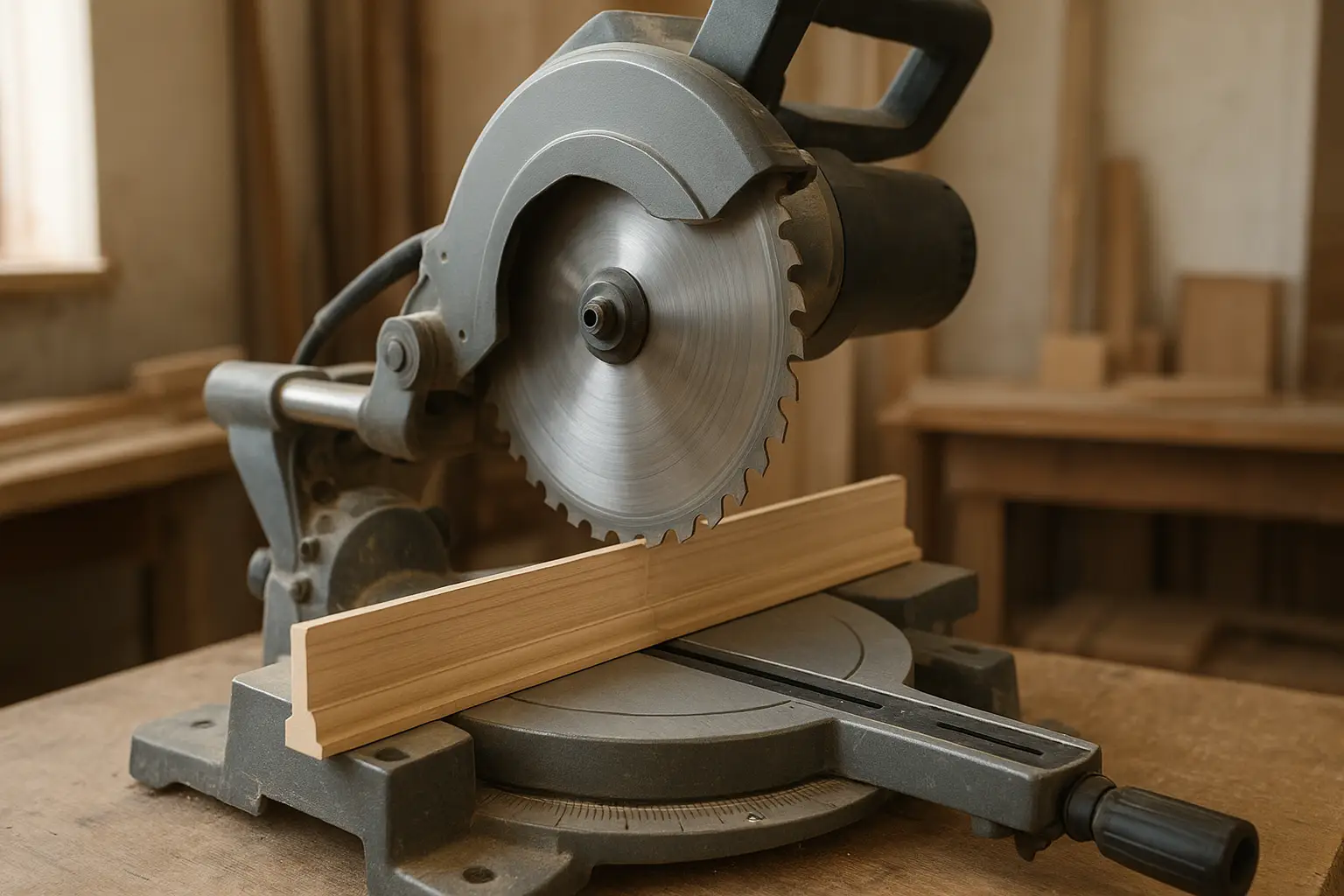
A chop saw moves only straight up and down for 90-degree cuts and cannot rotate or tilt; a miter saw’s base rotates for angled cuts, and compound models tilt the arm for bevel cuts too. Chop saws are built for metal and masonry – see our guide on cutting aluminum specifically on a chop saw for the blade and safety requirements that job needs; miter saws are built for wood.
The two tools look similar because both use a pivoting arm and a downward chopping motion — that similarity is exactly why the terms get confused. The distinguishing feature is the miter index: a chop saw has none, so its cutting angle is fixed at 90 degrees to the fence.
| Feature | Miter Saw | Chop Saw |
|---|---|---|
| Cutting motion | Rotates for angles; tilts on compound models | Straight up-and-down only, no rotation |
| Typical material | Wood, trim, molding | Metal, rebar, masonry |
| Blade type | Carbide-tipped wood-cutting blade | Abrasive wheel or metal-cutting blade |
| Angle range | 0-45° (up to 60° on some models), plus bevel tilt | Fixed at 90° only |
What Is the Difference Between a Miter Saw and a Table Saw?
A miter saw crosscuts narrow stock by pulling a blade down through it; a table saw rip-cuts long boards by feeding the material across a stationary spinning blade. Neither tool replaces the other — a fully equipped shop uses both for different cuts. If you’d rather build a rip-cutting machine yourself than buy one, see our guide on how to make a wood cutting machine at home.
A miter saw’s crosscut width is limited by its blade diameter, not just its labeled size — see exactly how wide a 10-inch miter saw can cut for the real numbers. It handles trim, molding, and framing lumber cut to length, and a table saw and miter saw combo station covers both jobs: the table saw breaks down sheet goods and rips boards to width, and the miter saw crosscuts them to length and angle.
| Feature | Miter Saw | Table Saw |
|---|---|---|
| Cut type | Crosscuts, miters, bevels | Rip cuts, crosscuts with a sled, joinery |
| Blade movement | Blade moves down through stationary work | Blade is stationary; workpiece moves through it |
| Max cut width | Limited to the blade’s crosscut capacity (~5.5 in on a square 10-inch cut) | Limited only by the table and fence length |
| Best for | Trim, molding, framing lumber | Sheet goods, long rips, panel breakdown |
What Types of Miter Saw Machines Are There?
The miter saw family has one base machine and three functional additions: a tilt (compound), a slide rail (sliding), and tilt in both directions (dual-bevel). Every miter saw on the market is the base machine plus zero or more of these three additions. The DeWalt DWS779 is a common real-world example of a double bevel saw at this size.
What Is a Compound Miter Saw?
A compound miter saw tilts the blade sideways in addition to rotating the base, so it cuts a bevel angle and a miter angle in the same pass. A standard, non-compound miter saw only rotates — it cannot tilt, so bevel cuts are not possible on it at all. For the step-by-step setup and cutting process, see how to use a compound miter saw.
What Is a Sliding Miter Saw?
A sliding miter saw’s head rides on rails, letting it pull forward before the cut and push back through the wood, which extends crosscut capacity well beyond the blade’s diameter. It is the type to choose for wide baseboard or crown molding laid flat.
What Is the Difference Between Single-Bevel and Dual-Bevel?
A single-bevel saw tilts in one direction only, so cutting the mirror-image angle means flipping the workpiece over and re-marking it. A dual-bevel miter saw tilts both left and right, cutting both bevel directions without repositioning the workpiece at all.
What Blade Size Does a Miter Saw Machine Need?
Most miter saws use an 8, 10, or 12-inch blade. A 10-inch blade is the standard all-purpose size; a 12-inch blade adds crosscut capacity for wide boards — see our 10-inch vs. 12-inch miter saw comparison for the actual spec differences before you size up; an 8-inch or cordless compact saw trades capacity for lighter weight and portability. Blade size only gets you started — matching tooth count to the wood and accounting for the blade’s kerf is what actually determines cut quality, covered in our guide on how to cut wood with a miter saw. For a full breakdown of tooth count, RPM matching, and material-specific blades, see our chop saw blade guide.
On a 10-inch compound miter saw in my shop, crosscut capacity tops out around 5-1/2 inches with the blade square to the fence — tilt the head for a bevel cut and that number drops further. Wide baseboard or crown molding run flat past that width needs a sliding rail or a flip-and-recut, not a bigger blade.
| Blade Size | Typical Crosscut (square) | Best For |
|---|---|---|
| 8 inch | ~3-4 inches | Cordless/compact saws, light trim, portability |
| 10 inch | ~5-6 inches | General trim, framing, all-purpose shop work |
| 12 inch | ~6-8 inches | Wide dimensional lumber, added capacity, more weight |
What Can You Actually Cut With a Miter Saw?
A miter saw crosscuts dimensional lumber, trim, molding, and plywood strips at an angle. Standard miter saws cut wood, and with a fine-tooth or abrasive blade swap, some cut thin plastic or non-ferrous metal — never steel, and never material wider than the blade’s crosscut capacity allows.
Cutting crown molding angles is one of the jobs a miter saw is built for — the compound tilt-plus-rotate combination cuts the compound angle crown molding needs in a single pass, without the manual angle math a basic saw requires.
The first time I ran a sliding miter saw, I pulled the head toward me after lowering it instead of before starting the cut — that is backward, and it is the single most common beginner mistake I have seen in a shop. Pull the head out first, lower the blade into the wood, then push it through and back.
Is a Miter Saw Safe to Use?
A miter saw’s retracting blade guard covers the teeth except where they contact the workpiece, but the spinning blade and the pinch point at the fence remain real hazards. Keep hands clear of the cut line and let the blade come to a complete stop before lifting it out of the wood.
According to OSHA’s machine-guarding eTool, miter saws require a guard that automatically covers the blade’s teeth except at the point of workpiece contact — the same retracting-guard mechanism built into every modern miter saw sold today.
A miter saw does not rip lumber lengthwise. Feeding a board through one the way you would a table saw wastes the blade and the workpiece; that job stays with the table saw. If you already own a specific model, the mechanics above apply directly to using a DeWalt miter saw, a Delta Cruzer sliding miter saw, or any other brand built on the same base machine.
Frequently Asked Questions
Is a mitre saw the same as a miter saw?
Yes. “Mitre” is the British spelling of “miter” — both terms describe the exact same tool and cutting mechanism, with no functional difference between them.
What is a compound miter saw used for?
A compound miter saw is used for crown molding, picture frames, and any joint that needs a combined miter angle and bevel angle cut in a single pass, without flipping the workpiece.
Can a miter saw replace a table saw?
No. A miter saw crosscuts stock to length and angle but cannot rip a board lengthwise to width. A fully equipped shop uses a table saw for rips and a miter saw for crosscuts.
What size miter saw do most woodworkers need?
A 10-inch miter saw handles the majority of trim, molding, and framing tasks. A 12-inch saw adds crosscut capacity for wide crown molding and dimensional lumber at the cost of extra weight. See our full breakdown of which miter saw type fits which project for a closer look at bevel type and blade size.
Do I need a sliding miter saw?
Only if you regularly cut stock wider than your blade’s fixed crosscut capacity — wide baseboard or crown molding run flat are the two most common reasons to choose a sliding model.
Sponsored / affiliate links. As an Amazon Associate I earn from qualifying purchases. I may earn additional commission from eligible campaigns.