Delta 6-Inch Jointer (37-071): Real Specs & How to Use It
The Delta 37-071 6-inch jointer flattens and squares warped or twisted boards using a two-knife aluminum cutterhead and cast-iron tables — but it only removes up to 1/8″ per pass, so a badly cupped board still needs several passes, not one. This guide covers real specs, how it compares to other 6-inch jointers, and how to use one correctly.
What Is the Delta 6-Inch Jointer, Really?
Current Pick: In-Stock 6-Inch Jointer
 |
Cutech 40160HB 6-Inch Spiral Cutterhead Jointer – $319.99 Delta-branded 6-inch jointer listings go in and out of stock; this is a comparably specced 6-inch benchtop jointer confirmed in stock, with a spiral cutterhead that leaves a smoother finish than a straight 2-knife head.
|
The current model sold under the Delta Machinery brand is the Delta 37-071 6 in. MIDI-Bench Jointer, made by Delta Power Equipment Corp. It’s a stationary machine with two parallel cast-iron tables that flatten one face or edge of a board at a time — it does not set final thickness across the whole board the way a planer does.
📊 The Delta 37-071 runs a 12-amp motor at 10,000 RPM cutterhead speed, cuts up to 1/8″ deep, and uses a 2-knife aluminum cutterhead — Source: Delta Machinery, official 37-071 product page (deltamachinery.com currently blocks automated/bot access to this page)
That 2-knife aluminum cutterhead detail matters: some older listings and reviews describe a 6-knife cutterhead, which is incorrect for this model and worth knowing before you buy replacement blades. A jointer is also not interchangeable with a planer — a jointer flattens warped or twisted surfaces, while a planer takes an already-flat face and brings the opposite face to a uniform thickness. Most shops eventually need both.
6-Inch Jointer Comparison
A 6-inch jointer handles most hobby and home-shop needs. Here’s how the Delta 37-071 stacks up against other 6-inch benchtop jointers on cutterhead type and motor size — the two specs that most affect finish quality and how hard the motor works on wide boards.
| Jointer | Cutterhead | Motor | Table Material |
|---|---|---|---|
| Delta 37-071 | 2-knife aluminum | 12 amp | Cast iron |
| Cutech 40160HB | Spiral, 12 inserts | 10 amp | Teflon-coated aluminum |
| WEN JT630H | Spiral | 10 amp | Cast iron |
| JET JJ-6HHBT | Helical | 1 HP | Cast iron |
Spiral and helical cutterheads use small replaceable carbide inserts instead of long straight knives — they cost more up front but resist nicking and produce a smoother finish with less tearout on figured grain. A straight 2-knife head like the Delta’s is cheaper to maintain and simpler to sharpen, which is why it’s still common on entry-level 6-inch machines.
How to Use a 6-Inch Jointer
- Rough-flatten one face first: If the board is badly warped, take a shallow pass on the jointer before running it through a planer — don’t try to remove 1/4″ of cup in a single pass.
- Level the infeed and outfeed tables: Both should sit at the same height as the cutterhead and parallel to each other.
- Set a shallow depth of cut: Start with 1/32″-1/16″ and increase gradually rather than taking the full 1/8″ in one pass.
- Feed the board steadily: Keep it flat against the table and fence, feeding with even pressure — don’t force it.
- Use a push block on the last few inches: Never let your hands pass directly over the cutterhead.
- Check the face with a straightedge: Sight down the board or use a straightedge to confirm it’s actually flat before moving to the planer.
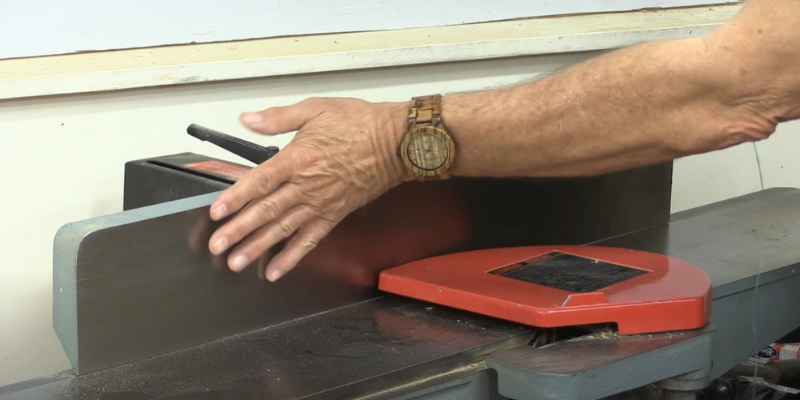
As the woodworking channel DIYTyler demonstrates when flattening large boards on a small jointer, table width doesn’t have to match board width — you can flatten one edge or one narrow reference face on a 6-inch jointer and then finish the rest of the board with hand planes or a router sled, so a 6-inch machine covers more projects than its table size suggests.
Maintenance and Common Issues
Clean the tables and fence after every use with a brush or compressed air, and wipe cast-iron surfaces with a light coat of paste wax to prevent rust. Check the drive belt for wear periodically, and keep the two knives sharp — dull knives are the most common cause of both rough cuts and snipe.
- Snipe (deeper cut at board ends): Usually means the infeed and outfeed tables aren’t level with each other — recheck the table height adjustment.
- Rough or torn-out cuts: Check the knives for dullness or nicks first before assuming it’s an operator error.
- Excess vibration: Check for a loose cutterhead or worn bearings, and confirm the machine is bolted to a stable bench or stand.
Frequently Asked Questions
Who makes Delta jointers?
Delta Power Equipment Corp. designs, manufactures, and distributes power woodworking tools under the Delta Machinery brand, including the 37-071 6-inch jointer. Delta Power Equipment Corp. is a subsidiary of Chang Type Industrial Co., Ltd.
What is a 6-inch jointer used for?
A 6-inch jointer flattens and squares lumber up to 6 inches wide, correcting warp, cup, and twist before the board goes to a planer or table saw. It’s one of the few machines that needs a companion tool (typically a planer) to finish producing flat, square, precisely-sized lumber.
What size jointer do I need?
A 6-inch jointer covers most hobby and home-shop projects, since most furniture parts and cabinet stock fall under 6 inches wide. If you regularly work with wider boards, an 8-inch or larger jointer avoids having to edge-glue narrower jointed pieces to reach your final width.
Which is better, a planer or a jointer?
Neither replaces the other. A jointer corrects warp and twist and creates a flat reference face; a planer then brings the opposite face to a uniform thickness parallel to that reference face. Most shops need both machines, in that order.
Conclusion
The Delta 37-071 is a solid, cast-iron 6-inch jointer for the price, but its 2-knife aluminum cutterhead is the detail to know before ordering replacement blades or comparing it to spiral-head competitors like the Cutech or WEN. Whichever 6-inch jointer you land on, the technique matters as much as the machine: shallow passes, a level infeed/outfeed setup, and a push block near the cutterhead.
Sponsored / affiliate links. As an Amazon Associate I earn from qualifying purchases. I may earn additional commission from eligible campaigns.