DeWalt Cordless Table Saw (DCS7485): Is It Really “20V”?
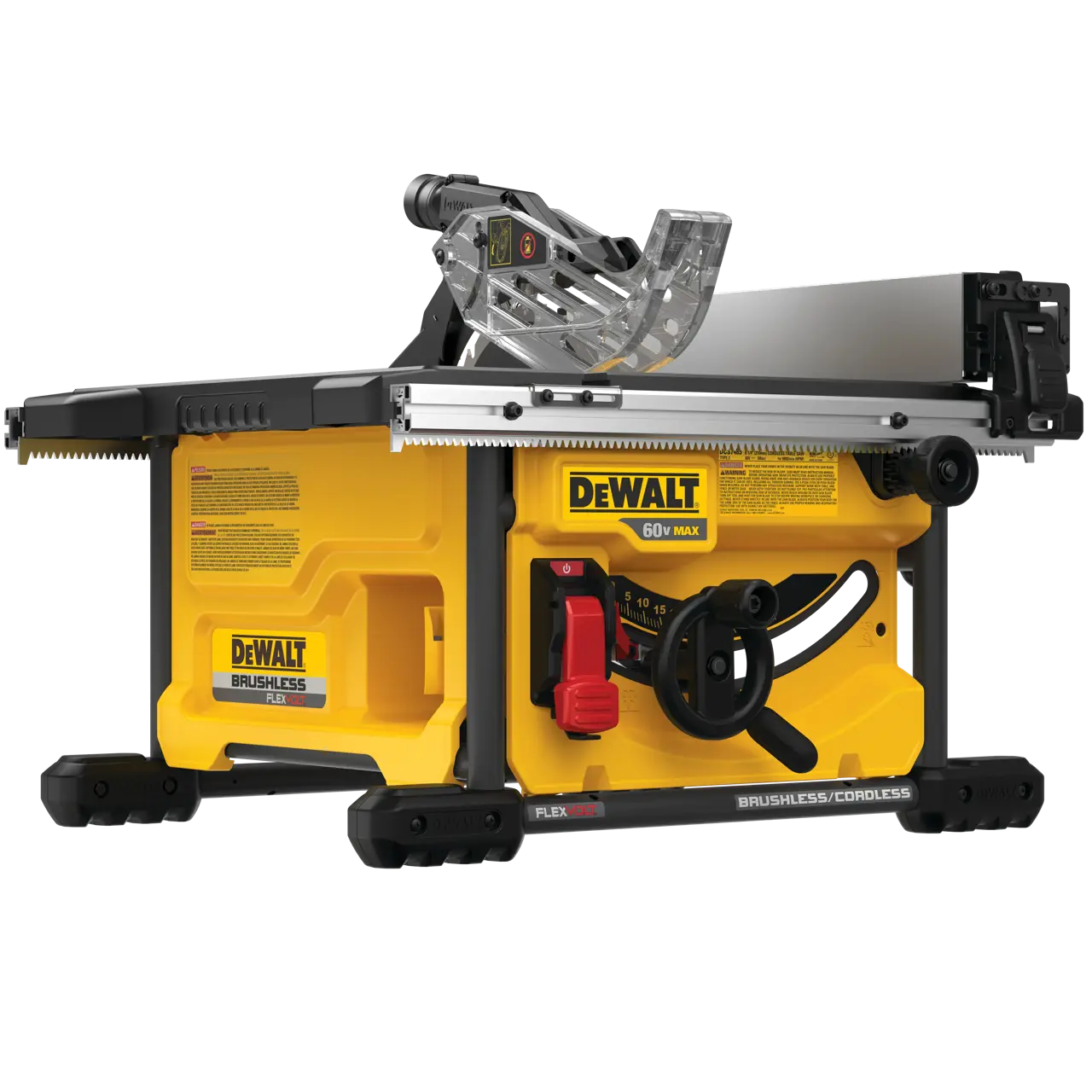
The saw people search for as the “DeWalt Cordless Table Saw 20V” is the DCS7485, and the name is a little misleading: it runs on DeWalt’s FlexVolt platform at 60V, not on a plain 20V MAX battery. What it does share with the 20V MAX lineup is the FlexVolt battery itself, which is built to work across both platforms — so if you already own DeWalt FlexVolt or 20V MAX tools, you’re buying into a battery ecosystem that also covers this saw.
Below is what the DCS7485 actually offers: real specs, where it fits against a corded saw, and the one limitation (no dado stack support) that most listings leave out.
Why a Cordless Table Saw Instead of Corded?
The Actual Saw This Article Covers
 |
DeWalt DCS7485B FlexVolt Table Saw (Tool Only) – $399 This is the exact saw reviewed above — real 60V FlexVolt power in a 48-lb cordless body.
|
The case for a cordless table saw comes down to setup speed and mobility. A corded jobsite table saw needs an outlet and usually an extension cord, which is one more tripping hazard and one more thing to route around a garage, backyard, or jobsite. A cordless saw like the DCS7485 sets up anywhere — a backyard deck build, a remote jobsite, a friend’s garage — without hunting for power.
The trade-off is capacity, not safety: cordless doesn’t mean underpowered here, since FlexVolt batteries deliver real 60V output, but it does mean planning around battery runtime and having a charged spare for a full day of cutting.
Key Features of the DCS7485
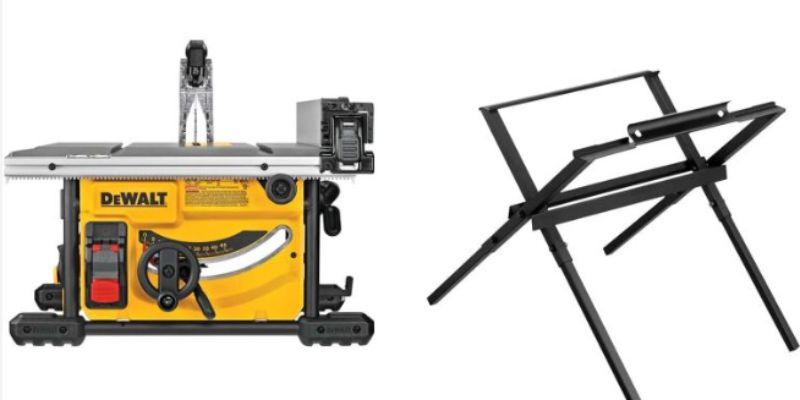
DeWalt markets this as the 20V MAX 8-1/4 in. Table Saw (model DCS7485), built on the FlexVolt platform. Here’s what defines it:
Brushless Motor
The brushless motor spins at a no-load speed of 5,800 RPM. Brushless motors run cooler and more efficiently than brushed motors, which translates to less battery drain and less bogging down on repeated rip cuts through hardwood or a stack of dimensional lumber.
Compact, Portable Build
At about 48 pounds with a metal roll cage base, the DCS7485 is light enough to carry one-handed and small enough to fit a cluttered garage or a truck bed for a jobsite run. Onboard storage holds the blade guard, fence, and push stick so small parts don’t get left behind between jobs.
Rack-and-Pinion Fence
The rack-and-pinion telescoping fence adjusts with a turn of a knob instead of tapping it into place, and it extends to a 24-inch rip capacity on the right side — enough to break down a full 4×8 sheet of plywood or OSB.
Battery Platform
The DCS7485 runs on DeWalt FlexVolt battery packs, which auto-detect voltage and step up to 60V for tools like this saw (and step down to 20V when the same battery is used in a 20V MAX tool). A larger-capacity FlexVolt battery (6.0Ah or up) will get most DIY projects done on a single charge; for a full day of continuous ripping, keep a charged spare on hand.
Safety Features
Power-loss reset keeps the switch from re-engaging automatically if the battery dies or is swapped mid-cut — you have to hit the switch again on purpose. The blade guard and riving knife are tool-free for quick removal and reinstallation, and a push stick stores directly on the saw for narrow rip cuts.
Here’s a quick table summarizing the key specs:
| Feature | Details |
|---|---|
| Blade Size | 8-1/4 inches |
| Motor Type | Brushless, 5,800 RPM |
| Rip Capacity | 24 inches (right), 12 inches (left) |
| Max Cutting Depth | 2-1/2 inches at 90°, 1-3/4 inches at 45° |
| Weight | 48 pounds |
| Battery Platform | DeWalt FlexVolt (60V; auto-detects 20V in 20V MAX tools) |
| Dado Stack Support | Not supported |
| Safety Features | Power-loss reset, tool-free blade guard, riving knife, onboard push stick |
Where the DCS7485 Fits Best
The 24-inch rip capacity and 8-1/4-inch blade make this saw well suited to the kind of work most DIYers and light-duty pros actually do: ripping deck boards and composite decking, breaking down plywood and hardwood for shelving and cabinet builds, and handling trim and punchout cuts on a finish-carpentry job. The compact size and no-cord setup mean it can go anywhere a corded saw can’t — a backyard, a remote site, or a tight garage — without running an extension cord.
One real limitation worth knowing before you buy: the DCS7485 does not accept a dado stack. If your projects regularly need dado or rabbet cuts on the table saw itself, that’s a dealbreaker this listing doesn’t always mention up front.
Cordless vs. a Corded Table Saw
A corded jobsite saw like the DeWalt DWE7491RS runs on unlimited AC power and tends to be heavier (often 90 pounds or more), which trades portability for continuous runtime. The DCS7485’s 8-1/4-inch blade is also smaller than the 10-inch blades common on corded jobsite saws, which caps its cutting depth at 2-1/2 inches versus roughly 3-1/8 inches on a typical 10-inch corded saw.
For someone cutting thick hardwood all day on a fixed job site, a corded saw with unlimited runtime is the better tool. For DIY and light-duty work where setup speed and mobility matter more than maximum cutting depth, the cordless DCS7485 is the more convenient choice — as long as you budget for at least one spare FlexVolt battery.
Tips for Getting the Most Out of This Saw
- Upgrade the blade for finish work: The stock 24-tooth blade is fine for general ripping; a 40-tooth carbide-tipped blade gives noticeably smoother cuts on plywood and trim.
- Keep a spare FlexVolt battery on hand: Swapping a battery takes seconds and prevents a big project from stalling mid-cut.
- Use a sacrificial surface underneath: A scrap sheet of plywood or foam board protects your workbench from accidental blade contact.
- Clean the dust port regularly: Sawdust buildup reduces dust collection efficiency over time.
- Check fence alignment before starting: A quick parallel check against the blade catches drift before it shows up in a cut.
Pros and Cons of the DeWalt Cordless Table Saw 20V
No tool is perfect, so here are the real strengths and weaknesses.
Pros
- Portability: At 48 pounds, it’s easy to carry and set up anywhere.
- Battery Compatibility: Runs on DeWalt’s FlexVolt battery platform, which also works across compatible 20V MAX tools.
- Precision: The rack-and-pinion fence adjusts smoothly and holds its setting.
- Safety Features: Power-loss reset and tool-free guards make it straightforward to use safely.
- Quiet Operation: The brushless motor runs quieter than a comparable brushed corded saw.
Cons
- Smaller Blade Size: The 8-1/4-inch blade caps cutting depth at 2-1/2 inches, less than a typical 10-inch corded saw.
- No Dado Stack Support: Not an option if your work regularly needs dado or rabbet cuts on the table saw.
- Battery Dependency: Sold as a bare tool in most listings — FlexVolt batteries and a charger cost extra, and heavy use means budgeting for a spare.
Who Should Buy This Saw?
This saw fits DIYers, homeowners, and light-duty pros who value portability — deck builds, shelving, trim and punchout work, or any job site without easy power access, like an off-grid cabin build. A professional framer or anyone cutting thick timber all day is better served by a corded saw with unlimited runtime and a larger blade.
Maintenance and Care
Wipe down the table after each use to clear sawdust and debris — the table’s low-friction coating gets gummed up with resin and pitch over time if it’s neglected. Check the blade periodically for resin buildup and clean it with a dedicated blade cleaner when needed. Store the saw somewhere dry to prevent rust, remove the battery during long storage periods to avoid drain, and check the fence and blade guard periodically to confirm they’re still secure.
Bottom Line
The DCS7485 delivers real 60V FlexVolt power in a 48-pound, cord-free package, with enough rip capacity for full sheet goods and enough precision for finish work. Its two real limits are the smaller 2-1/2-inch cutting depth and the lack of dado stack support — if either of those matters for your projects, a corded saw is the better fit. For most deck, shelving, and trim work where setup speed and portability matter more than maximum capacity, it’s a capable, well-built option.
FAQs
Is the DeWalt Cordless Table Saw 20V powerful enough for hardwood?
Yes. The brushless motor’s 5,800 RPM no-load speed handles oak, maple, and similar hardwoods without excessive bogging down, though very thick or dense stock may need a slower feed rate.
Can I use my existing DeWalt 20V batteries with this saw?
The saw is built around DeWalt’s FlexVolt battery platform, which auto-detects voltage across compatible 20V MAX and FlexVolt tools. Check DeWalt’s official compatibility chart for your specific battery model before buying, since not every 20V MAX battery is rated for a FlexVolt tool’s power draw.
How long does the battery last on a single charge?
Runtime depends on the material, cut frequency, and battery capacity. A larger FlexVolt battery (6.0Ah or higher) is built for extended cutting sessions; for a full day of continuous ripping, plan on at least one charged spare.
Is the DeWalt 20V table saw good for beginners?
Yes. The rack-and-pinion fence is easy to adjust accurately, and safety features like the tool-free blade guard and power-loss reset make it more forgiving for someone new to a table saw.
Can I use this saw for a large project like building a deck?
Yes. The 24-inch rip capacity handles full 4×8 sheets of composite decking and dimensional lumber. For a full deck build in one session, keep a charged spare FlexVolt battery on hand.
Sponsored / affiliate links. As an Amazon Associate I earn from qualifying purchases. I may earn additional commission from eligible campaigns.