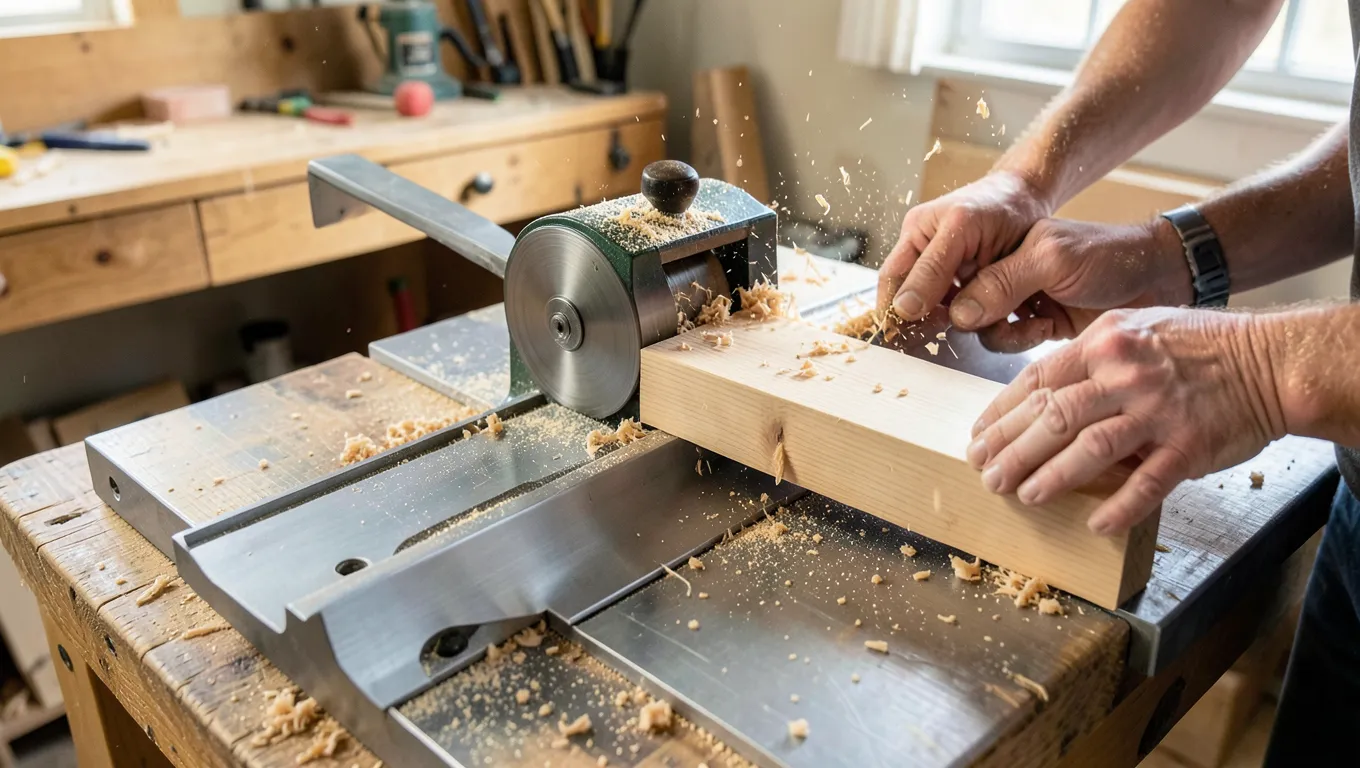
Do I Need a Jointer? Only If Your Lumber Isn’t Already Flat
It depends on what wood you buy. If you only ever work with pre-surfaced (S4S/S3S) lumber from a home center, you can skip a jointer entirely. If you buy rough-sawn lumber, reclaim old boards, or deal with cupped and twisted stock at all, a jointer isn’t optional — it’s the only tool that actually creates the flat reference face everything else in your workflow depends on.
The Nuance Most Guides Skip: A Planer Can’t Replace a Jointer
This is the part that trips people up, and it’s worth being precise about: a planer makes the two faces of a board parallel to each other. It does not make a board flat. A planer’s bed simply supports whatever shape the bottom of the board already has and shaves the top to match it — so if you feed a cupped or twisted board through a planer, you get a thinner cupped or twisted board, not a flat one.
A jointer’s job is different: it flattens one face against a reference table and squares one edge to that face. Once you have that one flat face and one square edge from the jointer, the planer can then reference off that flat face and make the opposite face parallel to it — which is what finally gives you a board that’s both flat and consistent thickness. Skip the jointer step and a planer alone will never fix a twisted board, no matter how many passes you run it through.
For the full mechanical breakdown of exactly how that outfeed-table height difference flattens a board pass by pass, see our guide on how a jointer works.
Get a Jointer That Actually Fits a Home Shop
Best Benchtop Jointer
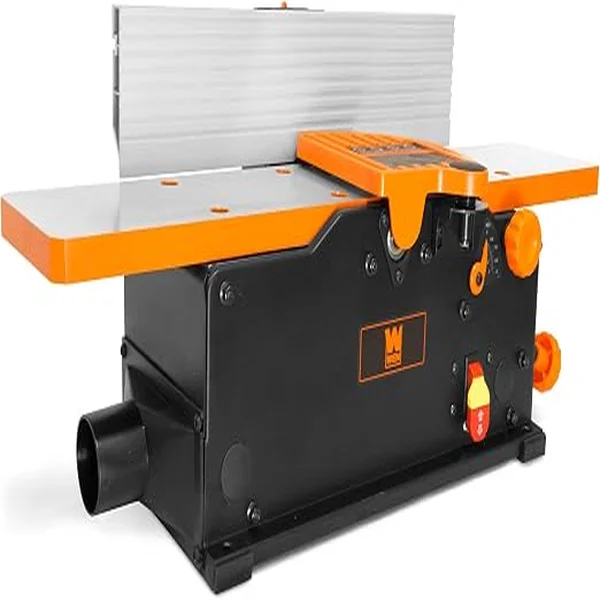 |
WEN JT630H 10-Amp 6-Inch Spiral Benchtop Jointer – $273.83 A 6″ cutting width handles the vast majority of hobbyist board widths, and the spiral cutterhead is quieter and easier to maintain than straight knives.
|
How a Jointer Works
| Part | Function |
| Infeed table | Supports the board before it reaches the cutterhead; set slightly lower than the outfeed table by the depth of cut |
| Cutterhead | Spinning knives (straight or spiral) that shave the face or edge flat |
| Outfeed table | Set exactly level with the cutterhead’s knife arc; supports the now-flattened section as it exits |
| Fence | Guides the board square to the table for edge-jointing |
When You Genuinely Don’t Need One
- You exclusively buy dimensional lumber that’s already surfaced on all four sides (S4S) from a lumberyard or home center.
- Your projects are rough construction work (framing, fencing, sheds) where dead-flat reference faces don’t matter.
- You do small enough work that a hand plane and a shooting board handle your flattening needs — genuinely viable for boxes, small frames, and similar projects, just slower.
- You have access to a shared shop or makerspace with a jointer you can use occasionally instead of owning one.
When You Genuinely Do
- You buy rough-sawn lumber directly from a sawmill (cheaper per board foot, but it comes cupped, twisted, and rough).
- You work with reclaimed or salvaged wood, which is almost never flat or square.
- You’re gluing up panels or tabletops from multiple boards — edge-jointing for a tight glue line is one of the most common jointer uses and hardest to fake by hand.
- You care about grain-matching and want to mill your own stock from thicker rough lumber instead of buying pre-dimensioned boards.
Alternatives If You’re Not Ready to Buy One
Hand planes can do everything a jointer does, just slower and with more skill required — a well-tuned #7 or #8 jointer plane and a winding stick pair are the traditional pre-power-tool answer, and they’re genuinely capable, just not fast for a lot of stock.
A table saw with a jointing jig (a straight-edge sled that rides the fence) can true one edge of a board, though it can’t flatten a cupped or twisted face the way a jointer’s two-table setup can — it only helps with edges, not faces.
A router sled (a flattening jig that rides a router across a board on two rails) can flatten a face on boards too wide for a benchtop jointer, and it’s a common workaround for slabs and wide glue-ups that exceed a 6″–8″ jointer’s capacity.
Choosing One: What Actually Matters
Cutting width is the first spec to check — a 6″ jointer handles most hobbyist work, but if you regularly work with 8″+ boards you’ll be ripping them down first or supplementing with a router sled anyway. Cast iron tables hold flatness and resist vibration better than stamped aluminum on cheaper models. A spiral or helical cutterhead costs more upfront but resists nicking, is quieter, and each of its small cutting inserts can be rotated individually when dull instead of needing the whole knife sharpened or replaced.
Maintenance
Keep the tables waxed with a paste wax (not oil, which attracts dust) so stock slides smoothly. Check the outfeed table’s height against the cutterhead’s knife arc periodically — if it drifts even slightly low, boards will taper; if it’s high, the cutterhead will gouge on exit. Inspect knives for nicks before each project, and clean pitch/resin buildup off the cutterhead with a dedicated blade cleaner rather than letting it accumulate.
Frequently Asked Questions
What is a jointer used for?
A jointer flattens one face of a board and squares one edge to that face, creating a flat, square reference surface for accurate joinery and for the planer to work from afterward.
How does a jointer work?
A jointer uses a spinning cutterhead between two tables to shave a board flat as it’s fed across — the infeed table sits slightly lower than the outfeed table by the depth of the cut being taken.
Do I need a jointer for woodworking?
Only if you work with rough-sawn, reclaimed, or otherwise unflat lumber. If you exclusively buy pre-surfaced (S4S) boards, you can skip one; anyone milling their own rough stock needs one.
Can a planer replace a jointer?
No. A planer makes two faces parallel but can’t flatten a cupped or twisted board on its own, since its bed just copies whatever shape the bottom of the board already has. You need a jointer to create one flat face first.
Bottom Line
A jointer isn’t universally necessary, but it’s not optional either once you’re milling rough or reclaimed lumber — and no amount of planer time substitutes for it, since the planer needs a flat face to reference off of in the first place.
Sponsored / affiliate links. As an Amazon Associate I earn from qualifying purchases. I may earn additional commission from eligible campaigns.