What Is a Jointer Plane? Anatomy, Sizes & How It Works
A jointer plane is a long hand plane — typically 22 to 24 inches — used to flatten a board’s face or true up an edge so it’s perfectly straight and square for gluing two boards together. It’s a hand tool, not to be confused with a “jointer” (the stationary power tool that does a similar job on an infeed/outfeed table), and its unusual length is the entire point of its design, not just a size preference.
Jointer Plane vs. Jointer (Power Tool): Don’t Confuse Them
Solid Entry-Level No. 7 Jointer Plane
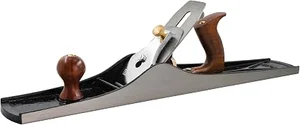 |
Faithfull No.7 Jointing Plane, 22″ – $114.23 A classic No. 7-pattern cast-iron jointer at a lower price point than premium makers, sized right for truing edges before glue-ups.
|
This mix-up is common enough to be worth clearing up first. The plane version is a hand tool you push manually along a board. A jointer (no “plane”) is a stationary power machine with two flat tables and a spinning cutterhead between them, used the same way a table saw or planer would be — you feed the board through it. Both flatten and straighten wood; a hand jointer plane is slower but needs no power, no dust collection setup, and gives finer control on a single board or a repair job, while a power jointer is the practical choice for processing a lot of rough lumber quickly.
Why It’s So Long: The Actual Mechanical Reason
The length isn’t tradition for its own sake — it’s the mechanism that makes the tool work. A plane can only cut where its sole contacts the wood. On a long, humped, or wavy board, a short plane’s sole rocks into every low spot and cuts every high spot, following the board’s existing waviness instead of correcting it. A long sole — 22″ to 24″ on a jointer plane, compared to 9-10″ on a smoothing plane — bridges over low spots entirely and only contacts (and cuts) the high points, which is exactly what progressively flattens a board or straightens an edge with each pass.
Anatomy of a Jointer Plane
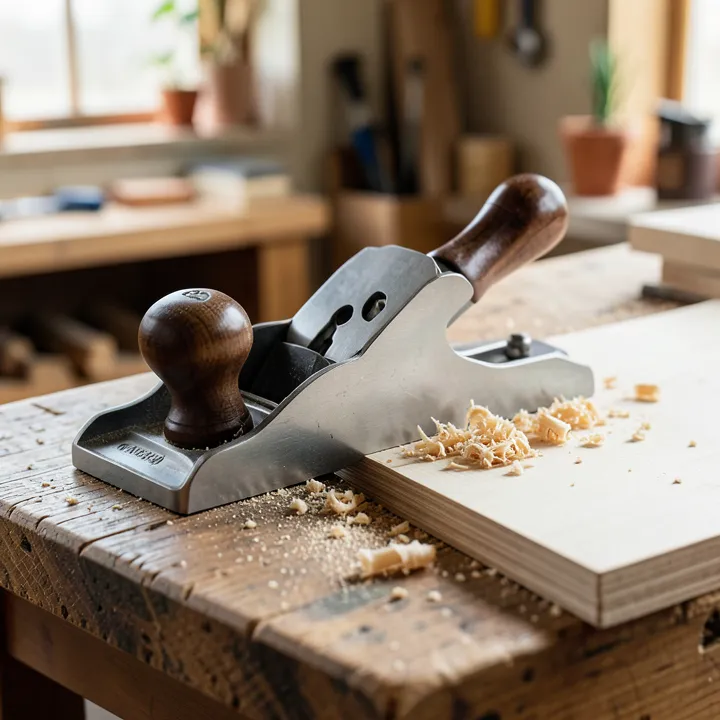
Beyond the long sole, a jointer plane has the same core parts as any bench plane, scaled up: a cast-iron or wooden body, a blade (called the “iron”) bedded at an angle — typically 45 degrees on a standard bench plane — a cap iron that curls and breaks the shaving to prevent tear-out, and a frog with adjustment screws that control the blade’s depth of cut and lateral alignment. The two classic sizes, standardized by Stanley in the late 1800s and still the reference sizes today, are the No. 7 (22″ long, 2-3/8″ wide iron) and the No. 8 (24″ long, 2-5/8″ wide iron).
Wood-Bodied vs. Metal-Bodied Jointer Planes
Choosing a Body Type
Metal (cast iron): The modern standard since the late 19th century. Heavier, which helps momentum through a cut, and adjustments are made with screws and a knurled wheel rather than tapping with a hammer. Available new from several makers at a wide range of price points.
Wood-bodied: The older tradition — wooden “trying planes” predate metal-bodied planes by centuries. Lighter, glides with less friction on the wood, and many woodworkers find them more pleasant to use for long sessions, but blade depth is adjusted by tapping the iron or the body with a small hammer, which takes practice to get consistent.
Using a Jointer Plane
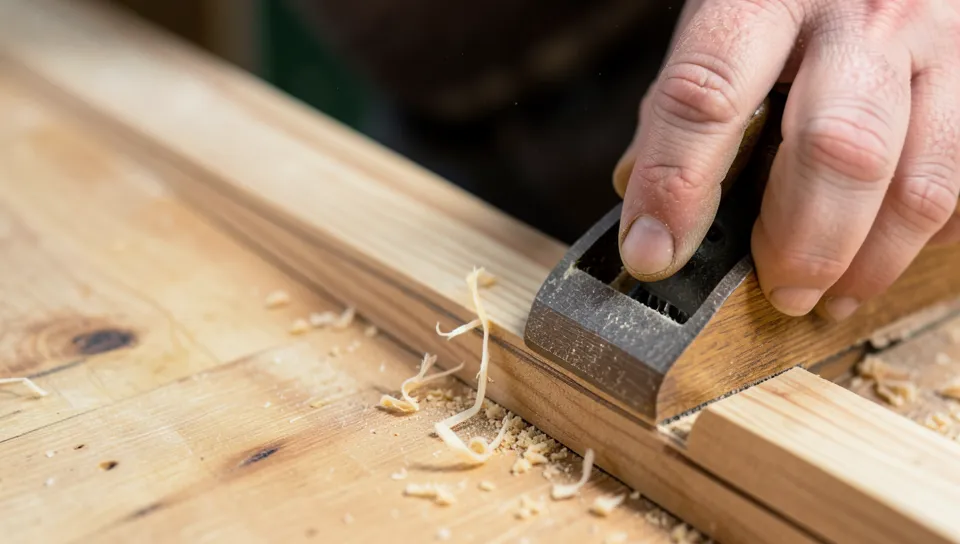
Secure the board firmly — in a vise for edge work, or against bench dogs/stops for face work — and check it for embedded debris or old fasteners before the first pass; a jointer plane’s long iron is expensive to nick and hard to resharpen without leaving a flat spot. Set the blade for a light cut (a thin, translucent shaving, not a thick curl) and take full-length passes, applying downward pressure on the front knob at the start of the stroke and shifting it to the rear handle by the end, which keeps the sole flat against the wood instead of rocking off either end of the board.
Check your progress with a straightedge or by holding two jointed edges together up to a light source — any gap shows exactly where more material needs to come off. For edge-jointing two boards that will be glued together, a very slight hollow (not a bump) in the middle of the edge is actually desirable in traditional technique, since clamping pressure closes that gap and puts the joint under slight tension at the ends.
Maintaining a Jointer Plane
Wipe the sole and blade after each session, since residual moisture from your hands or the air is enough to start surface rust on bare cast iron overnight. A light coat of paste wax or camellia oil on the sole after cleaning both prevents rust and reduces friction on the next use. Hone the iron on a sharpening stone at roughly a 25-degree primary bevel with a slightly steeper secondary “micro-bevel” around 30 degrees — a sharp iron is the single biggest factor in whether a jointer plane cuts cleanly or tears the grain, more so than any adjustment to the frog or cap iron.
Common Problems and Fixes
Troubleshooting
Chatter (a rippled, stuttering cut): Usually a dull iron or too heavy a cut. Take a lighter pass and re-hone the blade before adjusting anything else.
Digging in at the start or end of a stroke: A pressure problem, not a tool problem — apply downward pressure at the front knob starting the cut and the rear handle finishing it, not equal pressure on both throughout.
Tear-out (torn, fuzzy grain instead of a clean shaving): Usually cutting against the grain direction, too large a mouth opening, or a cap iron set too far back from the edge. Try planing from the other direction first.
Sole not gliding smoothly: Check for rust, debris, or wax buildup. A quick wipe and a fresh light coat of paste wax usually resolves it.
Frequently Asked Questions
What is a jointer plane used for?
Truing edges so two boards fit tightly together for gluing, and flattening the face of a board that’s cupped, twisted, or wavy. Its long sole is specifically what lets it bridge low spots and cut only the high points.
How does a jointer plane work?
The long sole rides across the high points of an uneven board while bridging over low spots, so the blade only removes material from the high areas. Repeated passes progressively flatten the surface or straighten the edge.
What size is a jointer plane?
The two standard sizes are the No. 7 (22″ long, 2-3/8″ wide iron) and the No. 8 (24″ long, 2-5/8″ wide iron) — sizes established by Stanley in the late 1800s that are still the reference standard today.
Is a jointer plane the same as a jointer?
No. The plane version is a hand tool you push manually. A jointer (without “plane”) is a stationary power machine with an infeed/outfeed table and a spinning cutterhead that you feed the board through. Both flatten and straighten wood, but they’re different tools.
How do I maintain a jointer plane?
Wipe the sole and blade after use to prevent rust, apply a light coat of paste wax or camellia oil to the sole, and keep the iron honed at roughly a 25-degree primary bevel with a 30-degree micro-bevel. A sharp iron matters more to cut quality than any other adjustment.
Bottom Line
A jointer plane’s length isn’t a style choice — it’s the mechanism that lets it bridge low spots and true up a long edge or a wavy face. Keep the iron sharp, use it in a No. 7 or No. 8 length, and don’t confuse it with the power-tool “jointer” that does a related job a different way.
Sponsored / affiliate links. As an Amazon Associate I earn from qualifying purchases. I may earn additional commission from eligible campaigns.