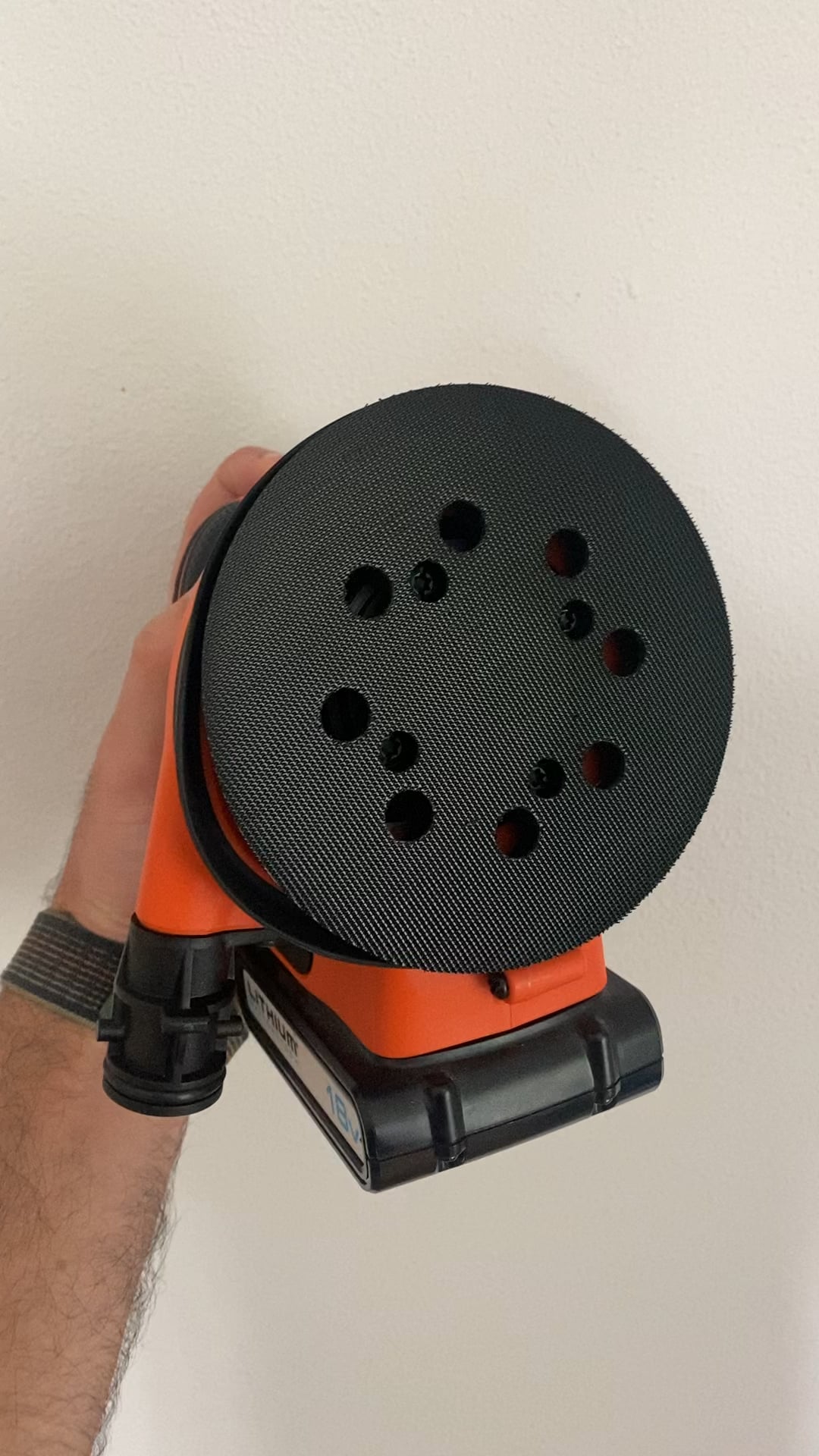
Do Orbital Sanders Spin? Yes, in Small Random Orbits
Yes, orbital sanders spin – but not around a fixed center like a drill. The pad spins while also moving in tiny random circles (orbits) at the same time, and it’s that combined motion, not the spin alone, that keeps the sander from cutting the same repeating scratch pattern into the wood. That dual movement is exactly what separates a random orbital sander from a simple spinning disc sander, and it’s why the swirl marks you’d expect from a rotating pad mostly don’t show up.
The Actual Mechanism: Two Motions at Once
Best Random Orbital Sander for Wood
 |
DEWALT DWE6423, 5″ Variable Speed – $79.00 The dual spin-plus-orbit motion this article explains, in a sander with speed control for both delicate and aggressive sanding.
|
Inside a random orbital sander, the round pad is mounted slightly off-center from the motor’s drive shaft. As the motor spins that shaft, the off-center mounting forces the pad into a small circular orbit (usually a few millimeters across) at the same time it’s spinning on its own axis. Because the pad is also free to spin somewhat independently – driven partly by friction against the wood rather than rigidly locked to the motor – the exact path any single grain of sandpaper takes across the surface is different every rotation. That’s the “random” in random orbital: it isn’t randomness in the electronics or the motor, it’s a mechanical byproduct of combining an orbit with a semi-free-spinning pad.
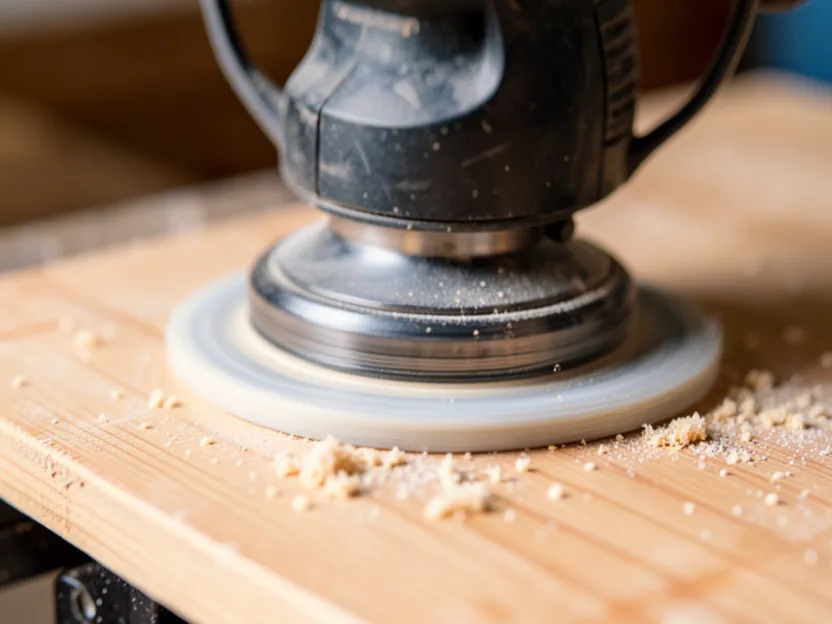
Why This Matters: No Repeating Scratch Pattern
A sander that only spins in one fixed circular path (like a simple disc sander) drags every grain of abrasive across the exact same arc, over and over, which carves a visible pattern of curved scratches into the surface – the classic “swirl marks” you’ll see on a poorly finished piece. Because a random orbital sander’s pad is constantly shifting its orbit position while also spinning, no single scratch gets repeated in the same spot twice. Individual passes overlap in slightly different directions each time, which is what makes the final surface look uniformly smooth instead of showing a pattern of arcs when light hits it at an angle.
Random Orbital vs. Other Sander Types
A sheet sander (sometimes called a finishing sander) moves in a tight oval or figure-eight pattern rather than spinning at all, uses quarter-sheets of standard sandpaper clipped into place, and is gentler but slower – a reasonable choice for light touch-up work or getting into corners the round pad of an orbital sander can’t reach. A belt sander is the opposite end of the spectrum: a continuous loop of abrasive spinning around two drums removes material fast in one direction, which makes it powerful for leveling rough stock but much easier to gouge or create low spots with if you’re not experienced. Random orbital sanders sit in the middle – more aggressive than a sheet sander, far more forgiving and swirl-free than a belt sander – which is why they’re the default choice for most furniture and general woodworking sanding.
Getting the Best Results
Let the sander’s own motion do the work: pressing down harder doesn’t sand faster, it just slows the pad’s free-spinning action, which actually reduces the “random” part of its motion and increases the odds of visible swirl marks – the opposite of what you want. Keep the sander moving continuously rather than parking it in one spot, work through grits progressively (coarse to fine, without skipping too many steps at once), and vacuum or wipe down the surface between grits so leftover coarse-grit dust doesn’t scratch the finer pass. A dust collection port or shop vac attachment, where the sander has one, keeps the pad’s holes from clogging, which otherwise reduces cutting efficiency and can reintroduce the very scratch pattern the random motion is designed to avoid.
Frequently Asked Questions
Do orbital sanders spin in a circular motion?
Yes, but not around one fixed center like a drill. The pad spins on its axis while the whole pad also moves in a small orbit at the same time, which is what prevents repeating scratch patterns.
What is the purpose of orbital sanders?
To smooth surfaces evenly without leaving the visible circular scratch pattern a single-direction spinning sander would create. They’re the standard choice for final sanding before finishing.
Can orbital sanders be used on wood?
Yes – they’re one of the most common sanders for wood, used for smoothing bare wood, removing old paint or finish, and prepping a surface before staining or sealing.
How do orbital sanders differ from belt sanders?
A random orbital sander combines a spin with a small orbit for a swirl-free, forgiving finish. A belt sander runs a continuous abrasive loop in one direction, removing material much faster but with a higher risk of gouging or uneven spots in less experienced hands.
Bottom Line
Orbital sanders do spin – the “random orbit” name describes what’s added on top of that spin, not a denial of it. That combined motion is the entire reason this sander type became the default for furniture and general woodworking: it removes material efficiently while avoiding the repeating scratch pattern a simple spinning disc leaves behind.
Sponsored / affiliate links. As an Amazon Associate I earn from qualifying purchases. I may earn additional commission from eligible campaigns.
 6" Random Orbit Air Sander, Air Palm Random Orbital Sander, Professional Pneumatic Palm Sander, Speed Adjustable Pneumatic Sander for Rust Removal, Sanding and Fine Polishing, Lightweight Low Noise
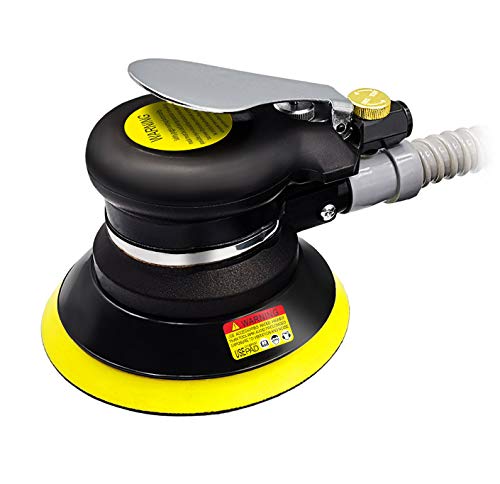 Air Random Orbital Sander, 5"6"Vacuum Air Sander, Dual Action Pneumatic Sander include5 inch 6 Inch Pads and sandpaper, Polisher for Car or Metal (Self-Vacuum)