Does MDF Split? Why It Happens and How to Stop It
MDF can split, but not nearly as easily as its reputation suggests. In practice, real splits trace back to one of three causes: a screw driven too close to an edge without a pilot hole, a sharp impact on an unsupported corner, or raw edges left unsealed so moisture swells the fibers until they force themselves apart. Handled the way a fiberboard actually needs to be handled – dry, pre-drilled, and supported while you cut – MDF holds up fine for shelving, cabinet parts, and most indoor furniture. This guide breaks down why MDF splits at a fiber level, which mistakes cause it most often, and the exact tools and techniques that stop it before you ever pick up a drill.
Why MDF Splits in the First Place
Prevents Splitting When Screwing Into MDF
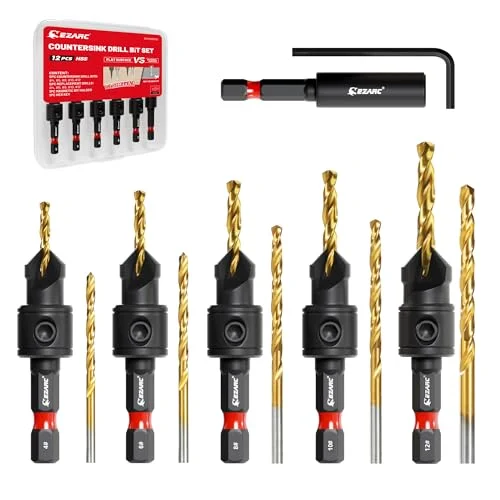 |
EZARC Countersink Drill Bit Set, 12PCS – $16.97 Drills the pilot hole and chamfers the surface in one pass – the single biggest fix for MDF splitting near screws, covered in the section below.
|
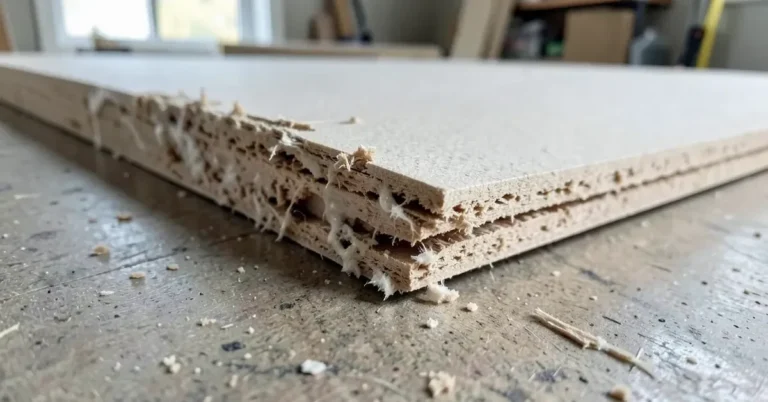
Solid wood resists splitting because its fibers run in one continuous direction, so a crack has to travel with the grain and the surrounding wood can flex to absorb the stress. Plywood goes a step further by cross-laminating thin veneers at alternating angles, so a crack in one layer runs into grain going the opposite way in the next. MDF has neither advantage. It’s made by breaking wood down into loose fibers, blending them with resin and wax, and pressing the mat flat under heat until the resin cures. Those fibers point in every direction at once, which is exactly what makes MDF so smooth and easy to machine – but it also means there’s no long grain to flex. When stress concentrates in one spot, the resin bond fails and the board fractures rather than bending. That’s the mechanism behind almost every MDF split: concentrated, localized stress with nowhere for the material to give.
Screws Are the #1 Cause of MDF Splitting
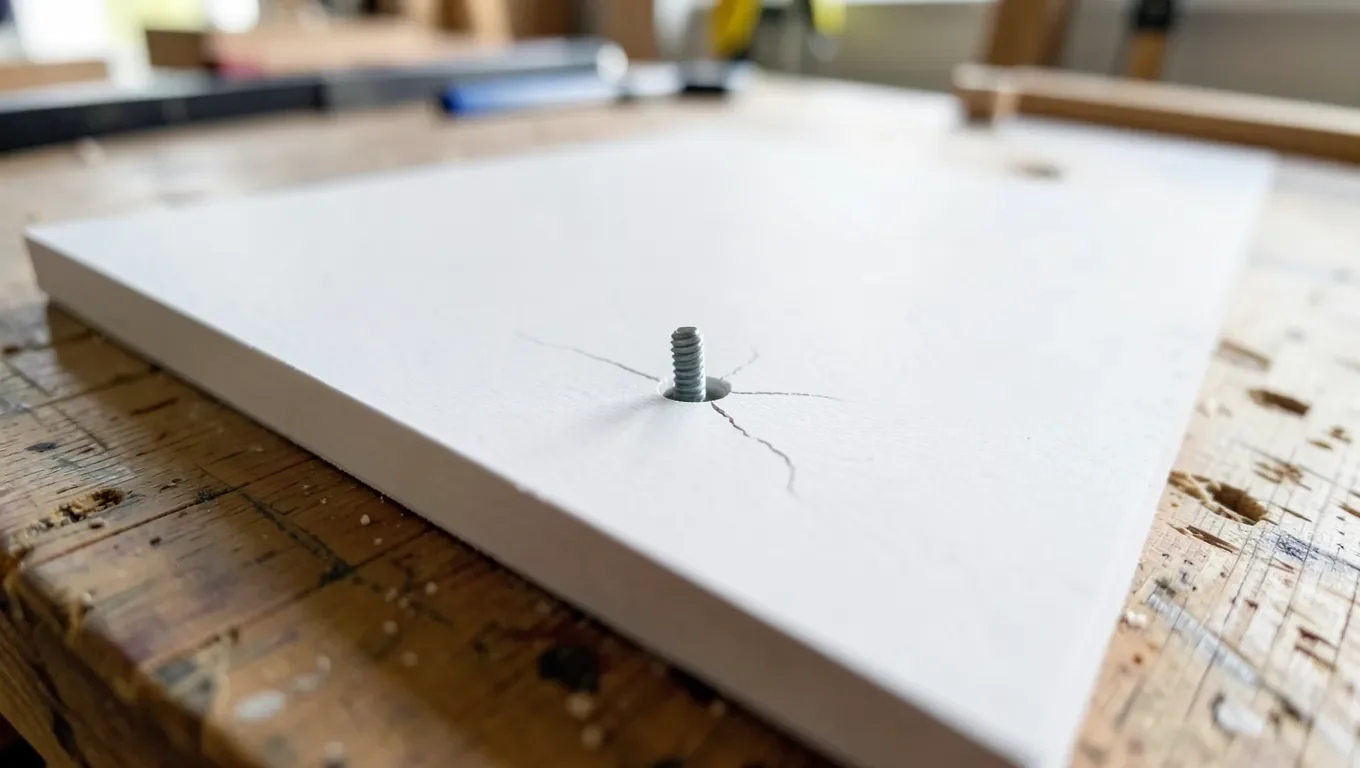
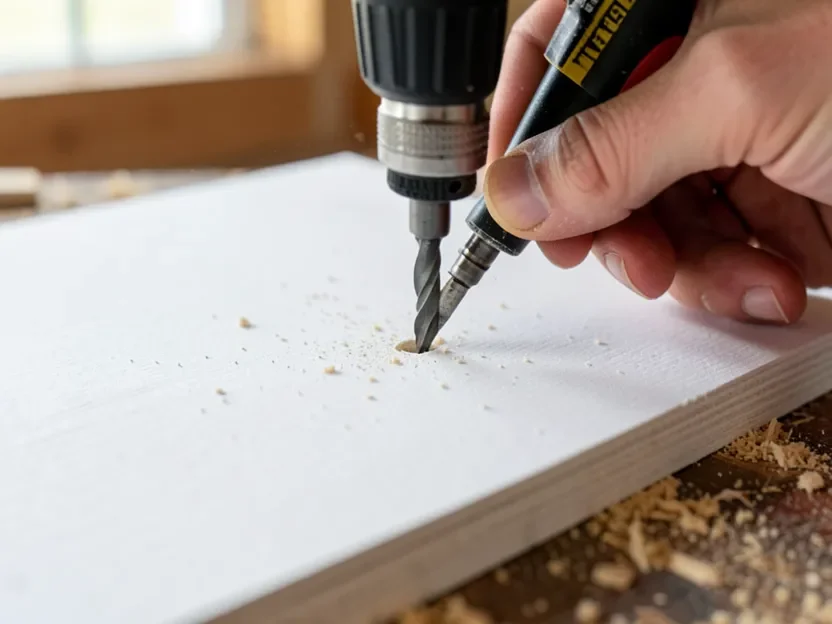
Most MDF splits happen during assembly, not during cutting. A screw driven straight into MDF without a pilot hole acts like a wedge — the threads have to displace fiber and resin to make room for themselves, and if that fiber has nowhere to compress into, the board cracks outward instead. Softwood can absorb some of that displacement because its cell structure compresses; MDF’s dense, uniform fiber mat can’t. Keep screws at least 1 inch (25mm) from any edge or corner, since that’s where a split has the shortest path to travel and the least surrounding material to resist it. Coarse-thread, self-tapping screws designed for particleboard and MDF cut their own channel more cleanly than standard wood screws, and a countersink bit that drills the pilot hole and chamfers the surface in one pass keeps the screw head from mushrooming the fibers around it. If you’re using an impact driver, drop the clutch setting for the last quarter-turn – over-tightening a screw that’s already seated is one of the most common ways a split shows up hours after assembly, not during it.
Moisture, Heat, and Impact: The Other Causes
Screws aren’t the only way MDF cracks. Raw, unsealed edges are porous and absorb moisture far faster than the smooth, resin-dense faces do, so a board stored in a damp garage or set near a sink without primer can swell unevenly and crack along that swollen edge – this is the same underlying mechanism covered in more depth in our guide to why MDF warps, though splitting and warping are different failure modes: warping is the board bowing as it absorbs moisture unevenly, while splitting is a fracture along a stress point. A dropped panel or a corner that takes a hard knock during transport can also crack MDF instantly, since there’s no flexible grain to absorb the shock the way solid wood would. Extreme heat is a slower threat: it dries out the resin binder over years, making the board more brittle and more likely to crack under stress it would have tolerated when new. None of these are reasons to avoid MDF – they’re just the specific conditions to plan around.
MDF vs. Plywood vs. Solid Wood: Splitting Behavior Compared
If splitting resistance is the deciding factor for a project, plywood generally outperforms MDF because its cross-laminated veneers interrupt a crack’s path and hold screws with real mechanical grip from the wood grain itself. MDF relies on friction between the screw threads and compressed fiber, which is weaker and more sensitive to pilot-hole size and edge distance. Solid wood sits in between: it splits more predictably along the grain line, which experienced woodworkers can actually work around by orienting cuts and screws with the grain, but it’s also prone to splitting from nails or aggressive fastening the same way MDF is. For a side-by-side breakdown of strength, moisture resistance, and cost between the two most common sheet goods, see our MDF vs. plywood buyer’s guide. In short: MDF isn’t the weakest option for every use case, but it is the least forgiving of poor fastening technique.
How to Cut MDF Without Splitting It
Use a carbide-tipped blade with a high tooth count – a 60- to 80-tooth blade on a table saw or circular saw leaves a cleaner edge than a standard 24-tooth ripping blade, which tends to tear the fiber mat instead of shearing it. Score the cut line first with a utility knife or a shallow first pass if your saw allows it; that single scored line keeps the underside from blowing out as the blade exits. Support the full length of the panel during the cut so it can’t flex or sag – unsupported overhang is a common cause of edge splits partway through a cut, especially on longer sheets. For curved or detail cuts with a jigsaw, a fine-tooth, downward-cutting blade and slow, steady feed pressure matter more than raw speed. Masking tape applied directly over the cut line before cutting also helps hold surface fibers in place on both plunge cuts and straight cuts, particularly with a jigsaw or router.
How to Drill and Screw Into MDF the Right Way
Pre-drill every hole – there’s no situation where skipping a pilot hole in MDF is worth the risk. Size the pilot hole to roughly 75% of the screw’s shank diameter so the threads still have material to bite into without having to force their way through solid fiber. A countersink bit that combines pilot-hole drilling with a chamfered recess for the screw head does this in one pass and keeps the surface from mushrooming or cratering around the fastener, which is its own small crack waiting to spread. Choose coarse-thread screws made for particleboard or MDF rather than standard fine-thread wood screws; the coarser thread grips the compressed fiber more securely with less torque. Never hammer a nail directly into MDF – the sudden shock has nowhere to disperse and almost always cracks the surface around the nail head. If a screw does strip out or a hole splits slightly, a drop of wood glue in the hole before re-driving the screw, or switching to a slightly larger screw, is usually enough to recover the joint without redoing the whole panel.
Fixing a Split or Cracked MDF Panel
A hairline split that hasn’t fully separated can usually be saved. Work wood glue into the crack with a thin applicator or a flexible putty knife, clamp the panel flat and closed while it cures, and wipe away squeeze-out before it skins over. For a crack that’s already opened up or chipped out a chunk of material, a two-part epoxy wood filler holds up better than standard wood filler because it doesn’t shrink as it cures and bonds more securely to the compressed fiber. Sand it flush once cured, then reseal the repaired area with primer before painting so it doesn’t absorb moisture differently than the surrounding surface. If the split runs through a load-bearing joint – a shelf pin hole, a cabinet corner, or anywhere weight transfers through the panel – reinforcing with a glued cleat or corner block behind the repair is more reliable than trusting filler alone to carry the load. A panel that’s split all the way through along a large section is usually faster and cheaper to replace than to rebuild.
Common Misconceptions About MDF Strength
The idea that MDF is fragile and will split under any normal handling isn’t accurate – it’s dense, heavy, and holds up well to everyday wear once it’s assembled correctly. The real vulnerability is concentrated at the point of installation: screws, edges, and moisture exposure, not general use. Another common misconception is that MDF can’t hold weight; a properly supported MDF shelf with correctly placed fasteners carries typical household loads without issue, it’s the fastening technique that determines whether it holds or splits, not the material itself. Finally, some assume any crack means the whole panel is compromised, but as covered above, most surface-level splits are a straightforward repair, not a reason to discard the piece.
Frequently Asked Questions
How To Keep MDF From Splitting?
Pre-drill every screw hole with a pilot bit sized to about 75% of the screw’s shank diameter, and keep all screws at least 1 inch from any edge or corner. Use coarse-thread screws made for particleboard or MDF, avoid hammering nails in directly, and store or seal MDF so raw edges don’t absorb moisture and swell.
Why Does MDF Split?
MDF splits because its wood fibers run in every direction and are held together by resin rather than a continuous grain, so there’s no flex to absorb concentrated stress from a screw, an impact, or swelling from moisture. Once that stress exceeds what the resin bond can hold, the fibers separate rather than bending.
What Is The Biggest Drawback Of Using MDF?
Its sensitivity to moisture is the biggest limitation – unsealed edges absorb water and swell, which can lead to warping or splitting, and MDF isn’t rated for outdoor or consistently damp use. Its weaker screw-holding power compared to plywood is the second most common practical drawback.
How Do You Cut MDF Without Splitting It?
Use a carbide-tipped blade with a high tooth count, score the cut line first to prevent blowout, and fully support the panel so it can’t flex during the cut. For jigsaw or detail cuts, apply masking tape along the line and use a fine-tooth, downward-cutting blade with slow, steady feed pressure.
The Bottom Line
MDF splits when it’s forced to absorb stress it has no grain to flex with – almost always at a screw near an edge, an unsealed edge exposed to moisture, or a hard impact on an unsupported corner. Pre-drill, keep fasteners away from edges, use the right screw type, and seal raw edges before they see any moisture, and splitting stops being a real concern for shelving, cabinets, and most indoor furniture builds.
Sponsored / affiliate links. As an Amazon Associate I earn from qualifying purchases. I may earn additional commission from eligible campaigns.