Medite MDF Review: Is It Worth the Price?
Medite MDF is worth the premium when you need a cleaner paint-ready finish, more reliable CNC or routing results, and less rework. If one bad sheet or an extra sanding cycle costs more than the price gap, buy Medite. Cheap MDF can fuzz, chip, or swell at cut edges, and that can turn a low sheet price into wasted labor and failed parts. This guide breaks down Medite’s finish quality, machining behavior, and where the extra cost pays back.
Medite MDF vs standard MDF

Surface quality and sanding
Medite Premier MDF is a premium MDF panel with a very smooth face. Standard MDF is the lower-cost benchmark, and the Medite Premier page says it can be rougher and need sanding. That difference matters most on visible painted parts, where face quality shows through primer and topcoat.
For furniture makers and shopfitters, that smoother face can cut the sanding needed before finishing. It does not remove prep work entirely. It does reduce the chance of sanding through fibers or chasing rough patches on the face and edges.
Machining and chip-out
Medite Premier is promoted for precision routing and CNC work, and the board is described as less prone to chipping than standard MDF. That matters at profiles, grooves, hinge cups, and shaped edges, where weak face layers can break out and force repair work.
Standard MDF can still machine well. It is just less forgiving. If the edge quality is hidden after assembly, the rougher board often makes more sense. If the edge will be painted and seen from normal viewing distance, Medite Premier is easier to justify.
Price versus labor saved
The real trade-off is not sheet price alone. It is sheet price against sanding time, edge repair, extra primer, and the chance of remaking a part. Medite Premier is higher priced than standard MDF, but that premium can cost less than one failed door or one extra finishing cycle on a small batch.
A common first-timer mistake is choosing the cheaper board for a painted cabinet door, then spending an hour fixing grain rise, fuzzy edges, and chip-out. The lower purchase price did not save money if the labor bill went up.
MDF cost-to-finish table
This comparison uses a typical cabinet door as the reference job. It is a decision table, not a price quote. The numbers can vary by thickness, supplier, and finish system, but the general labor pattern is the point: better board quality can save time where the finish is visible and the part needs to look clean.
| Project factor | Medite Premier MDF | Standard MDF | When the premium pays back |
|---|---|---|---|
| Board price premium | Higher upfront cost | Lower upfront cost | When the part is visible and labor matters more than the sheet price |
| Primer and paint savings | Typically less fill and less sanding before topcoat | Often needs more prep to even out the face | On painted furniture, especially flat fronts and framed door parts |
| Sanding time | Often reduced on faces and edges | More likely to need extra sanding passes | When you are finishing several doors or panels in one run |
| Edge sealing steps | Still needed before paint, but edges usually finish more cleanly | More likely to need extra sealing and touch-up work | When exposed edges must read as furniture-grade, not utility-grade |
| Failure-cost risk by use case | Lower risk for painted furniture and CNC parts; not the right fix for damp-room misuse | Higher risk of visible fuzzing or chip-out on show parts | When remake cost or finish failure costs more than the sheet gap |
What medite Premier MDF
Medite Premier MDF is a premium MDF panel aimed at furniture makers, shopfitters, and interior designers. The product is described as having a very smooth face, being ideal for painted finishes with minimal prep work, and being suitable for precision routing and CNC work. It is also rated E1 for low emissions.
Who it
Use Medite Premier when the part will be seen, painted, and handled closely. That includes door fronts, display parts, trim, panels, and shopfitting components where finish quality affects the final result. It fits jobs where the board itself is part of the surface system, not just a hidden core.
Why the surface matters
Painted MDF lives or dies by the face. A smooth board cuts the work needed before primer and topcoat, and that can lower the chance of telegraphing defects through the paint film. The cleaner the face, the less time you spend trying to bury texture with extra coatings.
Suppose you are building four shaker-style cabinet doors for a laundry room. If the face is rough, every part may need extra sanding and another coat of primer. If the board is smoother, the finishing schedule is more predictable, and the doors are less likely to need touch-up later.
How well does Medite machine?
Medite Premier machines well because the board is made for clean cutting and precision work. It is suitable for precision routing and CNC work, and it is described as chipping less than standard MDF. For joinery, that means cleaner edges, more reliable profiles, and less breakout at corners and cut lines.
Routing and edge profiling
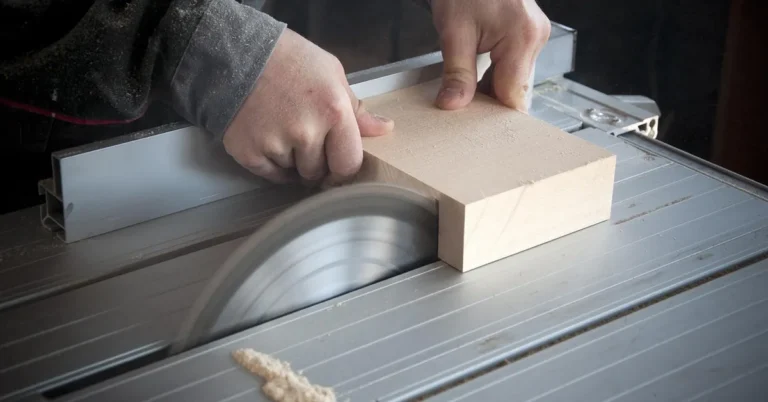
For routing, a sharp carbide bit matters more than brute force. Straight bits, flush-trim bits, and profile bits should stay sharp, and climb cuts should be used carefully where breakout is a concern. If you are edge profiling painted parts, take lighter passes rather than forcing a deep cut in one go.
Keep feed speed steady and avoid dwelling in one spot, especially on faces that will be painted. Slow, stalled passes can burnish the edge and increase tear at the cut line. A clean first pass usually leaves less cleanup later.
CNC cutting
For CNC work, the board’s smooth faces and low chip-out risk are the main selling points. A spoilboard, correct hold-down, and a sharp cutter do the rest. The more detailed the profile, the more the board quality matters, because tiny chips are harder to hide on painted parts.
Use a cutter and feed rate that match the thickness and tool diameter, and test a small offcut before cutting a full panel batch. That helps you catch edge fuzz, lift, or tool marking before the part count gets expensive.
Reducing blowout and splits
Pre-drill fixings to avoid splits at screw points, especially near edges and narrow rails. MDF does not split like solid wood, but it can break out or mushroom around fixings if the hole pattern is poor. Clean drilling and support under the workpiece help keep the face intact.
What finish does Medite take best?
Medite Premier is ideal for painted finishes. It is described as suitable for minimal prep work, high-quality primer, spray paint, and light sanding between coats. That is the finish path that makes the most sense for this board. It is not the board you buy for a natural wood look.
Painted finishes
Choose paint when you want a uniform, furniture-grade surface. Medite Premier is built for that job. Spray-applied primer and paint usually give the cleanest result on MDF, especially on flat fronts and moulded details that would be tedious to brush evenly.
Primer choice and light sanding
Use a primer designed for MDF or a high-build primer that can even out face texture and edge absorption. Light sanding between coats is still part of the process. The goal is not to grind the surface flat. It is to knock down nibs and keep the film level.
A common first-timer mistake is using cheap MDF for painted cabinet doors and assuming the filler and primer will hide every seam, only to find the edges swell and telegraph through the finish. Once the primer raises fine fibers, the surface can feel rough again. A quick light sanding after each coat keeps the finish tight and improves the final gloss or sheen.
Edge sealing before paint
Edge finishing is still necessary. Apply edge sealer before painting, then sand and prime. You can also use edge banding where the design allows it. The edges absorb more finish than the faces, so they need extra attention if you want a consistent paint build.
Medite Premier, MR, and FR compared
Do not treat Medite Premier and Medite MR as the same product. Medite Premier is the smooth, paint-ready panel. Medite MR is the moisture resistant variant. Medite FR is the fire-rated product. They solve different problems, and buying the wrong one can leave you with the right sheet for the wrong job.
| Variant | Primary use | Key point | What to verify before ordering |
|---|---|---|---|
| Medite Premier | Painted furniture, shopfitting, interior panels | Very smooth surface, clean machining, E1 low emissions | Product name and data sheet for the exact thickness |
| Medite MR | Humid areas and moisture-prone interiors | Different product from Premier, not a substitute by default | That the stock is Medite MR, not Premier |
| Medite FR | Fire-sensitive applications | Class A flame spread rating and no added formaldehyde, or NAF | FR data sheet and project compliance wording |
Moisture resistant MDF
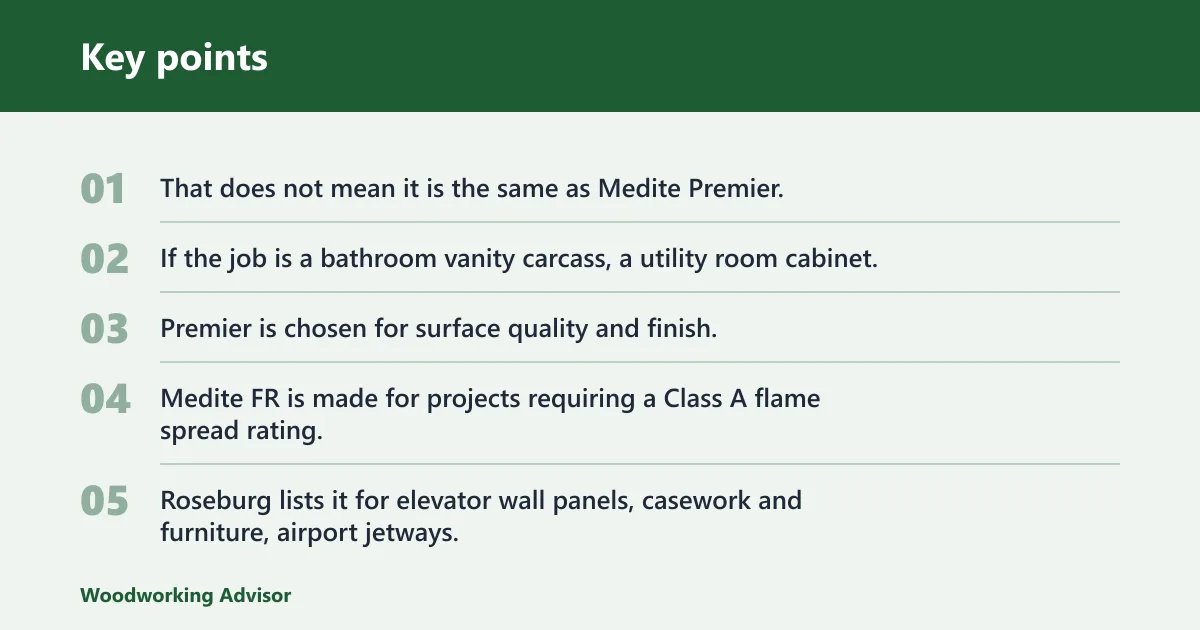
Medite MR is for humid areas. That does not mean it is the same as Medite Premier. If the job is a bathroom vanity carcass, a utility room cabinet, or another moisture-prone interior, check for the MR designation rather than assuming Premier will do the same job.
Premier is chosen for surface quality and finish. MR is chosen for moisture resistance. Those are different purchase decisions.
Fire-rated MDF
Medite FR is made for projects requiring a Class A flame spread rating. Roseburg lists it for elevator wall panels, casework and furniture, airport jetways, and kiosks. The same product page says it has no added formaldehyde, abbreviated NAF, and Roseburg offers technical resources including a technical data sheet for Medite FR.
If the spec calls for fire-rated material, do not substitute Premier or MR without checking the project documents. Fire performance is a compliance issue, not a finish preference.
Low-emitting and E1 notes
Medite Premier is rated E1 for low emissions. For the buyer, that matters in interior work where emissions language appears on the order or spec sheet. For Medite FR, the NAF wording and TSCA Title VI-related compliance language should be verified on the product data sheet before purchase, not assumed from the family name.
Choose Medite Premier MDF if… / Choose standard MDF if…
Choose Medite Premier when the face will be painted, seen, and judged up close. Choose standard MDF when the part is hidden, the budget is tight, or the finish does not justify extra labor. The right board depends on risk, not brand loyalty.
Choose medite premier MDF if…
- You need a cleaner painted finish on visible doors, panels, or trim.
- You are routing profiles or running CNC parts where chip-out would mean rework.
- You want to save sanding and edge repair time on a small production run.
- You are building shopfitting or furniture parts where the surface is part of the product value.
Choose standard MDF if…
- The part is hidden after assembly, such as internal carcass members or backers.
- The job is a budget build and finish appearance is not the priority.
- You can tolerate extra sanding and a rougher surface before paint.
- You are not dealing with a humid-room or fire-rated specification.
When neither is the right board
For damp rooms, use Medite MR only if the project calls for moisture resistant MDF. For fire-rated work, use Medite FR only if the spec requires the Class A flame spread rating and the related compliance language. For exterior exposure, neither standard MDF nor Premier is the right choice.
Picture a painted cabinet side that will sit beside a sink in a busy utility room. If the board choice ignores moisture exposure, the finish can fail at the cut edges no matter how smooth the face looked on the bench. The wrong product saves money only until the first swollen edge appears.
Frequently asked questions
What is Medite MDF?
The Premier board is described as very smooth, E1 low emissions, and suitable for furniture makers, shopfitters, and interior designers who need a better painted finish and cleaner machining.
Is Medite MDF worth the extra price?
Yes, when the board is used for visible painted work or precision machining where rework is costly. The premium is easier to justify if smoother faces, less sanding, and lower chip-out risk save time. For hidden parts, the extra spend is often harder to defend.
Is Medite more expensive than normal MDF?
Yes. Medite Premier is higher priced than standard MDF. The buying decision should focus on total project cost, not sheet price alone. If the board saves sanding, primer, edge repair, or remakes, the higher price can still be the cheaper choice overall.
Where can I buy Medite MDF?
Buy from a stockist that can name the exact product variant, thickness, and data sheet. Verify whether you need Medite Premier, Medite MR, or Medite FR before ordering. For FR jobs, ask for the technical data sheet and confirm the Class A flame spread and NAF wording.
Is Medite MDF fire rated?
Medite Premier is not the fire-rated product. Medite FR is the version made for projects requiring a Class A flame spread rating. The same source says Medite FR has no added formaldehyde, and the technical data sheet should be checked for the exact compliance language tied to the job.
What is the difference between Medite Premier and standard MDF?
Medite Premier has a very smooth surface, is promoted for painted finishes with minimal prep work, and is suitable for precision routing and CNC work. Standard MDF is cheaper, may be rougher, and may need sanding. Premier is the better choice when finish quality and labor savings matter most.
Sponsored / affiliate links. As an Amazon Associate I earn from qualifying purchases. I may earn additional commission from eligible campaigns.