Feet and Inches Calculator: Jobsite Math Reference
A feet and inches calculator often adds, subtracts, multiplies, divides, and converts mixed measurements by turning values into inches first, then converting back to feet, inches, and fractions. Bad math here means wrong cuts, wasted stock, and parts that do not fit. This guide shows safe jobsite workflows for fraction math, carry rules, decimals, and metric conversions.
How is this calculated?
Press Calculate to see the math with your numbers.
What a feet and inches calculator does


A feet and inches calculator handles add, subtract, multiply, and divide operations after converting inputs to one unit. It accepts whole numbers, fractions, decimals, and mixed numbers, then returns results as feet, inches, fractional inches, or metric values. That workflow keeps tape-measure math steady on the job.
Why one unit first matters
One foot comprises 12 inches. The foot is a unit of length in US customary and imperial systems, and it can be abbreviated as ft. The prime symbol is used for feet. Because inches roll over at 12, mixed-unit math gets messy fast unless the calculator converts first.
The inch is one-twelfth of a foot. That makes it simple to convert feet to inches by multiplying by 12, and that same 12:1 ratio is what the Inch Calculator page uses for feet to inches conversion. For layout work, that common unit keeps carry and borrow decisions clear.
Common input types
- Whole feet and whole inches, such as 7 ft 9 in.
- Fractional inches, such as 1/4, 1/16, or 1/64.
- Mixed numbers, such as 1 1/2 or 25 3/4.
- Decimals, especially when using spreadsheets or calculators set to decimal mode.
- Metric input and output when the job starts in millimeters or centimeters.
According to Feet to Inches Converter (ft to in) – Inch Calculator — The Inch Calculator page converts feet to inches using a 12:1 ratio.
How do I add feet and inches calculator style?
Add feet and inches by converting both measurements to inches, adding the totals, then converting back to feet and inches. Carry any total above 12 inches into feet before rounding. Round only after the final total is known, or the result can drift off by a fraction that matters at the saw.
Safe addition workflow
- Convert each measurement to inches.
- Add the inch values.
- Carry every 12 inches into 1 foot.
- Keep the remaining inches and fraction.
- Round to the tape fraction only at the end.
Example: 5 ft 9 3/8 in plus 2 ft 11 5/8 in becomes 69 3/8 in plus 35 5/8 in, which totals about 105 in. That converts to 8 ft 9 in exactly. The carry happens once, not twice, and the fraction cancels cleanly because 3/8 plus 5/8 makes a full inch.
How do I subtract feet and inches without getting fractions wrong?
Subtract feet and inches by turning both values into one unit before the math starts. If the top number is smaller, borrow 12 inches from the foot count instead of forcing a bad fraction. Check the sign before and after subtraction so a negative result does not get written as a positive cut length.
Borrowing inches the right way
Suppose the cut list says 6 ft 2 in and the actual opening measures 5 ft 10 1/2 in. Convert both to inches: about 74 in and 70 1/2 in. Subtract to get 3 1/2 in. No awkward borrowing is needed once the numbers are in a single unit.
When the inch value on top is smaller, borrow 12 inches from the feet column. That turns 5 ft 2 in into 4 ft 14 in, which can make subtraction from 3 ft 11 in easier to follow without losing track of the remaining inches. This is the same carry rule in reverse.
Failure cases to watch
- Typing 3 7/8 as 37/8 and reading it as a fraction with the wrong value.
- Forgetting that 0 in is still part of the total, so carry can change the feet count.
- Subtraction that crosses zero and should be negative.
- Rounding before subtraction, which can hide a real gap or oversize part.
How do I multiply feet and inches for length or area?
Multiply feet and inches by converting to inches or decimal feet first, then do the calculation in one unit. Use length × width for area, and keep the answer in square feet or square inches depending on the cut list. For trim and sheet goods, the best unit is the one the layout marks on the stock.
When to stay in feet and when to switch to inches
For large area work such as flooring or drywall count, square feet is usually the cleaner result. For trim, face frame parts, or cabinet parts, square inches or straight inches often fit the workflow better because the saw and tape both read that way. Convert early if the layout needs small fractions.
Example: 8 ft 6 in by 4 ft 0 in can be treated as 102 in by 48 in. That gives 4,896 square inches. Divide by 144 to get about 34 square feet. If the project needs a board-foot-style layout or a precise panel cut, the inch-based figure is easier to audit.
Area from length multiplication
The tool can show results in ft² and in² for multiplication. That matters when a room, panel, or bench top needs both a broad estimate and a cut-ready number. A shallow area answer that stops at feet can leave the shop short on the last piece.
How do I divide feet and inches into equal parts?
Divide feet and inches by converting the full measurement to one unit, dividing, and then converting the answer back to feet, inches, or fractions. That is the cleanest way to split a run for spacing, equal rips, or panel layouts. It also keeps repeating fractions from being entered by hand.
Using division for spacing and rips
If a 10 ft span needs five equal spaces, convert to 120 inches and divide by 5. The result is 24 inches per space. If the answer is not a whole inch, convert it to the nearest tape fraction only after the division is finished.
- Convert the total run to inches.
- Divide by the number of spaces or parts.
- Convert the quotient back to feet and inches.
- Round to the nearest useful tape fraction.
This method is especially useful for framing layout, stair trim spacing, and shelving where repeated marks must stay consistent. One bad divide-and-round step can compound across the whole run.
What is the difference between feet and inches and decimal feet?
Feet and inches uses mixed units, while decimal feet stores the same length as one decimal number. Decimal feet is easier for spreadsheets and quick calculation because it avoids mixed-number arithmetic. Feet and inches is usually easier at the bench because the tape measure already shows feet, inches, and fractions.
When decimal feet helps
Use decimal feet when entering dimensions into a spreadsheet, calculator app, or estimating sheet. A value like 6.5 ft is faster to multiply than 6 ft 6 in. But on the jobsite, converting decimal feet back to tape fractions before the cut keeps the dimension aligned with the saw and the mark.
How to enter 3 7/8 inches correctly
Mixed numbers are entered as a whole number followed by a space and then the fraction, such as 3 7/8. That is different from 37/8, which means a single fraction. The same rule applies to 1 1/2 and 25 3/4. Spacing matters because it tells the calculator where the whole inches end and the fraction begins.
How do I convert feet and inches to centimeters or meters?
Convert feet and inches to metric by turning the length into inches first, then converting inches to centimeters or meters. One inch equals 2.54 centimeters, one foot equals 0.3048 meters, and one foot equals 30.48 centimeters. For woodworking, millimeters often give the most practical metric precision.
Metric conversion and practical precision
When the stock came in metric, it is usually better to keep the work in millimeters until the last layout mark. That avoids repeated rounding between imperial and metric systems. If the plan calls for imperial cuts, convert once, write the number down, and do not bounce back and forth.
Example: 24 in equals 60.96 cm and 0.6096 m. A calculator may show more digits than the layout needs. For trim or framing, round to the nearest practical mark only after the final conversion, not before.
How do I round feet and inches to the nearest tape measure fraction?
Round feet and inches only after the final calculation, and round to the fraction that the tape and saw can actually hold. Common fractional inches are 1/8, 1/16, 1/32, and 1/64. If the project demands a cleaner cut, use the coarsest fraction that still keeps the part in tolerance.
Choosing the right tape fraction
For rough framing, 1/8 in may be enough. For cabinet parts and trim, 1/16 in is often the safer floor. For fine fitting and layout transfer, 1/32 in or 1/64 in can help, but only if the measuring and cutting setup can repeat that precision.
A good rule is simple: round away from the dangerous side. For an inside fit, a tiny bit short can be safer than a bit long. For an outside face or visible reveal, the opposite may be true. The calculator should support the fraction you plan to cut, not the one that is easiest to type.
Jobsite measurement cheat sheet: when to round and carry
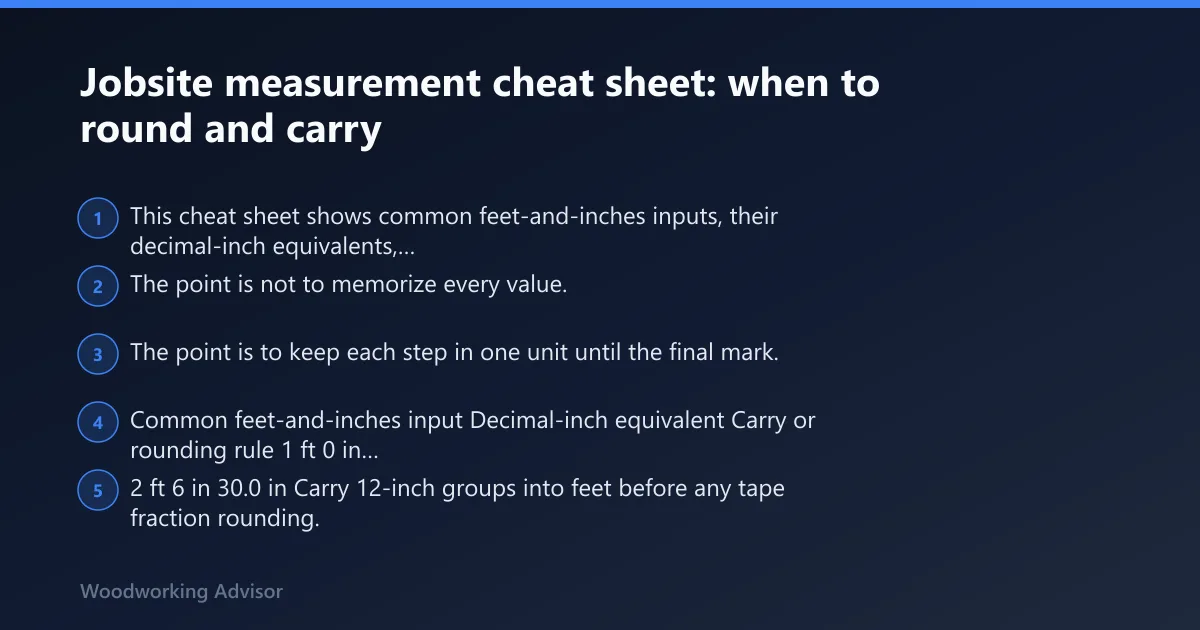
This cheat sheet shows common feet-and-inches inputs, their decimal-inch equivalents, and the carry or rounding rule to use on woodworking cuts and layout. The point is not to memorize every value. The point is to keep each step in one unit until the final mark.
| Common feet-and-inches input | Decimal-inch equivalent | Carry or rounding rule |
|---|---|---|
| 1 ft 0 in | 12.0 in | No rounding needed; use as the base carry unit. |
| 2 ft 6 in | 30.0 in | Carry 12-inch groups into feet before any tape fraction rounding. |
| 3 7/8 in | 3.875 in | Keep the fraction through the final step; round only to the tape fraction you can cut. |
| 5 ft 11 1/2 in | 71.5 in | Carry to 6 ft 0 1/2 in if another inch is added; do not round early. |
| 8 ft 3 1/16 in | 99.0625 in | Use 1/16 in or finer only if the cut and mark can repeat it cleanly. |
| 10 ft 0 in | 120.0 in | Use as a reference line for equal spacing and panel layout. |
Frequently asked questions
How do I multiply feet and inches calculator values?
Convert both values to inches or decimal feet, multiply, and then convert the result back to the unit needed for the cut list. For area, keep the answer in square feet or square inches. This prevents the common error of multiplying feet and inches as if they were separate whole numbers.
How do I divide feet and inches into a usable result?
Convert the total to one unit, divide, and then convert the quotient back to feet, inches, or a fraction that matches the tape. This is the cleanest way to split a run for spacing, rips, or repeated layout marks without losing track of the remainder.
Sponsored / affiliate links. As an Amazon Associate I earn from qualifying purchases. I may earn additional commission from eligible campaigns.