Wood Stove BTU Calculator: How Much Heat Do You Need?
Use a wood stove BTU calculator to estimate about 20 to 30 BTU per square foot for average homes, then adjust upward for colder climates, weaker insulation, or tall ceilings, and check that the stove’s tested output range aligns with that estimate. Too much stove output wastes fuel and can make clean burns harder; too little leaves rooms cold. This guide shows how to set a BTU target and compare it with real tested stove output instead of a marketing heat-area claim.
How is this calculated?
Press Calculate to see the math with your numbers.
What size wood stove do you need?

- Heats up to 2,000 square feet
- Accepts logs up to 21 inches
- Large ash pan and air wash system
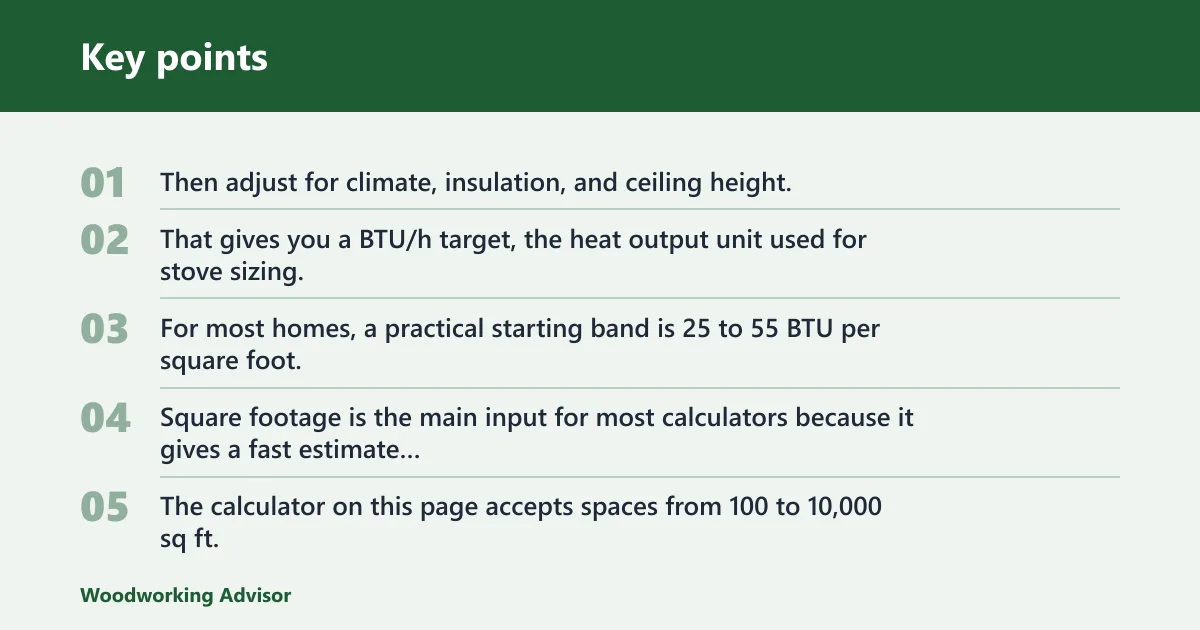
Start with square footage. Then adjust for climate, insulation, and ceiling height. That gives you a BTU/h target, the heat output unit used for stove sizing. For most homes, a practical starting band is 25 to 55 BTU per square foot, with 8-foot ceilings as the baseline.
Start with square footage
Square footage is the main input for most calculators because it gives a fast estimate of heating load. The calculator on this page accepts spaces from 100 to 10,000 sq ft. A 1,000 sq ft home usually needs a very different stove class than a 2,000 sq ft home.
Adjust for climate zone
Climate zone changes the target fast. Mild climates are sized at 25 BTU/sq ft, moderate climates at 35 BTU/sq ft, cold climates at 45 BTU/sq ft, and very cold climates at 55 BTU/sq ft. State or province matters here, because two homes with the same floor area can need very different output.
Check insulation and ceiling height
Insulation quality can shift the size by roughly 15 to 20 percent. Older drafty homes often need more output than newer tight homes. Ceiling height matters too: 8 ft is the standard baseline, 9 ft adds some load, and vaulted rooms raise the heated air volume further. Higher ceilings mean more BTU demand.
How do you calculate wood stove BTU?
Use BTU per square foot as the starting point, then apply climate, insulation, and ceiling factors. That gives a design-day heat load, which is more useful than guessing from marketing copy. If the stove will heat only one floor or an open connected zone, size for the space that will actually receive the heat.
Use BTU per square foot as the base
Most homes land in the 25 to 55 BTU per square foot band. Multiply your floor area by the climate rate first. A home around 1,000 square feet in a moderate climate may start near 35,000 BTU per hour before insulation or ceiling-height adjustments are considered.
Apply common home-condition adjustments
A common adjustment is to move up one sizing step for poor insulation or higher ceilings. A tight, average-insulated home with 8 ft ceilings can stay near the base number. A drafty older house with leaky windows, less wall insulation, or taller rooms often needs roughly 15 to 20 percent more output.
Account for partial heating zones
Open-plan layouts heat differently from closed rooms. If the stove will heat one floor, a connected great room, or a run of adjacent rooms, use the area that can share heat freely, not the entire house if doors stay closed. A stove does not move heat through the whole building at the same rate everywhere.
Suppose a 1,000 sq ft main floor has an open kitchen, dining area, and living room with a stair opening to the hall. That connected zone may behave more like one heating area than three separate rooms, so the stove target should match the shared space rather than each room counted alone.
Enter square footage, climate, insulation, and ceiling height, then compare the result with a stove’s tested output range. For average-insulated homes with 8 ft ceilings, the calculator should give a baseline heat output before you consider room layout or a drafty shell.
Input fields and assumptions
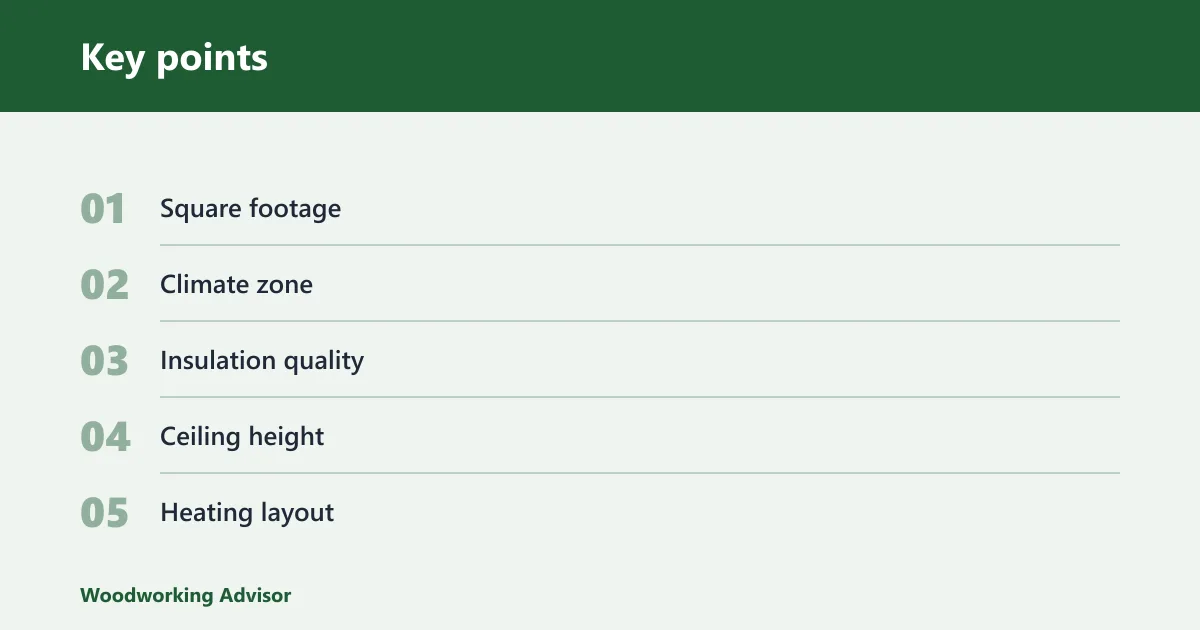
Use these inputs:
- Square footage: the area you want the stove to heat.
- Climate zone: mild, moderate, cold, or very cold.
- Insulation quality: good, average, or poor.
- Ceiling height: 8 ft, 9 ft, or vaulted.
- Heating layout: closed rooms, open plan, or connected rooms.
The quick chart below uses average insulation and 8 ft ceilings as the baseline. That is the starting point, not the final answer for every house. If your home is older, draftier, or taller, move up from there.
Sample outputs for small, medium, and larger homes
| Example home size | Estimated BTU need | Typical advertised heating area | Tested output range to look for |
|---|---|---|---|
| Up to 500 sq ft | About 12,500 to 27,500 BTU/h | Often listed around 500 sq ft | 20,000 to 25,000 BTU |
| 1,000 sq ft | About 25,000 to 55,000 BTU/h | Often listed around 1,000 sq ft | 25,000 to 45,000 BTU |
| 2,000 sq ft | About 50,000 to 110,000 BTU/h | Often listed around 2,000 sq ft | 45,000 to 100,000 BTU |
How to read the result
Use the calculator output as your target, then look for candidate stoves whose tested output range overlaps that target. A stove can have a large advertised heating area and still be a poor fit if its tested range sits too high or too low for your home. The tested range is the sizing number that matters most.
A common first-timer mistake is choosing a stove because the ad says it heats 2,000 sq ft, then placing it in a 900 sq ft open-plan home with mild winters. If the tested low end still starts above that home’s load, the stove may run too cool and make too much creosote.
BTU sanity-check table
This table shows how to compare three numbers at once: your estimated BTU need, the advertised heating area claim, and the tested output range. If the numbers disagree, trust the tested output range first. The heating-area claim is less standardized and changes more from brand to brand and test method to test method.
| Example home | Estimated BTU need | Advertised heating area claim | Tested output range to look for |
|---|---|---|---|
| Small home, 500 sq ft | About 12,500 to 27,500 BTU/h | Up to 500 sq ft | 20,000 to 25,000 BTU |
| Medium home, 1,000 sq ft | About 25,000 to 55,000 BTU/h | About 1,000 sq ft | 25,000 to 45,000 BTU |
| Large home, 2,000 sq ft | About 50,000 to 110,000 BTU/h | About 2,000 sq ft | 45,000 to 100,000 BTU |
If your numbers disagree: pick the stove whose tested output range fits your load, even if another model advertises a larger heating area. The heating-area claim is a marketing number, not a design load. The tested range gives you a better chance of matching the stove to the house without oversizing.
How do you read stove listings?
Read stove listings in this order: recommended heating area, minimum and maximum tested output, and then the EPA Certified Wood Heater Database entry. The heating-area number is a broad claim. The tested output range tells you what the stove is actually certified to produce under test conditions.
Recommended heating area
Most manufacturers publish a recommended heating area, often in square feet. That number varies by brand and test method, so it should not be treated as the same thing as actual design load. Two stoves with the same listed area can have very different tested output ranges.
Minimum and maximum tested output
Look for the tested output range, not the biggest marketing number. The low end matters because it shows how far down the stove can turn while still operating within its tested band. That matters in shoulder season and in smaller homes, where an oversized stove can run too hot or too cool.
Where to verify in the EPA database
Use the EPA Certified Wood Heater Database to compare candidate models and check their listed details. Check that the stove is currently certified, then compare its minimum and maximum tested output against your target. If the listing gives a wide heating-area claim but the tested range sits outside your calculated need, keep looking.
Should you size up or down?
Size up for drafty homes and cold climates, but only within reason. Size down if the stove will heat a small, tight space or a partial zone. Avoid the trap of buying the largest model on the shelf, because a stove that is too large often burns poorly at low demand and can create more creosote.
Drafty homes and cold climates
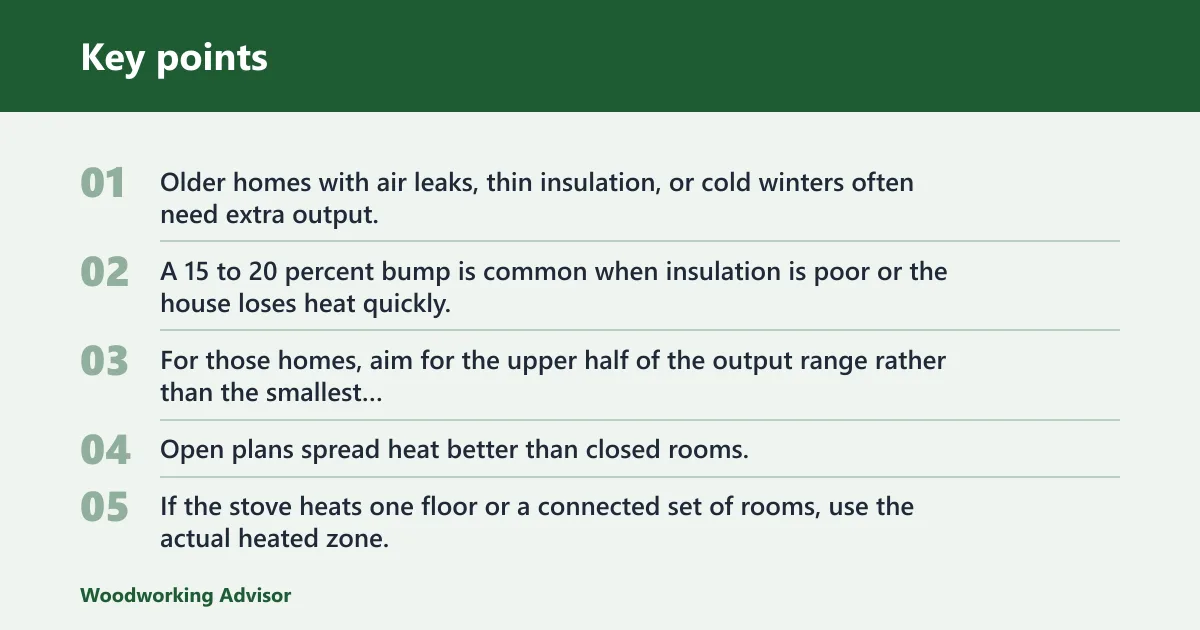
Older homes with air leaks, thin insulation, or cold winters often need extra output. A 15 to 20 percent bump is common when insulation is poor or the house loses heat quickly. For those homes, aim for the upper half of the output range rather than the smallest stove that barely covers the square footage.
Open plans and one-floor heating
Open plans spread heat better than closed rooms, so you may not need to size all the way up for every square foot in the building. If the stove heats one floor or a connected set of rooms, use the actual heated zone. A stove meant for the whole house can be too much for one open level.
How to avoid oversizing
Do not choose a stove from maximum marketing output alone. Check the low end of the tested range, the size of the zone you want to heat, and the house’s insulation level. Oversized stoves can idle too much, burn dirty, and leave more creosote in the flue.
Picture a 1,000 sq ft home with average insulation and 8 ft ceilings. A model listed for 2,000 sq ft may look appealing, but its tested range may sit above the home’s real load. A smaller model with a lower tested band often runs cleaner and is easier to control.
Frequently asked questions
How many BTU is a stove?
There is no single stove BTU number. Most homes need 25 to 55 BTU per square foot, so the right stove depends on the area, climate, insulation, and ceiling height. A 1,000 sq ft home can land anywhere from about 25,000 to 55,000 BTU/h before fine-tuning.
What BTU wood stove do I need for my house?
Match the stove’s tested output range to your calculated load, not the biggest heating-area claim. For a 1,000 sq ft home, a common starting point is 25,000 to 45,000 BTU listed in the tested range, with more output needed for poor insulation, colder climate, or taller ceilings.
What size wood stove do I need for 1,000 square feet?
A mild, tight home sits near the low end. A drafty or colder home needs more headroom.
Should I size up or down if my house is drafty?
Size up modestly if the house is drafty, because poor insulation can raise the heating need by about 15 to 20 percent. Do not jump to the largest stove available. Pick a tested range that covers the load without pushing you into a model that will idle too much.
Do pellet stoves size the same way as wood stoves?
Pellet stoves are sized with similar square-foot and climate logic, but the fuel and control behavior differ. Do not assume a wood stove and pellet stove with the same heating-area claim will behave the same. Compare their tested output ranges, pellet feed controls, and the space they actually need to heat.
Sponsored / affiliate links. As an Amazon Associate I earn from qualifying purchases. I may earn additional commission from eligible campaigns.