How Do You Calculate the Value of Timber? (MBF Formula)
Timber value = volume (in thousand board feet, or “MBF”) multiplied by the current stumpage price for that species and grade in your region — a stand with 8,000 board feet of red oak at $300/MBF is worth roughly $2,400 for that species alone. Species and log quality swing the price more than volume does: veneer-grade white oak can bring 3-4x what pulpwood-grade red oak brings per MBF. This guide covers the real formula, current regional price ranges, and the tools foresters actually use to measure a stand.
Quick Answer
Measure timber volume in thousand board feet (MBF), then multiply by the current per-MBF stumpage price for that species and grade in your region (check your state forestry extension’s price report). Example: 8 MBF of red oak × $300/MBF stumpage = $2,400. Get a professional forester’s cruise before selling — species mix and log quality change the price far more than a rough volume estimate can capture.

The Timber Value Formula: Volume × Price Per MBF (and How to Measure Volume)
Best Timber Cruising Tool Pick
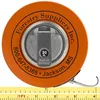
Forestry Suppliers English Fabric Diameter Tape – $58.99
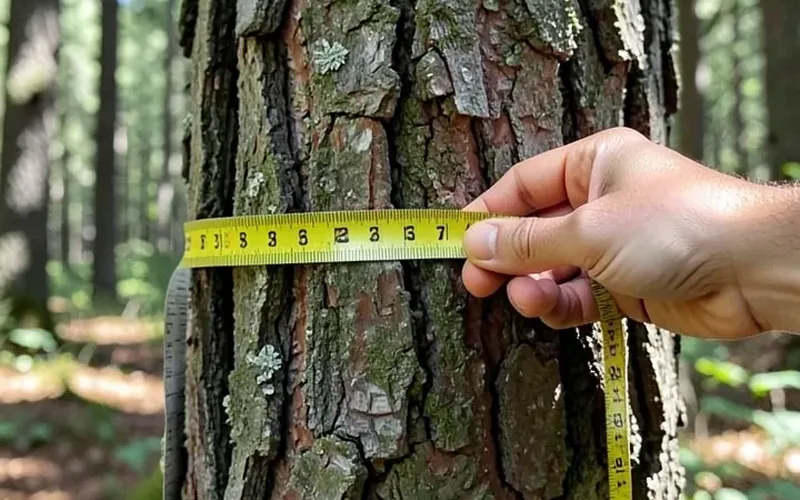
This is the actual tool behind the DBH measurement this guide’s formula depends on — wrap it around the trunk and read diameter directly instead of estimating by eye.
- Best for: Landowners doing their own rough volume estimate before calling in a professional cruise
- Why we picked it: Reads diameter directly (circumference × π conversion built into the graduations) — no math needed in the field
- Main drawback: A DIY estimate still isn’t a substitute for a licensed forester’s cruise before an actual sale
As an Amazon Associate we earn from qualifying purchases.
Timber isn’t priced per board foot the way lumber at a store is — standing timber is priced per thousand board feet (MBF). The formula is simple once you have both numbers:
Timber Value = (Volume in board feet ÷ 1,000) × Stumpage Price per MBF
Volume comes from a timber cruise — measuring tree diameter and estimating height across your stand, then converting to board feet using a log rule (Doyle and Scribner are the two most common). Stumpage price is what a buyer pays for standing timber before harvest, and it varies by species, grade, and your regional market. Neither number is optional: a stand’s volume without a real regional price is a guess, and a per-MBF price without an accurate volume estimate is meaningless.
Worked Example
| Species | Volume (MBF) | Typical Stumpage Price/MBF* | Estimated Value |
|---|---|---|---|
| White oak (sawlog grade) | 5 | $300 – $600 | $1,500 – $3,000 |
| Red oak (sawlog grade) | 8 | $200 – $400 | $1,600 – $3,200 |
| Mixed pine sawtimber | 10 | $150 – $250 | $1,500 – $2,500 |
*Regional Midwest/Southeast ranges — your local price will differ. Always check a current regional report before pricing a sale.
📊 Quality white oak sawlogs bring $300 to $600 per thousand board feet, while red oak typically runs $200 to $400/MBF in Midwest and Southeastern markets. — Source: NC State Extension, 2026 Standing Timber Price Report
Measuring Timber Volume
Professional foresters use a timber cruise — measuring a representative sample of trees across the stand rather than every single one — combined with forest inventory methods to estimate total volume. Two measurements drive the estimate for each tree: diameter at breast height (DBH, measured 4.5 feet up the trunk) and merchantable height (how many usable log lengths the tree contains).
Using a Biltmore Stick or Diameter Tape
A Biltmore stick is a calibrated ruler you hold against the trunk at arm’s length to read diameter directly, adjusted for your specific arm length. A diameter tape works even more directly — wrap it around the trunk at breast height and read the diameter straight off the tape (it’s graduated using circumference = π × diameter, so it converts automatically). Combine the diameter reading with an estimated or measured merchantable height, then look up the board-foot volume in a standard volume table for that species.
Species, Size, and Quality Drive Price More Than Volume
Two stands with identical volume can be worth very different amounts. Species sets the baseline — high-value hardwoods like white oak, black cherry, and walnut bring far more per MBF than pine or low-grade red oak. Within a species, grade matters just as much: a straight, defect-free log destined for veneer can bring 3-4x the price of the same species graded as sawlog, and a log with rot, sweep (curve), or heavy knots may only qualify as pulpwood at a fraction of sawlog value. Larger diameter logs also command a premium since sawmills get more usable lumber per log with less waste.
Merchandizing: Sorting Each Tree Into Its Best-Value Product
Merchandizing means dividing each tree’s stem into separate log sections based on diameter, straightness, and defects, then selling each section as whichever product pays the most — veneer, sawlog, or pulpwood — rather than selling the whole tree at one flat price. A single large hardwood might yield a veneer butt log worth several times the per-MBF sawlog price, a sawlog-grade midsection, and a pulpwood-grade top, all from the same tree. This is exactly the kind of judgment call that separates a professional timber sale from a rough landowner estimate.
Stumpage vs. Market (Delivered) Price
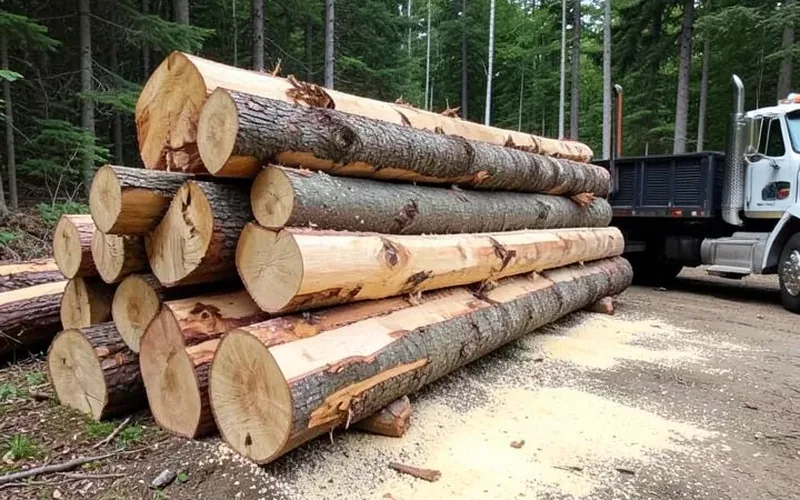
Every price in this guide so far is a stumpage price — what a buyer pays you for standing timber before it’s cut. Delivered or market price is what a sawmill pays for logs already cut, hauled, and dropped at their yard — it’s higher because it already includes logging and trucking costs the buyer would otherwise have to pay. Don’t compare a delivered log price you found online directly to your stumpage value — they’re not the same number, and the gap between them (logging, hauling, and the logger’s margin) typically runs 40-60% of the delivered price.
Selling Your Timber
Once you have a real volume-and-price estimate, the next step is finding the right buyer. A consulting forester (not employed by the buyer) can market your timber to multiple logging companies and negotiate on your behalf — typically for a percentage of the sale, which usually pays for itself through a higher final price than a landowner negotiating alone. Get bids from at least 2-3 buyers, use a written contract that specifies which trees are included, and confirm the buyer carries logging insurance before any cutting starts on your property.
Frequently Asked Questions
How is timber value calculated?
Multiply the estimated volume (in thousand board feet, or MBF) by the current per-MBF stumpage price for that species and grade in your region. A forester’s cruise provides the volume; a regional timber price report or professional appraisal provides the price.
What’s the difference between stumpage price and market price?
Stumpage price is what a buyer pays for standing, uncut timber. Market (delivered) price is what a sawmill pays for logs already cut and hauled to their yard — it’s higher because logging and trucking costs are already included.
Do I need a professional forester to sell timber?
It’s strongly recommended. A consulting forester’s cruise and market knowledge typically increase your final sale price by more than their fee costs, and they can write a contract that protects the rest of your property during logging.
Why does the same species have such a wide price range?
Grade (veneer, sawlog, or pulpwood), log diameter, straightness, and defects like rot or sweep all affect price within a single species — a defect-free veneer-grade log can be worth 3-4 times a sawlog-grade log of the same species and similar size.
Timber value comes down to volume (measured in MBF) multiplied by a real regional stumpage price for that species and grade — not a flat per-board-foot number. Get an actual diameter measurement, check a current state timber price report for your species, and bring in a consulting forester before you sign anything with a buyer.
Sponsored / affiliate links. As an Amazon Associate I earn from qualifying purchases. I may earn additional commission from eligible campaigns.