How Is Wood Hardness Calculated? The Janka Test Explained
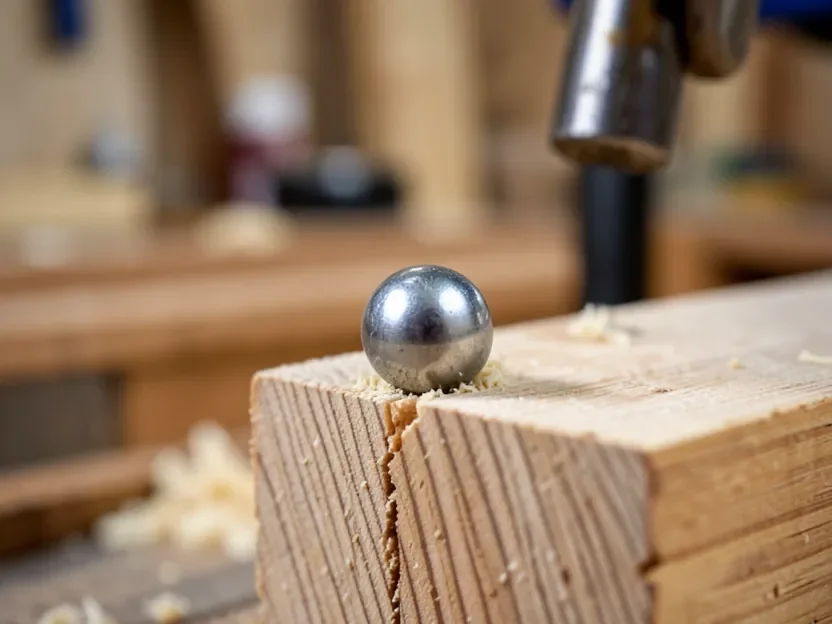
Wood hardness is calculated with the Janka hardness test: a hardened steel ball 0.444 inches (11.28mm) in diameter is pressed into a wood sample until it sinks to exactly half its diameter, and the force required – measured in pounds-force (lbf) – becomes that species’ Janka rating.
It’s a real, standardized test (ASTM D1037, built on the older ASTM D143 method), not a marketing number. A higher lbf rating means the wood resists dents and surface wear better – useful to know before you pick flooring or a workbench top – but it also means the wood fights back harder against your saw blades, drill bits, and nails. Below is exactly how the number gets calculated, what the real ratings look like across common species from balsa to Brazilian ipe, and why a high Janka number isn’t automatically “better” for every project.
What Is the Janka Hardness Test?
The Janka test is named after Austrian wood researcher Gabriel Janka, who developed the method in the early 1900s. It measures one specific thing: how much force it takes to embed a small steel ball halfway into a piece of wood. That single number – the Janka hardness rating – is the industry-standard way lumber mills, flooring manufacturers, and woodworkers compare how dent-resistant one species is against another.
Best Wood Science Reference
 |
Understanding Wood: A Craftsman’s Guide to Wood Technology – $36.01 Written by the researcher who literally wrote the textbook on wood science, this is the deepest explanation available of why species land where they do on the Janka scale.
|
How the Janka Number Is Actually Calculated
The mechanics are simple, but the calculation behind the published number is more careful than most charts let on:
- The ball: a 0.444-inch (11.28mm) steel ball is pressed into a clear, defect-free wood sample at a fixed rate, typically 0.25 inches per minute.
- The target depth: the ball is pushed in until it’s buried to exactly half its own diameter – not all the way, not a token dent.
- The measurement: the force needed to reach that halfway point, in pounds-force (lbf), is the raw Janka value for that one sample.
- Multiple faces, multiple samples: a single test on one board doesn’t produce a species’ published rating. Labs test several samples per species on both the flat (tangential) face and the edge (radial) face, then average the results – end-grain hardness is tested separately and runs noticeably higher.
- Extrapolation for very soft woods: some woods (balsa is the extreme example) compress or crush before the ball ever reaches half its diameter. For those, labs use a regression from the load/penetration curve to estimate what the halfway-point force would be, rather than a direct reading.
That averaging is also why you’ll see slightly different Janka numbers for the same species across different sources – moisture content, the specific tree stand, and which edition of the standard was used all shift the result a little. Treat published Janka numbers as a reliable comparison between species, not a lab-certified spec for the exact board in your cart.
Janka Hardness Ratings for Common Wood Species
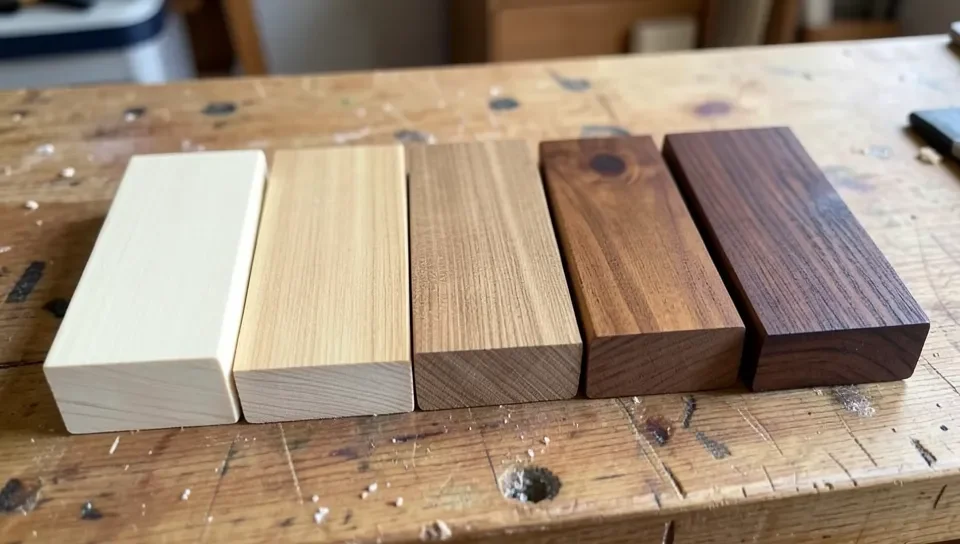
These are the widely-cited Janka ratings woodworkers reference most, in pounds-force (lbf), from softest to hardest:
| Wood Species | Janka Rating (lbf) | What It Tells You |
|---|---|---|
| Balsa | ~100 lbf | Among the softest commercial woods – dents under light pressure |
| Eastern White Pine | ~380 lbf | Soft, easy to hand-cut, dents easily as furniture or flooring |
| Black Walnut | ~1,010 lbf | Moderate hardness, a common furniture and cabinetry benchmark |
| Red Oak | ~1,290 lbf | The standard mid-hardness benchmark most flooring is compared against |
| Hard Maple | ~1,450 lbf | Harder than red oak, common in high-traffic flooring and bowling alleys |
| Hickory / Pecan | ~1,820 lbf | One of the hardest native North American woods, tough on blades |
| Brazilian Ipe | ~3,680 lbf | Among the hardest woods sold commercially – extremely dent-resistant, very hard to hand-nail |
Red Oak is the number worth memorizing – it’s the reference point most flooring and lumber comparisons are built around, similar to how “5W-30” is a reference point in motor oil. If a species is rated near or below red oak’s ~1,290 lbf, expect it to dent under furniture legs and dropped tools; well above it, and it starts fighting your saw blades and screws instead.
What the Janka Number Actually Means for Your Project
A higher Janka rating is not automatically “better” – it’s a tradeoff, and which side of it you want depends on what you’re building:
- Flooring and high-traffic surfaces: a higher Janka rating means fewer dents from dropped items, chair legs, and pet claws. This is the main reason hickory and hard maple outsell pine for flooring.
- Hand-tool work: higher hardness means more resistance when planing, chiseling, or hand-sawing – a board of ipe will dull an edge tool many times faster than a board of pine.
- Fasteners: above roughly 1,000-1,200 lbf, pre-drilling pilot holes before screwing or nailing stops being optional – the wood is dense enough to split or bend fasteners without one.
- Machine tooling: harder species generate more heat and wear on saw blades and router bits, which means slower feed rates and more frequent sharpening.
- Weight and cost: Janka hardness tracks fairly closely with density, so harder species are typically heavier and pricier per board foot.
Janka vs. Brinell, Rockwell, and Mohs: Why Wood Gets Its Own Test
If you’ve researched hardness testing outside of woodworking, you’ve probably run into the Brinell test, the Vickers/Vicker’s diamond test, and the Rockwell test – all real, standardized methods, but built for metals, not wood. Those tests press a hardened ball or diamond cone into a rigid material and measure the size or depth of the resulting indentation, using formulas like the Rockwell equation HR = N – (d / D). The Mohs scale, similarly, is for minerals – it ranks hardness by which materials can scratch which, from talc up to diamond.
Wood needed a different approach because it doesn’t behave like a metal or a mineral. It’s fibrous, anisotropic (its properties change depending on which direction you’re cutting or pressing relative to the grain), and compressible in a way steel and stone aren’t. Gabriel Janka’s ball-indentation method accounts for that by using a much larger, blunter indenter and measuring force at a fixed penetration depth rather than reading an indentation’s geometry afterward – a method suited to a material that compresses and springs back instead of holding a crisp dent. That’s also why a Janka lbf number and a Rockwell or Brinell number are never directly comparable to each other; they’re different scales measuring different kinds of materials under different physics.
What the Janka Test Doesn’t Measure
It’s worth being clear about the test’s limits, because it gets stretched to cover things it was never designed to measure. The Janka rating tells you about resistance to denting from a blunt, rounded force – it says nothing about scratch resistance (a coating and finish matter more there), stiffness or bending strength (that’s a separate modulus of elasticity test), impact toughness, rot or insect resistance, dimensional stability as humidity changes, or how well a species takes stain and finish. A wood can have an excellent Janka number and still be a poor choice for an application that depends on one of those other properties.
Frequently Asked Questions
How is the Janka hardness number actually calculated?
A 0.444-inch steel ball is pressed into a wood sample at a fixed rate until it’s embedded to exactly half its diameter. The force required, in pounds-force, is recorded, then averaged across several samples and wood faces to produce the species’ published Janka rating.
What is a good Janka rating for hardwood flooring?
Most residential flooring falls between about 1,000 and 1,800 lbf. Red Oak, at roughly 1,290 lbf, is the industry benchmark most other flooring species get compared against.
Is a higher Janka rating always better?
No. A higher rating means better dent and wear resistance, but it also means the wood is harder to cut, drill, nail, and sand, and it’s usually heavier and more expensive. The “best” rating depends on whether you’re prioritizing durability or workability.
What is the Janka rating of Red Oak?
Red Oak has a Janka hardness rating of approximately 1,290 lbf, which is why it’s used as the standard reference point for comparing other wood species.
Conclusion
Wood hardness isn’t a guess or a marketing claim – it’s calculated with the Janka test, a repeatable measurement of how much force it takes to press a steel ball halfway into a sample. That number, expressed in lbf, is the most reliable way to compare how species like balsa, red oak, hickory, and ipe will hold up to dents, tools, and daily wear. Use the chart above to check where your species falls, and weigh dent resistance against workability before you commit a project to an especially hard – or especially soft – board.
Sponsored / affiliate links. As an Amazon Associate I earn from qualifying purchases. I may earn additional commission from eligible campaigns.