How to Calculate the Weight of a Log (Formula + Species Chart)
Log weight = volume × species density. Measure the log’s diameter and length to get its volume in cubic feet, then multiply by the density of that wood species in pounds per cubic foot — using the green (freshly cut) density, not the dry lumber figure most calculators default to, since a green log can weigh 40–80% more than the same log after it seasons. Below is the exact formula, a real species density chart, and a worked example so you can check your own math.
Quick Formula: Diameter, Length, and Density
Best Tool For Measuring Log Diameter
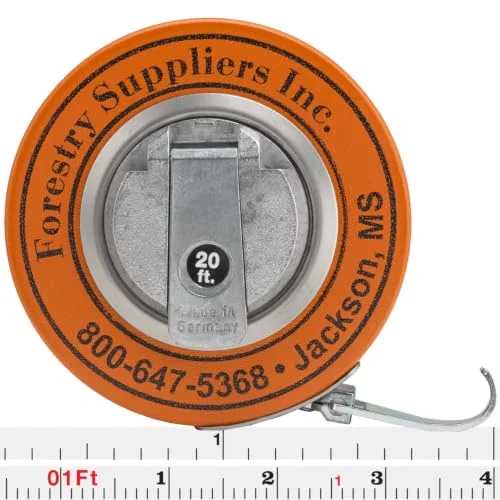 |
Forestry Suppliers English Diameter Tape (76 In.) – $49.99 This is the tool foresters actually use for the small-end diameter reading the formulas below need — wrap it around the log and read inches straight off the tape.
|
For a roughly cylindrical log, volume in cubic feet is V = 0.7854 × (D ÷ 12)² × L, where D is the small-end diameter in inches and L is the length in feet (0.7854 is π/4, and dividing D by 12 converts inches to feet before squaring). Multiply that volume by the species’ density in pounds per cubic foot — from the chart further down — and you have the log’s weight. A tapered log isn’t a perfect cylinder, so this method slightly overstates volume on a long, tapered log; for firewood, hauling, or a rough load estimate that’s close enough. For a more conservative, sawmill-accurate figure, foresters use a log rule instead.
Log Rules: A More Accurate Alternative to the Cylinder Formula
Sawmills don’t use straight cylinder volume because a log doesn’t yield a solid cylinder of lumber — slabbing, saw kerf, and the taper toward the small end all waste wood. Two standard log rules correct for that, and both are still worth knowing even if your goal is weight, not board footage, because they tell you how much of that cylinder volume is actually usable material:
- Doyle log rule: Board feet = (D − 4)² × L ÷ 16. The oldest of the common rules (1825), and the most conservative on small logs — it can under-estimate a log under about 16″ diameter by a wide margin, which is exactly why it’s still the regional standard in parts of the eastern hardwood market where smaller logs are discounted anyway.
- Scribner log rule: Board feet = (0.79 × D² − 2 × D − 4) × L ÷ 16. Built from actual diagrams of boards cut from real logs rather than a pure formula, and it’s the more widely used rule across U.S. sawmills today.
Neither rule outputs a weight directly — they output board feet of sawn lumber. To get from board feet back to weight, convert board feet to cubic feet (divide by 12, since 1 board foot = 1 ft × 1 ft × 1 in) and multiply by density as before. The gap between a log rule’s board-foot volume and the simple cylinder volume is the mill waste — useful to know if you’re estimating lumber yield, not just raw weight.
Species Density Chart: Green vs. Dry Weight Per Cubic Foot
This is the number most log-weight calculators get wrong: they use a dry lumber density figure on a log that’s still green. A freshly felled log can carry 40–100%+ of its dry weight in water alone, so the “green” column below — not the seasoned/air-dried column — is the one to multiply by volume for a log straight off the stump. Figures are pounds per cubic foot, compiled from USDA Forest Products Laboratory-derived species data and forestry weight references.
| Species | Green (Freshly Cut) | Air-Dried (~12% MC) |
|---|---|---|
| White Oak | 62 lb/ft³ | 47 lb/ft³ |
| Red Oak | 63 lb/ft³ | 44 lb/ft³ |
| Shagbark Hickory | 64 lb/ft³ | ~51 lb/ft³ |
| Sugar Maple | 56 lb/ft³ | 40 lb/ft³ |
| Southern Yellow Pine | 50 lb/ft³ | ~36 lb/ft³ |
| Eastern White Pine | 36 lb/ft³ | 25 lb/ft³ |
| Western Red Cedar | ~30 lb/ft³ | 22 lb/ft³ |
Notice how little cedar’s weight changes between green and dry compared to oak or hickory — cedar’s low resin/water-holding capacity is exactly why it’s a common choice for outdoor furniture and siding that needs to stay dimensionally stable as it dries. Oak and hickory, by contrast, can lose close to a third of their weight as they season, which is also why kiln-dried hardwood costs more per board foot than green: the mill paid to hold and dry weight that later disappears.
Worked Example: A 16-Inch, 8-Foot White Oak Log
Say you’ve got a freshly cut white oak log, 16 inches in diameter at the small end and 8 feet long, and you need to know if it’ll overload a trailer axle rated for 800 lbs.
- Volume: V = 0.7854 × (16 ÷ 12)² × 8 = 0.7854 × 1.778 × 8 ≈ 11.17 ft³
- Density: green white oak ≈ 62 lb/ft³ (from the chart above)
- Weight: 11.17 × 62 ≈ 693 lbs
That’s within the 800 lb axle rating, but not by a wide margin — worth double-checking against the trailer’s actual tongue and axle limits before loading, especially if there’s a second log going on. For comparison, the Doyle log rule on that same log — (16−4)² × 8 ÷ 16 = 72 board feet — tells a sawyer roughly how much sawn lumber it’ll yield, which is a different (and smaller) number than the log’s raw cylinder volume; the difference is slab and kerf waste that never leaves the mill as lumber but is still part of what you’re hauling as a whole log.
How Moisture Content Changes the Answer
Every figure above assumes either “green” (freshly cut, still near the tree’s natural moisture content) or “air-dried to about 12% moisture” — the two endpoints most density tables publish. A log sitting in a garage for a few months lands somewhere between those two numbers, not at either one, and there’s no reliable way to estimate exactly where without a reading. A pin-style or pinless moisture meter tells you the actual percentage; as a rough rule of thumb, every 1% drop in moisture content below fiber saturation (roughly 28–30% for most species) trims total weight by a small, fairly linear amount until the log reaches equilibrium with the air around it, usually in the 6–12% range depending on climate. If you only have a scale and no meter, weighing a cut cross-section now and again after it’s fully air-dried and comparing the two weights will back out the same information for that specific log.
Frequently Asked Questions
How do I calculate the weight of a log?
Measure the small-end diameter and length, find the volume with V = 0.7854 × (diameter in feet)² × length, then multiply that volume by the species’ density in pounds per cubic foot. Use the green (freshly cut) density figure, not the dry lumber figure, unless the log has already fully seasoned.
What’s the difference between the Doyle and Scribner log rules?
Both estimate board feet of sawn lumber a log will yield, not raw weight. Doyle, formula (D−4)² × L ÷ 16, is more conservative and under-scales small-diameter logs significantly. Scribner, formula (0.79D² − 2D − 4) × L ÷ 16, is based on actual sawn-board diagrams and is the more widely used rule at U.S. sawmills today.
How heavy is a 10-foot log?
It depends entirely on diameter and species — there’s no single answer. A 10-foot, 12-inch-diameter green white oak log works out to about 7.85 ft³ × 62 lb/ft³ ≈ 487 lbs, while the same dimensions in green eastern white pine (36 lb/ft³) would be roughly 283 lbs. Run your own diameter and species through the formula above rather than relying on a flat per-foot estimate.
Does a log’s weight change much as it dries?
Yes, substantially for most hardwoods. Green white oak (62 lb/ft³) drops to about 47 lb/ft³ air-dried — a loss of roughly a quarter of its green weight. Low-density softwoods like cedar change less in absolute terms because they hold less water per cubic foot to begin with.
For lumber that’s already been milled into boards rather than a round log — where board-foot volume, not cylinder volume, is the starting point — see our general wood weight calculator guide, which covers the milled-lumber version of this same density × volume math.
Sponsored / affiliate links. As an Amazon Associate I earn from qualifying purchases. I may earn additional commission from eligible campaigns.