How Do You Know If Your Ash Tree Is Infected? EAB Warning Signs
The clearest sign your ash tree is infected is small, D-shaped exit holes in the bark, about the width of a pencil eraser — that shape is unique to the emerald ash borer and isn’t produced by any other common pest. Combine that with a thinning crown, vertical bark splits, and increased woodpecker activity, and you’re almost certainly dealing with an active infestation.
The emerald ash borer (EAB) has killed several hundred million ash trees across North America since it was first identified in Michigan in 2002, and it’s now confirmed in most U.S. states east of the Rockies plus much of southern Canada. Here’s exactly what to check, in the order it’s fastest to spot from the ground.
Fast Treatment Option If You Confirm Infestation
Best Pick For DIY Systemic Treatment
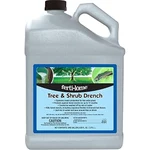 |
Fertilome Tree & Shrub Drench Systemic Insecticide – $33.69 A soil-drench imidacloprid treatment for trees showing early, light infestation — poured around the base rather than sprayed, so it works its way up through the roots.
|
For anything beyond light infestation, a licensed arborist doing a trunk injection is more effective than a homeowner soil drench — but if you caught it early, treating it yourself the same week you spot symptoms matters more than which method you use.
D-Shaped Exit Holes and Bark Splitting
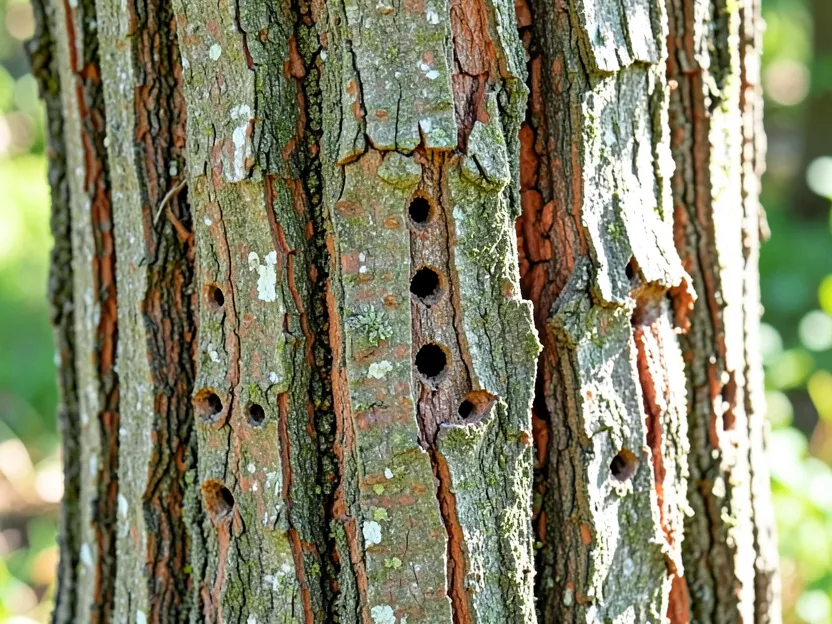
Adult borers chew their way out of the trunk in early summer, leaving distinctive D-shaped holes roughly 1/8 inch across — flat on one side, curved on the other. You’ll usually find them concentrated on the upper trunk and main branches first, since that’s where the beetles prefer to lay eggs, so check higher up with binoculars before writing off a tree that looks clean at eye level.
Vertical bark splitting is the tree’s own response to the larvae tunneling underneath. As S-shaped galleries carve through the cambium layer (the tissue that carries nutrients up and down the trunk), the bark above cracks and sometimes flakes away entirely, exposing pale wood and the winding tunnel pattern beneath it. Woodpeckers key in on this same larval activity, so patches of bark stripped away in a blotchy, flaking pattern — sometimes called “blonding” — are one of the most reliable early indicators, often showing up before the D-shaped holes themselves are visible from the ground.
Crown Thinning and Canopy Dieback
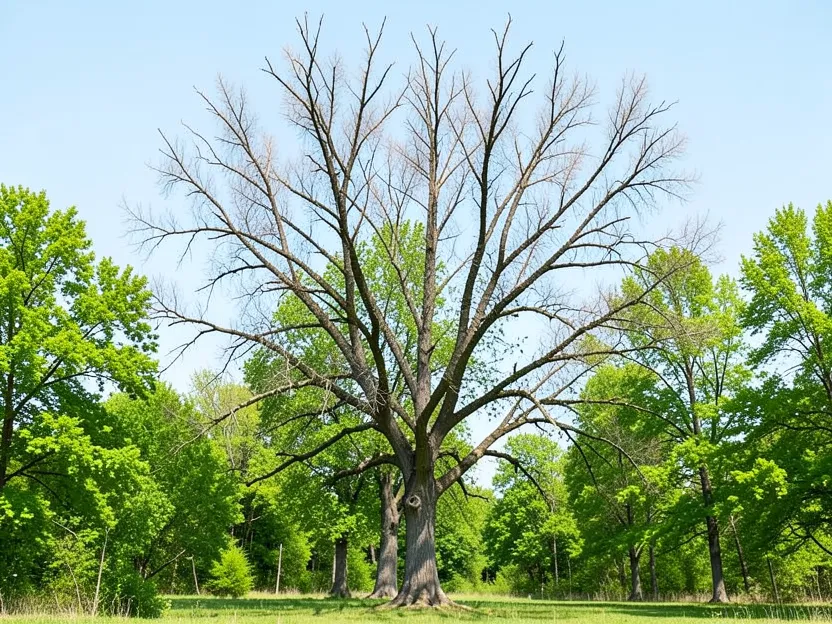
Because larvae feed on the cambium layer that moves water and nutrients through the tree, the first visible symptom for most homeowners is actually at the top of the tree, not the bottom. Look for die-back starting in the upper crown: branch tips lose leaves first, then entire upper limbs go bare while lower branches still look normal. This top-down pattern is a strong tell — drought stress and most fungal diseases tend to thin a crown more evenly, while EAB dieback concentrates at the top and works its way down over one to three growing seasons.
A related symptom worth checking for is epicormic sprouting — clusters of small shoots growing directly out of the trunk or major limbs, low on the tree. It’s the tree’s last-ditch attempt to keep producing leaves after its main canopy has been cut off from nutrients, and seeing it on an ash that previously had a clean trunk is a sign the infestation is already advanced.
Other Warning Signs Worth Checking
- Bark flaking in patches (“blonding”): woodpeckers stripping bark to reach larvae underneath, often the very first visible sign.
- S-shaped galleries under loose bark: if bark has already come away, the winding larval tunnel pattern underneath is a definitive confirmation — no other North American borer makes this exact shape in ash.
- Fine sawdust (frass) at the base or in bark crevices: a byproduct of larvae tunneling, though it’s less reliable for EAB specifically than for other wood-boring beetles since EAB frass is often packed inside the galleries rather than falling free.
- Root and soil symptoms unrelated to EAB: brown, mushy roots or a leaning trunk usually point to root rot from poor drainage instead — a different problem with a different fix (improve drainage, don’t reach for insecticide).
Can an Infected Tree Be Saved?
It depends almost entirely on timing. A tree with less than 30% canopy loss has a genuinely good chance of recovery with prompt insecticide treatment — either a soil drench you apply yourself or a professional trunk injection, which acts faster and lasts longer per application. Once a tree has lost more than half its canopy, most arborists will recommend removal rather than treatment, since the tree is unlikely to recover even with intervention and a dead ash becomes a safety hazard (the wood turns brittle and branches drop unpredictably within a year or two of the tree’s death).
If you’re managing several ash trees on a property, it’s worth treating the healthy-looking ones preventatively once EAB is confirmed anywhere in your area, rather than waiting for symptoms on each tree individually — by the time a specific tree shows visible dieback, the infestation inside it has usually been established for a full year or more.
Frequently Asked Questions
What does an infected ash tree look like?
An infected ash tree shows thinning foliage starting at the top of the crown, dead upper branches, vertical bark splits, and small D-shaped exit holes about the size of a pencil eraser. Patchy bark flaking from woodpeckers feeding on larvae is often the earliest visible sign, sometimes showing up before the exit holes are noticeable.
How to treat an infected ash tree?
For light infestation (under 30% canopy loss), a systemic soil-drench insecticide like imidacloprid gives about 12 months of protection with no spraying or drilling. For moderate-to-heavy infestation, a licensed arborist’s trunk injection works faster and more reliably. Trees that have already lost more than half their canopy are usually past the point where treatment makes sense, and removal becomes the safer option.
How to tell if an ash tree is diseased vs. infested?
Emerald ash borer damage shows a distinct top-down pattern — crown dieback starting at the uppermost branches, D-shaped exit holes, and S-shaped tunnels under the bark. General disease or drought stress tends to thin a crown more evenly across the whole tree rather than starting at the top, and won’t produce the D-shaped holes or larval galleries that confirm EAB specifically.
Can an infected ash tree be saved?
Yes, if caught while canopy loss is still under roughly 30%. Prompt systemic insecticide treatment, either DIY or through an arborist, stops the larvae and lets the tree regrow lost foliage over one to two seasons. Past that point, recovery odds drop sharply and removal is usually the safer, more cost-effective call.
Conclusion
The fastest way to confirm an ash tree infection is checking for D-shaped exit holes, vertical bark splitting, and top-down crown dieback — all three together are close to a certain EAB diagnosis. Catch it while canopy loss is still under 30% and a systemic insecticide or arborist injection has a real chance of saving the tree; wait past that point and removal usually becomes the more practical choice.
Sponsored / affiliate links. As an Amazon Associate I earn from qualifying purchases. I may earn additional commission from eligible campaigns.