Ash Lumber Price Chart by Board Foot and Grade
Ash lumber is often budgeted at about $4–$9 per board foot for common 4/4 stock, with clearer grades, 8/4 thickness, and smaller orders tending to push the price higher. Ignoring grade and order size can leave you over budget fast, especially when a supplier prices premium boards and short packs at a markup. Use this ash-only price chart to estimate board-foot cost by grade, thickness, and order size before you place the order.
Ash lumber pricing basics
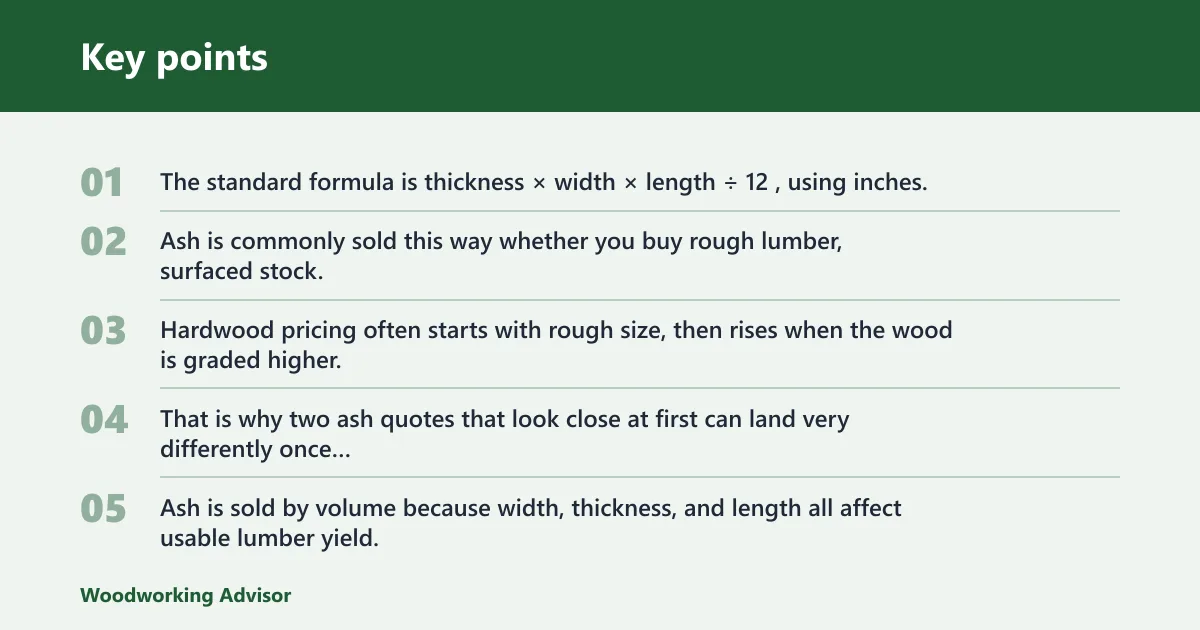


A board foot is 144 cubic inches. The standard formula is thickness × width × length ÷ 12, using inches, and it is the unit most hardwood sellers use for pricing. Ash is commonly sold this way whether you buy rough lumber, surfaced stock, or kiln-dried retail boards.
Hardwood pricing often starts with rough size, then rises when the wood is graded higher, milled flatter, or sold in shorter packs. That is why two ash quotes that look close at first can land very differently once surfacing, freight, and yield are counted.
Why ash is priced per board foot
Ash is sold by volume because width, thickness, and length all affect usable lumber yield. A 4/4 board and an 8/4 board are not interchangeable, even if both are sold as ash. The thicker board holds more wood, and that extra volume usually means a higher price per board foot.
For budgeting, treat ash as a material where grade, thickness, milling status, and region all matter at once. A quote from the Midwest may look nothing like a quote on the West Coast once freight and local supply are added.
How ash grade changes price
Grade changes price because it changes usable yield. Ash #2 common contains more knots, color variation, and defects, so it is the cheapest common grade. Select stock has fewer defects and more clear cuttings, so it commands a higher price. #1 common usually sits between them.
That grading gap matters most when you need long, clear parts. A table leg set, cabinet face frame parts, or visible furniture rails waste less material when you start with cleaner boards.
#2 common vs select ash
#2 common ash typically runs $3–$4 per board foot. Select ash runs $5–$7 per board foot. The difference is not cosmetic. Higher grade lowers the chance that you will lose time and yield cutting around knots, checks, wane, or short clear sections.
A common first-timer mistake is buying the cheapest pile and then discovering that the “cheap” stock produces less usable lumber than a cleaner pack would have. If the project needs wide, clear faces or long rails, select stock can be the safer buy even at a higher rate.
How defects affect usable yield
Defects matter because you pay for board feet, but you build with clear parts. If one board includes knots, end checks, or sap-heavy areas, you may have to cut around them. That pushes your effective cost per usable part higher than the invoice price suggests.
For small projects, a mixed pack can be a trap if the supplier does not separate clear boards from lower-grade boards. Ask how the grade is sorted before you commit.
Does thickness change ash price?
Yes. Thicker ash stock usually costs more per board foot, and 8/4 boards often carry the largest premium. A common planning assumption is that thicker ash can raise cost by 30–50% per board foot compared with the same grade in 4/4 stock. That premium reflects slower sawing, lower yield, and more handling.
Use thicker boards when the project needs the thickness, not just because the material is available. Legs, aprons, rails, and handles sometimes justify 6/4 or 8/4 ash. Shelf parts, panels, and many furniture components do not.
4/4, 6/4, and 8/4 ash
4/4 means roughly 1 inch rough thickness before drying and surfacing. 6/4 is roughly 1.5 inches rough. 8/4 is roughly 2 inches rough. After surfacing, the finished thickness is lower, so a board sold as 4/4 does not arrive as a full finished inch.
Suppliers often bill by the rough size, not the finished size, especially for S2S stock. That is why surfaced ash can still be priced on the rough board-foot count.
When to buy thicker ash on purpose
Buy thicker stock when you need to mill parts down to a stable finished thickness, remove movement, or shape a part from a deeper blank. Legs, thick rails, drawer pulls, and hand-shaped handles are common examples. If the project only needs 3/4-inch material, 8/4 stock usually wastes money.
Picture a small bench build that needs four straight legs and a few rails. If the legs start at 8/4 ash, you can clean them up and still keep enough thickness for joinery. For the rails, 4/4 or 6/4 may be the better buy.
Ash price chart
The table below converts ash grade and thickness into planning budgets. It uses the typical ash range of $3–$6 per board foot, the grade ranges for #2 common and select stock, and a practical planning band for #1 common that sits between them. Totals are simple extensions at 10, 25, 50, and 100 board feet.
| Grade and thickness | Estimated price per board foot | 10 BF | 25 BF | 50 BF | 100 BF | Notes |
|---|---|---|---|---|---|---|
| #2 common, 4/4 | $3.00–$4.00 | $30–$40 | $75–$100 | $150–$200 | $300–$400 | Lowest common ash grade; best for shop parts and hidden components. |
| #1 common, 4/4 | $4.00–$5.50 | $40–$55 | $100–$138 | $200–$275 | $400–$550 | Planning band between #2 common and select; ask how much clear yield is in the pack. |
| Select, 4/4 | $5.00–$7.00 | $50–$70 | $125–$175 | $250–$350 | $500–$700 | Cleaner boards for visible furniture parts and longer clear cuts. |
| #2 common, 6/4 | $3.90–$6.00 | $39–$60 | $98–$150 | $195–$300 | $390–$600 | Built from the 4/4 range with a thickness premium of about 30–50%. |
| #1 common, 6/4 | $5.20–$8.25 | $52–$83 | $130–$206 | $260–$413 | $520–$825 | Useful for thicker furniture stock when you still need decent yield. |
| Select, 6/4 | $6.50–$10.50 | $65–$105 | $163–$263 | $325–$525 | $650–$1,050 | Better for visible pieces that need thicker parts and fewer defects. |
| #2 common, 8/4 | $4.50–$6.00 | $45–$60 | $113–$150 | $225–$300 | $450–$600 | Thicker stock often carries the highest per-BF premium, especially in small orders. |
| #1 common, 8/4 | $6.00–$8.25 | $60–$83 | $150–$206 | $300–$413 | $600–$825 | Good for legs and heavy rails when the project can justify the extra thickness. |
| Select, 8/4 | $7.50–$10.50 | $75–$105 | $188–$263 | $375–$525 | $750–$1,050 | Highest planning band here; the cleanest and thickest stock costs the most. |
Say your project needs 50 board feet of furniture stock in select 4/4 ash. The table places that budget at $250–$350 before surfacing, freight, or waste. If the same order moves to 8/4, the budget rises to $375–$525 before add-ons.
What adds to the final quote?
Rough lumber, S2S stock, and retail kiln-dried boards do not price the same way. Rough lumber is usually the cheapest starting point. S2S stock has already been surfaced on two sides, so it should save time in your shop, but that milling is part of the price. Retail boards may cost more again because of handling and smaller pack sizes.
Low-looking quotes can hide real costs. Short lengths, mixed-grade packs, surfacing charges, and freight can move the total faster than the board-foot rate alone suggests.
Rough lumber and surfaced stock
Buying rough lumber and milling it yourself can cut cost by 25–35%. That saving is real only if you have the tools and time to plane, joint, and rip the material accurately. If you need ready-to-use boards, surfaced lumber may still be the smarter purchase.
S2S stock can also hide a shorter finished thickness. The supplier may bill on the rough size while delivering a board that has already lost some thickness to planing.
Freight, short lengths, and mixed packs
Freight matters more on small ash orders. A 10-board-foot pickup can get expensive once delivery is added. Short lengths often sell at a discount, but they can create waste in furniture layouts if your parts need longer clear runs.
Mixed-grade packs are another caution point. A pack labeled “select and better” may include only a few clean boards and several boards that are merely serviceable. Ask for the actual grade mix before you pay.
Suspiciously low quotes
A quote that sits far below the chart should trigger questions. Ask whether the price is for rough or surfaced stock, whether the boards are kiln-dried, whether the lengths are short, and whether the pack is mixed grade. A low ash quote can be a good deal, but it can also mean hidden constraints.
Suppose a yard offers 100 board feet of ash at a price that looks far under market. If the boards are short, lightly graded, and sold as rough only, the bargain may disappear once you add waste and extra milling.
How much waste should you budget?
A 10% waste allowance is a common planning buffer for board-feet buying. It covers defects, cut loss, and planing loss. For projects with long parts, narrow boards, or visible faces that need careful grain matching, you may want to budget more than 10%.
Wider parts and cleaner grades usually reduce waste. Small orders, lower grades, and highly selective builds increase it. That is why the same ash quote can work fine for shop fixtures and fail for a clean furniture panel set.
- Calculate the net board feet your project needs.
- Add 10% for normal waste and planing loss.
- Increase the buffer if the parts need matching grain or long clear lengths.
- Check whether the quote is rough, S2S, or retail surfaced stock.
- Confirm whether freight, surfacing, or short-length charges are included.
Is ash cheaper than oak?
Ash is often cheaper than white oak and can be close to red oak depending on grade and region. Typical ash runs $3–$6 per board foot, while red oak runs $4–$8 and white oak runs $6–$10. That makes ash a useful benchmark when you want hardwood performance without paying oak prices.
For furniture projects, ash can be the better buy when you want strong, open-grain hardwood at a lower entry cost. For high-visibility work where oak’s color or hardness matters more, the premium may still make sense.
Using red oak as a benchmark
Red oak #2 common is $3.50–$5 per board foot, and red oak #1 common averages $5–$7 per board foot. Ash in 4/4 typically costs 20% less than red oak of the same grade, so ash can be the lower-cost option when the grades are comparable.
That said, a cheap ash quote is not automatically better than a fair red oak quote. If the ash is short, mixed, or heavy on defects, the usable yield can erase the savings.
Using white oak as a benchmark
White oak is usually the more expensive benchmark. White oak runs $6–$10 per board foot, and select white oak commands $8–$11. If you are comparing a clean ash quote to white oak, ash usually gives you a lower material budget.
That comparison helps most on furniture, casework, and shop jigs. It matters less if the design specifically calls for the color, weather resistance, or appearance of white oak.
When ash is the better buy
Ash is usually the better buy when you need straight-grained hardwood with predictable machining and you can accept some variation in color and figure. It is especially practical for furniture parts, utility pieces, handles, and thicker components where the project does not need oak’s price tier.
Regional supply can change the answer. In one market, ash may beat red oak clearly. In another, freight or supply limits can push ash close to white oak pricing.
Frequently asked questions
How much does ash lumber cost per board foot by grade?
Ash typically budgets at $3–$6 per board foot overall. #2 common ash runs $3–$4, while select ash runs $5–$7. #1 common usually sits between those bands, so it is a useful middle-grade budgeting choice when you want cleaner boards without paying select pricing.
What is the difference between #2 common and select ash?
#2 common ash has more knots, defects, and mixed clear sections, so it costs less and wastes more in visible work. Select ash has fewer defects and better clear yield, which is why it costs more and is easier to use for furniture faces, rails, and long parts.
How do I calculate board feet for ash lumber?
Use thickness × width × length ÷ 12, with all dimensions in inches. A board that is 1 inch thick, 6 inches wide, and 8 feet long equals 4 board feet. That formula works for rough lumber and for pricing most hardwood stock.
Does ash cost more in thicker 8/4 stock?
Yes. Thicker ash stock usually carries a higher per-board-foot price, and a 30–50% premium over 4/4 is a common planning assumption. That extra cost reflects lower yield, slower milling, and more handling, so buy 8/4 only when the part truly needs the extra thickness.
Is ash cheaper than oak for furniture projects?
Often, yes. Ash usually lands below red oak and well below white oak on price, especially in 4/4 stock. For furniture, ash can lower the material budget without giving up a hardwood look, but the real answer still depends on grade, thickness, region, and freight.
What should I budget for ash flooring versus rough lumber?
Unfinished ash flooring in 3/4" x 2 1/4" typically runs $3.50–$7 per square foot, while rough lumber is priced by board foot at about $3–$6. Flooring pricing includes a different product form, so do not convert it directly from rough lumber without checking milling, waste, and installation needs.
How much waste should I add when buying ash lumber?
Add 10% as a common planning buffer for defects, cuts, and planing loss. If your parts are long, the grain must match, or the stock is lower grade, increase the allowance. Thin margins disappear quickly when a board has checks or unusable ends.
Why do ash prices vary so much by region?
Regional pricing shifts with local supply, freight, mill access, and the amount of kiln-dried or surfaced stock in the market. Midwest and Great Lakes quotes are often different from West Coast quotes because shipping and local availability change the landed cost.
What is the difference between rough and surfaced ash lumber?
Rough lumber is sold with saw marks and extra thickness left for you to plane. Surfaced lumber, often sold as S2S, has already been planed on two sides. Surfacing saves shop time, but the seller may still bill on rough board feet and may charge more for the milling.
How do grading and thickness change the price of ash?
Higher grades cost more because they offer better clear yield. Thicker stock costs more because it holds more wood and is harder to process. Put those two together and the price climbs quickly, especially in small orders or in regions where ash supply is tight.
Sponsored / affiliate links. As an Amazon Associate I earn from qualifying purchases. I may earn additional commission from eligible campaigns.
 PATIKIL 12 x 10 Inch Wood Panel Board, 2 Pack Unfinished Wooden Canvas Boards Square Blank Deep Cradle Board for Painting Pouring DIY Art Use with Oils Acrylics
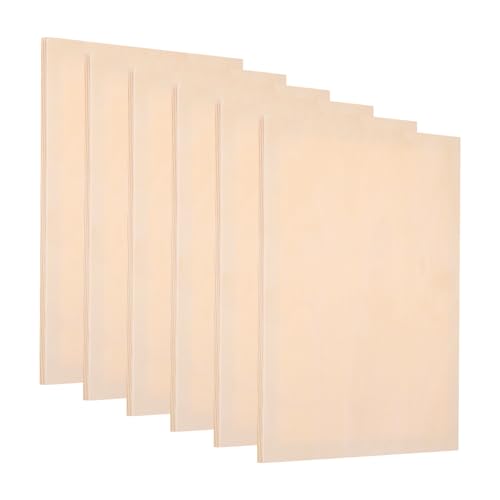 PATIKIL 12 x 10 Inch Wood Panel Board, 6 Pack Unfinished Wooden Canvas Boards Square Blank Deep Cradle Board for Painting Pouring DIY Art Use with Oils Acrylics