Hardwood Flooring Calculator
A hardwood flooring calculator should start with room area, then add about 7% to 15% waste; a common rule of thumb is 7% for simple straight layouts and about 15% for diagonal, herringbone, or many cuts. Buying without those allowances often leaves you short, especially because hardwood sells by bundle and random-length pack, not exact square feet. This guide covers how to size quantity, account for grade and length mix, round up to bundles, and estimate cost before ordering.
How is this calculated?
Press Calculate to see the math with your numbers.
How much hardwood do you need?
Start with room length and width, multiply them to get square footage, then add a waste factor before you buy. That gives you a realistic order size for hardwood, where cuts, board matching, and bundle rounding usually push the final purchase above the bare room area.
Start with room length and width
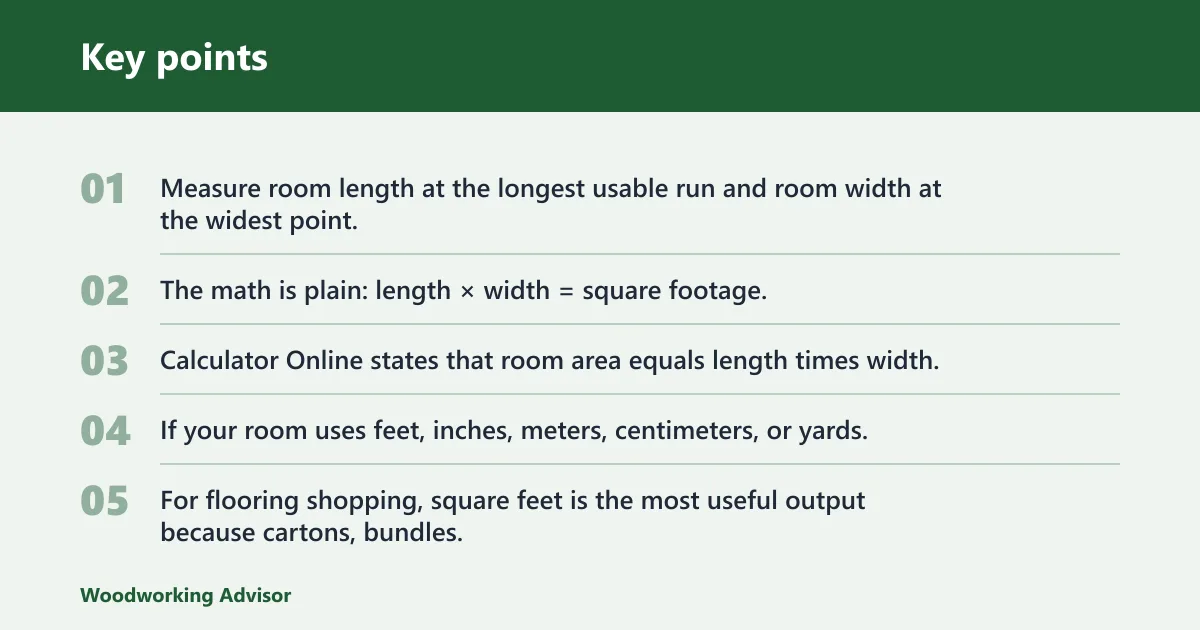
Measure room length at the longest usable run and room width at the widest point. The math is plain: length × width = square footage. Calculator Online states that room area equals length times width, and that same approach is the starting point for hardwood quantity planning.
If your room uses feet, inches, meters, centimeters, or yards, convert the measurements to one unit before multiplying. Keep both dimensions in the same unit. For flooring shopping, square feet is the most useful output because cartons, bundles, and cost estimates usually refer to that unit.
Convert the room to square footage
Square footage is the primary quantity for flooring orders. If a room is 12 feet by 15 feet, the room area is 180 square feet. If the room is measured in inches, convert to feet first or use a calculator that handles mixed units. The same area can also be converted to square yards or square meters when needed.
Add a waste factor before ordering
Waste covers trimming, end cuts, damaged boards, and layout loss. For standard installs, a common planning range is 7% to 10%. For diagonal, herringbone, or other heavy-cut layouts, 15% to 20% waste is often a safer planning range. The guide recommends adding 10% extra for standard installations, and diagonal or herringbone patterns should add 20% extra.
Say your room is 180 square feet and you choose a straight lay with 10% waste. You would plan for 198 square feet before rounding to boxes or bundles. The room did not change. The layout did.
Hardwood ordering table
Hardwood quantity is shaped by room form, pattern, and product type. A square room with straight planks needs less allowance than a long hallway, a diagonal layout, or a room with closets and bump-outs. Use this table as a hardwood-specific planning aid, then round up to the next full box or bundle after you add waste.
| Room shape and layout | Recommended waste % | Example room size | Square footage to buy | Box or bundle rounding example |
|---|---|---|---|---|
| Simple rectangle, straight lay | 7% | 12 ft × 15 ft | 193 sq ft from 180 sq ft | Buy 7 boxes if each box covers 28 sq ft |
| Rectangle, solid hardwood with wider boards | 10% | 12 ft × 15 ft | 198 sq ft from 180 sq ft | Buy 8 boxes if each box covers 25 sq ft |
| Diagonal layout | 15% | 14 ft × 16 ft | 258 sq ft from 224 sq ft | Buy 9 boxes if each box covers 30 sq ft |
| Herringbone or parquet | 20% | 10 ft × 20 ft | 240 sq ft from 200 sq ft | Buy 10 boxes if each box covers 24 sq ft |
| L-shaped room with closet | 12% | Two rectangles totaling 170 sq ft | 191 sq ft from 170 sq ft | Buy 8 boxes if each box covers 25 sq ft |
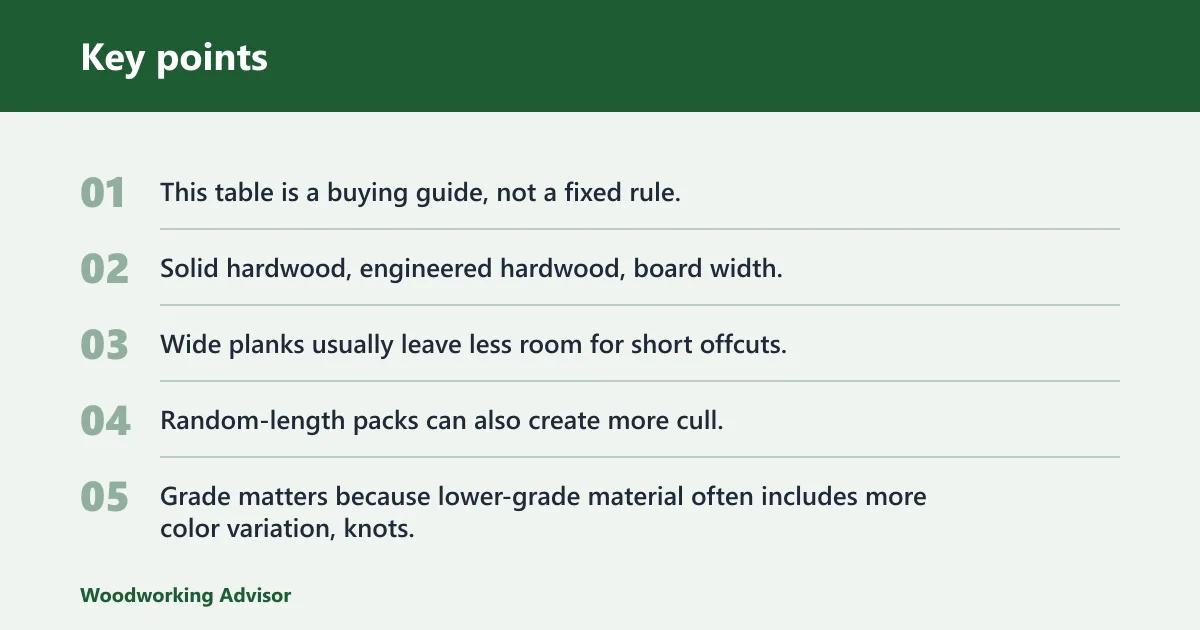
This table is a buying guide, not a fixed rule. Solid hardwood, engineered hardwood, board width, and bundle format all affect the final order. Wide planks usually leave less room for short offcuts. Random-length packs can also create more cull, especially when the room includes multiple doorways or narrow sections.
How grade changes the order
Grade matters because lower-grade material often includes more color variation, knots, or short usable pieces. That can increase cull rate, which means you may need more footage than the room area alone suggests. Board width matters too. Wider planks can require more careful layout and may increase waste in rooms with many turns or obstacles.
A common first-timer mistake is buying to the exact room area and assuming every board in the bundle will be usable. With hardwood, that is a weak plan. Bundle length mix, color sorting, and cut placement can turn a tight order into a short one.
How do you measure an irregular room?
Break the room into smaller rectangles, measure each section separately, and add the results together. That works for L-shapes, U-shapes, closets, bump-outs, and alcoves. Do not guess at the full outline. Hardwood planning gets much more accurate when you reduce a complex room to simple shapes.
Split L-shapes and U-shapes into rectangles
Measure each leg of the room as its own rectangle. If an L-shaped room has a main section and a side extension, calculate both areas separately and add them. This prevents hidden area loss where the room turns or narrows. The same approach works for a U-shaped space with a central opening.
Measure closets and bump-outs separately
Closets, bay-window returns, and bump-outs should be measured on their own, then added to the main room. These smaller zones often need more cuts than the main field. That makes them a real source of waste, even when their square footage looks minor on paper.
- Measure the main rectangle.
- Measure each attached section.
- Add all areas together.
- Apply the waste factor for the layout.
- Round up to full boxes or bundles.
Suppose a main room measures 14 feet by 12 feet, with a 4-foot by 6-foot closet attached. The total area is 192 square feet before waste. If the closet adds extra cuts because of a narrow doorway, a 10% or 12% allowance is more realistic than a bare 7% figure.
What waste factor should you use?
Use the layout, not just the room size, to set waste. Straight installations usually need less extra material than diagonal, herringbone, or parquet work. Solid hardwood and engineered hardwood can also need different allowances depending on board width, grade, and whether the bundles contain random lengths.
Straight lay versus diagonal
For a simple straight lay, 7% to 10% is a practical planning range. Diagonal installs cut more off the ends of boards, so 15% is a safer starting point, and 20% is often better for tighter fits or rooms with several obstacles. The guide recommends 20% extra for diagonal or herringbone patterns.
Herringbone and parquet
Herringbone and parquet create more offcuts than straight rows. That is why they usually need the highest waste allowance. A room that would need 198 square feet in a straight lay can move much higher once pattern turns, starter courses, and end matching are counted. Pattern work also makes box rounding more likely to leave some extra material on hand.
Solid hardwood, engineered hardwood, and board width
Solid hardwood often comes in random-length bundles, so the usable count depends on mix, not just coverage on the label. Engineered hardwood can be more predictable, but it still needs waste for cuts and rounding. Wider boards may create more cut loss in irregular rooms because they waste more at the edges and around doorways.
Mullican advises adding 5% to 7% for waste, while Omni Calculator recommends 5% to 10% extra material for waste. Those figures fit simpler jobs. For hardwood with diagonal or herringbone patterns, the higher end is the safer choice, especially when board lengths are mixed and the room includes several cuts.
How many boxes do you need?
After you add waste, divide the adjusted square footage by the coverage per box or bundle, then round up. Flooring is sold by the box or bundle, so you cannot buy a fraction of a carton. If the result is 7.01 boxes, still order 8.
Convert square footage to boxes or bundles
Use the coverage printed on the carton or bundle label. Some hardwood is packaged by square feet per box, while some solid hardwood is sold in random-length bundles with a stated average coverage. The practical step is the same: divide your waste-adjusted footage by the package coverage and round up to the next whole unit.
Suppose your order target is 198 square feet and each bundle covers 27 square feet. You need 7.33 bundles, so you order 8. That extra bundle is often less costly than discovering you are short after the first few rows are installed.
Account for mixed production lots
When a job needs several boxes, check whether they come from one production lot. Mixed lots can vary slightly in color, sheen, or grain character. Hardwood is especially sensitive to this because grade variation can be visible across the floor. If the job is large, buying a little extra from the same lot is safer than trying to match later.
How do you estimate cost?
Multiply the waste-adjusted square footage by the price per square foot, then add hardwood-specific extras. That means trim, thresholds, transition pieces, and acclimation time or supplies if they are not already included. Cost planning for hardwood should be built from the full order size, not just the room area.
Use price per square foot
Price per square foot is the fastest way to estimate material cost. The calculator can accept an optional cost per square foot and convert the result to a flooring estimate in square feet. It also converts the result to square yards and square meters, which helps when product pricing is listed in another unit.
If the flooring is priced at a different unit, convert it before estimating. A per-square-yard price can be converted to square feet, and a per-square-meter price can be converted as well. Keep the math tied to one unit so you do not double count waste or understate the total.
Adjust for trim, thresholds, and acclimation
Hardwood cost is rarely just the boards. Thresholds, transitions, reducer strips, baseboards, stair noses, and matching trim can add to the total. Acclimation may also add cost if the material needs to sit in the installation space before placement. Those items matter more on hardwood than on many simple floating-floor projects.
Add the waste-adjusted order total
Use the full order total, not the bare room total, when you budget. That keeps the estimate closer to the final purchase order and helps avoid a gap between what the floor needs and what the cart contains. If the room is irregular or the pattern is diagonal, the waste-adjusted total is the number that should guide the budget.
Common hardwood planning mistakes
The most common hardwood errors are under-ordering random-length bundles, ignoring grade and board width, and forgetting pattern-specific waste. Another frequent miss is treating every room like a clean rectangle. Hardwood rewards a more careful count because cuts, color mix, and bundle rounding all affect the final result.
- Under-ordering random-length bundles: a box may cover the area on paper but still leave too few long boards for the layout.
- Ignoring grade variation: lower grades can raise cull rates and reduce usable boards.
- Using one waste percentage for every room: straight rows, diagonals, and herringbone do not need the same allowance.
- Skipping irregular sections: closets, bump-outs, and alcoves still consume material.
- Forgetting full-box rounding: the floor cannot be installed from partial cartons.
Picture a 9-foot by 13-foot bedroom with a closet recess and a diagonal layout. The room area looks small enough for a tight order, but the diagonal cut loss and the recess both push the real need higher. In that case, the wasted difference between exact footage and rounded cartons is normal, not excessive.
Frequently asked questions
How much waste should I add for hardwood flooring?
A standard hardwood install often starts around 7% to 10% waste. Diagonal, herringbone, and parquet layouts usually need more, and rooms with closets or multiple turns may need extra allowance as well. Mullican advises 5% to 7% for waste, while broader planning guides often use 10% for standard installs.
How many boxes of hardwood flooring do I need?
Divide the waste-adjusted square footage by the coverage per box or bundle, then round up. If the result is 6.1 boxes, buy 7. If the material comes in random-length bundles, keep an eye on the stated coverage and the board-length mix, because usable footage can vary by carton.
How do I estimate hardwood flooring cost?
Multiply the waste-adjusted square footage by the price per square foot, then add hardwood extras such as thresholds, trim, and acclimation materials if they are not included. The calculator can also convert to square yards or square meters, which helps when the product price is not listed in square feet.
What waste factor should I use for herringbone hardwood?
Use a higher allowance than you would for a straight lay. The guide recommends 20% extra for herringbone and diagonal patterns because the layout creates more offcuts and fitting loss. Wider planks, irregular walls, and mixed production lots can push the safe allowance higher still.
Can I use the same calculator for engineered hardwood?
Yes. The area math is the same for engineered hardwood, laminate, and vinyl, and the calculator estimates quantity and cost for all three. The difference is in the ordering details: hardwood often needs more attention to waste, bundle rounding, random lengths, and lot matching than basic square-foot math alone would suggest.
Sponsored / affiliate links. As an Amazon Associate I earn from qualifying purchases. I may earn additional commission from eligible campaigns.