How Old Is an Oak Tree? Age-by-Size Chart and Formula
The fast way to age an oak without cutting it: wrap a tape around the trunk 4.5 feet above the ground, divide that circumference by 3.14 to get the diameter, then multiply the diameter in inches by a species growth factor. A white oak with a 30-inch diameter comes out near 150 years old (30 x 5), and a red oak of the same width near 120 years (30 x 4).
That answer is a ballpark, not a birth certificate. Below you will find the age-by-size chart, the arithmetic worked step by step, the common mistake that makes people guess a tree is half or double its real age, and the one method that gives the true number: counting rings.
How to Tell How Old an Oak Tree Is From Its Size
Best DBH Tape Pick
 |
Forestry Suppliers Diameter Tape, 76 in, Model 343D ($39.95) Step one of any oak age estimate is trunk diameter at 4.5 feet, and this tape reads that number directly when you wrap it around the trunk.
|
Foresters and arborists use diameter at breast height, usually shortened to DBH. Breast height is 4.5 feet above the ground on the uphill side of the tree. Every published growth factor is built on that one measurement, so measuring at the wrong height ruins the estimate.
- Wrap a tape around the trunk at 4.5 feet. Keep it level and skip any bulges, burls or low branch collars (move up or down a few inches if you have to).
- Divide the circumference in inches by 3.14 to get the diameter. A diameter tape does this step for you.
- Multiply the diameter by the growth factor for that species: about 5.0 for white oak, 4.0 for red oak and 3.0 for pin oak.
- Treat the result as a range, roughly 20 percent either way, not an exact year.
Oak Tree Size by Age: Chart for White, Red and Pin Oak
This chart does the multiplication for you. Find your trunk diameter in the first column and read across for the circumference and the estimated age of each species. Values are rounded, and the circumference column is diameter times 3.14.
| Diameter at 4.5 ft | Circumference | White oak (x5) | Red oak (x4) | Pin oak (x3) |
|---|---|---|---|---|
| 10 in | 31 in | 50 yrs | 40 yrs | 30 yrs |
| 20 in | 63 in | 100 yrs | 80 yrs | 60 yrs |
| 30 in | 94 in | 150 yrs | 120 yrs | 90 yrs |
| 40 in | 126 in | 200 yrs | 160 yrs | 120 yrs |
| 50 in | 157 in | 250 yrs | 200 yrs | 150 yrs |
Notice how much the species matters. A 30-inch oak is 90 years old if it is a pin oak and 150 if it is a white oak. If you cannot tell which oak you are looking at, give the answer as a range instead of picking one factor. White oak leaves have rounded lobes, while red and pin oak leaves have pointed lobes with bristle tips.
Worked Example: Diameter vs Circumference
Say your tape reads 120 inches around at breast height. That is 10 feet of circumference. Divide by 3.14 and the diameter is about 38 inches. Then multiply:
- White oak: 38 x 5 = about 190 years
- Red oak: 38 x 4 = about 152 years
- Pin oak: 38 x 3 = about 114 years
The most common error is plugging the circumference into the formula as if it were the diameter. Doing that to the same tree gives 120 x 5 = 600 years for a white oak, more than three times too old. It is also why the question “how old is a 48 inch oak tree” has two answers: a 48-inch diameter is roughly 240 years for a white oak, while a 48-inch circumference is only about 15 inches across and closer to 76 years.
Why the Old “One Inch Per Year” Rule Is Wrong
A rule you will still find online says an oak adds about one inch of diameter per year. That would make a tree with a 16-inch diameter just 16 years old. The growth factors above imply the opposite: a white oak adds roughly 0.2 inch of diameter a year, or about a tenth of an inch of radius, which is why a 16-inch white oak is nearer 80 years old.
Fast growth is real in young trees on good soil, and a young oak in the open can put on much more than that for a few decades. The factors are averages across a whole life, including the long slow stretch once the crown fills out, so they only work as a multiplier on a finished trunk, never as a yearly rate.
Why Any Size-Based Estimate Can Be Wrong
- Competition. An oak squeezed in a dense stand grows slowly and can be much older than its diameter suggests. An oak in an open field grows faster and is often younger than it looks.
- Soil and water. Deep, moist soil produces wide rings. Thin, dry or compacted soil produces narrow ones, so two oaks with the same trunk can be decades apart in age.
- Species mix-ups. Using the white oak factor on a red oak overstates its age by 25 percent, and the reverse understates it.
- Very large trees. Growth slows with age and the factors were built for ordinary-sized trunks, so a result above a few hundred years is a range, not a date.
- Hollow, leaning or multi-stemmed trunks. The tape reading no longer represents solid wood laid down evenly each year.
If you know the land history, use it as a cross-check. An oak standing alone in a field that was cleared for farming 100 years ago may have started after clearing, though a large remnant tree can predate the farm. Old aerial photos, deeds and survey notes are free ways to confirm a size-based number.
The Accurate Method: Counting Growth Rings
Rings give a real count, not an estimate. In a temperate climate an oak adds one ring per growing season. Oak is a ring-porous wood: each year starts with a row of large open pores (earlywood) and ends in dense, darker latewood, so one pore row to the next is one year. That is easy to see on a clean cut surface, and one reason oak is so readable compared with a diffuse-porous wood like maple.
Count on a freshly cut stump, or sand the surface and wet it with a little water so the bands stand out. Count from the bark inward. If the center is cracked or rotted, estimate the missing rings from the width of the ones next to it and say so.
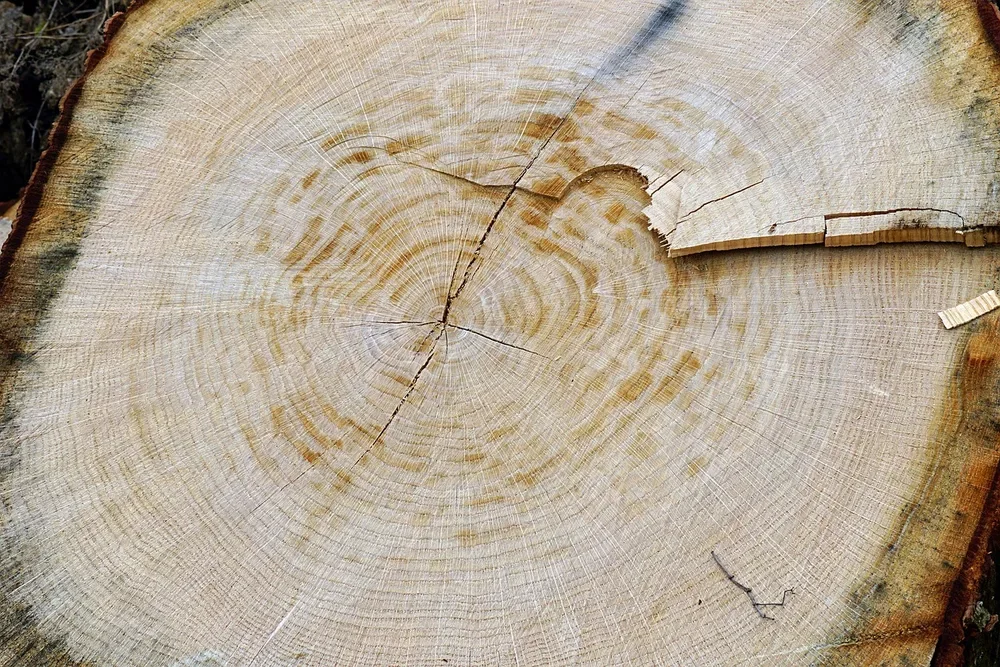
Two details people miss. First, a ring count at 4.5 feet misses the first several years the sapling spent growing up to that height, so add a few years for a closer total. Second, wide rings mark good years and narrow rings mark drought or crowding, which means you can read the tree’s history, not just its age.
Counting a standing tree with an increment borer
For a tree you want to keep, a forester uses an increment borer. It is a hollow auger that threads into the trunk and pulls out a pencil-thin core, typically about 0.2 inch (5 mm) across, which you then read for rings. Professional borers run from a couple hundred dollars up, so for a single backyard tree it is usually cheaper to hire a certified arborist. A short borer also cannot reach the center of a very wide trunk, so you may count to a point and estimate the remainder.
Visual Clues: What Bark, Crown and Limbs Can and Cannot Tell You
Bark and branches are supporting evidence only. Use them to check whether your number is plausible, never to produce one.
| Clue | Young oak | Mature oak | Very old oak |
|---|---|---|---|
| Bark | Smooth to lightly furrowed | Developing ridges and furrows | Deep, rugged furrows |
| Trunk | Slender, straight | Thick, tapering | Massive, often buttressed at the base |
| Crown | Narrow, upright | Broad and rounded | Wide, flat-topped, with dead limbs |
| Limbs | Slender and upright | Thick, spreading | Heavy, gnarled, may droop toward the ground |
White oak bark is pale gray and scaly or ridged. Red oak bark is darker with long vertical ridges. Lichen and moss on bark tell you about moisture and air quality, not age, so ignore them as a clue.
How Long Do Oaks Live Compared With Your Estimate?
Your result should land somewhere inside the normal lifespan for the species. White oaks often live 200 to 300 years and some pass 400, red oaks usually peak around 150 to 250 years, and pin oaks are shorter-lived, roughly 100 to 150 years. If your formula says a pin oak is 280 years old, you have the wrong species or the wrong measurement.
For lifespans and record-holders see how old oak trees can get. If your real question is how fast one grows, read how fast an oak tree grows and how long an oak takes to reach full size, and for the final dimensions see how big oak trees can grow.
Why This Matters in the Workshop
If you mill or buy oak lumber, the same rings are on the end of every board. Counting rings per inch across the end grain shows how fast the tree grew. In ring-porous woods like oak, fast-grown wood with wide rings is generally denser and harder than slow-grown wood with narrow rings, which is opposite to what many people assume from softwoods. A board with 4 rings per inch and one with 20 rings per inch can behave differently under a plane, so it pays to look before you buy.
Frequently Asked Questions About Oak Tree Age
How do you tell how old an oak tree is without cutting it down?
Measure the trunk circumference 4.5 feet above the ground, divide by 3.14 to get diameter, then multiply by a species growth factor (about 5 for white oak, 4 for red oak, 3 for pin oak). The result is a rough estimate. An arborist with an increment borer can count the actual rings in a thin core without felling the tree.
How old is a 48 inch oak tree?
It depends on whether 48 inches is the diameter or the circumference. A 48-inch diameter white oak works out to about 240 years (48 x 5), and a red oak to about 190 years (48 x 4). A 48-inch circumference is only about 15 inches across, which gives roughly 76 years for a white oak and 61 years for a red oak.
Does bark tell you the age of an oak tree?
Only loosely. Young oaks have smoother bark and old oaks have deep ridges, but bark texture varies by species, and sun, moisture, disease and injury change how quickly furrows form. Use bark to sanity-check a size-based estimate, not to calculate an age.
How accurate is the oak tree age formula?
It is a ballpark, and it can be off by 20 percent or more. Trees in dense forest grow slowly and can be older than the formula says, while an open-grown tree on rich soil grows fast and can be younger. The formula also drifts on very large trees, so treat big results as a range.
How do you count the rings on an oak tree?
Count from the bark inward to the center on a clean cut stump, or on a core pulled with an increment borer. Oak has large pores in the early part of each year’s growth, so each year shows as one band that starts with a visible pore row and ends in dense, darker latewood. Count those bands, one per year, and add the years the tree needed to reach the height of the cut.
Can you estimate the age of a live oak the same way?
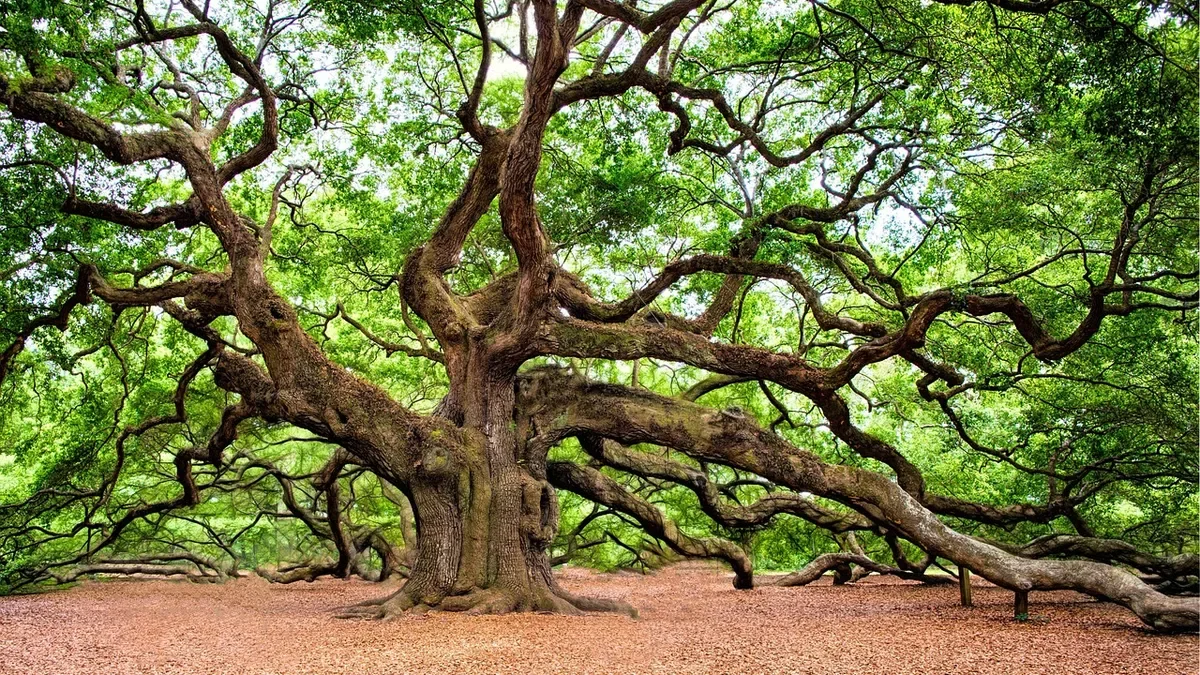
Not reliably. Live oaks grow wide instead of tall, often split into several trunks and keep leaves year-round, so a single trunk diameter does not map cleanly onto age. For a big live oak, treat any size-based number as a very rough range and use records, old photos or a professional core sample.
Sponsored / affiliate links. As an Amazon Associate I earn from qualifying purchases. I may earn additional commission from eligible campaigns.