How to Identify Walnut Wood: 6 Checks and a Look-Alike Chart
Black walnut is identified by a combination of traits, not color alone: pale sapwood beside dark heartwood, semi-ring-porous pores, a density near 38 lb per cubic foot, and only a faint odor when worked. Any one of these can be faked or shared by a look-alike, so stained poplar and cherry fool people who check just one. This guide gives six checks in order, then a chart that shows which look-alike each one rules out.
How to Identify Walnut Wood: The Six-Check Order
Best Wood ID Loupe Pick
 |
Carson TriView 5x/10x/15x Folding Loupe, $11.99 The pore-pattern check below is a 10x job, and this loupe stacks its three 5x lenses to reach 10x or 15x, so you can read walnut’s end grain without buying a pricier jeweler’s loupe.
|
As an Amazon Associate we earn from qualifying purchases.
Run the checks from cheapest to most reliable. The first two take seconds and need no tools; the pore check is the one that settles close calls. The numbers below come from the Wood Database entry for Juglans nigra.
| Check | What black walnut shows | What it helps rule out |
|---|---|---|
| Color and sapwood | Heartwood from lighter pale brown to dark chocolate brown with darker streaks; sapwood pale yellow-gray to nearly white | Uniformly stained pale woods |
| Grain and texture | Usually straight but can be irregular; medium texture, moderate natural luster | Very fine, featureless woods |
| Pores (10x) | Semi-ring-porous: large early pores shrinking gradually across each ring | Red oak (ring-porous), poplar and alder (diffuse) |
| Weight | About 38 lb per cubic foot dried (610 kg/m3) | Poplar, alder, butternut |
| Hardness | 1,010 lbf Janka | Soft look-alikes (poplar 540, alder 590) |
| Smell when worked | Faint, mild odor | Oak, which has a distinct smell |
What Does Walnut Wood Look Like?
The first thing to look for is not the brown but the border. Walnut heartwood can be a lighter pale brown or a dark chocolate with darker streaks, and the sapwood beside it is pale yellow-gray to nearly white. A sharp color break near a board edge is a good sign, because a stain would have to paint two colors on one piece to copy it. Sapwood is often trimmed off or absent, so its absence proves nothing, but its presence is useful evidence.
Grain is usually straight but can turn irregular, with a medium texture and moderate natural luster. How walnut and cherry change color as they age is covered in our walnut vs cherry color guide, so this page sticks to identification. For the stain shades people call walnut, see dark walnut vs espresso stain.
Read the Pores: Walnut vs Oak, Cherry, Poplar and Mahogany
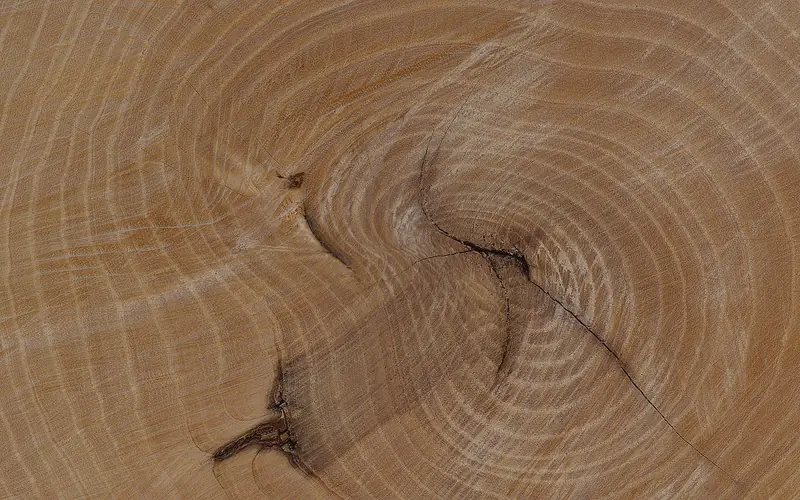
Pore pattern is the most reliable check because color and finish do not change it. Hold a 10x lens against a freshly cut or freshly planed end, not a sanded, finished or dirty one. The Wood Database describes the pore types of the common candidates this way:
- Black walnut: semi-ring-porous, with a gradual change from earlywood to latewood pores.
- Red oak: ring-porous, with notably large open earlywood pores in rows and very wide rays you can see without magnification. If you can see a bold ring of big pores, it is not walnut. Our oak wood grain pattern guide shows what to expect.
- Black cherry: semi-ring-porous to diffuse-porous with medium to small pores that may form a single continuous row. This is the closest pore match to walnut, so use color change, weight and gum pockets to separate them.
- Yellow poplar and red alder: diffuse-porous, with small pores and no ring pattern.
- Honduran mahogany: diffuse-porous with large, few vessels, and grain that can be straight, interlocked or wavy. See mahogany durability for how it behaves in use.
Weight and Hardness: What the Numbers Can and Cannot Prove
Most guides say walnut is heavier than its imitators. That is true only for the light ones. Walnut separates cleanly from poplar, alder and butternut, but it is lighter than red oak and close enough to cherry and mahogany that a hand-lift test will not separate them. The table puts the Wood Database figures side by side, with the weight of one board worked out so you can use a kitchen scale.
| Wood | Dried weight (lb/ft3) | Janka (lbf) | Pores | 3/4 x 5-1/2 x 36 in board |
|---|---|---|---|---|
| Black walnut | 38 | 1,010 | Semi-ring-porous | about 3.3 lb |
| Butternut | 27 | 490 | Semi-ring-porous | about 2.3 lb |
| Yellow poplar | 29 | 540 | Diffuse | about 2.5 lb |
| Red alder | 28 | 590 | Diffuse | about 2.4 lb |
| Black cherry | 35 | 950 | Semi-ring to diffuse | about 3.0 lb |
| Honduran mahogany | 36.8 | 900 | Diffuse | about 3.2 lb |
| Northern red oak | 43.8 | 1,220 | Ring-porous | about 3.8 lb |
The board weights are our own arithmetic: a 3/4 x 5-1/2 x 36 inch board is about 0.086 cubic feet, multiplied by each density. Real boards vary with moisture content and with the natural density range within a species (black walnut is listed at a specific gravity of 0.51 to 0.61), so treat a result within about half a pound as a tie. A board at 2.4 lb is almost certainly not black walnut; one at 3.3 lb is only consistent with it.
The Smell and Sanding Test
Black walnut has a faint, mild odor when being worked, so do not expect a strong nutty smell. The test is better at elimination: red oak has a distinct smell, cherry a mild distinctive scent, and dry poplar, alder and mahogany have no characteristic odor. Smell only works on raw wood, a fresh cut or fresh sanding, and it fades once a finish is on.
Safety note: the Wood Database lists black walnut as a sensitizer, and the usual reactions are eye and skin irritation. If you sand or saw a board to check it, wear a dust mask and eye protection, and sand only a small hidden spot.
Other Walnuts and Other Look-Alikes
Not every walnut is black walnut. English walnut (Juglans regia) has the same pale-brown to dark-chocolate range with a pale sapwood, a Janka of 1,220 lbf and a density of 40 lb per cubic foot, and its pores run from semi-ring-porous to diffuse-porous. Claro walnut, native to California and Oregon, is 1,130 lbf and 40 lb per cubic foot, and grafted English walnut rootstock can give a colorful, streaked look called marbled Claro. A hand lens and a scale cannot reliably separate these three, so if the species matters for a purchase, ask the seller for the species name.
Butternut (Juglans cinerea) is the true walnut-family look-alike. The Wood Database describes it as closely related to black walnut but much lighter in color and weight, with a light to medium tan heartwood, 490 lbf and 27 lb per cubic foot. If a board has walnut-like grain but feels light and soft, suspect butternut, poplar or alder before suspecting a bad scale.
Solid Walnut, Veneer or Stained Imitation?
For furniture, the question is often whether the walnut is solid, veneered or just walnut-colored. These checks use general woodworking practice rather than a lab test, so treat them as clues.
- Look at the edges and the underside. A thin line where a surface layer meets a different core, or a solid-color core with no wood grain, points to veneer or laminate over MDF or particleboard.
- Follow the grain over the edge. On a solid board the grain wraps continuously around the corner; on a veneered panel the face pattern usually stops at an applied edge band.
- Check a hidden spot. A shallow stain over poplar or alder shows paler wood once a hidden patch is lightly sanded. Do this only where a repair will not show.
- Count the checks. One match proves little. Sapwood contrast plus semi-ring-porous pores plus a walnut-range weight is a strong case.
Veneered walnut is still real walnut on its face, and it is often the better choice for large flat panels. The point is knowing what you paid for, not that veneer is bad.
Walnut Shavings Are Not for Horse Bedding
If you work walnut in a shop that shares a barn or farm, keep the waste out of stalls. The Ontario government warns that bedding containing as little as 20% black walnut shavings is a problem, and that signs of laminitis typically appear within one to two days of exposure. Sawdust from walnut shops should be bagged separately and never sent to a stable.
Walnut Identification FAQ
Is walnut wood always dark brown?
No. Black walnut heartwood runs from a lighter pale brown to a dark chocolate brown with darker streaks, and the sapwood is pale yellow-gray to nearly white. A raw board can show both colors, and a finished piece can look anywhere from light brown to near-black depending on the finish.
How can you tell walnut from stained poplar?
Check the pores and the weight. Poplar is diffuse-porous with small pores in no set pattern and weighs about 29 lb per cubic foot, versus about 38 for black walnut. Poplar can also show gray or green streaks that stain does not hide. Sanding an out-of-sight spot shows the pale wood under a shallow stain.
Does walnut have a smell?
Only a faint one. The Wood Database describes black walnut as having a faint, mild odor when being worked, so the smell test is weak on its own. It is most useful for ruling out oak, which has a distinct smell, and it only works on raw wood or fresh sanding.
What does walnut end grain look like?
Walnut is semi-ring-porous: the pores are largest at the start of each growth ring and shrink gradually toward the end of the ring. You will not see the bold, open row of large pores that red oak shows, and you will not see the near-uniform tiny pores of poplar or alder.
Is walnut sawdust harmful?
It can irritate. The Wood Database lists black walnut as a sensitizer, with eye and skin irritation as the usual reactions. Wear a dust mask and eye protection when sanding or cutting it. Separately, shavings from black walnut should never go into horse bedding.
Bottom Line
No single test names walnut for certain. Sapwood contrast and a semi-ring-porous end grain make the case, weight rules out the light imitators, and smell only helps against oak. Remember what the scale cannot do: it will not separate walnut from cherry or mahogany. When the pores say walnut and the weight agrees, you can be confident. For a broader look at how it compares with other species, see our types of wood guide.
Sponsored / affiliate links. As an Amazon Associate I earn from qualifying purchases. I may earn additional commission from eligible campaigns.