What Wood Did Sam Maloof Use? Walnut Grades Explained
Sam Maloof built nearly all his furniture from black walnut — but common #1 and #2 grade lumber, not premium clear stock, because the streaks and knots gave more character than flawless boards. Picking the wrong grade wastes both money and the wood’s natural figure. This guide covers which species Maloof actually used, the one rule he never broke, and how to match grain the way he did.
This article may contain affiliate links. If you buy through them, we may earn a small commission at no extra cost to you.
Quick Answer
Sam Maloof built almost all his furniture from black walnut, deliberately buying common #1 and #2 grade lumber instead of flawless clear stock because it showed more figure. He also worked in cherry, figured maple, and claro walnut — but never mixed two species in the same piece.
The Legacy of Sam Maloof
Best Wood Selection Reference Pick

Identifying Wood: Accurate Results with Simple Tools
R. Bruce Hoadley’s companion reference for identifying species by grain, pore structure, and figure — the same fundamentals behind the grade-and-grain decisions this guide covers.
- Best for: learning to read grain, grade, and moisture like a professional before you buy lumber
- Why we picked it: it’s the reference that grain-matching decisions like Maloof’s are actually based on
- Main drawback: dense, textbook-style reading — not a quick skim
Compare more wood-selection tools
 Option 1 General Tools MMD4E Pinless Wood Moisture Meter
|
 Option 2 Rockler Black Walnut Wood Board by the Piece
|
 Option 3 WOOD! Identifying and Using Hundreds of Woods Worldwide
|
As an Amazon Associate we earn from qualifying purchases.
Sam Maloof began his woodworking career in the 1940s, working out of his own garage in Southern California with no formal training. He returned to walnut again and again for its rich color and strength, and worked in figured maple and cherry when a piece called for it.
His pieces are known for smooth, sculpted curves rather than sharp joinery lines — a style that blended traditional techniques with a modernist sensibility. Chairs and rocking chairs made up much of his early work, and each piece was built around the specific board he’d chosen for it, not the other way around. You can see how that shaped his overall approach in our guide to Sam Maloof’s legacy.

Why Maloof Used Common-Grade Walnut Instead of Premium Lumber
Most furniture makers buy the highest grade of lumber they can afford — clear, straight-grained boards with no streaks or knots. Maloof did the opposite. According to his own account in Fine Woodworking’s “How I Make a Rocker,” he deliberately bought common #1 and #2 grade black walnut rather than clear stock, because the lower grades carried more mineral streaks and character marks. To him, that character was more visually interesting than a flawless board.
This is a useful rule for your own projects: the wood graded “lower” for structural or cabinetry use is often the wood with the most interesting figure for a one-off furniture piece. You’re paying less for it, too.
📊 Black walnut rates 1,010 lbf on the Janka hardness scale — hard enough for chair frames and tabletops that see daily use, but still workable with hand tools. Source: Janka hardness scale (industry wood-density standard)
Want to apply this to your own project? Here’s what makes it possible to evaluate grade and figure with confidence instead of guessing.
Claro Walnut vs. Eastern Black Walnut: What’s the Difference
Maloof didn’t limit himself to one type of walnut. Eastern black walnut was his everyday material, but he also worked in claro walnut, a California native species prized for wilder, more dramatic figure — burl, crotch, and curly grain patterns that black walnut rarely shows. Sam Maloof Woodworker Inc., the shop that continues his work, still sells claro walnut offcuts specifically for the figure collectors want.
| Characteristic | Eastern Black Walnut | Claro Walnut |
|---|---|---|
| Color & grain | Rich chocolate brown, mostly straight, uniform grain | Pale to dark brown with dramatic streaks, often wild figure |
| Janka hardness | 1,010 lbf | 1,130 lbf |
| Availability | Widely available, moderate cost | Rarer, usually priced by the board for figure |
| Best for | Everyday chairs, tables, consistent production runs | Statement tabletops, live-edge slabs, one-of-a-kind pieces |
Both species belong to the broader family of hardwoods furniture makers rely on — see our full guide to types of wood for how walnut compares to oak, maple, and cherry. If you are specifically weighing black walnut against other walnut varieties, our walnut vs. black walnut comparison breaks down the naming confusion in more detail.
Other Woods in Maloof’s Palette: Cherry and Figured Maple
Cherry brought a warmth walnut doesn’t have — a lighter starting color that darkens into a deep reddish-brown patina over years of handling and light exposure. Maloof used it on pieces where he wanted that shift to be part of the piece’s life, not just its finish.
Figured maple gave him a tighter, paler grain for pieces where he wanted contrast against walnut components, or where a client wanted a lighter wood. Both woods were chosen for the same underlying reason as his walnut: strength, workability with hand tools, and a grain pattern that could carry sculpted curves without looking busy.
The One Rule Maloof Never Broke: Don’t Mix Wood Species
Within a single chair, table, or cabinet, Maloof used one species and stuck with it. He didn’t pair walnut legs with a maple seat, or a cherry top with walnut trim. Mixing species in one piece almost always fights itself — the grain, color, and the way each wood ages will pull the eye in different directions instead of reading as one cohesive object.
If you’re planning your own build, decide on one species before you start selecting individual boards. It’s a simple rule, and it’s one of the easiest ways to make a homemade piece look intentional instead of improvised.
How to Match Wood Grain the Way Maloof Did
Once you’ve picked a species and a grade, the next step is matching individual boards to the parts you’re building. This is the process Maloof described using on his own rocking chairs:
- Buy common grade, not clear grade: Choose #1 or #2 common walnut boards instead of flawless clear stock — the streaks and character marks give more interesting figure once finished.
- Lay every board out before cutting: Spread your full stock in one place so you can compare grain and color side by side before committing to a layout.
- Match curves to the grain: For curved parts like chair legs or arms, look for a board where the grain already bends in roughly the same direction as the cut you’ll make.
- Arrange panel boards for figure, not orientation: Rotate boards to get the best-looking grain match across a glued-up seat or panel, regardless of whether the bark side faces up or down.
- Cut only after you’ve committed to the arrangement: Mark your final layout on every board before any cuts, so you don’t lose track of the match you spent time finding.
Grain-matched boards are only half the process — what you do to the wood after this point matters just as much. See our guides to Sam Maloof’s wood shaping techniques and Sam Maloof’s wood finishes for what comes next.
Crafting Techniques Built Around the Wood
Maloof used both hand tools and machines, but the joinery itself was designed around how the grain he’d selected would move and wear. He was known for mortise-and-tenon joints reinforced with details like his signature exposed spline, cut to follow the grain rather than fight it. You can see how these choices carried through into finished pieces in our guide to Sam Maloof chair dimensions.
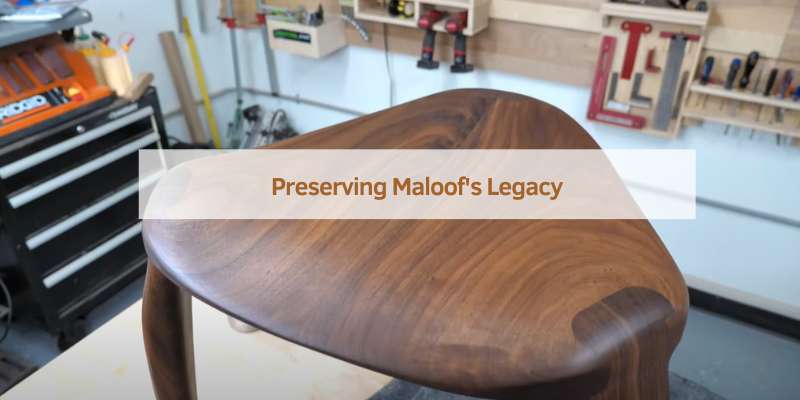
Preserving Maloof’s Legacy
Maloof’s work and his approach to wood selection are preserved today through several institutions. The Sam Maloof Foundation runs workshops from his original California studio. The Smithsonian American Art Museum holds pieces in its permanent collection, and Craft in America has featured his work and process on film.
You can see examples of his finished work discussed in our guide to Sam Maloof exhibitions.
| Organization | Type | Location |
|---|---|---|
| Sam Maloof Foundation | Workshop & studio tours | Alta Loma, California |
| Smithsonian American Art Museum | Permanent collection | Washington, D.C. |
| Craft in America | Documentary feature | Los Angeles, California |
Frequently Asked Questions
What wood did Sam Maloof use most in his furniture?
Sam Maloof built most of his furniture from black walnut, the wood he returned to throughout his career for its strength and rich figure. He also worked regularly in cherry, figured maple, and claro walnut, choosing the species based on the piece, but walnut remained his primary material for decades.
According to Maloof’s own account in Fine Woodworking’s “How I Make a Rocker,” he deliberately bought common #1 and #2 grade walnut rather than clear, select-grade stock, because the lower grades carried more mineral streaks and character marks — figure he considered more visually interesting than flawless lumber.
What’s the difference between claro walnut and eastern black walnut?
Eastern black walnut has a rich brown color and mostly straight, uniform grain, rating about 1,010 lbf on the Janka hardness scale. Claro walnut, a California native, is slightly harder at roughly 1,130 lbf and known for wilder figure — burl, crotch, and curly grain — making it prized for statement tabletops and live-edge work.
Did Sam Maloof ever mix different wood species in one piece?
No. Maloof consistently built each piece from a single wood species rather than combining two species in the same design. This kept the grain, color, and figure consistent across a chair or table — a rule worth following in your own furniture builds.
What other woods besides walnut did Maloof work with?
Beyond black walnut, Maloof regularly used cherry for its warm color and figured maple for its fine, tight grain. Both were chosen for the same reason as his walnut: strength, workability, and a grain pattern that could carry his signature sculpted curves without looking busy or artificial.
Conclusion
Sam Maloof’s wood selection wasn’t about buying the most expensive board available — it was about recognizing character in common-grade lumber, staying loyal to one species per piece, and matching grain by eye before ever making a cut. Apply the same three habits to your next project, and the wood will do a lot of the design work for you.
Sponsored / affiliate links. As an Amazon Associate I earn from qualifying purchases. I may earn additional commission from eligible campaigns.