How to Reactivate Silica Gel: Winter Woodshop Use
Reactivate silica gel by heating it at about 250°F to 300°F for 1 to 2 hours, or until the gel returns to a dry, free-flowing state. Stop using packets that remain clumped, discolored, or damaged. Wet desiccant left in a winter shop can leave tool drawers, finish cans, and hardware prone to rust or corrosion. This guide covers safe reactivation methods, packet inspection, and when reuse still makes sense in a woodshop.
This guide is part of our Winter Woodshop Guide: Heat, Humidity, Rust and Safety series.
Can silica gel be reactivated?

- Orange beads change color as they absorb moisture
- Reusable after drying out
- Resealable bag for storage
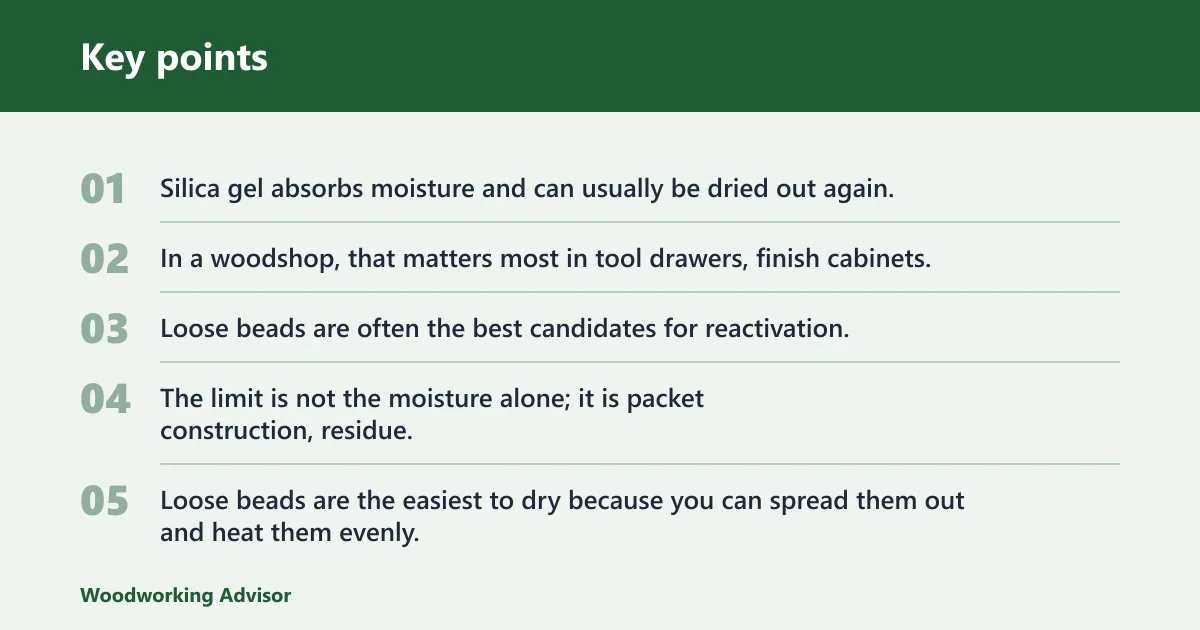
Yes. Silica gel absorbs moisture and can usually be dried out again, so long as the material has not been contaminated or physically damaged. In a woodshop, that matters most in tool drawers, finish cabinets, and sealed bins that open often enough to pull in damp air.
Loose beads are often the best candidates for reactivation. Heat-safe packets can often be reused too. The limit is not the moisture alone; it is packet construction, residue, and repeated humidity exposure.
Which forms are worth reusing?
Loose beads are the easiest to dry because you can spread them out and heat them evenly. Indicator silica gel can also be reused, but the color system varies by product line, so watch the maker’s color cue rather than assuming every packet behaves the same way.
Packet material matters. Paper shells, mixed laminates, inks, glues, and foil layers can fail under heat or in a microwave. If the packet is stained, torn, scorched, or unknown, replacement is the safer call.
When replacement is smarter than drying
Replace the packet if it has oil, finish residue, metal dust, or a burnt smell. Replace it if the shell is brittle, the seams are open, or the gel stays caked after drying. A packet that keeps failing early in a humid drawer has usually reached the end of practical reuse.
What you’ll need
- An oven or other heat source approved by the product label
- A shallow metal pan or baking sheet
- Gloves or tongs for hot trays and packets
- An airtight container or zip bag for cooling and storage
- A hygrometer or other humidity check for sealed cabinets and bins
- A timer
How do you reactivate silica gel in an oven?
For loose beads and heat-safe packets, a conventional oven is commonly used. Set a steady temperature in the 250°F to 300°F range, and follow the packet or brand instructions if they differ. Spread loose beads in a single layer on a shallow metal pan so hot air reaches every bead.
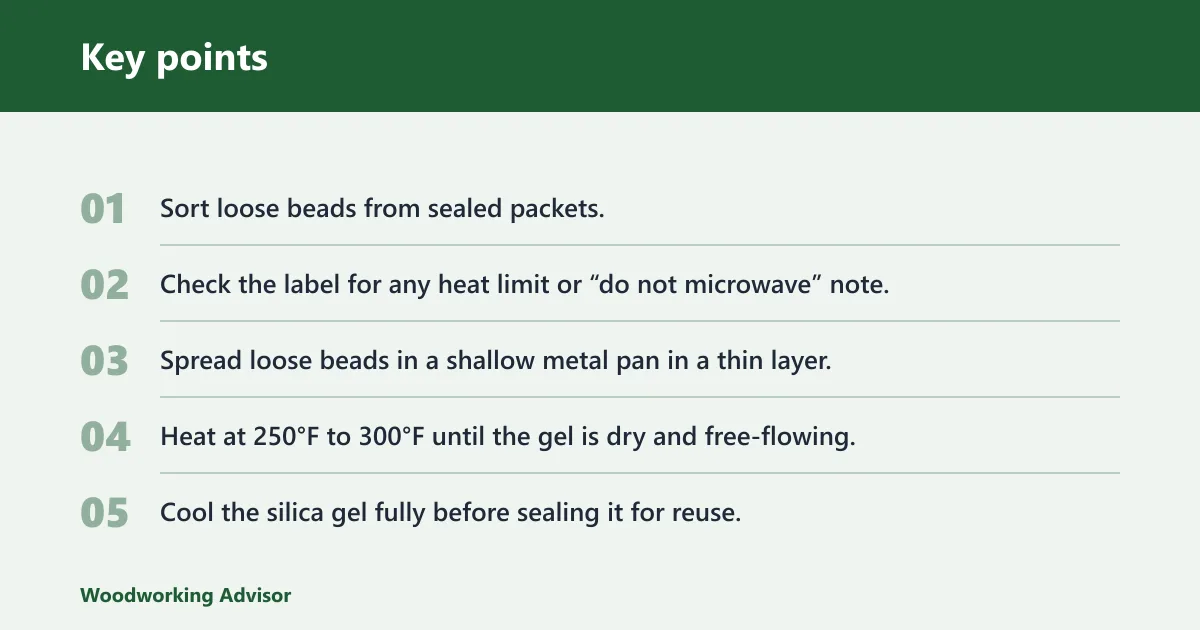
- Sort loose beads from sealed packets.
- Check the label for any heat limit or “do not microwave” note.
- Spread loose beads in a shallow metal pan in a thin layer.
- Heat at 250°F to 300°F until the gel is dry and free-flowing.
- Cool the silica gel fully before sealing it for reuse.
- Store it in an airtight container or zip bag until needed.
Picture a small hardware bin that opens every day in a damp basement shop. If the beads are spread thinly and the bin stays sealed between uses, the gel dries more predictably than a packet tucked under screws in a pile.
For timing, use the product’s instructions first. As a reference point, some guidance calls for 15 minutes at 175°F to 200°F, while other manufacturers specify 1.5 to 3 hours or 2 to 4 hours at different temperature bands. The right time depends on bead load, packet size, and the maker’s directions.
How to reactivate silica gel packets in microwave
Microwave reactivation is riskier than oven drying and is not universal for all silica gel products. Use it only when the packet instructions allow it, because shells, inks, glues, and foil layers can scorch or fail. If the packet is heat-safe and microwave-safe, short intervals are the only cautious approach.
- Read the packet label for microwave approval.
- Inspect the shell for foil, mixed layers, stains, or tears.
- Place only approved packets in the microwave, not loose mixed packaging.
- Heat in 1-2 minute intervals and check after each pass.
- For 1-5 packets, keep total time in the 2-4 minute range only if the product allows it.
- For 6-10 packets, use 5-8 minutes only if the maker recommends microwave drying.
- Cool the packets for at least 30 minutes before storage or reuse.
Some packets are wrapped in materials that do not belong in a microwave at all. If the label is missing or the shell looks layered, skip this method. Oven drying is the safer default for woodshop use.
How do you know when it needs reactivation?
Indicator silica gel gives the clearest signal because its color shifts when it is spent, but the exact colors vary by product line. Some indicators move from orange to blue, while others use blue to pink or different systems altogether. Use the packet’s own color guide, not a generic rule.
For plain silica gel, check whether the beads feel heavier, clump together, or have stopped drying the storage space. A hygrometer in a closed cabinet can help confirm the problem. If a sealed drawer stays damp after reactivation, the cabinet may be opening too often or leaking moisture.
What humidity does to service life
More frequent reopening shortens service life because fresh humid air keeps entering the space. Residual dampness from unfinished lumber, uncured finishes, or a not-quite-sealed cabinet can saturate packets quickly at first use. A sealed bin or closed drawer gives the best result.
Silica gel reuse table
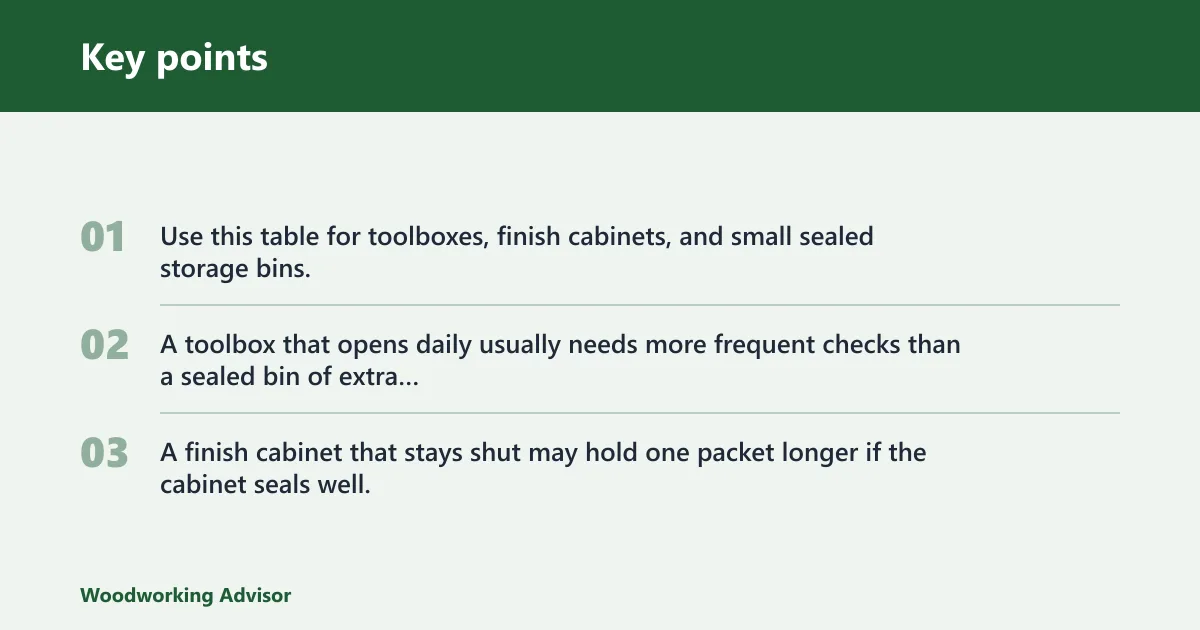
| Form factor | Heat method | Safe temperature band | Estimated time | Signs it is done | Replace-versus-reactivate triggers |
|---|---|---|---|---|---|
| Loose beads | Oven on a shallow metal pan | 250°F to 300°F | 1 to 2 hours | Free-flowing, no cool damp spots, no clumping | Replace if contaminated with oil, finish residue, or metal dust |
| Heat-safe packet | Oven only if the label allows it | 250°F to 300°F unless the maker lists another band | Follow the packet label; larger packets need longer | Packet feels lighter and the gel no longer clumps | Replace if the shell is torn, stained, scorched, or unknown |
| Indicator packet | Oven only if approved by the maker | Follow the product listing | Until the color returns to the dry state named on the packet | Color returns to the ready state shown by that product line | Replace if the indicator color looks burned or the packet no longer changes cleanly |
Use this table for toolboxes, finish cabinets, and small sealed storage bins. A toolbox that opens daily usually needs more frequent checks than a sealed bin of extra fasteners. A finish cabinet that stays shut may hold one packet longer if the cabinet seals well.
Common mistakes
- Using one temperature for every product. Follow the packet or brand instructions when they differ.
- Heating loose beads in a pile. Spread them in a thin layer so moisture can escape evenly.
- Microwaving packets with unknown shell materials. Skip mixed layers, foil, glued seams, and stained packets.
- Sealing the gel before it cools. Cool it fully first, then store it airtight.
- Reusing contaminated desiccant. Oil, finish, and metal dust shorten service life fast.
Suppose a packet from a tool drawer still looks fine after drying, but the cardboard shell has dark spots near the seam. That packet should be replaced, not cycled again. The gel may still be usable, but the shell no longer is.
Prevention: keep reactivated silica gel in an airtight container or zip bag until the moment you place it back in the drawer, cabinet, or bin. Exposure to open winter air starts the next saturation cycle immediately.
Frequently asked questions
How hot should I heat silica gel to reactivate it?
A practical oven band is 250°F to 300°F. If the packet or brand instructions list a different temperature, follow that listing instead. Do not guess with mixed-material packets or indicator packets that have a special label.
Can you reactivate silica gel packets more than once?
Usually yes, but the reuse cycle is not endless. Performance drops faster in spaces that open often or stay damp, and replacement becomes the better choice if the packet clumps, stains, scorches, or stops drying the space well.
Sponsored / affiliate links. As an Amazon Associate I earn from qualifying purchases. I may earn additional commission from eligible campaigns.