
How To Use Wood Steamer: The Best, Proven Method
To use a wood steamer, prepare your wood, heat water in a steam generator, and feed the steam into an insulated steam box containing the wood. Steam for approximately one hour per inch of wood thickness. Once pliable, quickly remove the wood with heat-resistant gloves, bend it around a form, and clamp it securely to dry.
Hello friends! Md Meraj here. Have you ever seen a beautiful, curved wooden chair or a graceful archway and wondered how it was made? The secret is often steam bending. It might sound like a complicated process reserved for expert woodworkers, but I promise you, it’s something you can learn. Many beginners feel intimidated by the idea of steaming wood. They worry about getting it right, staying safe, and not wasting good lumber.
If that sounds like you, take a deep breath. You’ve come to the right place. I’m here to walk you through every single step in a simple, clear way. We will break it down together, from picking the right wood to clamping your final piece. By the end of this guide, you will feel confident and ready to try steam bending on your own. Let’s get started and unlock a whole new level of creativity in your workshop.
What Exactly Is Wood Steaming?
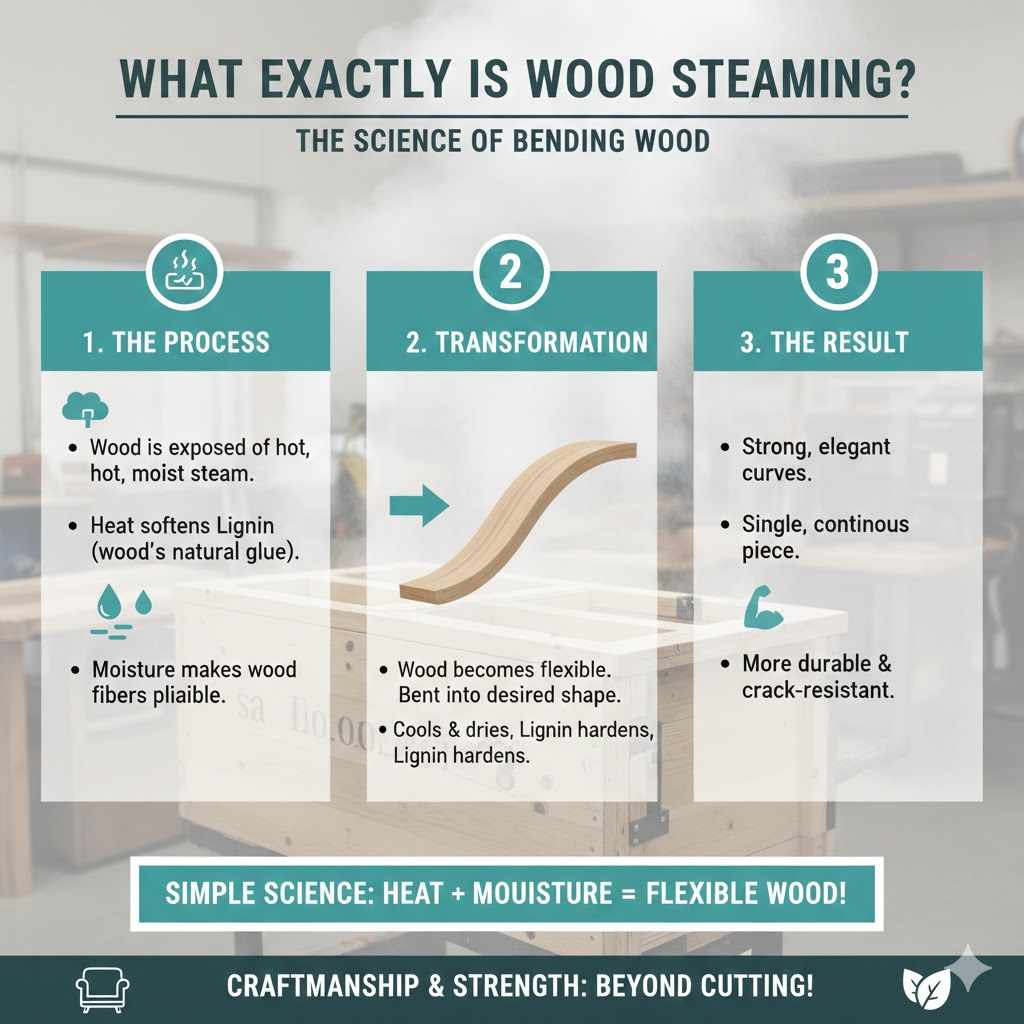
Before we jump into the “how,” let’s quickly cover the “what.” Wood steaming is a traditional technique used to make wood flexible. When you expose wood to hot steam, two things happen inside it. First, the heat softens lignin, which is a natural glue that holds the wood fibers together. Think of it like slightly melting a plastic ruler—it becomes bendy.
Second, the moisture from the steam gets into the wood fibers, making them more pliable. This combination of heat and moisture turns a rigid piece of wood into something you can bend into a curve without it snapping. Once you bend it into your desired shape and let it cool down and dry, the lignin hardens again, and the wood holds its new form permanently. It’s a bit like magic, but it’s really just simple science!
This technique allows woodworkers to create strong, elegant curves that would be impossible to achieve just by cutting. Instead of cutting a curve from a large, wide board (which creates weak cross-grain sections), steam bending uses a single, continuous piece of wood. This makes the final product much stronger and more durable.
Essential Tools and Materials You’ll Need
Getting your gear ready ahead of time makes the whole process smooth and stress-free. You don’t need a giant professional workshop for this. Here’s a list of the basics to get you started on your wood steaming journey.
The Core Steaming Setup
- Steam Generator: This is what creates the steam. You can use a dedicated electric steam generator, a wallpaper steamer, or even a large kettle or pot on a portable heating element like a turkey fryer. The key is that it can produce a steady flow of steam.
- Steam Box: This is the container where your wood will sit while it steams. You can easily build one yourself out of plywood or even use a large-diameter PVC pipe. The box needs an inlet for the steam to enter and a small outlet for pressure and condensation to escape.
- Hose: A heat-resistant hose to connect your steam generator to your steam box. A reinforced radiator hose from an auto parts store works great.
Bending and Shaping Tools
- Bending Form: This is the mold or jig you will bend your hot wood around. You make this yourself out of scrap wood. Its shape will be the exact curve you want to create.
- Clamps: You can never have too many clamps! You will need several strong clamps (like F-clamps or C-clamps) to hold the wood tightly against the bending form while it dries.
- Support Strap (Optional but Recommended): For sharp bends, a thin metal strap placed on the outside of the bend helps prevent the outer wood fibers from splitting or breaking.
Safety Gear (Non-Negotiable!)
Working with steam is serious business. It is incredibly hot and can cause severe burns instantly. Please, never skip on safety. Your well-being is more important than any project.
| Safety Item | Why You Need It |
|---|---|
| Heat-Resistant Gloves | To handle the hot wood and steam box. Regular work gloves are not enough. Look for welding or foundry gloves. |
| Safety Glasses or Goggles | Protects your eyes from unexpected puffs of steam or wood splinters. |
| Long-Sleeved Shirt & Pants | Covers your skin to protect from accidental contact with steam or the hot steam box. |
| Closed-Toe Shoes | Protects your feet from dropped tools, wood, or hot water spills. |
Step-by-Step Guide: How to Use a Wood Steamer
Alright, let’s get to the fun part! Follow these steps carefully, and you’ll be bending wood like a pro. Remember to take your time. Rushing is where mistakes happen.
Step 1: Prepare Your Wood for Bending
Not all woods are created equal when it comes to steam bending. Some bend beautifully, while others are likely to snap. For your first project, I highly recommend choosing a wood known for being easy to bend.
The best woods for steam bending are hardwoods with straight grain. Air-dried wood is far superior to kiln-dried wood, as the high heat of the kiln can make the lignin brittle. If you can find it, air-dried is the way to go.
Here’s a quick guide to some common woods:
| Wood Type | Bendability | Notes for Beginners |
|---|---|---|
| White Oak | Excellent | The traditional choice for boat building and furniture. Very forgiving. |
| Red Oak | Very Good | A great alternative to white oak and often more available. |
| Ash | Excellent | Lightweight and strong. Bends very well, often used for tool handles and sports equipment. |
| Hickory | Excellent | Extremely strong and flexible. Can be a bit tougher to work with but holds a curve well. |
| Beech | Very Good | A classic choice for bentwood furniture, like Thonet chairs. |
| Birch | Good | Bends well but can sometimes be a little brittle. Good for smaller projects. |
Once you’ve selected your wood, make sure it’s milled to its final dimensions, but leave it a little longer than you need. This extra length, often called a “handle,” gives you leverage during the bend. Inspect the wood for any knots or grain irregularities, as these are weak points where a break is most likely to occur.
Step 2: Set Up Your Steam Box and Generator
Your setup should be in a well-ventilated area, preferably outdoors or in a garage with the door open. Steam creates a lot of moisture, and you don’t want that building up inside your house or a closed workshop.
- Position the Steam Generator: Place your steam source on a stable, level surface. Fill it with water, following the manufacturer’s instructions. Do not turn it on yet.
- Connect the Hose: Securely attach the heat-resistant hose from the steam generator’s outlet to the steam box’s inlet. Make sure the connection is snug to prevent steam from leaking.
- Arrange the Steam Box: The steam box should be slightly angled so that condensation can drain out of the small outlet hole at the far end. You can prop one end up on a block of wood. This prevents water from pooling inside and waterlogging your wood.
- Prepare the Bending Area: Have your bending form and all your clamps ready and within arm’s reach of the steam box. When the wood comes out, you have to move very fast. You won’t have time to look for a missing clamp.
Step 3: The Steaming Process
This is where patience is key. The general rule of thumb for steaming is: one hour of steam time for every one inch of wood thickness. It’s better to steam for a little too long than not long enough. Under-steamed wood will crack.
- Place Wood in the Box: Put your wood pieces inside the steam box. Use small stickers or spacers (thin pieces of wood) to keep them elevated and separated. This allows steam to circulate around all sides of each piece.
- Start the Steam: Turn on your steam generator and let the box fill with steam. You’ll start to see steam gently escaping from the drain hole. This is good—it means the box is full. Your goal is to keep the temperature inside the box near the boiling point of water, which is about 212°F (100°C).
- Time the Process: Once the box is full of steam, start your timer. Don’t open the box to peek! Every time you open it, you let out all the heat and steam, which sets your progress back. Trust the process and the clock. For detailed guidance on wood properties, the U.S. Forest Products Laboratory is an excellent resource for woodworkers.
Step 4: Bending and Clamping the Wood
This is the moment of truth! You need to work quickly and safely. As soon as the wood leaves the steam box, it starts to cool and lose its flexibility. Experts say you have less than a minute to complete your bend.
- Get Your Safety Gear On: Before the timer goes off, put on your heat-resistant gloves and safety glasses.
- Remove the Wood: Once the time is up, carefully open the steam box door. Be prepared for a big cloud of hot steam. Using your gloved hands, quickly take out one piece of wood.
- Bend it Around the Form: Immediately take the wood to your bending form. Place the center of the wood at the center of the curve and smoothly bend the ends around the form. Apply firm, steady pressure. Don’t jerk or force it aggressively. You should feel the wood give way and take the shape of the form.
- Clamp, Clamp, Clamp: As soon as the wood is flush against the form, start clamping it down. Start clamping in the middle and work your way out toward the ends. Use as many clamps as you need to ensure the wood is held tightly against the form along the entire curve.
Don’t be discouraged if your first attempt isn’t perfect, or even if a piece breaks. Steam bending has a learning curve. Each piece of wood is different, and it takes a bit of practice to get a feel for it.
Step 5: Drying and “Springback”
Now that your wood is clamped securely in its new shape, it needs to dry completely. How long this takes depends on the thickness of the wood and the humidity in your workshop. A general guideline is to leave it clamped on the form for at least 24 hours. For thicker pieces (over one inch), it could take a week or more.
Once the wood is dry, you can unclamp it. You will notice that the wood relaxes or “springs back” a little bit, slightly opening up from the tight curve of the form. This is completely normal! Experienced woodworkers always account for springback by making their bending form a slightly tighter curve than what they need for their final product.
The amount of springback varies by wood species and the sharpness of the bend. It’s a good idea to make a test bend with a piece of scrap from the same board to see how much it springs back before you bend your final project pieces.
Final Words of Encouragement
You did it! You took a straight, rigid piece of wood and transformed it into a beautiful, strong curve. The possibilities this technique opens up are truly exciting. You can now think about making curved chair backs, decorative arches, custom furniture parts, and so much more. Your woodworking projects just took a huge leap forward.
Remember that like any new skill, practice is everything. Don’t get down on yourself if a piece breaks or a curve isn’t perfect. Every attempt is a lesson learned. For a deeper dive into workplace safety including handling hot equipment, always check resources like the Occupational Safety and Health Administration (OSHA). Stay safe, be patient, and have fun exploring the art of steam bending. I can’t wait to see what you create!

Frequently Asked Questions (FAQ)
1. What is the best steam source for a beginner?
For beginners, an electric wallpaper steamer is often the best choice. They are affordable, readily available, and designed to produce steam for long periods. They are also relatively safe and easy to operate compared to using a propane burner with a large pot.
2. Can I steam bend any type of wood?
No, not all woods are suitable. The best woods are straight-grained hardwoods like oak, ash, hickory, and beech. Softwoods like pine and fir generally do not steam bend well because their structure tends to crinkle or break. Tropical hardwoods are also often too dense and brittle.
3. Do I need to soak the wood in water before steaming?
This is a common myth. Soaking wood before steaming is not necessary and can actually be counterproductive. The steam itself provides all the moisture and heat needed. Waterlogged wood takes longer to heat up and can result in a less effective bend.
4. How can I build a simple steam box?
You can build a simple, effective steam box from a length of wide-diameter PVC pipe (like 4-inch or 6-inch). Cap one end, and create a simple wooden door for the other. Drill a hole for the steam inlet near the capped end and a few small drain holes at the bottom of the same end. Prop the box up so the drain holes are at the lowest point.
5. Why did my wood break when I tried to bend it?
There are a few common reasons for breakage. The wood might have been under-steamed (not left in the box long enough). It could be a poor choice of wood (like kiln-dried pine). Or, there might have been a hidden knot or flaw in the grain. Finally, bending too slowly allows the wood to cool and stiffen.
6. What is “springback” and how do I deal with it?
Springback is the natural tendency of the wood to partially straighten out after it’s removed from the bending form. All wood does this to some degree. To compensate, you must make your bending form slightly more curved than your desired final shape. There’s no magic formula, so making a test bend with a scrap piece is the best way to figure out how much to over-bend.
7. Can I re-bend a piece of wood that didn’t turn out right?
It’s generally not recommended. Once the wood has been steamed, bent, and dried, its internal structure is set. Attempting to re-steam and re-bend it is very likely to cause it to crack or break. It’s best to start with a fresh piece of wood.