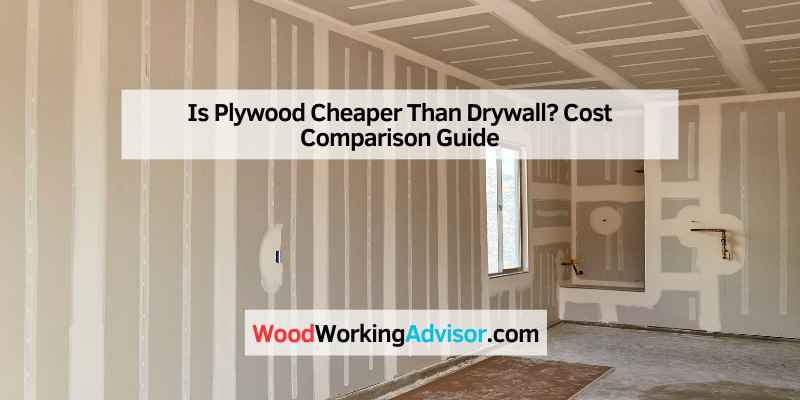
Is Plywood Cheaper Than Drywall? Exact Costs Compared
Drywall is cheaper per sheet than plywood — a standard 4×8 panel costs $10-15 versus $25-45 for structural-grade plywood. But total installed costs are closer than most people expect, because drywall requires taping, mudding, and compound finishing that plywood skips entirely. This guide covers exact material costs per sheet, total installed cost per square foot, and the specific situations where plywood actually comes out ahead.
Quick Answer
Standard 1/2-inch drywall costs $10-15 per 4×8 sheet; structural plywood runs $25-45. Per square foot installed (materials and labor combined), drywall averages $1.50-3.00 and plywood averages $2.50-5.50. For most interior walls, drywall is cheaper. The exception: garages and workshops, where skipping mud, tape, and compound can make plywood competitive on total project cost.
Plywood vs. Drywall: Material Cost Per Sheet
Best Drywall Finishing Starter Set Pick
Goldblatt 5 Piece Stainless Steel Taping Knife Set
A complete five-knife set covering every size you need for drywall taping and finishing — from 4-inch to 12-inch blades. Stainless steel holds its edge longer than carbon blades and cleans up faster.
- Best for: First-time and DIY drywall installations needing a complete tool set
- Why we picked it: Covers all finishing stages in one kit — no buying knives piecemeal
- Main drawback: Overkill if you only need one repair knife; the set is sized for full rooms
Compare more drywall finishing options
 Option 1 Sheetrock All Purpose Joint Compound (1 Qt)
|
 Option 2 Fiberglass Mesh Drywall Joint Tape, 1.88 in x 180 ft
|
 Option 3 Coarse Thread Drywall Screws #8 x 2″ (100 pack)
|
As an Amazon Associate we earn from qualifying purchases.
The simplest way to compare plywood and drywall cost is by the sheet. Both materials come in standard 4×8-foot panels, but the price gap is wide — and it widens further as you move up in plywood grade.
| Material (4×8 sheet) | Thickness | Approx. Cost |
|---|---|---|
| Standard drywall | 1/2-inch | $10-15 |
| Type X fire-rated drywall | 5/8-inch | $15-21 |
| CDX/BC plywood (structural grade) | 1/2-inch | $25-40 |
| BC plywood | 3/4-inch | $35-55 |
| Baltic birch plywood | 3/4-inch | $80-130 |
One 4×8 sheet covers 32 square feet. At $10-15 per sheet, standard drywall runs $0.31-0.47 per square foot in materials alone — roughly 3x to 5x cheaper per square foot than structural-grade plywood before labor enters the picture.
Total Installed Cost Per Square Foot — Where the Gap Narrows
Material cost per sheet is only half the story. Drywall requires taping, mudding (joint compound), and sanding before it can be painted — steps that add $0.40-0.70 per square foot in labor on top of the base hanging cost. Plywood skips all of that: screw it to the studs, and it is finished. That labor difference closes the gap significantly.
| Material | Materials/sqft | Hanging Labor | Finishing Labor | Total Installed |
|---|---|---|---|---|
| Standard drywall (1/2″) | $0.31-0.47 | $0.15-0.65 | $0.40-0.70 (tape + mud) | $1.50-3.00 |
| Type X drywall (5/8″) | $0.47-0.66 | $0.15-0.65 | $0.40-0.70 | $2.00-4.00 |
| CDX/BC plywood (1/2″) | $0.78-1.25 | $0.25-0.80 | None required | $1.80-3.50 |
| BC plywood (3/4″) | $1.09-1.72 | $0.25-0.80 | None required | $2.50-5.50 |
The practical takeaway: for a 12×12 room (about 400 square feet of wall area), drywall runs roughly $600-1,200 installed. Thin structural plywood installed in the same space runs $720-1,400. The gap is real, but it is not as dramatic as the per-sheet price difference suggests.
When Plywood Ends Up Cheaper Than Drywall
Despite higher material costs, plywood genuinely wins on total project cost in several real scenarios:
- Garage and workshop walls: When no smooth finish is needed, you skip all mudding and taping labor. Installing 1/2-inch plywood in an unfinished garage typically costs $1.80-2.50 per square foot all-in — comparable to or cheaper than drywalled and mudded garage walls ($2.00-3.50/sqft).
- Walls where you mount heavy loads: Drywall requires locating studs for anything heavy. Plywood lets you drive screws at any point along the panel. In a workshop with lots of wall-mounted tools, the labor saved on stud-finding and blocking can offset plywood’s higher material cost.
- High-humidity spaces (with sealant): Drywall absorbs moisture and disintegrates in wet areas. Using standard drywall in a basement or bathroom means using moisture-resistant boards at higher cost, or eventually replacing damaged panels. Sealed plywood resists moisture far better and won’t need early replacement.
- Small repair patches: Cutting and blending drywall patches into existing wall finishes requires feathering compound over a large area. A plywood patch in a utility space is cut, screwed, and done in minutes.
Garage Walls — Which One Does Building Code Require?
This is where the comparison changes based on code, not just cost. The International Residential Code (IRC) requires fire separation between an attached garage and any living space. The wall and ceiling shared between your garage and the interior of your home must be fire-rated — which means Type X drywall, not plywood.
Plywood is combustible and provides no fire-resistance rating. Using it on the garage-to-home shared wall will fail inspection in most jurisdictions. On the remaining garage walls (exterior-facing, not shared with living space), plywood is typically code-compliant and is widely used in workshops.
The practical approach most contractors use: Type X drywall on the shared wall (code-required) and plywood on the other three garage walls (cost-effective, sturdy, easy to mount tools and shelving). This hybrid approach satisfies fire code without running drywall everywhere and avoids paying plywood prices on the one wall that legally must be drywall anyway.
Strength, Moisture, and Fire Resistance
Plywood is a structural panel — its cross-laminated veneers distribute load across the full panel, not just at stud locations. You can drive screws or nails at any point along a plywood wall without needing to hit a stud behind it. It handles moisture better than standard drywall, especially when the exposed edges are sealed or painted. Plywood’s main weaknesses are its combustibility (no fire resistance) and its higher cost.
Drywall earns its place on interior walls because of fire resistance and acoustic properties. The gypsum core acts as a thermal mass that slows fire spread — which is why building codes require it between garages and living spaces, and between dwelling units in multi-family construction. Standard 1/2-inch drywall achieves approximately R-0.45, which is not meaningful insulation on its own but does contribute to the wall assembly. Drywall does not resist moisture well in un-treated form, but moisture-resistant and mold-resistant variants are available at higher cost.
| Property | Plywood | Drywall |
|---|---|---|
| Structural strength | High — load-bearing, stud-free mount | Low — requires stud behind mount points |
| Moisture resistance | Good (sealed) / moderate (unsealed) | Poor (standard) / better (MR/mold-resist.) |
| Fire resistance | None — combustible | Yes — gypsum core slows fire spread |
| Sound insulation | Moderate | Better — denser gypsum absorbs sound |
| Finish requirement | None in utility spaces | Tape, mud, sand, prime, paint |
Environmental Considerations
Plywood is made from layered wood veneers and is a relatively renewable resource when sourced from certified forests. Look for FSC (Forest Stewardship Council) certification on the panel edge stamp. Drywall’s gypsum core requires quarrying and chemical processing with a larger manufacturing footprint, though synthetic gypsum (a byproduct of coal-fired power plant scrubbing) has reduced the mining demand for natural gypsum significantly.
Both materials can be recycled, though drywall recycling is more specialized — most municipal recycling programs do not accept it. Plywood scraps are widely reusable in other woodworking projects and compostable at end of life. If sustainability is a priority, plywood from FSC-certified sources has the more transparent chain of custody.
Frequently Asked Questions
Is plywood more expensive than drywall per square foot?
Yes, plywood costs more per square foot of material. Standard 1/2-inch drywall runs $0.31-0.47 per square foot; structural plywood runs $0.78-1.72 per square foot depending on grade and thickness. However, total installed cost per square foot is closer once drywall’s finishing labor (taping, mudding, sanding) is included. Installed drywall averages $1.50-3.00 per square foot; basic structural plywood installed averages $1.80-3.50 per square foot.
Can you use plywood instead of drywall in a garage?
On most garage walls, yes — plywood is a common and practical choice. However, the wall shared between the garage and the living space (including the ceiling if there is living space above) must be fire-rated under IRC Section R302.6, which means drywall (minimum 1/2-inch standard or 5/8-inch Type X), not plywood. A common approach: use Type X drywall on the shared wall and plywood on the remaining garage walls.
Does plywood or drywall last longer?
Plywood typically lasts longer when properly installed and sealed. Its cross-laminated construction is more resistant to impact and moisture damage than standard drywall. Drywall is susceptible to denting, water absorption, and mold in damp conditions. In a dry, climate-controlled interior room, well-installed drywall can last 30-50 years without replacement; plywood in similar conditions lasts at least as long and often longer because it does not crumble when wet or damaged by impact.
Which is cheaper to install yourself — plywood or drywall?
For a DIYer, plywood is often cheaper to install in utility spaces because it skips the hardest parts of drywall: taping, mudding, and feathering joints. Those steps require skill to do invisibly and multiple coats of compound with drying time between each. Plywood just gets cut and screwed to studs. For finished living spaces where a smooth painted surface is expected, drywall is still the practical choice — plywood’s exposed grain requires significant priming and sanding to achieve a smooth finish, and the labor ends up being similar or more.
What is the cheapest alternative to drywall?
Plywood is one of the more practical alternatives, especially for utility spaces. Other budget options include OSB (oriented strand board) at $8-15 per 4×8 sheet, wood paneling, and peel-and-stick wall panels. OSB is the cheapest structural panel option but has a rough texture that is harder to finish than plywood. For finished living areas, no true alternative beats drywall on cost plus ease of installation.
Conclusion
Drywall is cheaper per sheet, and for most interior living spaces it remains the lower-cost option overall when material and finishing labor are both counted. The per-sheet price gap (drywall at $10-15 vs. plywood at $25-45) overstates the true cost difference for most projects once tape, mud, and finishing labor are added to the drywall side of the ledger. Plywood wins on total cost in garages and workshops where a smooth finish is not required, on walls where heavy mounting is planned, and in high-humidity spaces where standard drywall would need early replacement. When in doubt, use drywall for finished rooms and plywood for utility spaces — and never skip the Type X drywall on the wall between your garage and your home.
Sponsored / affiliate links. As an Amazon Associate I earn from qualifying purchases. I may earn additional commission from eligible campaigns.
 Baltic Birch Plywood Sheets Box of 45 - Laser Engraving Cutting, Scroll Saw Nature Veneer Color, Stronger Than Basswood, A/A Grade,12 x 12 x 1/8”, 3mm Thickness Perfect for Wood Burning
 AXK #6 Fine Thread Drywall Screws Assortment Kit, 130 Pcs Phillips Bugle Head Self Tapping Wood Screws for Drywall, Sheetrock & Wooden Furniture Repair