Laguna Table Saw Review: F1 vs F2 vs F3 Specs & Prices (2026)
Laguna’s Fusion lineup covers three table saws: the 110-volt F1 ($1,399), the F2 ($1,999), and the 220-volt F3 52″ ($3,599) — each built around a riving knife and quick-release blade guard rather than a SawStop-style flesh-detection brake. Picking the wrong one means either too little rip capacity for sheet goods or overpaying for 3HP a hobby shop won’t use. This guide covers real specs for all three saws, how the safety systems compare, and what each model actually costs.
Laguna Fusion Table Saw Lineup: F1 vs F2 vs F3
Laguna sells the Fusion table saw in three configurations that share the same core design — precision-ground cast iron top, tool-less riving knife, and a European-style Hi/Low fence — but differ in motor size, rip capacity, and price. The table below compares official specs from Laguna’s own product pages.
| Spec | F1 | F2 | F3 (52″) |
|---|---|---|---|
| Motor | 1.5 HP, 110V | 1.75 HP, 110V | 3 HP, 220V |
| Arbor speed | 4,000 RPM | 4,500 RPM | 4,500 RPM |
| Max rip capacity | 31″ | 37″ (52″ optional) | 52″ |
| Max depth of cut (90°) | 3-1/8″ | 3-1/8″ | 3-1/8″ |
| Weight | 195 lbs | 276 lbs | 405 lbs |
| Price (MSRP) | $1,399 | $1,999 | $3,599 |
The F1 suits a hobby shop with 110V-only power and no room for a 44″ table. The F2 is the practical middle ground — still 110V but with enough rip capacity for a half sheet of plywood. The F3 is the only true cabinet saw of the three: 220V, 3HP, and a 52″ fence for breaking down full 4×8 sheets without an outfeed table doing all the work.

Design and Build Quality
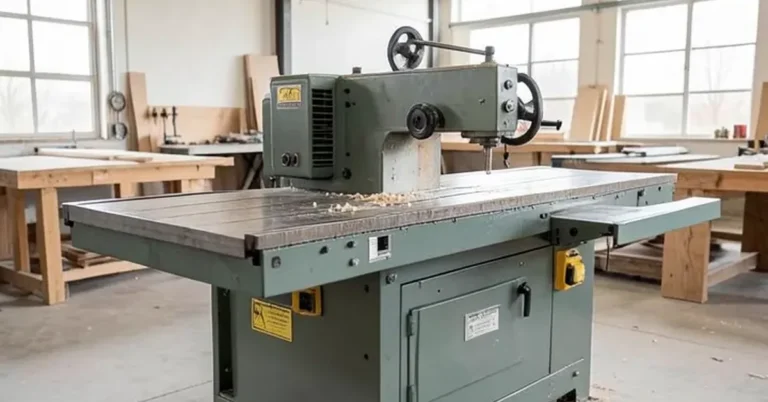
All three Fusion saws use a precision-ground cast iron table — 44″ wide on the F1/F2 with extension wings, 77″ wide on the F3 with the 52″ fence installed. Cast iron adds mass that damps vibration during a rip cut, which matters more than motor size for a clean edge on hardwood. The Hi/Low aluminum-extrusion fence, borrowed from European saw designs, locks parallel to the blade at both ends of the rail instead of just the front, which is the usual cause of a fence that drifts out of parallel over months of use. Laguna markets the F1 and F2 as hybrid table saws — cabinet-saw features on a 110V motor — while the F3 crosses into full cabinet-saw territory on 220V.
Each saw ships with a 10″ carbide-tipped blade — 40-tooth on the F1 and F2, 60-tooth on the F3 — on a 5/8″ arbor, the same arbor size used by nearly every other 10″ contractor and cabinet saw on the market, so aftermarket blades swap in without an adapter. Laguna designs its machines domestically and builds them at contract factories overseas, a common approach among mid-size tool brands — see our breakdown of where Laguna tools are made for the full sourcing picture.
Precision and Performance
Motor size determines what material a Fusion saw handles without bogging down. The F1’s 1.5 HP motor rips 3/4″ plywood and most hardwood cleanly but will slow down in 8/4 hard maple. The F2 steps up to 1.75 HP and a faster 4,500 RPM arbor speed, which noticeably reduces burning on rip cuts in dense woods. The F3’s 3HP, 220V motor is built for repeated full-sheet breakdown and thick hardwood without stalling mid-cut — the same reason cabinet shops choose a 220V saw over a contractor saw in the first place.
All three share the same 3-1/8″ maximum depth of cut at 90° and 2-1/8″ at a 45° bevel, so blade tilt capacity is not a reason to pick one model over another — motor power and rip width are.
Best Replacement Blade Pick
 |
DEWALT 10″ 40-Tooth Table Saw Blade (DWA11040) – $22.97 Every Fusion saw uses a 10″ blade on a 5/8″ arbor — the same size this blade is built for — so it drops straight in as an upgrade or replacement for the stock 40T blade covered above.
|
As an Amazon Associate we earn from qualifying purchases.
Safety Features: Riving Knife, Blade Guard, and Why It’s Not a SawStop
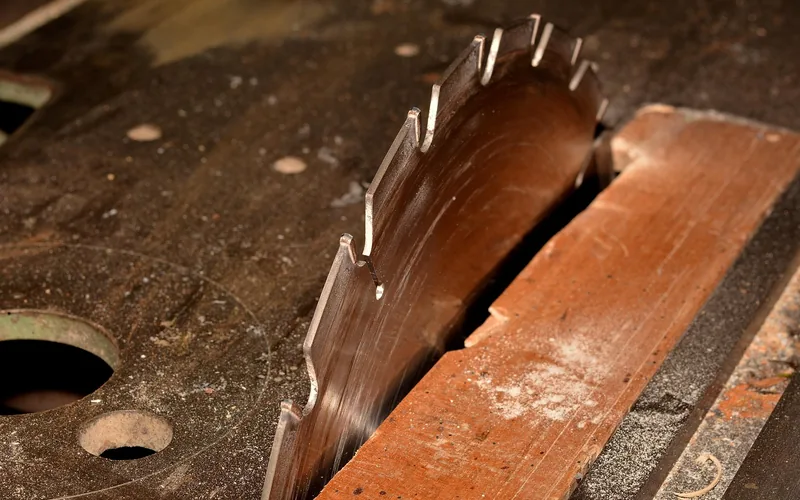
Every Fusion saw includes a riving knife (3/32″ thick on the F2 and F3) that rises and falls with the blade to keep the kerf open behind the cut, which is the single most effective defense against kickback on a table saw. A quick-release blade guard and anti-kickback pawls sit on top of the riving knife and can be removed without tools for cuts like a dado or rabbet that require it.
What the Fusion series does not have is active flesh-sensing technology: a system that detects skin contact and drops the spinning blade below the table in milliseconds, destroying the blade in the process. That feature is exclusive to SawStop, whose patents on the specific braking mechanism have kept every other manufacturer — Laguna, Powermatic, Grizzly, and Delta included — on conventional riving-knife-and-guard safety systems. For a shop where flesh-detection is a hard requirement, that rules out the Fusion line regardless of how the rest of the spec sheet compares.
Ease of Use and Setup
The toolless blade lock speeds up blade changes on all three models, and the fence rail is graduated for both standard and metric measurements. The one recurring complaint across woodworking forums is setup time: Fusion saws arrive mostly assembled but still need the fence rail squared to the miter slots and the blade checked for parallel to the miter slot before first use — a 30-60 minute job with a dial indicator, not a five-minute unboxing. For a deeper look at the entry-level model alone, see our full Laguna F1 table saw review, which covers its stock blade and alignment steps in more detail.
Versatility and Dado Capacity
All three Fusion saws accept a stacked dado set up to 13/16″ wide (Laguna lists 3/4″ as the standard rating with common dado stacks). Combined with the 4″ main dust port and a secondary 1-1/2″ port on the blade guard, dust collection is rated for over/under collection with a sealed cabinet bottom — a real difference from older contractor-saw designs that vent sawdust into an open base and rely on a shop vacuum alone to keep up.
Maintenance and Durability
- Check the blade for pitch buildup and dull carbide every 8-10 hours of cutting — a pitch-coated blade burns wood and strains the motor.
- Wipe the cast iron table with paste wax every few months to prevent rust, especially in a shop without climate control.
- Re-check the fence for parallel to the miter slot after moving the saw — the mobility base makes relocation easy, which also makes it easy to knock the fence rail out of square.
- Replace the riving knife’s anti-kickback pawls if they no longer engage cleanly — a pawl that doesn’t grip is a silent failure that only shows up during an actual kickback event.
How Much Does a Laguna Table Saw Cost?
MSRP for the Fusion line runs $1,399 for the F1, $1,999 for the F2, and $3,599 for the 220V F3 52″ — all before shipping, which runs $150-$400+ given the F3’s 405-lb crated weight. Compared to a contractor saw in the $600-$900 range, the jump buys a cast iron top, a European fence, and a riving knife/guard system as standard rather than an add-on. Compared to a 3HP SawStop Professional Cabinet Saw (roughly $2,999-$3,999 depending on fence length), the F3 lands in the same price bracket without flesh-detection but with a comparable cast iron table and rip capacity.
Laguna vs SawStop vs Powermatic: How It Compares
| Saw | Flesh detection | Starting price | Best For |
|---|---|---|---|
| Laguna Fusion F1/F2 | No | $1,399 | 110V hobby shop, cast-iron precision on a budget |
| Laguna Fusion F3 | No | $3,599 | 220V cabinet-saw power without flesh-detection |
| SawStop Contractor/PCS | Yes | ~$1,799-$3,999 | Shops that treat flesh-detection as non-negotiable |
Powermatic’s cabinet saws sit in a similar bracket to the F3 on price and cast-iron build quality, but like Laguna, Powermatic does not offer flesh-detection either — that comparison comes down to fence system and dealer support rather than safety technology, since neither brand has it.
Frequently Asked Questions
What are the key features of a Laguna Fusion table saw?
Every Fusion saw uses a precision-ground cast iron table, a European-style Hi/Low fence, a tool-less riving knife, and a quick-release blade guard. The F1 and F2 run on 110V with 1.5-1.75 HP motors; the F3 runs on 220V with a 3HP motor and a 52-inch rip capacity.
How does the Laguna Fusion compare to SawStop?
Both use a riving knife and blade guard, but SawStop adds a patented flesh-detection brake that stops and drops the blade on skin contact, which Laguna’s Fusion line does not include. Price brackets overlap: the F3 (about $3,599) is close to a comparable SawStop Professional Cabinet Saw.
Is the Laguna Fusion table saw good for beginners?
The F1 ($1,399, 110V, 195 lbs) is the beginner-friendly option in the lineup because it needs only standard household power and takes up less floor space than the F2 or F3. It still ships needing fence and blade alignment before first use, which is a normal step for any cabinet-grade saw.
What is the price range for a Laguna table saw?
MSRP runs from $1,399 for the F1 up to $3,599 for the 220V F3 52-inch model, with the F2 at $1,999 in between. Shipping adds roughly $150-$400 depending on the model’s crated weight.
Does a Laguna table saw include a dado stack?
No. Each Fusion saw is rated to accept a stacked dado set up to about 13/16 inch wide, but the dado blades themselves are sold separately from the saw.
Conclusion
The Laguna Fusion F1, F2, and F3 give a real spread of price and power — $1,399 to $3,599 — built around the same cast iron table, Hi/Low fence, and riving-knife safety system. None of them include SawStop’s flesh-detection brake, so that single feature, not motor size or rip capacity, is what should decide between this lineup and a SawStop if flesh-detection is a requirement rather than a nice-to-have.
Sponsored / affiliate links. As an Amazon Associate I earn from qualifying purchases. I may earn additional commission from eligible campaigns.