Largest Table Saw Guide: 52 Inch Industrial vs. 32.5 Jobsite Rip
The largest table saws rip up to 52 inches — true 16-inch industrial cabinet saws from Grizzly and Oliver Machinery — but that much capacity needs 230V (often three-phase) power and floor space few home shops have. Buying more saw than your shop can run wastes money on a machine you cannot fully use. This guide compares real industrial rip capacities against the largest practical benchtop option, the 32.5-inch DEWALT DWE7491RS, plus how to size a saw to your own shop.
Quick Answer
Industrial cabinet saws top out around 52 inches of rip capacity (Grizzly G0605X1, Oliver 4065.003) but require 230V+ power and dedicated floor space. Unless you’re running a production shop, a 32-33 inch jobsite or contractor saw — like the DEWALT DWE7491RS on standard 120V — will break down full 4×8 sheets without the extra cost, weight, or wiring.
The Actual Largest Table Saws You Can Buy
Largest 120V Table Saw Pick
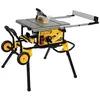
DEWALT DWE7491RS Table Saw – $599.00
32-1/2″ rip capacity on a standard 120V/15A circuit — the largest cut you can make without running 230V service, matching the full-sheet breakdown work this guide covers.
- Best for: Home shops without 230V wiring who still need to break down full sheets
- Why we picked it: Largest rip capacity available on standard household power, with a rolling stand for shops that can’t dedicate floor space
- Main drawback: 15A motor is underpowered next to the 3-10 HP industrial saws above — fine for plywood and softwoods, slower through thick hardwood
As an Amazon Associate we earn from qualifying purchases.
“Largest table saw” splits into two very different categories: production-floor industrial cabinet saws with 16-inch blades and three-phase motors, and the largest saws a typical home or small shop can realistically wire and afford. Here’s how the real numbers compare.
| Saw | Class | Rip Capacity | Motor | Best For |
|---|---|---|---|---|
| Oliver 4065.003 (16″) | Industrial | 52″ | 10 HP, 230/460V 3-phase | High-volume production shops |
| Grizzly G0605X1 | Industrial | 52″ | 5 HP, 220V | Serious production shops without 3-phase service |
| SawStop Industrial Cabinet Saw | Cabinet | 36-1/2″ | 3 HP, 230V | Small shops that want flesh-detection safety |
| DEWALT DWE7491RS | Jobsite/Contractor | 32-1/2″ | 15A, 120V | Home shops without 230V service |
📊 A 4×8 sheet of plywood is 48 inches wide, so ripping a full sheet lengthwise down the middle needs at least 24 inches of usable rip capacity — every saw above handles that with room to spare. — Source: Grizzly Industrial, G0605X1 spec sheet
Largest Table Saw for Most Shops: DEWALT DWE7491RS
If you don’t have 230V service run to your shop, the motor power jump from a 1.75 HP saw to a 3 HP cabinet saw isn’t an option anyway — the DEWALT DWE7491RS is the largest-capacity saw you can run on a standard 120V, 15-amp circuit. Its 32-1/2 inch rip capacity clears a full sheet of plywood with several inches to spare, and the rolling stand means it doesn’t need a dedicated spot on the floor when you’re done.
How to Choose the Right Table Saw Size
Match rip capacity to what you actually cut. Furniture and cabinet parts rarely need more than 24-30 inches of rip capacity. Breaking down full 4×8 plywood or MDF sheets efficiently calls for 30+ inches so you’re not flipping the sheet mid-cut. Production shops cutting sheet goods all day benefit from the 50+ inch capacity of an industrial saw.
Check your electrical service before you check the price tag. Anything above about 2 HP — including every cabinet and industrial saw in the table above — needs a dedicated 230V circuit, and the true production saws need 230/460V three-phase. If your shop only has standard 120V outlets, a jobsite/contractor saw like the DWE7491RS is your practical ceiling until you upgrade the electrical service.
Fence accuracy matters as much as rip distance — a saw with a long rail but a fence that drifts out of parallel will ruin a cut just as fast as one with too little capacity. If your current saw’s cuts are inconsistent, check miter gauge calibration before blaming the blade. And if you’ll be cutting joinery on a larger saw, confirm the arbor accepts a dado stack before you buy — not every cabinet saw ships dado-ready.
Safety Features on Large Table Saws
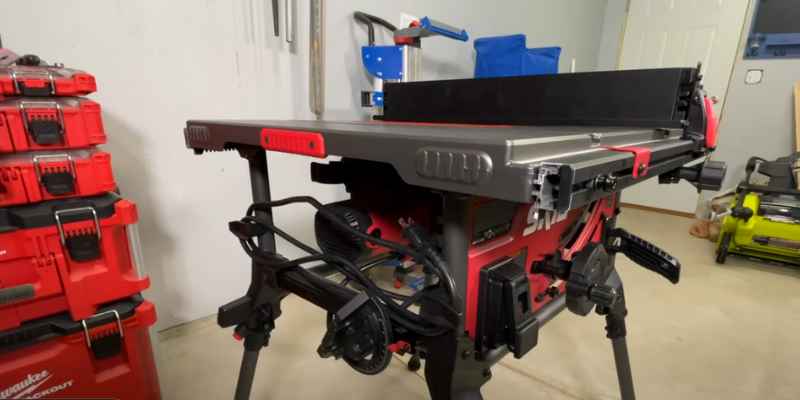
A bigger table and a bigger blade both raise the stakes if something goes wrong. Look for a riving knife to stop the wood from pinching the blade, anti-kickback pawls, and a blade guard that doesn’t need to be removed for normal ripping. An emergency stop within easy reach matters more on a saw big enough that you can’t always step back from it quickly.
Flesh-detection technology — SawStop’s signature feature — stops and retracts the blade in milliseconds on contact with skin. It’s standard across SawStop’s cabinet and industrial lines, including the saws made through SawStop’s Oregon-designed, Taiwan-assembled production. It’s the single biggest safety differentiator on a large saw, where the blade is bigger and the table gives you less room to keep hands clear.
“The biggest mistake we see with a new large-capacity saw is buying more rip capacity than the shop’s electrical service can support, then running an underpowered extension cord to make it work. Get the circuit sized correctly before the saw ever gets plugged in.”
Maintenance Tips for Large Table Saws
A larger table gives rust more surface area to start on, so wipe it down after use and keep a light coat of paste wax on cast iron tops. Check fence-to-blade parallelism every few uses — on a longer rail, a small drift at the front translates into a bigger error by the time the cut reaches the back of the table. Inspect belt tension on belt-driven cabinet saws, since a loose belt shows up first as bogging down in thick hardwood.
Keep the blade sharp — a dull blade on a big saw draws more current and is more likely to kick back, not less. If the saw vibrates or the cut quality drops, check blade balance and arbor runout before assuming the motor is failing.
Frequently Asked Questions
What is the largest table saw available?
The largest table saws are 16-inch industrial cabinet saws like the Oliver 4065.003 and Cantek TA16B, both with roughly 52-inch rip capacity. For shops without 230V three-phase power, the largest practical option is a 32-1/2 inch jobsite saw like the DEWALT DWE7491RS.
How do I choose a table saw size?
Match rip capacity to your typical material: 24-30 inches covers most furniture and cabinet work, while 30+ inches is needed to break down full 4×8 sheets efficiently. Check your available voltage too — anything above roughly 2 HP typically needs a dedicated 230V circuit.
Are larger table saws more powerful?
Not automatically, but they usually pair a bigger table with a bigger motor. The SawStop Industrial Cabinet Saw runs 3 HP on 230V, while 16-inch production saws like the Oliver 4065.003 use up to 10 HP three-phase motors. Blade quality and arbor size affect cut quality as much as raw horsepower.
What safety features should a large table saw have?
Look for a riving knife, blade guard, anti-kickback pawls, and an emergency stop within easy reach. SawStop’s cabinet and industrial saws add flesh-detection technology that stops the blade on contact with skin — increasingly common on larger, higher-priced saws where the stakes of a mistake are higher.
Do I need 220V for a large table saw?
Yes, for anything above roughly 2 HP. The DEWALT DWE7491RS runs on standard 120V/15A, but cabinet and industrial saws with 3-10 HP motors need a dedicated 230V circuit, and some 16-inch production saws require 230/460V three-phase service.
Conclusion
The true largest table saws top out around 52 inches of rip capacity, but that’s a production-shop tool requiring 230V+ power most home shops don’t have. For everyone else, matching rip capacity, motor power, and available electrical service — not just chasing the biggest number — gets you a saw you can actually run. A 32-1/2 inch saw like the DEWALT DWE7491RS covers full sheet breakdown on standard household power; a SawStop Industrial or Oliver-class saw only pays off once you’re running a real production shop.
Sponsored / affiliate links. As an Amazon Associate I earn from qualifying purchases. I may earn additional commission from eligible campaigns.
 Thin Rip Jig Table Saw Guide for Narrow Cuts - Aluminum Alloy Fence with Roller Bearing for Repetitive Strips - Fits 1/4x3/8 for miter Slot
 SamLng Benchtop Table Saw Guide Rail Lock Fence Head Complete Pair Assembly N773286 & N773292, Aftermarket Wood Cutting Fence Parallel Anti-Shift Lock Spare Plastic Hardware