Compact Table Saw Guide: 3 Real Picks Compared (2026)
A compact table saw is any table saw built around a smaller blade (usually 8-1/4 inch instead of the standard 10 inch) or a folding/rolling base, so the whole machine takes up less floor space than a full-size cabinet or contractor saw. The trade-off is rip capacity and cutting depth, not just size – and that trade-off is what most buying guides skip over. Below we compare real footprint, weight, and rip-capacity numbers for three current models so you can see exactly what you gain and give up at each size, plus our top pick for a genuinely small shop.
Our Pick for a Small Shop: DEWALT DWE7485
Best 8-1/4″ Compact Pick
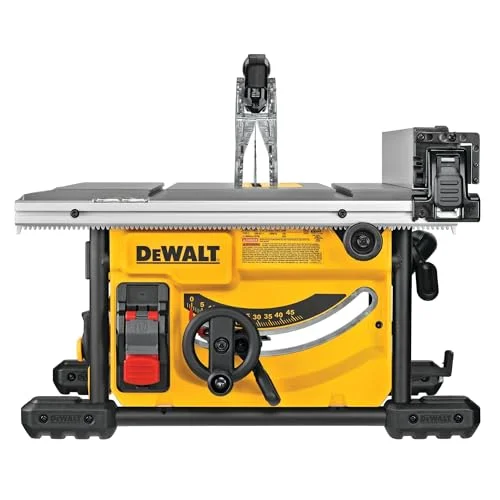 |
DEWALT DWE7485 8-1/4″ Compact Table Saw – $429 At 46 lbs and 13 x 22.75 x 22.75 in, this is the smallest saw in our comparison below – it fits on a shelf or under a bench between uses.
|
If you need more rip capacity and don’t mind a bigger footprint, the two alternatives further down this page – the SKIL TS6307-00 and the DEWALT DWE7491RS – are both worth a look before you buy.
What “Compact” Actually Means on a Table Saw
“Compact table saw” gets used two different ways, and mixing them up is why a lot of buying advice online is vague. The first is blade size: an 8-1/4 inch blade saw (like the DWE7485) is physically smaller than a 10-inch saw, with a shallower body and lighter base – but it also cuts a shallower maximum depth (about 2-9/16 in. at 90°, versus roughly 3-1/8 in. on a 10-inch saw). The second is base design: a 10-inch saw with folding legs or a rolling stand (like the SKIL TS6307-00 or DEWALT DWE7491RS) keeps the full 10-inch cutting capability but collapses down for storage or transport. Neither one is “more compact” in every sense – a folded 10-inch saw on a rolling stand can actually have a larger stored footprint than a benchtop 8-1/4 inch saw sitting on a shelf, even though it looks more “portable” on a spec sheet.
Knowing which kind of compact you actually need comes down to one question: are you tight on floor space when the saw is stored, or tight on floor space when you’re actually cutting? A closet or shelf-stored saw favors the smaller 8-1/4 inch body. A saw that has to roll in and out of a single-car garage bay favors a rolling stand, even if the saw itself is bigger.
Real Footprint, Weight, and Rip Capacity Comparison
Most “best compact table saw” roundups compare price and blade size and stop there. Here are the actual manufacturer footprint and weight numbers side by side, because that’s the number that decides whether a saw fits your specific corner, shelf, or closet.
| Model | Blade | Rip Capacity | Weight | Footprint / Notes |
|---|---|---|---|---|
| DEWALT DWE7485 | 8-1/4″ | 24.5″ | 46 lbs | 13 x 22.75 x 22.75 in. – no stand, sits on a bench or shelf |
| SKIL TS6307-00 | 10″ | 25.5″ | ~60 lbs with stand | ~42 x 27 x 29 in. set up; integrated folding legs collapse for storage |
| DEWALT DWE7491RS | 10″ | 32.5″ | ~90 lbs with stand | ~26 x 22 in. table, ~30 in. deep on its rolling stand |
The pattern is consistent: every 6-8 inches of extra rip capacity costs you roughly 15-30 lbs of weight and a noticeably bigger stand. If your shop is a corner of a garage you still park a car in, the DWE7485’s bench-stored 46 lbs beats rolling a 90 lb stand in and out every session.
Rip Capacity Trade-Offs You’ll Actually Notice
Rip capacity is the distance from the blade to the fence at its farthest setting, and it’s the spec that determines whether you can break down a full 4×8 sheet of plywood in one pass. A saw with 24-25 inches of rip capacity, like the DWE7485 or the TS6307-00, can rip a sheet roughly down the middle but can’t handle a narrow rip off a full 48-inch-wide sheet without repositioning it. The DWE7491RS’s 32.5 inches gets you closer to a true half-sheet cut without extra setup. If you mostly work with pre-cut lumber and smaller stock – face frames, trim, shelving boards – the smaller rip capacity rarely matters. If you regularly break down full sheets of plywood or MDF, the extra capacity on a 10-inch saw is worth the added weight.
Safety Features Worth Checking Before You Buy
Smaller saws don’t come with fewer safety requirements – if anything, a lighter saw needs a stable base more, since it’s easier to tip or shift under load. Before buying, confirm the saw has:
- A riving knife or splitter that rides behind the blade to stop wood from pinching and kicking back.
- Anti-kickback pawls on the blade guard assembly.
- A rack-and-pinion fence (all three saws above have one) – it locks parallel to the blade instead of racking out of square, which is a common failure point on cheaper clamp-style fences.
- On-board storage for the blade guard, push stick, and miter gauge, so you’re not tempted to run a cut without the guard installed because it’s been misplaced.
If a full stop-on-contact safety system matters more to you than saving space or weight, that’s a different saw entirely – see our SawStop Compact Table Saw review for how that technology changes the buying decision.
Setting Up and Storing It Without Losing Shop Space
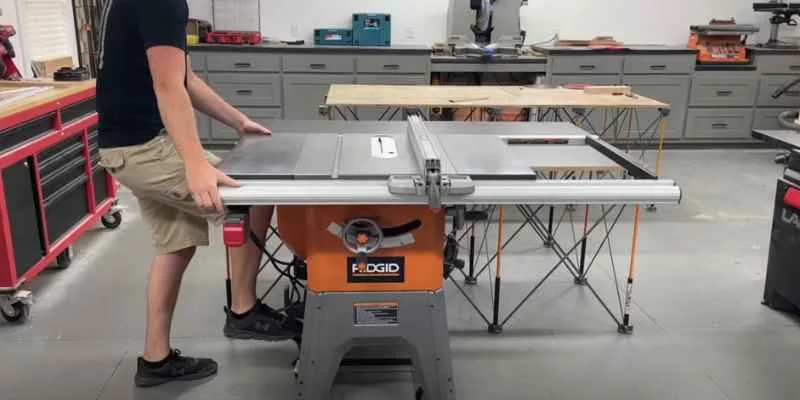
A benchtop saw like the DWE7485 needs a stable, level surface bolted or clamped down – it has no stand of its own, so an unsecured saw on a wobbly bench is the single biggest safety issue with this size class. A folding-stand saw needs its legs fully locked and checked for level before the first cut of the session; a stand that’s slightly unlocked on one corner is a common cause of inaccurate cuts, not just a tipping risk.
For storage, keep these in mind:
- Clean before storing. Sawdust left on the table and fence rails for weeks can cause surface rust, especially in an unheated garage.
- Store the blade guard and riving knife attached, or in the on-board storage slot – a guard left loose in a drawer tends to get “temporarily” skipped next session.
- Check fence alignment after every move. A saw that gets moved on and off a shelf regularly will drift out of square faster than one that stays bolted in place; a quick parallel check with a combination square takes under a minute.
Frequently Asked Questions
What is a compact table saw?
A compact table saw is a table saw built with either a smaller blade (typically 8-1/4 inch instead of 10 inch) or a folding/rolling base, so the machine takes up less space than a full-size cabinet or contractor saw. The size reduction usually costs some rip capacity or cutting depth compared to a full-size saw.
Is an 8-1/4 inch blade too small for real woodworking?
No, but it has a shallower max cutting depth than a 10-inch blade – roughly 2-9/16 inches at 90 degrees versus about 3-1/8 inches on a 10-inch saw. For most plywood, MDF, and standard dimensional lumber this is not a limitation. If you regularly rip thick hardwood over 2.5 inches, a 10-inch saw is the better choice.
How do I choose between a benchtop and a folding-stand table saw?
Choose a benchtop saw (no stand, sits on a bench or shelf) if your shop space is tight when the saw is stored, such as a closet or wall shelf. Choose a folding or rolling stand saw if your space is tight when the saw is in use, such as a single-car garage bay you still need to park in between projects.
Can a compact table saw rip a full sheet of plywood?
A saw with 24-25 inches of rip capacity can rip a 4×8 sheet roughly down the middle but can’t take a narrow strip off the full 48-inch width without repositioning the sheet. A saw with 30+ inches of rip capacity, like the DEWALT DWE7491RS, can handle a true half-sheet rip in one pass.
Bottom Line
For most small shops, the DEWALT DWE7485 hits the best balance: a real 24.5-inch rip capacity, a rack-and-pinion fence, and a 46 lb body that stores on a shelf instead of needing a dedicated stand. Step up to the SKIL TS6307-00 or DEWALT DWE7491RS only if you regularly break down full sheets of plywood and have the floor space to roll a stand in and out.
Sponsored / affiliate links. As an Amazon Associate I earn from qualifying purchases. I may earn additional commission from eligible campaigns.