Wood Load Capacity Calculator: Plywood, Shelf & Screw Limits
A wood shelf almost always sags past its span ÷ 360 limit long before it breaks. By the APA tables, a 3/4-inch plywood shelf on one 32-inch span carries about 33 psf at that limit, roughly 88 lb on a 12-inch-deep shelf. This page runs the beam deflection, waste weight and firewood rick calculators and links to our separate shelf, plywood, screw and lumber calculators, using Wood Handbook, APA and NDS data. Planning estimates only, not engineering advice.
Quick Answer
Wood load capacity has two separate limits: strength (when it breaks) and stiffness (when it sags too much), and sag almost always governs first. This page runs the load and deflection math and links to the separate plywood, screw, board-foot, lumber-weight and lumber-cost calculators so you can plan a whole build. For anything structural, check your local code or ask an engineer.
Best Screw Kit for Shelf Builds
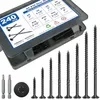 | #8 and #10 Wood Screws Assortment Kit, 240 pcs, $21.99 A starter set of #8 screws from 1 to 2-1/2 inches and #10 screws from 2-1/2 to 4 inches, the same two gauges used in the capacity table of our screw shear strength calculator.
|
As an Amazon Associate we earn from qualifying purchases.
Which Tool Fits Your Question?
Several pages on this site touch wood strength, so here is how they differ. This page is the all-in-one set, with design values taken from the NDS and APA tables rather than rules of thumb.
- One shelf board and how far it bends: the wood sag calculator is a single-purpose sag check, while the shelf breaking load and sag calculator also compares strength to sag.
- Floor joists, rafters and deck beams: the American Wood Council span calculator works from a span table at a 40 psf live load.
- A plywood panel or shelf, explained in prose: how much weight plywood can hold walks through the APA span ratings and grain direction. The plywood load capacity calculator runs the numbers.
- A solid board by species: the wood weight load calculator linked in the paragraph above.
- Weight, screws and lumber cost: the 2×6 weight calculator estimates board and lumber weight, the wood screw length calculator picks the screw, and the linear foot lumber calculator and lumber price calculator handle the conversions and the budget.
Wood Load Capacity & Deflection Calculator
Estimate deflection and bending stress for a uniformly loaded, simply supported wood beam or shelf member. This is a planning estimate, not structural approval — real design depends on species, grade, load duration, fasteners, bearing, and local code.
Enter your values and click calculate.
Formula & Example
Deflection = 5wL&sup4; / 384EI | Bending stress = M / S, with M = wL²/8 and S = bd²/6. For a 6 ft span under 50 lb/ft on a 2×8 (1.5 × 7.25 in) of southern pine, the calculator gives 0.022 in of sag and 205 psi of bending stress, far inside the L/360 and design-value limits. The E and Fb you enter should be design values for the species and grade, not clear-wood averages.
Reference Table
Reference design values for common framing lumber, from the AWC NDS Supplement (Tables 4A and 4B, normal load duration, dry service). These are base values: the NDS adjusts Fb for member size and repetitive use, so treat them as a starting point.
| Species and grade | Bending Fb (psi) | Stiffness E (psi) |
|---|---|---|
| Douglas fir-larch No.2 | 900 | 1,600,000 |
| Spruce-pine-fir No.1/No.2 | 875 | 1,400,000 |
| Southern pine No.2, 2×8 | 925 | 1,400,000 |
| Northern red oak No.2 | 975 | 1,300,000 |
| Mixed maple No.2 | 700 | 1,100,000 |
Common Mistakes
- Using nominal instead of actual dimensions.
- Ignoring concentrated (point) loads.
- Using this for permit or code approval.
- Forgetting bearing, fasteners, and load path.
- Using the clear-wood stiffness from a handbook table for a graded board with knots.
Wood Shelf Breaking Load & Sag Calculator
This shelf calculator compares a board’s allowable bending load against the load at which it reaches the common L/360 sag limit. In practice, sag usually sets the real-world safe load long before the wood is anywhere near breaking. It now has its own page.
Plywood Load Capacity Calculator
This calculator returns the APA allowable uniform load in pounds per square foot for your panel, using the lowest of the L/360 sag, bending and shear limits. Pick the thickness, support spacing, grain direction and single or multi-span support. It now has its own page.
Wood Screw Length Calculator
This calculator recommends a screw length for joining two boards using the 2/3 rule (3/4 for softwoods), capped just under the combined thickness so the point cannot break through. Enter the board thicknesses, wood type, gauge and whether the screw is countersunk to see the length, base penetration and pilot-hole guidance. It now has its own page.
Linear Foot / Board Foot Calculator
This calculator converts linear feet to board feet (and back) for any board size, then adds the total cost and the cost per board foot. Enter the thickness, width, amount and price per foot to compare lumber sold by the foot with lumber sold by the board foot. It now has its own page.
Lumber Price Calculator
This calculator turns the board feet you need into a budget by adding waste, discount, sales tax and delivery to your price per board foot. It shows the material cost, the cost with waste, the tax and the total. It now has its own page.
Wood & Board Weight Calculator
This calculator estimates how much a board, slab, panel or LVL beam weighs from its size, species and moisture condition, which also answers what a 2×6 weighs. It reports cubic feet, total weight, weight per piece and kilograms. It now has its own page.
Waste Weight Calculator (Sawdust, Shavings & Offcuts)
Shop waste is far lighter per cubic foot than solid lumber — useful for staying under a dumpster or hauler’s weight limit instead of just its volume limit.
Formula & Example
Waste weight = volume (cu ft) × material density. Loose sawdust runs about 12-13 lb/ft3, wood shavings/chips about 11-12 lb/ft3, and solid offcuts weigh close to full lumber density (roughly 30-45+ lb/ft3, species dependent). Example: 10 cubic feet of loose sawdust ≈ 10 × 12.5 = 125 lb.
Rick (Face Cord) of Firewood Calculator
There is no such thing as wood measured “in a rock” — the real firewood term is a rick (also called a face cord). A rick is 4 ft × 8 ft, one row deep, with depth equal to log length; it is not a legally standardized unit, unlike a full 128 cubic foot cord.
Formula & Example
Cubic feet per rick = 32 × (log length in inches / 12). A rick of 16-inch logs is about 42.7 cubic feet, roughly one-third of a full 128 cubic foot cord.
Screw Weight Limit Calculator (Shear & Pullout)
This calculator estimates how much load a group of screws in a joint can carry, checking both shear (sideways force) and pullout (withdrawal force) and using whichever is lower. The defaults are a #8 screw in spruce-pine-fir, with NDS design values by wood species. It now has its own page.
How Accurate Are These Calculators?
All of the calculators on this page and its linked calculator pages are planning-level estimates. They are not engineering advice and not code approval. Real capacity and cost depend on species, grade, moisture content, defects, fastening pattern, support condition, and regional pricing. For floors, decks, stairs, or any load-bearing or code-regulated work, check your local building code and have a qualified engineer or inspector confirm the design before you build or buy.
Frequently Asked Questions
Wood Load, Weight & Deflection
Can I use this for structural approval?
No. It is for planning and education only. Consult a qualified professional for structural decisions.
Why does depth matter so much?
Moment of inertia increases with depth cubed, so deeper members are much stiffer.
What is L/360?
L/360 is the common deflection limit: maximum acceptable sag equals the span divided by 360. A 36-inch shelf should sag no more than 0.10 inch. Many woodworkers target a tighter 0.02 inch per foot of span (L/600) to allow for long-term creep.
Waste Weight
How much does a 5-gallon bucket of sawdust weigh?
A 5-gallon bucket holds about 0.67 cubic feet, so at ~12.5 lb/ft3 for loose sawdust that is roughly 8-9 lb; packed sawdust can weigh somewhat more.
Do dumpster companies charge by weight or volume?
Most charge by volume (the size of dumpster rented) but enforce a maximum weight limit, and overage fees apply per ton over that limit — which is why converting waste volume to weight matters before a pickup.
Does wet sawdust weigh more than dry sawdust?
Yes, significantly. Wet or green sawdust can weigh 30-50% more than kiln-dried sawdust of the same volume due to absorbed moisture.
Rick of Firewood
Is a rick the same as a face cord?
Yes, the two terms are used interchangeably for a stack that is one log-length deep, 4 ft high, and 8 ft long.
How many ricks are in a full cord?
It depends on log length, since a rick isn’t standardized — but ricks of 16-inch logs run about 3 to a full 128 cubic foot cord.
Why does my search show “how much wood is in a rock”?
That phrase is a common mis-hearing or typo of “rick” — the actual firewood measurement term. There is no standard unit called a wood “rock.”
Why isn’t a rick a standardized measurement?
Unlike a full cord (legally defined as 128 cubic feet), a rick’s volume depends entirely on the seller’s log length, so the same-looking stack can vary significantly between sellers — always ask for the log length before buying.
Sources and Methodology
These are original Woodworking Advisor calculator guides combining standard beam-bending, deflection, and lumber-measurement formulas with conservative planning assumptions and clear limitations.
- Bending: S = bd²/6, allowable bending load = kFbS/L. Deflection: I = bd³/12, sag = 5WL³/(384EI) distributed or WL³/(48EI) point; limit L/360. Fb and E are design values from the AWC National Design Specification (NDS Supplement Tables 4A and 4B); clear-wood averages come from Chapter 5, Table 5-3 of the USDA Forest Products Laboratory Wood Handbook. Creep follows NDS 3.5.2 (factor 1.5 for seasoned lumber).
- None of these tools are a substitute for engineered span tables or professional review on safety-critical work.
Sponsored / affiliate links. As an Amazon Associate I earn from qualifying purchases. I may earn additional commission from eligible campaigns.