Woodworking Miter Cut Calculator: Piece Length for Frames and Boxes
For a mitered frame or box, each piece’s cut length is measured long-point-to-long-point (the outer edge) to match your target outer dimension, while the short-point-to-short-point (inner edge) length is shorter by twice the setback — the board width divided by the tangent of the miter angle — enter your outer dimension, board width, and number of sides below.
Quick Answer
For a mitered frame or box, each piece’s cut length is measured long-point-to-long-point (the outer edge) to match your target outer dimension, while the short-point-to-short-point (inner edge) length is shorter by twice the setback — the board width divided by the tangent of the miter angle — enter your outer dimension, board width, and number of sides below.
Woodworking Miter Cut Calculator: Piece Length for Frames and Boxes
Enter your values below for an instant result, then see the formula, worked example, and common mistakes.
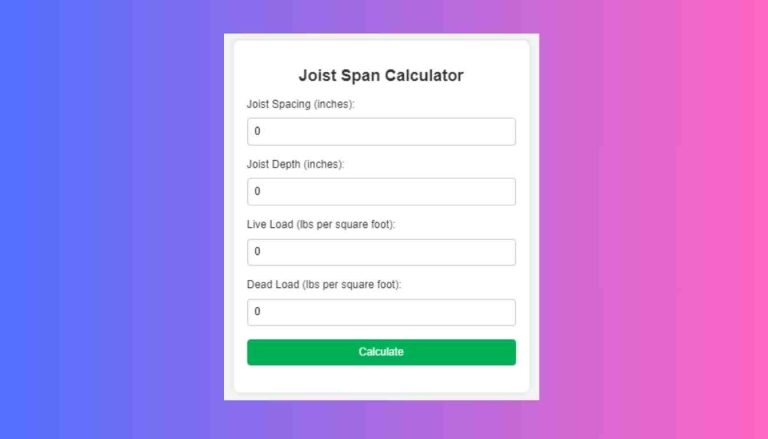
Enter your frame dimensions, then click calculate.
How to Use This Calculator
A standard picture frame or box is 4-sided (rectangular); hexagonal and octagonal shapes (planters, mirrors, clock surrounds) use 6 or 8 sides — see our 120 degree angle miter saw guide for the hexagon case.
This is the finished outer measurement you want for that particular side of the frame or box once assembled.
This is the visible face width of your frame stock or molding — wider stock requires a bigger setback difference between the long-point and short-point measurements.
This is the standard way trim carpenters and framers measure and mark miter cuts — measuring along the longer (outer) edge of the mitered piece to the point where the two angled cuts would meet if extended.
For a rectangular frame, opposite sides need matching long-point lengths — length pairs and width pairs will differ unless the frame is a perfect square.
Formula
Miter Angle = 180 / n (same formula as our angle calculator). Setback = Board Width / tan(Miter Angle in radians). Long-point-to-long-point length = target outer dimension (this is what you cut to and mark). Short-point-to-short-point length = Long-point length – (2 x Setback). The setback accounts for how much shorter the inside edge becomes once the corners are angled off.
Reference Table: Setback by Board Width and Shape
| Shape | Miter angle | Setback formula | Setback for 3 in wide stock |
|---|---|---|---|
| 4-sided (rectangle) | 45 deg | W / tan(45) | 3.00 in |
| 6-sided (hexagon) | 30 deg | W / tan(30) | 5.20 in |
| 8-sided (octagon) | 22.5 deg | W / tan(22.5) | 7.24 in |
Common Mistakes to Avoid
- Cutting to the short-point length by mistake — most tape-measure marking and saw fence setups are easiest to reference from the long point (outer edge), and mixing up the two produces an undersized frame.
- Forgetting that wider stock needs a bigger setback — on many-sided shapes (hexagons, octagons) with wide molding, the setback can be substantial, and ignoring it will make the frame’s inner opening far smaller than expected.
- Not accounting for saw kerf (blade width) when cutting multiple pieces from one board — add extra length per piece to cover material lost to each cut.
- Mixing up which dimension is the ‘outer dimension per side’ for a non-square rectangle — a rectangular frame has two different long-point lengths (one for the width sides, one for the height sides), not one shared length for all four pieces.
When the Estimate May Be Wrong
This calculator assumes a regular flat-miter shape (or a single side of a rectangle) with square, non-beveled stock. It does not account for saw blade kerf loss, stock that is beveled/profiled (like crown molding installed at a spring angle), or irregular shapes with unequal side lengths — always add a small trim allowance and verify with a test piece before cutting your final material.
FAQs
What does long-point-to-long-point mean in a miter cut?
It refers to measuring a mitered piece along its longer (outer) edge, from the outermost tip of one angled cut to the outermost tip of the other — this is the standard reference measurement trim carpenters use when marking miter cuts.
How do you calculate the setback for a mitered frame?
Setback equals the board’s width divided by the tangent of the miter angle — wider boards and shapes with smaller miter angles (more sides) both increase the setback amount.
Why is the inner edge of a mitered frame piece shorter than the outer edge?
Because the two ends are cut at an angle rather than square, the inner (short-point) edge loses length on both ends equal to the setback, while the outer (long-point) edge retains the full target dimension.
Do all four sides of a picture frame need to be the same length?
Only if the frame is square. For a standard rectangular frame, the two width-side pieces share one long-point length and the two height-side pieces share a different long-point length.
Sources and Methodology
Long-point-to-long-point measurement convention and the setback formula (board width / tan(miter angle)) are standard trim carpentry and woodworking practice, confirmed against Hunker’s “How To Calculate Mitre Angles” guide and Woodworkingtraining.com’s Compound Miter Calculator methodology, alongside standard trigonometric miter joint geometry.
Sponsored / affiliate links. As an Amazon Associate I earn from qualifying purchases. I may earn additional commission from eligible campaigns.