How Many Board Feet in an 8-Foot Log (Doyle Rule Chart)
An 8-foot log’s board footage depends entirely on its diameter, not one fixed number: under the Doyle Rule, an 8-inch log yields just 8 board feet, while a 20-inch log yields 128 — a 16x difference. Quoting one flat figure can undervalue or overvalue a log by that same margin when selling to a sawmill or budgeting a milling job. This guide covers the Doyle formula, a diameter chart, and why Doyle underestimates small logs.
Insert your Affiliate Disclosure reusable block here
Why There’s No Single Board-Foot Number for an 8-Foot Log
Best Log Scaling Stick Pick
Forestry Suppliers Tree & Log Scale Stick, Doyle Scale
Lay it against the log’s cut face and read board feet directly — no formula or calculator needed in the field.
- Best for: Log owners and hobbyist millers who scale logs on-site before selling or milling
- Why we picked it: Uses the same Doyle Rule this guide’s chart is built on, so field readings match the math above
- Main drawback: Doyle-only — buy the Scribner version below if your local mill scales differently
Compare more log-measuring options
 Option 1 Forestry Suppliers 76″ Diameter Tape
|
 Option 2 Perfect Pi Diameter Tape Measure
|
 Option 3 Forestry Suppliers Scribner Scale Stick
|
As an Amazon Associate we earn from qualifying purchases.
A log is a tapered cylinder, and board feet is a volume measurement — so length alone can never determine it. A skinny 8-inch fence-post-sized log and a thick 24-inch saw log are both “8-foot logs,” but the second one holds 25 times more usable lumber. Any page that gives you one number for “an 8-foot log” without asking for the diameter is guessing, or averaging across logs that have nothing in common.
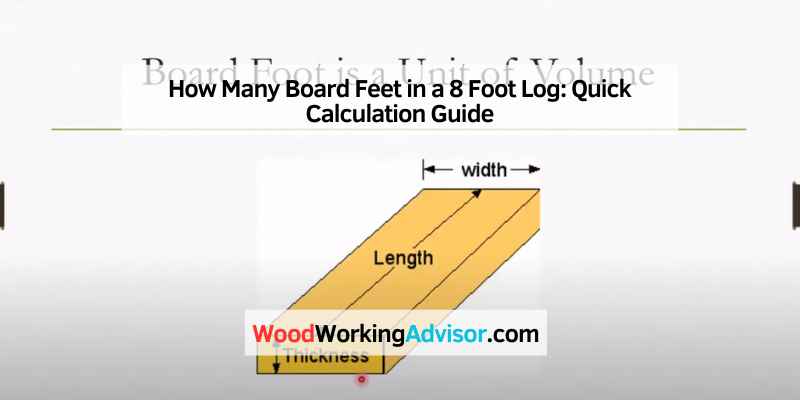
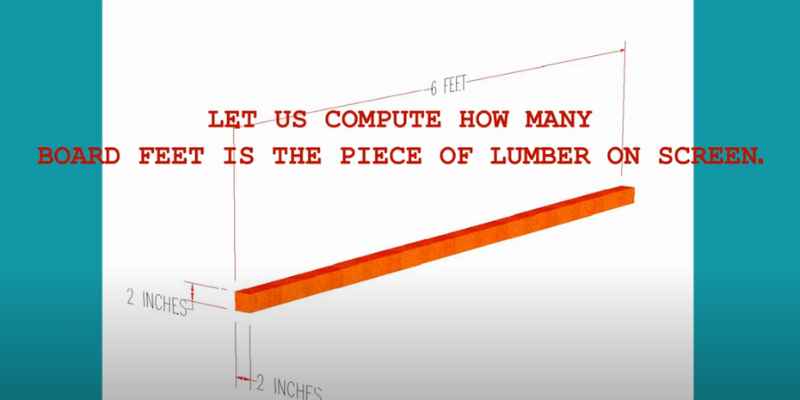
The board foot itself is simple — one board 12 inches long, 12 inches wide, and 1 inch thick. Applying that unit to a round, tapered log is where a scaling rule like Doyle comes in, and it’s what the rest of this guide walks through.
Board Feet in an 8-Foot Log by Diameter (Doyle Rule Chart)
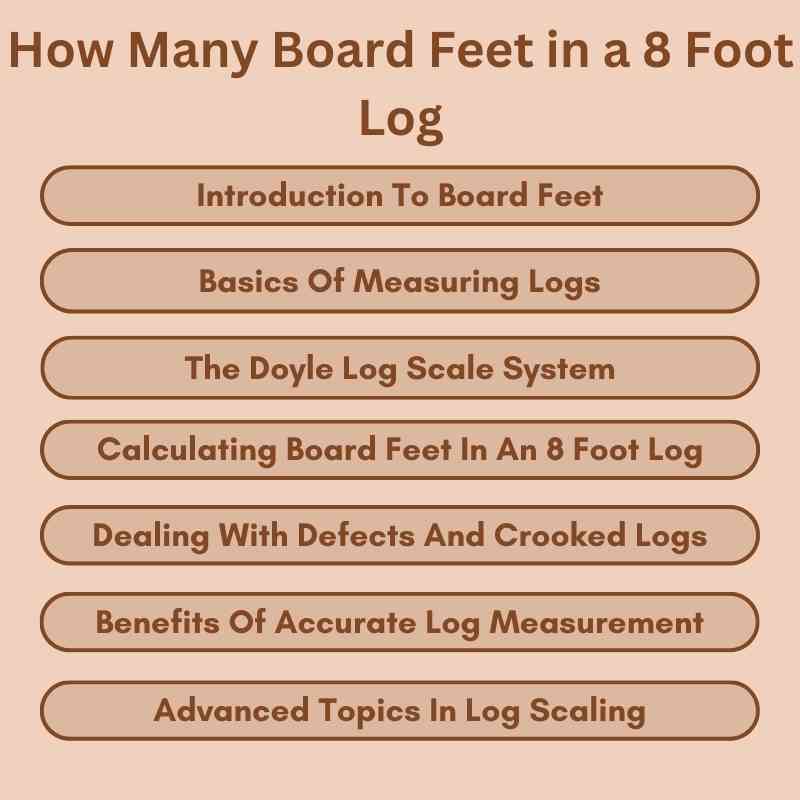
The table below applies the Doyle Log Rule — BF = (D − 4)² × L ÷ 16, where D is the small-end diameter inside the bark in inches and L is the log length in feet — at a fixed length of 8 feet, so all you need is the diameter.
| Diameter (small end, inches) | Board Feet in an 8-Foot Log (Doyle Rule) |
|---|---|
| 8″ | 8 bf |
| 10″ | 18 bf |
| 12″ | 32 bf |
| 14″ | 50 bf |
| 16″ | 72 bf |
| 18″ | 98 bf |
| 20″ | 128 bf |
| 22″ | 162 bf |
| 24″ | 200 bf |
These figures are gross board feet before any deduction for defects, rot, or excess taper — see the defects section below for how to adjust them. If your log’s diameter falls between two rows, the Doyle formula scales smoothly, so a 13-inch log lands roughly halfway between the 12-inch and 14-inch figures (around 40 bf).
How to Calculate Board Feet in Your Own Log
- Measure the diameter at the small end: Measure inside the bark at the narrower end of the log, since that’s the limiting dimension for what a sawmill can cut. Round down to the nearest whole inch.
- Measure the length: Measure the log’s usable length in feet, rounding down to the nearest even foot if your mill scales in 2-foot increments.
- Apply the Doyle formula: Subtract 4 from the diameter, square the result, multiply by the length, then divide by 16 — or read the diameter off the chart for an 8-foot log.
- Adjust for defects: Deduct an estimated percentage for rot, knots, or crook before quoting a final number to a buyer or mill.
Prefer not to do the math by hand? Our woodworking calculators hub links to every board-foot and lumber tool on the site, including calculators that handle multiple boards or logs at once.
Doyle vs. Scribner vs. International: Which Scale Should You Trust?
Doyle, Scribner, and International 1/4-inch are the three log rules used in North America, and they don’t agree with each other. Doyle assumes a wide 4-inch allowance for slabs and saw kerf on every log regardless of size — that allowance is too generous for a small log and too stingy for a large one.
📊 Doyle underestimates small-diameter logs (under roughly 28″) and can overestimate large ones — the opposite of a common claim you’ll see repeated online. It’s the least accurate of the three scales but remains the standard in the Southern and Eastern U.S. because it’s fast to read off a stick in the field. Source: Virginia Cooperative Extension, Forest Landowner’s Guide to the Measurement of Timber and Logs.
International 1/4-inch is the most accurate of the three but requires a more complex formula. Scribner sits in between. In practice, use whichever rule your buyer or local mill quotes in — the chart above is only useful if you’re comparing apples to apples with the person paying for the log.
Always ask a mill or buyer which log rule they scale by before you haul a load in — the same log can price out noticeably differently under Doyle versus International 1/4-inch, and that gap is a real property of the two formulas, not a negotiating trick.
Accounting for Defects, Taper, and Crooked Logs
The chart above gives gross board feet for a straight, defect-free log. Real logs rarely are. Knots, rot, and insect damage all reduce the usable volume, and different hardwood grading standards allow different amounts of defect before a log drops a grade — check the standard for your species before quoting a price.
For a crooked or tapered log, measure the diameter at the narrowest point along the curve, not the average. A log with significant sweep yields noticeably less usable lumber than a straight log of the same small-end diameter, because more of the log’s width gets consumed by the curve rather than converted into straight boards.
How Much Usable Lumber Will You Actually Get?
A modern band sawmill typically recovers 40–65% of a log’s total volume as finished lumber, with well-shaped, larger-diameter logs landing at the high end and small or defect-heavy logs at the low end — not the flat 20–25% figure sometimes quoted, which understates what a properly set-up mill gets today. The board-foot numbers in the chart above are themselves already a scaled estimate of sawn yield, not raw log volume, so they’re a reasonable starting point for budgeting a milling job.
If you’re planning a larger framing or building project rather than scaling a single log, our lumber calculator for framing converts a stud, plate, and joist list into total board feet so you know how much to order.
Frequently Asked Questions
How do you calculate board feet in a log?
Measure the small-end diameter inside the bark and the length in feet, then apply a log rule formula — for Doyle, that’s (diameter − 4)² × length ÷ 16. Deduct an allowance for defects before treating the result as a final number.
How many board feet is a load of logs?
It varies with each log’s size, since board feet depends on diameter and length individually. Scale each log separately using the chart or formula above, then add the totals — there’s no shortcut that works from the load’s total weight or count alone.
What’s the Doyle Rule formula for calculating board feet from a log?
BF = (D − 4)² × L ÷ 16, where D is the small-end diameter in inches and L is the length in feet. For an 8-foot log this simplifies to (D − 4)² ÷ 2, which is how the chart above was built.
How much lumber can I get out of a log?
On a modern band sawmill, expect roughly 40–65% of the log’s total volume as finished lumber, depending on diameter, straightness, and defects. Small, crooked, or knotty logs land at the low end of that range.
How many 8-foot logs make 1,000 board feet?
At a mid-size 16-inch diameter, each 8-foot log scales at 72 board feet under Doyle, so it takes about 14 logs to reach 1,000 board feet. Larger-diameter logs get you there faster — five 24-inch logs alone would clear 1,000 bf.
Understanding board feet in an 8-foot log comes down to one thing: diameter, not length, drives the number. Measure the small-end diameter, apply the Doyle Rule (or read it straight off the chart above), and adjust for defects before you buy, sell, or plan a milling job around the result.
Sponsored / affiliate links. As an Amazon Associate I earn from qualifying purchases. I may earn additional commission from eligible campaigns.