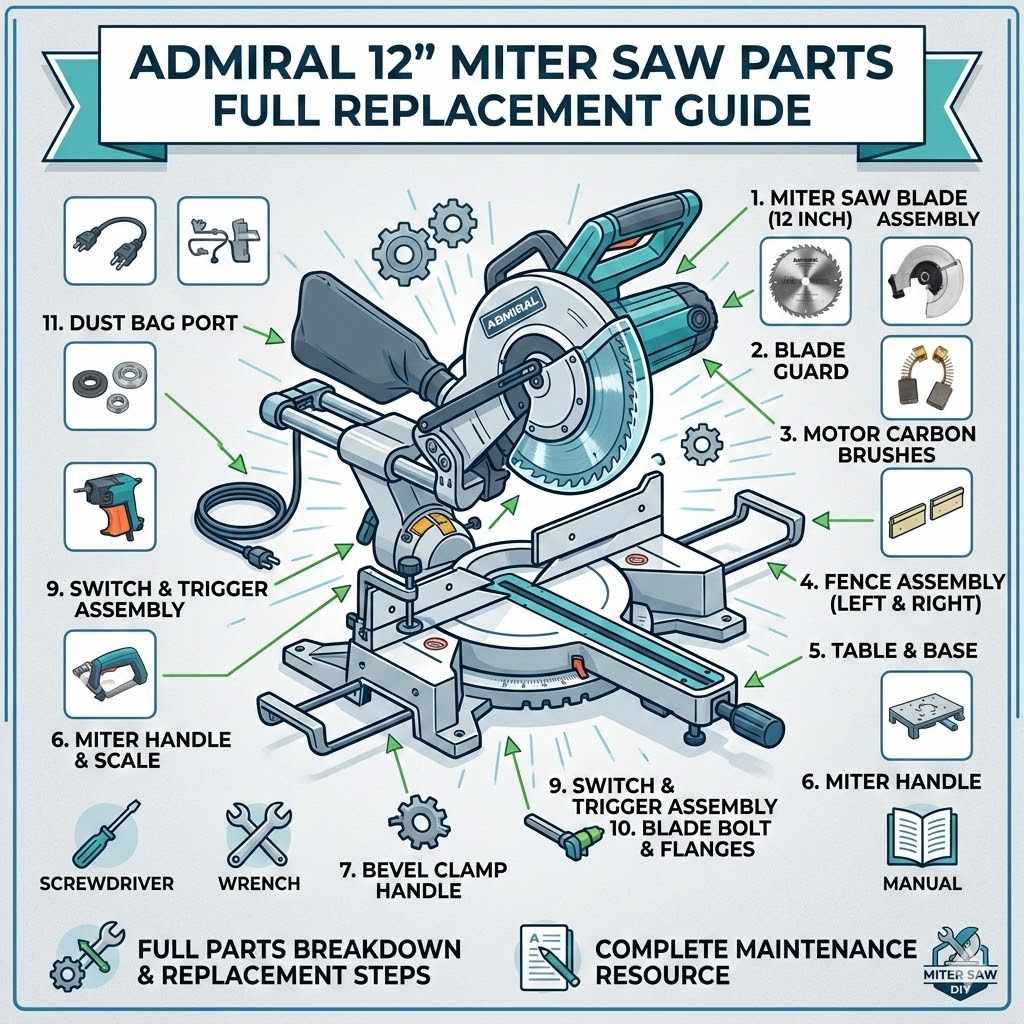
Admiral 12 Miter Saw Parts Full Replacement Guide
Finding the right Admiral 12 Miter Saw Parts: Full
Admiral 12 Miter Saw Parts Replacement Explained
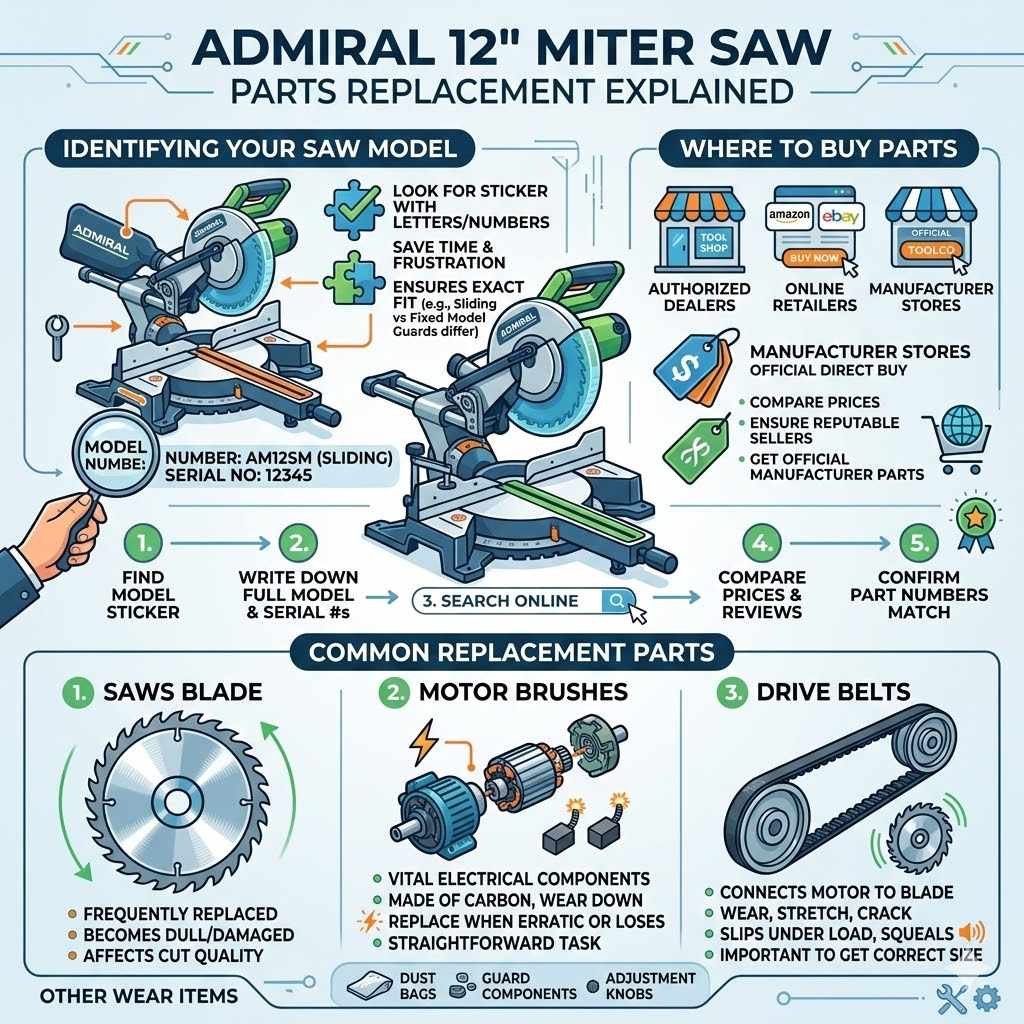
This section covers the basics of finding and identifying the correct replacement parts for your Admiral 12 miter saw. It’s about understanding what you need to look for and where to find it. We’ll break down how to check your saw’s model number and how that helps you pick the right components.
Getting this first step right makes all the other steps much smoother. It ensures you buy parts that will fit perfectly and work well, saving you time and frustration.
Identifying Your Admiral 12 Miter Saw Model
Knowing your exact saw model is the very first step. Many Admiral saws look similar, but they might have slight differences in their parts. The model number is usually on a sticker on the saw’s body.
It might be on the base, the motor housing, or the side. Look for a series of letters and numbers. Sometimes, a manufacturing date or serial number is also helpful.
This information is key to ordering the precise parts you need. Without it, you might end up with parts that don’t fit.
For example, an Admiral 12 inch sliding miter saw might have a different part number for its blade guard than a fixed 12 inch model. Even small changes in design can affect part compatibility. So, take a few minutes to locate and write down your saw’s model number before you start searching for parts.
This will save you headaches later on.
Where to Buy Admiral 12 Miter Saw Parts
Once you know your model, you need to find a good place to buy parts. There are several options. You can check with authorized Admiral tool dealers.
These are usually local hardware stores or specialized tool shops. They often have access to official manufacturer parts. Online retailers are also a popular choice.
Websites like Amazon, eBay, and specific tool parts stores carry a wide variety of components. Some manufacturers also have their own online stores where you can buy parts directly. It’s a good idea to compare prices from different sellers to find the best deal.
Always ensure the seller is reputable.
Example Scenario
- Find the model number sticker on your Admiral 12 miter saw.
- Write down the full model number and any serial numbers.
- Search online for “Admiral 12 miter saw replacement parts.”
- Compare prices and reviews from different online stores and local dealers.
- Confirm the part numbers and descriptions match what you need for your saw.
Common Admiral 12 Miter Saw Replacement Parts
Some parts wear out more often than others on any power tool. For an Admiral 12 miter saw, common parts that might need replacing include the blade, brushes, and belts. The blade can become dull or damaged over time, affecting cut quality.
Motor brushes wear down with use and need to be replaced to keep the motor running. Belts can stretch, slip, or break, impacting the saw’s power transfer. Other parts like the dust collection bag, blade guard components, and adjustment knobs can also wear out or get lost.
Understanding these common wear items can help you anticipate future needs and keep your saw in top shape.
Blade Replacement
The saw blade is the most frequently
Motor Brushes
Motor brushes are small but vital components that deliver electricity to the spinning motor. They are made of carbon and wear down as they make contact with the motor’s commutator. When brushes get too short, the motor will start to run erratically or stop altogether.
You might notice sparks coming from the motor housing or a loss of power. Replacing motor brushes is usually a straightforward process. Most saws have access covers for the brushes, allowing you to easily remove the old ones and install new ones.
This is a common maintenance task that can significantly extend the life of your motor.
Drive Belts
The drive belt connects the motor to the saw blade mechanism. It transfers the motor’s rotational energy to the blade. Over time, belts can become stretched, cracked, or glazed.
A worn belt might slip under load, causing a loss of cutting power. It can also make a squealing noise. If the belt breaks, the saw will no longer spin its blade.
Replacing a drive belt typically involves removing a cover on the saw, loosening a tensioner, removing the old belt, and installing the new one. It’s important to get the correct belt size and type for your Admiral 12 miter saw to ensure proper fit and performance.
Admiral 12 Miter Saw Parts Installation Steps
This part of the guide focuses on the practical steps of installing new parts onto your Admiral 12 miter saw. We’ll cover safety precautions and then go through a general process that applies to most common part replacements. Following these steps carefully will help you successfully repair your saw and ensure it operates safely and effectively.
It’s about breaking down the task into manageable actions.
Safety First When Replacing Parts
Safety is the most important aspect when working on any power tool. Before you start any repair or
For instance, when replacing a blade, the guard is there to protect you. Make sure it’s correctly reinstalled. Similarly, if you’re working inside the motor housing, be aware of exposed electrical components.
Always double-check that the power is disconnected before touching anything inside the saw.
Step-by-Step Installation Process General Guide
The general process for replacing parts on your Admiral 12 miter saw usually follows a pattern. First, ensure the saw is unplugged and safe to work on. Next, identify the specific part that needs
Replacing a Saw Blade
- Unplug the miter saw.
- Locate the blade lock or arbor lock button on the saw.
- Press and hold the lock button to keep the arbor from spinning.
- Use the appropriate wrench (usually included with the saw) to loosen and remove the arbor nut. The nut is typically left-hand threaded, meaning you turn it clockwise to loosen.
- Carefully remove the old blade, noting the direction of the teeth.
- Clean the arbor and any washers.
- Place the new blade onto the arbor, ensuring the teeth are pointing in the correct direction for the cut.
- Reinstall any washers and the arbor nut. Tighten it firmly by hand first.
- Hold down the blade lock button again and use the wrench to tighten the arbor nut securely.
- Remove your hand and tools from the blade area.
- Plug in the saw and test it briefly at a low speed to ensure the blade is spinning freely and without wobble.
Replacing Motor Brushes
- Unplug the miter saw.
- Locate the brush caps on the motor housing. They are usually small, round plastic or metal caps.
- Use a screwdriver or pliers to unscrew or pop off the brush caps.
- The old brushes will be visible. They might be held in place by a spring.
- Gently pull out the old brushes. Note how they are seated.
- Insert the new brushes, making sure they fit correctly and the springs are in place.
- Screw or snap the brush caps back into place.
- Plug in the saw and run it for a few minutes. This helps seat the new brushes properly.
Replacing a Drive Belt
- Unplug the miter saw.
- Remove the access cover for the drive belt. This usually involves unscrewing a few screws.
- Examine the old belt. Note its path around the pulleys.
- If there is a tensioning mechanism, release the tension on the belt.
- Carefully remove the old belt from the pulleys.
- Install the new belt, ensuring it is properly seated on both the motor pulley and the blade arbor pulley.
- Re-apply tension to the belt if necessary, following your saw’s design.
- Plug in the saw and test the belt’s operation.
Troubleshooting Common Issues After Replacement
Sometimes, even after replacing a part, a problem might persist or a new one may appear. If your Admiral 12 miter saw is still not working correctly after a part
When the Saw Won’t Start
If your Admiral 12 miter saw refuses to start after a part
Uneven or Rough Cuts
If your miter saw is still making uneven or rough cuts after replacing the blade, the problem might lie elsewhere. First, ensure the new blade is correctly installed and tightened. A loose blade will cause vibrations and poor cuts.
Check if the blade is indeed flat and has no bends or chips. Beyond the blade itself, inspect the saw’s alignment. The blade should be perfectly perpendicular to the table (90 degrees) and square to the fence.
Small misalignments can greatly affect cut quality. Also, ensure the motor is running at full speed; a worn drive belt or motor issue could cause the blade to spin too slowly, leading to rough cuts, especially in hardwoods.
Maintaining Your Admiral 12 Miter Saw
Keeping your Admiral 12 miter saw in good condition is key to its longevity and performance. Regular maintenance goes beyond just replacing parts when they break. It involves cleaning, lubrication, and regular checks.
This proactive approach helps prevent major issues, ensures the saw operates safely, and delivers precise cuts every time. A well-maintained saw is a reliable partner in any woodworking project.
Cleaning and Lubrication Best Practices
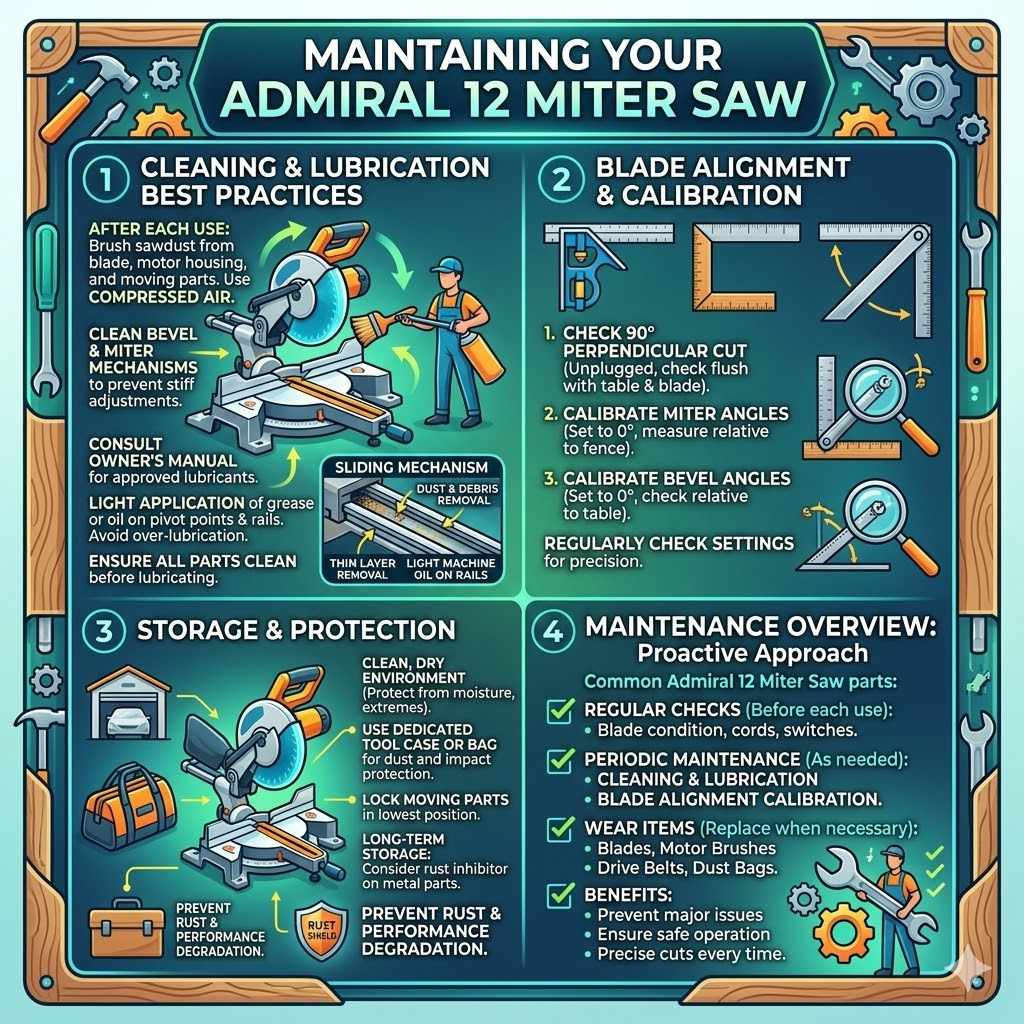
Regular cleaning is crucial for keeping your Admiral 12 miter saw functioning smoothly. After each use, it’s a good idea to brush away sawdust from the blade, motor housing, and moving parts. A compressed air blower can be very effective for this.
Pay attention to the bevel and miter adjustment mechanisms; sawdust accumulation here can make adjustments difficult and inaccurate. For lubrication, consult your owner’s manual. Some pivot points and sliding mechanisms may require a light application of grease or oil.
Use only the type of lubricant recommended by the manufacturer. Over-lubrication can attract more dust and debris, so a little goes a long way. Ensure all moving parts are clean before applying any lubricant.
For example, the sliding mechanism on a sliding miter saw can become stiff if not cleaned and lightly lubricated. Dust and debris can build up on the rails, making it hard to move the saw head smoothly. A quick wipe-down and a thin layer of light machine oil on the rails can make a big difference in operation.
Blade Alignment and Calibration
Ensuring your Admiral 12 miter saw’s blade is properly aligned and calibrated is essential for accurate cuts. Miter and bevel adjustments can become loose or knocked out of alignment with regular use or accidental bumps. Most saws have adjustment screws or slots that allow you to fine-tune these angles.
Start by checking the 90-degree perpendicular cut. Use a combination square or carpenter’s square to verify the blade is exactly at a right angle to the table. Then, check your miter (side-to-side) and bevel (tilting) angles.
Calibrate them against a known accurate angle finder or a reliable square. Regularly check these settings, especially if you notice your cuts are not matching the markings on the saw.
- Checking the 90-Degree Cut: With the saw unplugged, place a reliable combination square against the blade and the saw table. The blade should sit flush against both edges of the square. If not, adjust the rear trunnion or related components as per your manual.
- Calibrating Miter Angles: Set the saw to 0 degrees miter. Use an angle finder to measure the angle between the blade and the fence. Adjust the miter lock or limit screws until the angle is precisely 90 degrees relative to the fence.
- Calibrating Bevel Angles: Set the saw to 0 degrees bevel. Use the angle finder to check the blade’s angle to the table. Adjust the bevel stops or calibration screws to achieve a perfect 90-degree angle.
Storage and Protection
Proper storage can significantly extend the life of your Admiral 12 miter saw and its parts. When not in use, store the saw in a clean, dry environment. Protect it from moisture, extreme temperatures, and physical damage.
If possible, store it in its original box or a dedicated tool bag or case. This not only protects it from dust and impact but also keeps all its accessories together. If you need to store it long-term, consider applying a rust inhibitor to metal parts.
Ensure that any moving parts are in their lowest position or locked down to prevent accidental damage during storage. A little care in storage can prevent many potential issues with wear and tear.
For example, storing a miter saw in a damp garage without protection can lead to rust on the metal components, including the blade and sliding rails. This rust can degrade performance and require more intensive cleaning and repair later on. Keeping it covered also prevents sawdust from accumulating in mechanisms.
Admiral 12 Miter Saw Parts: Full Replacement Guide Overview
This guide has walked you through identifying, obtaining, and installing
Frequently Asked Questions
Question: Where can I find the model number on my Admiral 12 miter saw?
Answer: The model number is usually found on a sticker attached to the main body of the saw. Look on the base, motor housing, or side of the unit for this identifying label.
Question: Do I need special tools to replace Admiral 12 miter saw parts?
Answer: Typically, basic tools like screwdrivers, wrenches, and Allen keys are sufficient for most common part replacements on Admiral 12 miter saws. Your saw’s manual will specify any unique tool requirements.
Question: How often should I replace the motor brushes on my Admiral 12 miter saw?
Answer: Motor brushes wear down with use and need replacement when they become significantly short, often indicated by reduced motor power or sparking. There isn’t a fixed time interval; it depends on how much you use the saw.
Question: Can I use a generic blade on my Admiral 12 miter saw?
Answer: While generic blades might fit, it’s best to use blades specified for your Admiral 12 miter saw model and size to ensure optimal performance and safety. Always check arbor size and blade diameter compatibility.
Question: What should I do if my Admiral 12 miter saw is making strange noises after a part replacement?
Answer: Strange noises often indicate improper installation or a misaligned part. Double-check that the new part is securely fastened and correctly oriented. Ensure no debris is interfering with moving components.
Wrap Up
This guide has provided a clear path to managing Admiral 12 miter saw parts. You learned how to identify your saw, find the right components, and install them step-by-step. Remember that regular cleaning and checking alignment are key.
By following these tips, you can keep your saw in top condition, ready for any cutting task.