Best Winter RH for a Woodworking Shop (2026): Research Shows
For most woodworking shops in winter, a common target is about 35% to 45% relative humidity, with the mid-30s to low-40s often used as a practical range for heated shops; go a little lower for damp garages and match final assembly humidity to the room where the piece will live. Dry air can open checks in wood and weaken glue joints, while damp air can swell parts, rust tools, and throw off fit. This guide shows how to set a winter RH target by shop type, then adjust it for heated garages, slab moisture, and finished pieces.
Quick comparison
| Product | Badge | Best for | Price | ||
|---|---|---|---|---|---|
 |
TempPro TP50 Digital Hygrometer Indoor Thermometer RoomTempPro | Our pick | Indoor thermometer · humidity monitor · tabletop/magnetic | $10.49
Price as of 27 Oct 2026
|
View |
 |
AcuRite Wireless Digital Indoor Thermometer and HygrometerAcuRite | Also great | Wireless indoor monitor · temp/humidity · compact display | $12.99
Price as of 27 Oct 2026
|
View |
 |
Levoit LV600S Smart Warm&Cool Mist Humidifiers for HomeLevoit | Also great | $109.00
Price as of 27 Oct 2026
|
View | |
 |
hOmeLabs Dehumidifier 7,500 Sq Ft 50 Pint with Pump 120hOmeLabs | Pair with it | 7,500 sq ft · 50 pint · pump/WiFi | $309.99
Price as of 27 Oct 2026
|
View |
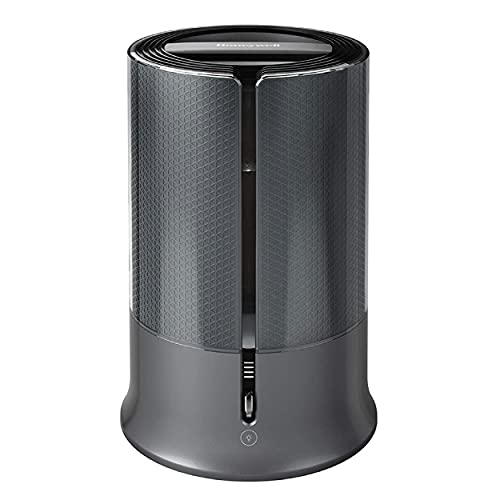 |
Honeywell Designer Series Cool Mist Humidifier, RoomHoneywell | Also great | $97.79
Price as of 27 Oct 2026
|
View |
Start with the outdoor temperature band, then use the shop’s RH ceiling from that band as a condensation-control limit rather than as a woodworking target. That keeps you aware of building safety, but the best setting for lumber stability still depends on the wood’s EMC needs.
If your shop is a heated garage or a slab-on-grade room, treat the table as a ceiling, not a promise. The actual RH you reach may sit lower because of air leakage, concrete moisture, or the limits of a small humidifier.
How we chose
The target bands below follow four checks: outdoor temperature, the RH ceiling that reduces condensation risk, the wood MC range that lines up with interior work, and the job stage you are doing. Rough stock can tolerate more drift than milled parts, but glue-up and finished-piece holding need tighter control.
The goal is not a single perfect number. It is a range that fits winter air, your building, and the room the furniture will end up in.
| Outdoor temperature band | Recommended shop RH ceiling | Corresponding wood MC band | Notes for rough stock, milling, glue-up, and storage |
|---|---|---|---|
| 20 to 40°F | Less than 40% RH | About 6% to 8% MC | Good ceiling for most heated shops. Rough stock can sit here, but check MC before milling. Glue-up is usually safer when stock is near the middle of the band. Finished-piece holding should match the room where it will live. |
| 0 to 10°F | Less than 30% RH | About 5% to 7% MC | Use this in colder winter air. Milling and assembly need drier, more stable stock to avoid movement after the heat comes on. Watch for over-drying in long storage periods, especially with thin parts and end grain. |
| -20°F or below | Less than 15% RH | About 5% MC or a little higher if the room will stay very dry | Very cold air pulls indoor RH down fast. This is a ceiling for tight, conditioned spaces, not a comfort target for every garage. Limit exposure time before milling, and move finished pieces slowly to avoid shock drying. |
| Milder winter, near thaw | 35% to 45% RH | About 7% to 8% MC | Best for heated shops that stay fairly sealed. Use this band for interior furniture work when the room is stable and condensation is not showing up on cold walls, windows, or steel tools. |
35% RH for most heated shops

Thirty-five percent RH is a practical winter starting point for many heated shops because it sits close to the 6% to 8% wood MC range often used for interior furniture. It also leaves a little buffer below the level where a warm shop can start pushing moisture onto cold windows or metal.
Why this is the default winter target
Relative humidity is the percent of water vapor in air compared with the maximum that air can hold at that temperature. Around 35% RH, wood commonly lands near 7% MC, though the exact EMC can vary with temperature and species, which is why the number is only a practical estimate. That lines up with many interior furniture builds and helps limit seasonal movement after delivery.
Say your shop is a 12 by 20 foot heated garage and the hygrometer reads 35% RH with the slab staying dry. That is usually a workable starting point for stored hardwood, parts milling, and glue-up, as long as the finished piece will also live in a dry room.
What wood MC it usually supports
Woodweb puts 25–32 RH around 6% MC and 19–25 RH around 5% MC, while Wagner ties 26-32% RH indoors to 6% EMC and 6% MC, 40-46% RH to 8% EMC and 8% MC, and 47-52% RH to 9% EMC and 9% MC. That puts 35% RH in the band where many shops land near 7% MC for interior work, recognizing that EMC shifts with temperature and species.
Wagner also recommends drying wood within two percentage points of the EMC where it will be used. For interior furniture, that usually means you should check both the shop air and the wood MC before milling, not after.
Where it stops being safe
Thirty-five percent RH is not automatically safe in every winter shop. If your outdoor temperature is near 0 to 10°F, or if cold concrete and windows are already showing condensation, you may need a lower ceiling to avoid moisture on surfaces and the corrosion that follows.
A common first-timer mistake is to set the humidifier by the thermostat reading alone. A 68°F garage can still be too moist if a cold wall is sweating, and that extra moisture can affect iron tops, saw tables, and fasteners before it shows up in the wood.
What relative humidity keeps wood at about 7% moisture content?
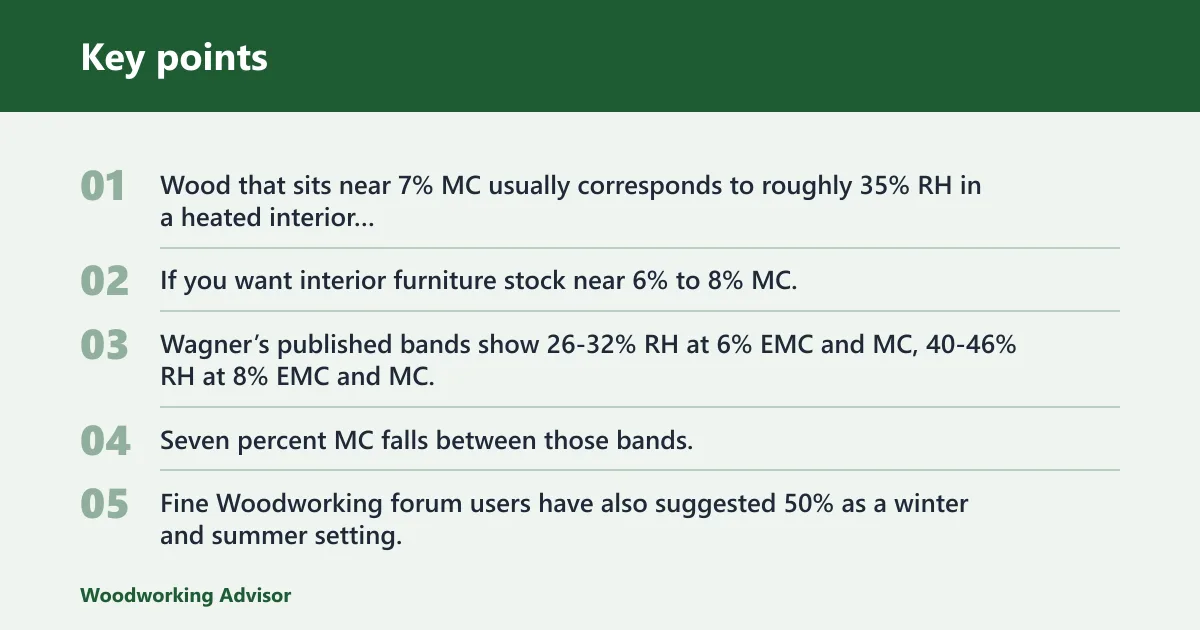
Wood that sits near 7% MC usually corresponds to roughly 35% RH in a heated interior shop, though the exact number shifts with temperature, the building envelope, and the species of wood. If you want interior furniture stock near 6% to 8% MC, a winter range around 30% to 45% RH is a practical working band.
The RH range that typically lands near 7% MC
Wagner’s published bands show 26-32% RH at 6% EMC and MC, 40-46% RH at 8% EMC and MC, and 47-52% RH at 9% EMC and MC. Seven percent MC falls between those bands, so 35% RH is a reasonable midpoint for many heated shops.
Fine Woodworking forum users have also suggested 50% as a winter and summer setting, but that is too high for many cold-weather shops and can invite condensation when outdoor temperatures drop. Temperature matters because colder air lowers the safe indoor RH ceiling.
Why temperature changes the answer
Outdoor temperature affects how much water vapor indoor air can hold before it condenses on cold surfaces. CEE says 20 to 40°F outdoor temperature corresponds to less than 40% indoor RH, 0 to 10°F corresponds to less than 30% indoor RH, and -20°F or below corresponds to less than 15% indoor RH.
That is why a shop can be fine at 35% RH on a mild winter day and too wet on a bitter cold day. The wood does not care about the calendar. It cares about EMC, and EMC shifts with the air around it.
How to verify with a hygrometer and moisture meter
A hygrometer tells you the actual shop RH, while a wood moisture meter tells you whether the stock is close to the EMC your build needs. Use both. Thermostat settings and heater run time do not tell you the same thing.
Check rough stock after it has sat in the shop long enough to respond, then recheck before milling and again before glue-up if the weather has changed. For interior furniture, a stock reading near 6% to 8% MC is usually the better target than a guess based on feel.
Best for heated garages
Heated garages need a different rule because air leaks, slab moisture, and cold wall surfaces can upset the indoor RH you thought you were holding. In that setting, a humidifier may be useful, but it must be tuned carefully and paired with heat, sealing, or both.
How to handle leaky walls and slab moisture
If the building leaks air, the humidifier may never stabilize the room. Warm air rushing out and cold air leaking in can force the unit to run hard while RH still swings. Concrete slabs can also release moisture, so a garage can feel dry on the meter and still sweat at the floor edge or along cold masonry.
Dehumidifiers help in humid seasons, but they may not solve a leaky winter garage by themselves, especially if the slab is damp. In that case, air sealing and heat matter as much as moisture removal.
Why a humidifier may need backup heat or air sealing
Humidifiers can raise dry winter air, but they should be set carefully to avoid condensation on windows, walls, or other cold surfaces. If the room holds moisture but the surfaces stay cold, you can end up with rust and, where damp conditions persist on surfaces, mold risk before you get better wood stability.
Humidifiers are for dry winter air. Air conditioners lower temperature and remove moisture, so they belong to summer control, not the winter target itself.
Condensation checks for windows, tools, and concrete
Condensation is the warning sign that indoor moisture is too high for the coldest surfaces in the room. Check windows, uninsulated garage doors, steel machine tables, and the slab edge. If they are sweating, the shop RH is probably too high for that weather.
Suppose a garage reads 38% RH at 65°F, but the single-pane window is fogging and the cast-iron table has a thin film of moisture. The wood may still be within a useful range, but the room is already too wet for corrosion control, so the setpoint needs to come down.
Which one should you buy?
Choose the target by job, not by habit. Rough stock can sit in the broader winter band, milling needs stock close to the shop’s EMC, glue-up wants the tightest match, and finished pieces should be brought as close as practical to the room where they will live.
Best target for rough stock
For rough stock storage, start around 35% to 45% RH in a heated shop, or lower if your outdoor temperature pushes you toward the CEE winter ceiling. The point is to keep the lumber moving slowly, not to force a perfect number every day.
Choose the higher end only if the room stays dry on cold surfaces. If the walls or slab show condensation, lower the target first.
Best target for milling and glue-up
For milling and glue-up, aim for wood MC near the middle of the interior range, usually around 6% to 8% MC. That often means a shop around 35% RH, though a colder winter may pull the acceptable ceiling down toward less than 30% RH or even less than 15% RH in extreme conditions.
Bond quality depends on stable parts. If the stock is still moving fast because the shop RH is swinging, wait before cutting joinery or spreading glue.
Best target when the finished piece will live in a drier room
If the finished piece will live in a drier room, set the shop closer to that room’s RH before final assembly and finishing. The practical rule of matching the shop to the room where the furniture will live points the same way as Wagner’s two-point EMC guidance.
That matters for tabletops, doors, and face frames. If you assemble at one humidity and the piece dries after delivery, joints can open and panels can shrink more than you planned.
When to humidify, dehumidify, or leave the shop alone
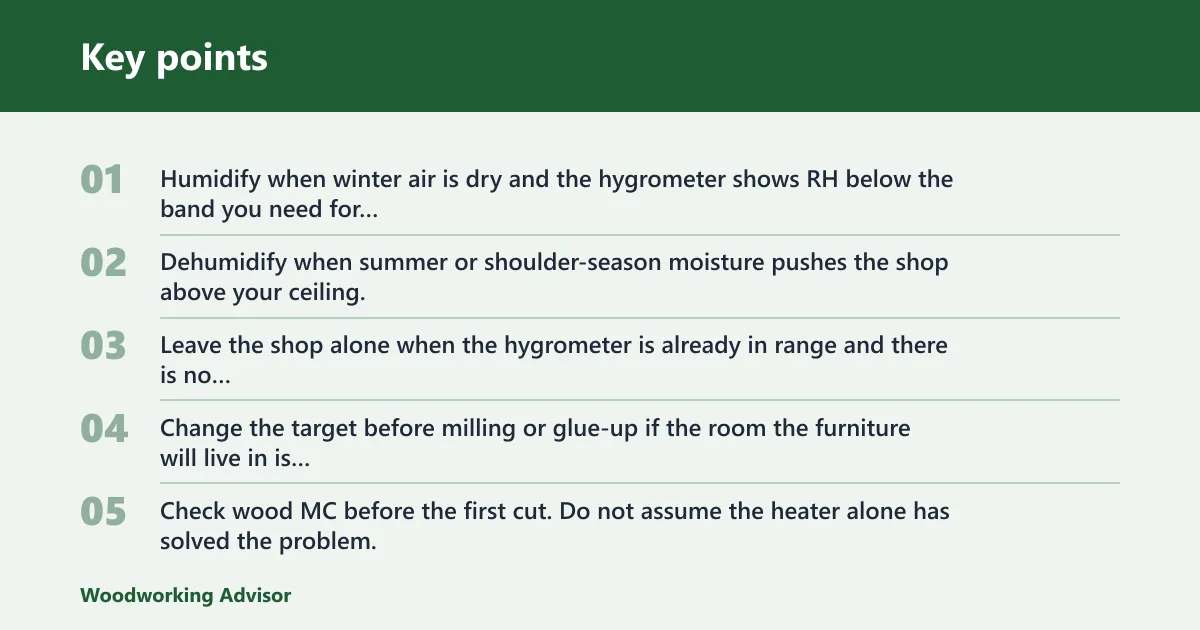
- Humidify when winter air is dry and the hygrometer shows RH below the band you need for the current job.
- Dehumidify when summer or shoulder-season moisture pushes the shop above your ceiling, especially if rust or swelling appears.
- Leave the shop alone when the hygrometer is already in range and there is no condensation on cold surfaces.
- Change the target before milling or glue-up if the room the furniture will live in is clearly drier or wetter than the shop.
- Check wood MC before the first cut. Do not assume the heater alone has solved the problem.
Frequently asked questions
What humidity should a woodworking shop be in winter?
For most woodworking shops in winter, 35% to 45% RH is a workable band. Colder outdoor temperatures call for lower indoor RH ceilings, so a shop that is fine in mild weather may need adjustment during cold snaps.
Is 35% humidity good for a woodshop?
Yes, 35% RH is often a good winter target for a heated woodshop because it usually lands near about 7% wood MC. It is not universal, though. If outdoor temperatures are very low or the shop shows condensation on cold surfaces, you may need a lower ceiling.
Should I humidify or dehumidify my workshop in winter?
Humidify if winter air is too dry for the wood MC you need, but watch for condensation on windows, walls, or tools. Dehumidifiers are mainly for humid seasons. In winter, a dehumidifier usually is not the right fix for dry-air cracking or movement problems.
How low can humidity go before wood starts cracking in a shop?
Cracking risk rises as wood gets drier and as RH swings faster. The same source lists 19–25 RH around 5% MC and 25–32 RH around 6% MC, so very dry winter air can push parts into a range where shrinkage and checking become more likely, especially in thin stock and end grain.
Does a woodshop need the same humidity as the room the furniture will live in?
It should be as close as practical, especially before milling and final assembly. Matching the destination room reduces seasonal movement after delivery. If the shop and final room differ a lot, set the shop closer to the final room for the last stages of the build.
Sponsored / affiliate links. As an Amazon Associate I earn from qualifying purchases. I may earn additional commission from eligible campaigns.