Safest Heater for a Garage Workshop
Electric, hardwired, thermostatically controlled infrared or convection heaters are usually the safest garage workshop choice because they avoid open flame, combustion gases, and fuel storage; pick one sized for the garage and wired to the circuit, not a plug-in strip. Poor placement or the wrong fuel can start a fire or fill the shop with carbon monoxide. This guide compares heater types, mounting options, fuel choices, and safety controls for garage workshops, so you can match the heater to the space.
Garage workshop heater safety: the main trade-off
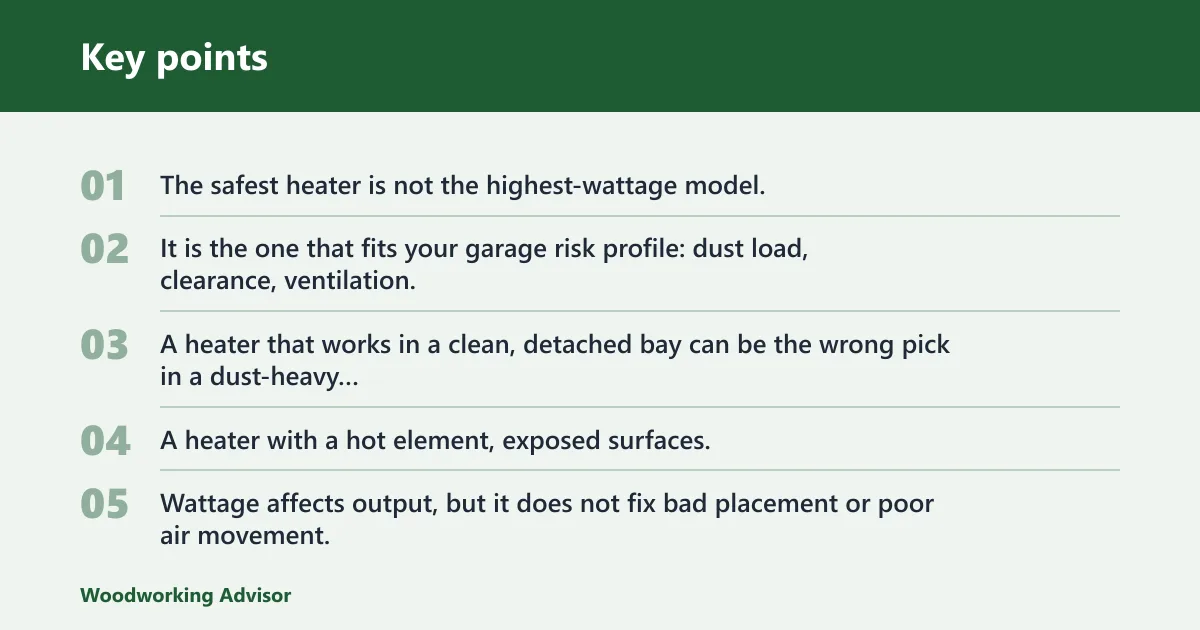


The safest heater is not the highest-wattage model. It is the one that fits your garage risk profile: dust load, clearance, ventilation, mounting method, and whether the space is attached, detached, insulated, or shared with parking. A heater that works in a clean, detached bay can be the wrong pick in a dust-heavy woodworking shop.
Why dust, clearance, and ventilation matter more than wattage
Sawdust is fuel, not just a cleanup issue. A heater with a hot element, exposed surfaces, or weak airflow can ignite dust on the unit or on nearby lumber, rags, and finishes. Wattage affects output, but it does not fix bad placement or poor air movement.
How fixed mounting changes the safety profile
Wall and ceiling mounts keep hot surfaces off the floor, away from traffic, and out of the path of tools, carts, and lumber stacks. They also cut tip-over risk. Fixed units still need clearance from combustibles and enough spacing for airflow, especially where dust collection shapes the shop layout.
What “safe” means in an attached vs detached garage
An attached garage adds a house-to-shop risk path. Fumes, smoke, and carbon monoxide can move through door gaps and framing penetrations. A detached garage gives more separation, but it does not excuse poor ventilation or sloppy clearance. The heater choice should change with the structure, not only the square footage.
📊 Family Handyman says the Mr. Heater Big Maxx is a 50,000-BTU natural gas heater. Source: Familyhandyman.
Heater types compared
Electric, propane, and gas heaters each solve a different problem. Popular Mechanics notes that garage heaters most commonly come in electric and propane styles, while natural gas units are powerful options for larger garages. The better choice depends on whether you need clean indoor heat, high output, or flexibility in a cold, drafty shop.
| Heater type | Best use case | Main safety strengths | Main limits |
|---|---|---|---|
| 120V portable electric heater | Small, temporary heat in a clean area | No combustion gases; easy to move; some models add tip-over and overheat shutoff | Limited coverage; easy to block with tools or cords; can sit too close to combustibles |
| 240V hardwired ceiling heater | Larger insulated garage or fixed workshop bay | Off the floor; saves space; can use built-in thermal cutout and thermostat control | Requires proper circuit, mounting height, and clearances; not a casual plug-in option |
| Infrared heater | Drafty spaces where you heat people and work zones | Warms objects and people directly; useful when air leaks make convection heat less effective | Must still respect mounting clearances; line of sight matters; dusty buildup can reduce performance |
| Propane forced-air heater | High-output heating in a ventilated detached space | Strong output for large, open areas | Needs ventilation, fuel handling, and strict clearance; not the right fit for enclosed woodworking dust |
120V portable electric heater
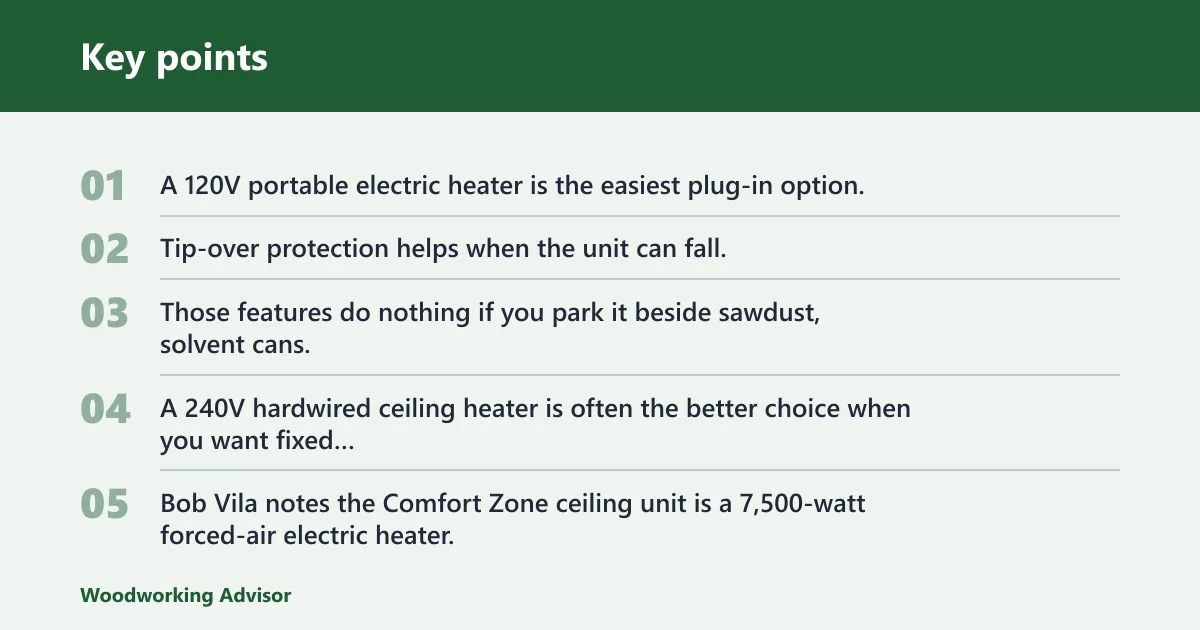
A 120V portable electric heater is the easiest plug-in option, but it is also the easiest to misuse. Tip-over protection helps when the unit can fall, and overheat protection can shut the heater down if airflow is blocked. Those features do nothing if you park it beside sawdust, solvent cans, or a pile of offcuts.
240V hardwired ceiling heater
A 240V hardwired ceiling heater is often the better choice when you want fixed installation and a cleaner floor plan. Bob Vila notes the Comfort Zone ceiling unit is a 7,500-watt forced-air electric heater, and that it can be hardwired or fit with a cord for a 30-amp outlet. It also includes a built-in sensor that can shut it off if the temperature gets too high.
Infrared heater
Infrared heaters warm people and objects more directly than the surrounding air, which helps in drafty spaces. That makes them useful in a garage with frequent door opening or poor insulation. They still need careful mounting, because hot surfaces and radiant heat can create a combustibles problem if you place them too close to lumber or finishing supplies.
Propane forced-air heater
Propane forced-air heaters are the high-output choice, but they bring the most setup risk in a workshop. They need ventilation, enough separation from combustibles, and careful fuel handling. An oxygen depletion sensor may be present on some propane heaters, but it is not a substitute for ventilation and it is not universal across gas heater designs.
Are garage heaters safe?
Garage heaters are safe when the heater type matches the space and the installation follows clearance, ventilation, and power requirements. UL or ETL listing matters because it shows the heater has been evaluated to a safety standard, but it does not prove the unit is safe in every garage layout. Placement and fuel choice still decide the outcome.
What UL/ETL listing does and does not tell you
A UL or ETL listing matters because it shows the heater has been tested for recognized electrical or appliance hazards. It does not tell you that the heater will be safe if you place it near sawdust, under stacked lumber, or in front of solvent fumes. Certification is a starting point, not permission to ignore the manual.
The failure modes that matter in woodworking shops
The main risks are dust ignition, blocked airflow, hot-surface contact, fuel leakage, and carbon monoxide from combustion heaters. Overheat protection helps when airflow is restricted. Tip-over protection helps portable units only. An oxygen depletion sensor helps certain unvented propane models, but it does not make a closed shop suitable for combustion heat.
When a heater becomes unsafe around dust or solvent vapors
A heater becomes a problem when fine dust can collect on its intake, element, or housing, or when finishing supplies and solvents sit close enough to heat up. A common first-timer mistake is parking a portable heater beside a bench with mineral spirits and lacquer thinner on the shelf above it. That is too much exposure in one spot.
Garage workshop heater decision table
This table turns the setup into the decision. Match the garage to the heater, then check the required features and what to avoid. If your space fits more than one row, use the stricter guidance.
| Garage setup | Safest heater type | Required safety features | Ventilation and clearance notes | What to avoid |
|---|---|---|---|---|
| Attached insulated shop | 240V hardwired ceiling heater | UL or ETL listing, thermostat, overheat protection | Keep it off the floor and away from house walls, lumber, and finishes; follow the mounting clearances in the manual | Unvented propane heat and any unit that can blow dust toward the house side |
| Detached uninsulated shop | Infrared heater or 240V ceiling unit | UL or ETL listing, thermostat, overheat protection | Choose a mount that keeps the heater clear of storage and allows full airflow; drafty shops usually need zone heating | Small portable heaters as the main heat source in a large open bay |
| Dust-heavy woodworking bay | 240V hardwired ceiling heater with closed, fixed placement | UL or ETL listing, overheat protection, thermostat, preferably remote control or timer | Mount away from saws, sanding stations, dust-collector discharge, and overhead lumber racks; keep dust from building on the unit | Open-flame or high-exposure portable heaters near sanding, cutting, or finishing areas |
| Mixed-use parking and shop | 240V ceiling heater or infrared heater | UL or ETL listing, thermostat, overheat protection | Keep the heater above vehicle clearance and away from doors, bumpers, ladders, and fuel cans | Portable heaters on the floor where tires, cords, or tools can hit them |
How much clearance does a garage heater need?
Clearance is one of the most important safety checks, and it varies by heater type and model. You need room above, beside, and below the unit, plus extra distance from sawdust, lumber stacks, solvents, and rags. The manual sets the actual numbers, but the workshop layout must make those numbers realistic.
Ceiling clearance for mounted units
Mounted heaters need enough distance from the ceiling, joists, shelves, and stored material to keep heat from building up around the housing. Family Handyman says the Mr. Heater Big Maxx needs at least 8 feet of clearance from the floor to the base. That matters because a unit mounted too low can overheat nearby materials or interfere with vehicle clearance.
Floor and side clearance for portable units
Portable heaters need open floor space, stable footing, and room around the intake and outlet grilles. Do not set one behind a stool, beside a tarp, or under a bench. Tip-over protection is helpful, but it is not enough if cords, dust, or cardboard can still touch the hot housing.
Clearance from lumber stacks, sawdust, and finishes
Keep heaters away from lumber piles, sheet goods, finish rags, spray cans, and solvent containers. Dust can settle on hot parts and restrict airflow. Finishing supplies should stay in a separate cabinet or cabinet-like enclosure, not on the same wall or shelf as a space heater.
What is the safest electric heater for a garage?

The safest electric heater is usually the one that is fixed, thermostatically controlled, listed by UL or ETL, and sized for the garage without relying on extension cords. For a clean, enclosed workshop, a 240V ceiling unit is often safer than a portable model. For a small bay, a controlled 120V unit can work if you keep strict clearance.
When a 120V portable model fits the job
A 120V portable heater fits a small, temporary task area where you can keep the unit in sight and away from dust or storage. It works best as supplemental heat, not as the main heat source for a full garage workshop. Choose one with overheat shutoff and tip-over protection, then keep it off the floor path.
When a 240V ceiling unit is the safer choice
A 240V ceiling heater is usually the better safety choice when the garage is insulated, permanently used, and wired for the load. It clears floor traffic, keeps heat out of the way of tools, and can reduce the temptation to use a weaker portable unit too close to the bench. The same source lists the Fahrenheat FUH as best for ceilings.
Where infrared makes sense in a drafty shop
Infrared makes sense when the garage is drafty, the door opens often, or you want to heat the work zone rather than the whole volume of air. That is useful in poorly insulated spaces. The same source notes that garages are often poorly insulated and prone to extreme cold, which is exactly where radiant heat can feel more effective.
Choose electric if… / Choose propane if…
Choose electric if you want the cleanest workshop setup, already have the right circuit, and need heat near dust, tools, and stored wood. Choose propane if you need high output in a detached, ventilated space and can manage fuel, clearance, and exhaust concerns. If the garage is attached and dusty, electric usually wins on safety.
Choose electric if you have power, dust, and enclosed-shop priorities
Go electric when you want no combustion gases, no fuel storage, and fewer ventilation concerns. That makes sense for an attached garage, a woodworking bay, or a shop with frequent sanding and cutting. A 240V ceiling heater is often the best fit when you can hardwire it and keep it off the floor.
Choose propane if you need high output in a ventilated detached space
Choose propane when the shop is detached, you need fast heat in a larger open area, and you can provide proper ventilation. Do not treat a cracked door as a full ventilation plan. If the unit is unvented, you need to be even more careful about air exchange and carbon monoxide control.
When neither option is a fit
If the garage is crowded with vehicles, solvent storage, and sawdust, neither a portable propane heater nor a weak plug-in electric model is a good answer. Rework the layout first. Put flammables in storage, move dust collection away from the heater zone, and pick a fixed electric unit only after the clearances are realistic.
Say your 24-by-24 insulated garage is attached to the house and doubles as a bench room. A wall-hung or ceiling-hung electric unit is the cleanest option, because it keeps the heater out of the walkway and avoids combustion gases near the house wall. A portable propane heater would add more risk than benefit in that layout.
Suppose your detached 20-by-30 shop stays cold, the doors open often, and the benches sit near the center. An infrared heater aimed at the work zone can be a better fit than a portable fan heater, because it gives you usable warmth without trying to heat every draft of air. The mounting still needs strict clearances.
Frequently asked questions
What is a good garage heater for a workshop?
A good garage heater for a workshop is usually a fixed electric unit with thermostat control, overheat protection, and the right mounting height for your space. For larger garages, a 240V ceiling heater is often the best balance of safety and convenience. For drafty spots, infrared can be a smarter fit.
How do I safely heat a garage without starting a fire?
Keep the heater listed, mounted correctly, and away from combustibles. Do not place it near sawdust, cardboard, lumber stacks, finishing supplies, or fuel containers. Use overheat protection and, for portable units, tip-over protection. A timer or smart thermostat helps limit run time and prevents forgotten heaters.
What is the safest electric space heater for a garage?
The safest electric space heater for a garage is usually a hardwired, thermostatically controlled ceiling unit with overheat protection and a proper listing. Portable electric heaters can work in smaller spaces, but they are easier to bump, block, or place too close to combustibles. Ceiling mounting reduces those risks.
Do propane garage heaters need ventilation?
Yes. Propane garage heaters need ventilation because combustion uses oxygen and can produce carbon monoxide and moisture. An oxygen depletion sensor, when present, is not a substitute for fresh air. Ventilation needs are especially important in enclosed garages, and they are not the same for vented and unvented models.
Sponsored / affiliate links. As an Amazon Associate I earn from qualifying purchases. I may earn additional commission from eligible campaigns.