Best Dehumidifiers for Woodshops (2026): We Compared
The best woodshop dehumidifier is a 50–70 pint unit for a leaky, damp garage or basement shop, but a smaller compressor model can work in a tight, insulated room above 60°F; below that, choose desiccant or a low-temperature model. Choose wrong, and you get rust on tools, swollen stock, mold, and finish failures. This guide shows how to size and choose by leakiness, winter temperature, and rust risk, then compares the types and features worth paying for.
Quick comparison
| Product | Badge | Best for | Price | ||
|---|---|---|---|---|---|
 |
Waykar 34 Pints 2025 Most Efficient Energy StarWaykar | Our pick | 34 Pints · ENERGY STAR · Home & Basement | $185.99
Price as of 26 Oct 2026
|
View |
 |
Tehanld 50 Pint Dehumidifier for Basement, Energy StarTehanld | Also great | 50 Pint · Energy Star · Smart WiFi | $189.99
Price as of 26 Oct 2026
|
View |
 |
DECIUU 5000 Sq.Ft Dehumidifier with Pump, 100 Pint, SmartDECIUU | Upgrade pick | 100 Pint · ENERGY STAR · With Pump | $289.99
Price as of 26 Oct 2026
|
View |
 |
AprilAire E100 Whole House Dehumidifier for Basement &Aprilaire | Pair with it | 100 Pint · ENERGY STAR · Whole House | $2,320.12
Price as of 26 Oct 2026
|
View |
Square footage can mislead you fast. A leaky garage at 45°F can need more capacity than a tighter basement at 60°F, even if the floor plans look similar.
How we chose
The main filter was realistic rating type. DOE, AHAM, and saturation ratings do not mean the same thing, so inflated saturation claims do not count as direct shop capacity.
Cold-shop fit mattered next. Auto-defrost, low-temperature operation, and stable drainage matter more than glossy coverage numbers in winter garages and basements.
Drainage and noise also counted. A shop dehumidifier should run long enough to hold humidity between 35% and 50% RH, not short-cycle, frost up, or demand constant bucket checks.
Finally, rust control was the job. The point is to keep humidity between 35% and 50% RH, where cast iron, fasteners, and hand tools stay protected without over-drying lumber.
Woodshop dehumidifier sizing matrix
Use the shop type first, then match the rating. A sealed basement shop can often do well with a 50-pint DOE unit, while a detached uninsulated garage often needs more capacity and better cold-weather performance.
| Shop type | Recommended rating range | Ideal RH target | Drainage setup | Common failure mode |
|---|---|---|---|---|
| Sealed basement shop | 35 to 50 DOE pints or similar AHAM class | 40% to 45% RH | Bucket drain can work; hose drain is better | Over-drying and short cycling if the unit is oversized |
| Attached garage shop | 50 to 70 DOE pints, or an AHAM-rated commercial-style unit | 40% to 50% RH | Continuous hose drain is the safer default | Frost-up and weak recovery after door openings |
| Detached uninsulated garage | 50 DOE pints minimum, often more if winter stays cold | 45% to 50% RH when temperature allows | Continuous drainage with freeze-resistant routing | Compressor short-cycling, frost, and poor moisture removal |
The humidity target for woodshops is 35% to 50% RH. Above 55% to 60% RH, rust risk is commonly reported on cast-iron tops and exposed steel; below 30% RH, stock can dry too far and move more than you want.
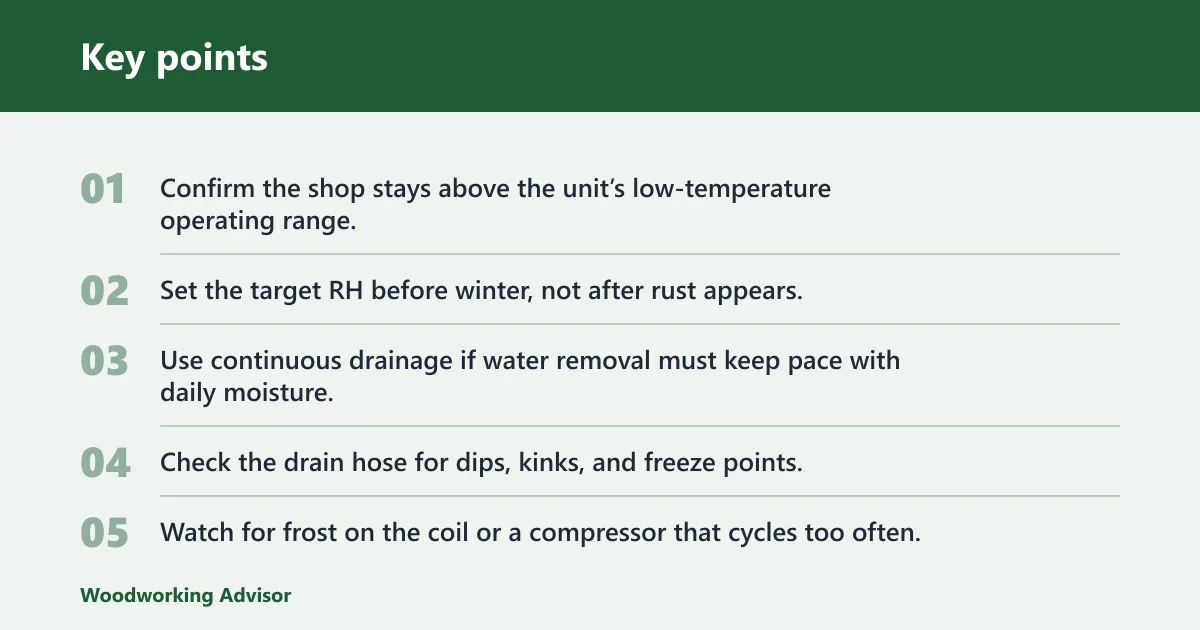
For cold-weather operation, run through this checklist:
- Confirm the shop stays above the unit’s low-temperature operating range.
- Set the target RH before winter, not after rust appears.
- Use continuous drainage if water removal must keep pace with daily moisture.
- Check the drain hose for dips, kinks, and freeze points.
- Watch for frost on the coil or a compressor that cycles too often.
- Raise the setpoint slightly if lumber begins to dry too fast.
A simple running-cost estimate helps with planning. If a dehumidifier averages 300 watts while running, then 8 hours of runtime uses about 2.4 kWh; at $0.15 per kWh, that works out to about $0.36 per day. Longer runtimes, colder rooms, and leakier buildings push that number up.
What pint rating do you need?
Use the rating that matches the test condition, not the biggest number on the box. DOE pints are measured at 65°F and 60% RH in the U.S., so they are the most useful starting point for basement and garage sizing. Older 70-pint units can equal newer 50-pint DOE models.
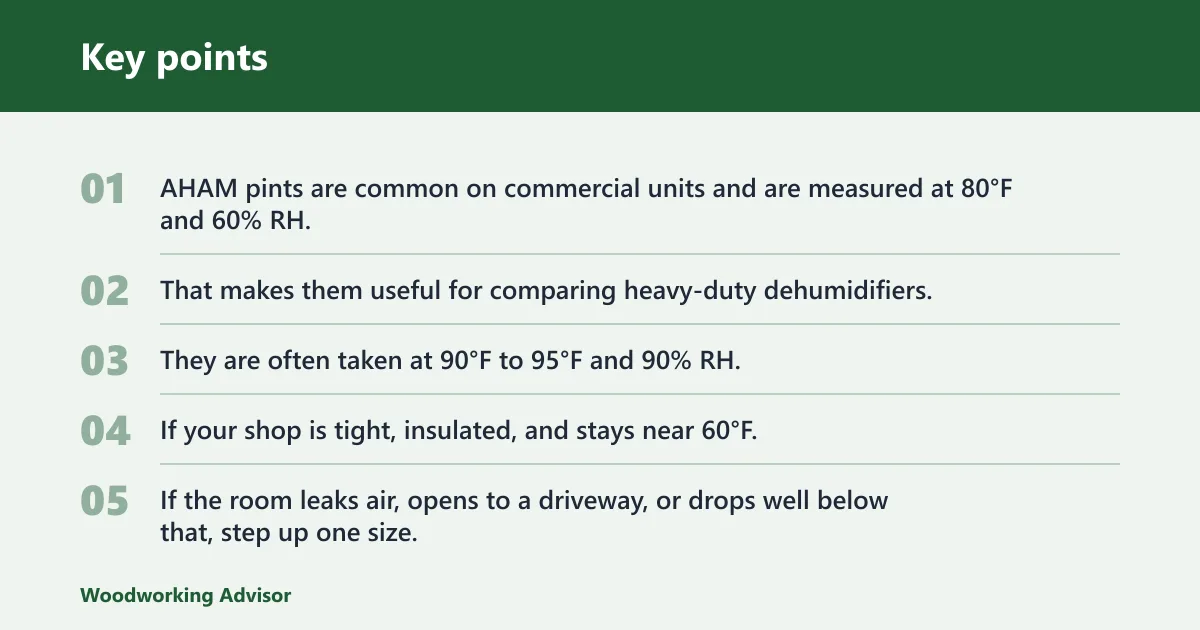
AHAM pints are common on commercial units and are measured at 80°F and 60% RH. That makes them useful for comparing heavy-duty dehumidifiers, especially when you are looking at a workshop that stays warmer than a basement.
Saturation ratings are a different thing. They are often taken at 90°F to 95°F and 90% RH, which can make a small consumer unit look larger than its real DOE performance for woodshop use.
How to map winter conditions to capacity
If your shop is tight, insulated, and stays near 60°F, a 35- to 50-pint DOE unit is a practical starting point. If the room leaks air, opens to a driveway, or drops well below that, step up one size. In a detached garage that gets cold, size for the coldest useful operating range, not the warmest day in spring.
Say your garage shop is only 14 by 24 feet, but the overhead door leaks and winter nights sit near 45°F. A “small” unit can still underperform because the air changes are high and the coil runs cold. Capacity needs to follow leakage and temperature, not floor area alone.
Suppose the room is a sealed basement with a sump pit and a stable 62°F. In that case, oversizing can create short cycles, which lowers moisture removal efficiency and leaves the setpoint swinging instead of steady.
When to step up one size
Step up if the shop has a leaky door, exposed concrete, or a damp wash area. Step up again if the unit will sit in a cooler corner, because lower air temperature slows moisture removal and can trigger frost.
Quick picks
- Frigidaire 50 Pint Dehumidifier w/WiFi: best for most basement and attached garage shops.
- ALORAIR Sentinel HD55: best for cool, damp, rust-prone shops.
- Waykar 2000 Sq. Ft. Energy Star Dehumidifier: best budget pick for smaller sealed shops.
Frigidaire 50 Pint dehumidifier w/WiFi: best for general shop control
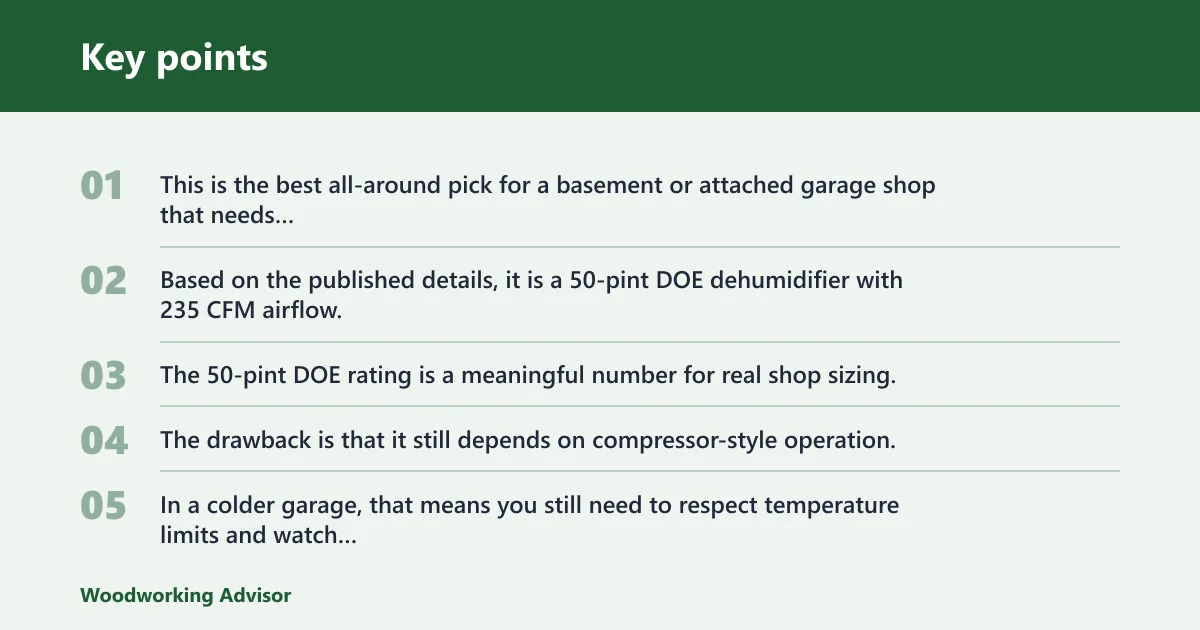
This is the best all-around pick for a basement or attached garage shop that needs steady humidity control. Based on the published details, it is a 50-pint DOE dehumidifier with 235 CFM airflow, Wi-Fi monitoring, and bucket or hose drainage, which makes it easier to keep a shop in range without constant babysitting.
It fits the middle of the market well. The 50-pint DOE rating is a meaningful number for real shop sizing, and the airflow spec suggests it can move enough air for machine clusters and dead-air corners.
The drawback is that it still depends on compressor-style operation. In a colder garage, that means you still need to respect temperature limits and watch for frost or short-cycling if the room gets too cool.
ALORAIR Sentinel HD55: best for commercial-duty rust control
This is the strongest fit for a damp, rust-prone shop that needs a tougher housing and a more serious duty cycle. The published specs show 113 pints saturation and 53 pints per day AHAM, with rugged metal housing, auto-defrost, and tankless gravity drain support.
That combination is useful in a shop where the unit may run often and the floor may stay damp. The AHAM number is the more useful comparison point here, because it helps you compare commercial-style units on a common basis.
The drawback is cost and scale. It is more machine than many small hobby shops need, so a tight insulated basement can end up paying for capacity it does not use.
AEOCKY 80 Pint Smart Dehumidifier: best for colder, higher-load spaces
This is the best match when winter temperatures are lower and moisture load stays high. The published details list 80 pints per day at 95°F, 95% RH, 56 pints per day at 86°F, 80% RH, effective operation down to 42°F, and sound as low as 44dB.
That low-temperature note matters. A shop that sits near the edge of a basement or an unheated garage needs a unit that can keep working after the room cools off, not one that gives up as soon as the season changes.
The drawback is the same one common to big-capacity units: if your shop is tight and only mildly damp, this much capacity can be more than you need.
KNKA 2500 Sq.Ft dehumidifier: best for small-to-medium shops with drain hose
This is a practical pick for a smaller shop that still needs continuous drainage. The published details list up to 34 pints per day at saturation, a 3.28-foot drain hose, and a 3L backup tank, which gives you a simple setup if bucket emptying is not ideal.
It is the kind of unit that can make sense in a sealed or lightly leaky shop where the moisture load is moderate. The drain hose helps reduce interruption, which matters if you want the machine to keep running during a long humid spell.
The drawback is capacity. Saturation numbers can look larger than the real-world DOE or AHAM performance, so this is not the first choice for a cold, open garage.
Waykar 2000 Sq. Ft. Energy Star dehumidifier: best budget-friendly compact pick
This is the budget-minded option for a smaller, more controlled shop. The published details list up to 30 pints per day at saturation, a 2,000 sq. ft. rating, 35 dB low-speed operation, and Energy Star design.
The quieter low-speed operation is useful in a shop attached to living space, and the compact size can fit a cramped basement corner more easily than bulkier units. It also offers more than one drainage path, which helps if you want to avoid bucket emptying.
The drawback is that the rating is expressed at saturation, so the number needs context. That matters a lot in a winter garage, where the real job is harder than the label suggests.
Where should you place it?
Put the unit where air actually moves through the shop. That usually means near machine clusters, along the path between a damp wall and the work area, or near a dead-air corner that tends to stay clammy.
Keep it away from lumber racks if the outlet air blows directly at stored stock. You want the whole room to stabilize, not one stack of boards to dry faster than the rest of the shop.
A common first-timer mistake is parking the dehumidifier in the middle of the room and calling that “good circulation.” If a wall corner stays damp, the center placement may miss the problem entirely while the display looks fine.
What is the best place to put a dehumidifier in a workshop?
The best place is usually close to the dampest air path, not the most open floor space. Aim for a spot with clear intake and exhaust, a stable drain route, and enough clearance that the coil can pull from the room instead of recirculating its own dry discharge.
Should you use continuous drainage?
Yes, for most garage and basement shops. Continuous drainage is the safer default because it keeps the unit running longer without bucket interruptions, and that matters when humidity rises after rain, thaw, or door openings.
Use the bucket as a backup, not the main plan. Bucket draining is fine for a small, tight shop that only needs occasional moisture removal, but it becomes a weak link when the room runs damp for days.
Do I need continuous drainage for a woodshop dehumidifier?
If the shop sees regular moisture, continuous drainage is the better choice. It reduces missed shutoffs, avoids overflow, and makes the unit more reliable in a garage or basement where you may not check it every day.
Freeze and clog checks
In cold basements and garages, check the hose slope and the end point often. A hose that freezes, kinks, or runs uphill can stop drainage and make the machine look undersized when the real problem is the line.
Which one should you buy?
Buy by shop type, not just square footage. If your space is sealed and only mildly damp, the Waykar can be enough. If your shop is a damp basement or an attached garage, the Frigidaire is the safer general pick. If rust control and colder air are the main problem, the ALORAIR or AEOCKY makes more sense.
Choose more capacity if winter temperatures stay low. That rule matters more than smart features, app control, or a flashy room-size claim. A Wi-Fi feature helps you monitor humidity; it does not make a weak unit stronger.
Pick the quieter unit only after capacity and drainage fit. Quiet operation is a comfort feature, not a sizing shortcut.
Frequently asked questions
What dehumidifier to buy for a woodshop
For most woodshops, start with a 50-pint DOE unit if the space is attached, leaky, or damp. Move up for colder garages and rust-prone conditions, and keep the target between 35% and 50% RH. Below that range, you risk over-drying stock.
What is a good dehumidifier to buy for a garage workshop?
A good garage workshop dehumidifier has enough capacity for leakiness, not just floor area, plus continuous drainage and low-temperature behavior. A 50- to 70-pint DOE class is the usual starting point for attached garages, while colder detached garages often need more margin.
What should I set my dehumidifier to in a workshop?
Set a workshop dehumidifier to hold roughly 35% to 50% RH. If cast iron starts to flash rust or the air feels damp, move toward the lower half of that range. Do not chase bone-dry air, because that can over-dry lumber and make movement worse.
Can a dehumidifier prevent rust on cast iron tools?
Yes, if it keeps humidity below the range where rust risk climbs. The key threshold is staying under about 55% to 60% RH, which is where cast-iron machine tops become more vulnerable. It will not protect tools if the shop keeps opening to wet air.
What is the best place to put a dehumidifier in a workshop: place it near the dampest?
Place it near the dampest air path, dead-air corners, or machine clusters, with clear space around intake and exhaust. Keep it away from lumber racks if the discharge stream points at stored stock. The goal is even room control, not local drying in one spot.
How to buy a dehumidifier for a workshop
Buy in this order: shop type, winter temperature, drainage, then noise. Use DOE or AHAM ratings for real comparison, not saturation numbers alone. If the space is cold, look for auto-defrost and low-temperature operation before you worry about app features.
Sponsored / affiliate links. As an Amazon Associate I earn from qualifying purchases. I may earn additional commission from eligible campaigns.