Can You Use Side-Mount Slides as Undermount?
No, side-mount slides are not a safe substitute for undermount slides unless the drawer, cabinet opening, mounting position, extension length, and load rating all match the undermount system exactly. Force the wrong hardware and the drawer can bind, sit out of square, or fail under load. This guide shows the fit checks that decide whether a swap is possible and when replacement is the only correct fix.
Why side-mount and undermount geometries do not match
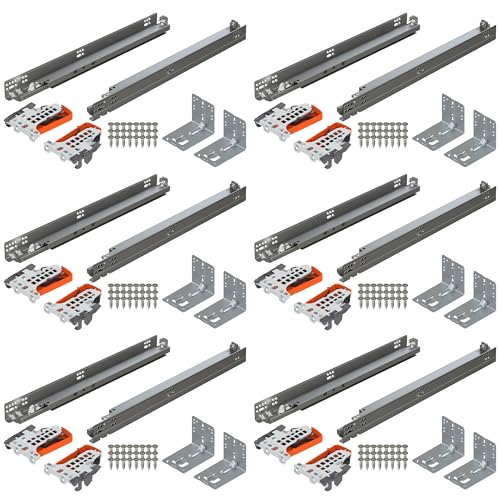

Usually no. Side-mount slides mount to the cabinet sides and the drawer sides, while undermount slides mount underneath the drawer box. Those are different geometries, so a side-mount slide will rarely land on the same screw points, clearances, and drawer-box cutouts that an undermount runner needs.
The practical answer is simple: if the drawer box was built for undermount hardware, a side-mount slide is not a drop-in replacement. A rebuild or a true undermount replacement is safer when the drawer lacks the right notches, rear cuts, hook hole, or locking-clip layout.
Why the mounting geometry does not match
Side-mount slides depend on side clearance. One reference side-mount model, KV 8450FM, uses one-half-inch side clearance per side. That is a side-gap requirement, not an undermount geometry. Undermount slides depend on shaped drawer parts under the box, not open side space for a ball-bearing rail.
That difference changes where the drawer rides, where the hardware hides, and how the front of the drawer locks to the runner. If the box was not built for the runner maker’s exact layout, the slide can misalign even when the nominal drawer width seems close enough.
When a rebuild is safer than a swap
If the drawer has no rear corner notches, no hook hole, or no front locking clips, the box is not ready for most undermount systems. In that case, trying to convert a side-mount setup into an undermount setup usually means rebuilding the drawer box or replacing the hardware with the correct slide family.
Say your 18-inch drawer is binding after a hardware change and one side sits 3/16 inch high at the front. That points to a geometry mismatch, not a minor adjustment issue. A force-fit conversion can leave the drawer racked and damage the slide bearings.
Side-mount vs undermount slides
Side-mount slides are visible when the drawer is open and are relatively straightforward to install. Undermount slides are hidden under the box, offer complete access to drawer contents, and demand precision and level surfaces. Those differences drive the fit test, the machining, and the failure modes.
| Slide type | Required clearances | Required drawer-box modifications | Replacement verdict |
|---|---|---|---|
| Side-mount slide | Side clearance on both sides; KV 8450FM uses one-half-inch per side | Drawer sides must accept side-mounted rail screws; no underside notch pattern is required for the slide itself | Use only when the cabinet opening and drawer width are built for side clearance |
| Undermount slide | Clearance under the drawer box plus the maker’s specified side and front geometry | Rear corner notches, hook hole, and front locking clips must match the runner maker’s published spec | Use only when the drawer box was built for that specific undermount system |
| Retrofit case | Measure cabinet opening width, drawer-box width, and existing side gaps before buying parts | May need new drawer sides or a new box if the old box lacks undermount cutouts | Possible only when the new slide family matches the box geometry and load class |
| Face-frame case | Opening width must account for frame members, not just the clear cabinet carcass | May need mounting hardware designed for a face-frame opening and the correct clip position | Convertible only if the drawer and frame clearances match the chosen runner system |
| Frameless case | Side clearance and drawer width must match the rail maker’s published opening math | Undermount boxes still need the correct rear cuts, hook hole, and front clips | Possible with the right system; not interchangeable by slide type alone |
| Wrong-slide failure | Clearances do not align with the runner geometry | Often no correct modification path exists without rebuilding the box | Replace the slide family or rebuild the drawer; do not force the fit |
Clearance needs and drawer-box shape
Side-mount slides need room beside the drawer. Undermount slides need room under and around the drawer box in a different pattern. The drawer box shape matters as much as the cabinet opening, because a box made for undermount hardware has a very different underside than one built for side rails.
Blum TANDEM and Blum MOVENTO are useful reference undermount systems because their published fit depends on maker-specific parts and adjustment points. TANDEM in the cited U.S. program has a 100-pound load class. MOVENTO 763 has a 125-pound load class, and MOVENTO 769 heavy duty has a 170-pound load class.
Load rating, extension, and soft-close differences
Load class is rated per runner pair and must match the drawer plus contents. A drawer full of hardwood tools needs a different runner rating than a shallow cutlery drawer, even if both fit the same opening. Full extension and soft-close behavior are also model-specific, not universal traits.
Blum TANDEM plus BLUMOTION 563H with 5/8-inch sides uses opening minus 13/32 inch. Grass Dynapro, Hettich Quadro V6, and KV MuV+ use opening minus 13/32 inch with 5/8-inch sides. Those numbers show why a “close enough” swap is risky. The opening math must match the runner family.
Drawer slide compatibility matrix
The real test is whether the cabinet opening, drawer-box machining, and locking hardware match the runner maker’s spec well enough for safe travel and load support.
| Slide type | Required clearances | Required drawer-box modifications | Replacement verdict |
|---|---|---|---|
| Side-mount slide | Side clearance on both sides; one-half-inch per side is a common reference point on a competitor page | Drawer sides accept side-mounted hardware; the slide does not rely on underside cutouts | Use for side-mount builds only; not a direct undermount replacement |
| Undermount slide | Clearance pattern follows the runner maker’s opening formula and underside layout | Rear corner notches, hook hole, and front locking clips must match the chosen system | Use only with a drawer box built for that system |
| Retrofit drawer | Existing opening width must leave enough room for the new runner geometry | May need new underside machining or a new drawer box | Convertible only if the drawer can accept the exact maker’s hardware spec |
| Face-frame cabinet | Opening width must clear the frame, not just the cabinet carcass | Front mounting and clip position must line up with the frame and drawer face | Usually a system-specific purchase, not a slide swap |
| Frameless cabinet | Side clearances must match the runner family’s published math | Drawer underside still needs the proper notches and locking devices | Possible with the correct undermount runner, not with any side-mount slide |
| Wrong-slide failure | Clearances do not match the intended slide type | Missing or wrong notch layout, hook hole, or clips | Replace the hardware or rebuild the drawer; do not force the fit |
What must match for a safe substitute?
A safe substitute needs more than a matching length. The slide type, cabinet opening width, drawer-box width, drawer-box notches, rear corner cuts, hook hole, front locking clips, and load class all have to fit the same runner system. If one of those points is off, the swap becomes a guess instead of a fit check.
Cabinet opening width and side clearance
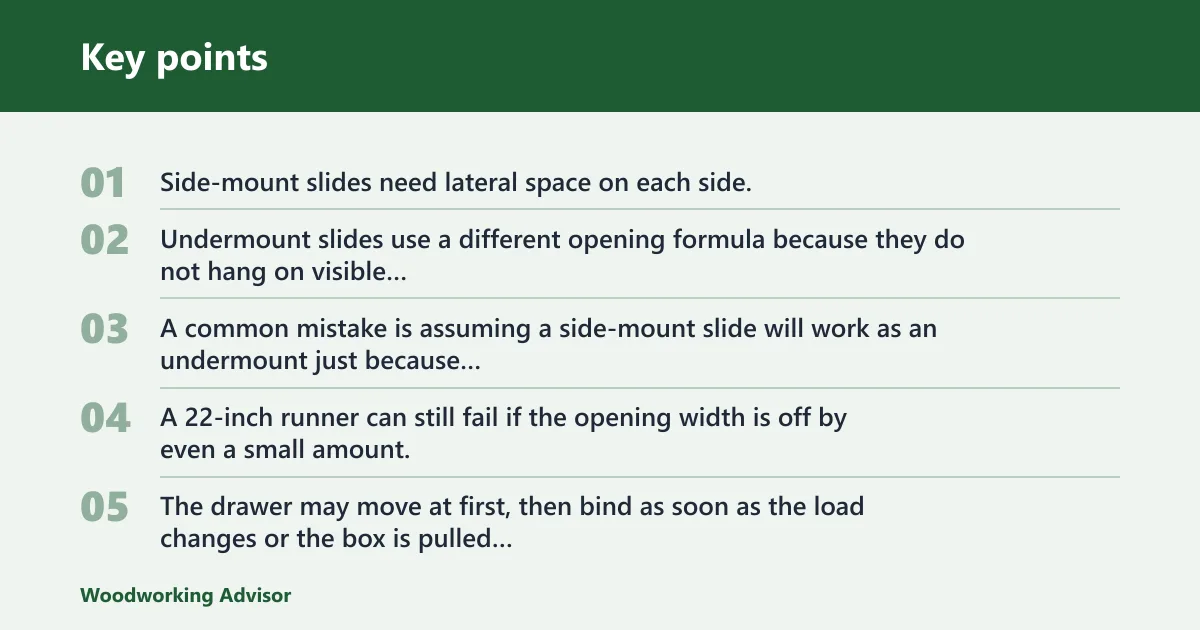
Measure the opening first. Side-mount slides need lateral space on each side, and the drawer box must be sized to that side clearance. Undermount slides use a different opening formula because they do not hang on visible side rails in the same way.
A common mistake is assuming a side-mount slide will work as an undermount just because it matches the cabinet depth. A 22-inch runner can still fail if the opening width is off by even a small amount. The drawer may move at first, then bind as soon as the load changes or the box is pulled fully open.
Drawer-box notches, hook holes, and front clips
Most undermount systems need rear corner notches, a hook hole, and front locking clips that match the published runner spec. Those parts are not optional trim details. They are the interface between the drawer box and the concealed hardware.
If the box was built for side-mount hardware, those underside features often are not present. That usually means conversion stops at the hardware level and turns into a drawer rebuild. Forcing a side-mount slide into that setup does not create the missing mating features.
Load class and runner length
Load class is not a vague strength claim. It is the rated capacity of the runner pair, and it must suit the drawer plus contents. A heavy file drawer, for example, needs a different rating than a shallow kitchen utensil drawer even if both use the same cabinet width.
Runner length also matters because extension and support change with length. A drawer that is too deep for the runner can overhang the support path and feel unstable, especially under heavier contents.
Manufacturer-specific parts and adjustment range
Blum TANDEM and MOVENTO show why the brand match matters. Their fit depends on maker-specific runner geometry, locking devices, and adjustment range. A slide that looks similar on paper can still miss the clip location or side-clearance math by enough to cause travel problems.
A 24-inch opening and a 23 1/4-inch drawer box do not, by themselves, confirm compatibility. That does not prove compatibility by itself. If the box lacks the underside notch pattern and front clips required by the chosen runner, the drawer still needs new machining or replacement.
Can you convert retrofit, face-frame, or frameless drawers?
Sometimes, but not by slide type alone. A conversion works only when the drawer box can accept the exact drawer-box prep the new system needs. If the hardware family and geometry do not line up, a conversion is really a rebuild with new parts.
Retrofit drawer conversions
Retrofit work is most realistic when the existing drawer is square, the cabinet opening is correct, and the new runner family matches the drawer box with minimal modification. Even then, you still need the right side clearance, the right underside machining, and the correct load class.
Face-frame cabinets
Face-frame cabinets add a second constraint: the frame changes the opening math. The runner has to clear the frame and land on the correct mounting points. That makes face-frame swaps more sensitive to manufacturer-specific instructions than a frameless box.
Frameless cabinets
Frameless cabinets are often more predictable because the opening is cleaner, but the drawer box still has to match the undermount spec. A frameless opening does not make side-mount and undermount slides interchangeable. It only removes one variable from the fit check.
When the conversion stops making sense
If the drawer lacks the underside cuts, the side clearance is wrong, or the load class is too low for the contents, replacement is the better answer. At that point, a new drawer box or a correct runner family is safer than trying to make mismatched hardware fit.
Choose side-mount slides if… / Choose undermount slides if…
Choose the slide type that matches the box you have, not the look you want. Side-mount slides fit side-clearance builds and are relatively straightforward to install. Undermount slides fit drawers built for concealed hardware and exact maker specs. That is the clean dividing line.
Choose side-mount slides if…
- Your cabinet and drawer are already sized for side clearance.
- You want visible hardware to be acceptable when the drawer opens.
- The drawer box is not built with undermount notches or clips.
- The load class you need is available in a side-mount model with the right length.
Choose undermount slides if…
- Your drawer box already has the rear corner notches, hook hole, and front locking clips required by the runner maker.
- You need the hardware hidden under the drawer.
- The cabinet opening matches the runner family’s published math.
- You are replacing with the exact system rather than trying to adapt a side-mount rail.
Cases that call for replacement only
If the drawer is racked, the slide binds under load, or the drawer box lacks the underside prep for an undermount system, replacement is often the right fix. That is especially true when the wrong slide has already damaged the drawer side, the clip mount, or the runner body.
What happens when the wrong slide type is installed?
The most common result is poor travel. The drawer can bind, sit out of square, or stop short of full extension because the runner path does not match the box. In more severe cases, the slide hardware and drawer parts wear each other down.
Binding and poor travel
Binding usually shows up first at the front corners or near full extension. The drawer may feel smooth for part of the travel and then tighten when the load shifts. That is a sign that the slide geometry is wrong, not that the drawer only needs a small tweak.
Loss of soft-close or full-extension behavior
Soft-close and full-extension behavior are model-specific features, not guaranteed traits. If the wrong runner is installed, the drawer may lose the damping action, fail to close evenly, or stop before full travel because the slide family and mounting method do not match.
Damage to drawer parts and hardware
A mismatched slide can chip the drawer side, bend a locking clip, or scar the runner body. In undermount setups, the hook hole and front locks are especially sensitive because they carry the drawer’s alignment at the front. Once those points are damaged, the fit usually gets worse.
How do I tell whether my drawer box is built for undermount slides?
Check the underside first. If you see rear corner notches, a hook hole, and front locking clips that match a known runner maker’s instructions, the box may be built for undermount slides. If those parts are missing, the drawer is probably not ready for a concealed runner system.
- Measure the cabinet opening width.
- Measure the drawer-box width and compare it with the runner family’s opening formula.
- Inspect the underside for rear corner notches.
- Look for a hook hole and the correct front locking clips.
- Check the slide’s load class and runner length against the drawer plus contents.
- Confirm the manufacturer’s spec for the exact model, not just the brand name.
Frequently asked questions
Can you use side mount slides as undermount?
Usually not. Side-mount slides and undermount slides use different mounting geometry, different clearance needs, and different drawer-box prep. A safe swap requires the cabinet opening, drawer width, mounting position, extension length, and load rating to match the target system exactly. Otherwise, replacement is the correct fix.
Can you use side mount drawer slides as undermount?
Not as a general rule. Side-mount slides need side clearance and mount to the drawer sides, while undermount slides mount under the drawer and depend on underside notches and locking clips. If the drawer box was not built for that geometry, the parts will not line up correctly.
What is the difference between side-mount and undermount drawer slides?
Side-mount slides mount on the sides of the cabinet and drawer, and they are visible when the drawer is open. Undermount slides mount underneath the drawer and hide from view. Undermount systems also rely on precise drawer-box machining, which side-mount systems usually do not.
What clearance do side-mount slides need compared with undermount slides?
Side-mount slides need lateral side clearance. One reference model, KV 8450FM, uses one-half-inch side clearance per side. Undermount slides use a different geometry, so the needed space shifts from the sides to the underside and front interface. That is why the two types are not direct substitutes.
What happens if I install the wrong type of drawer slide?
The drawer may bind, travel unevenly, or sit out of square. Soft-close and full-extension behavior can disappear, and the hardware can damage the drawer sides or locking points. If the wrong type is already forcing the fit, a rebuild or full replacement is safer than trying to keep adjusting it.
Sponsored / affiliate links. As an Amazon Associate I earn from qualifying purchases. I may earn additional commission from eligible campaigns.