What Length Drawer Slides Do I Need?
For most side-mount drawers, choose slides that match the drawer box depth; if the exact size is unavailable, use the next shorter standard length. A wrong length can leave the drawer short, bind against the cabinet, or waste usable storage space. This guide shows how to measure cabinet depth, drawer depth, and slide type so you can pick the correct length the first time.
This guide is part of our Cabinets, Drawers and Built-Ins: Building, Hardware, Fixes and Refinishing series.
What you need to measure first
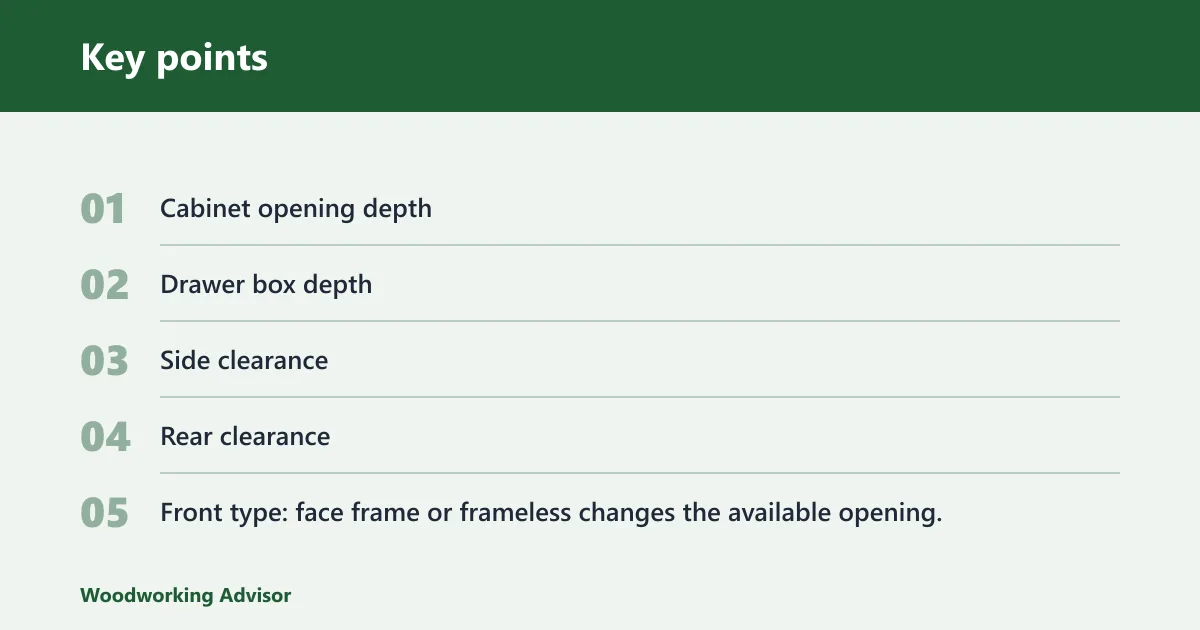


Start with cabinet opening depth, drawer box depth, side clearance, rear clearance, and mounting style. Drawer slide length usually means the closed length, not the travel length, so the number on the package must fit the cabinet, not just the drawer opening. Side-mount, center-mount, and undermount slides do not all size the same way.
What to measure
- Cabinet opening depth: sets the maximum usable slide length.
- Drawer box depth: affects how far the drawer can open and how the front aligns.
- Side clearance: varies by slide type and changes the usable width.
- Rear clearance: leaves room for brackets, stops, and frame hardware.
- Front type: face frame or frameless changes the available opening.
- Slide family: side-mount, center-mount, or undermount.
- Extension length: partial or full extension changes access.
- Load rating: choose a rating that fits the drawer contents.
What each measurement controls
Cabinet depth limits the slide length. Drawer depth limits how much drawer you can actually use, especially on replacement jobs where the box already exists. Side clearance and rear clearance decide whether the chosen slide physically fits once hinges, stiles, or rear brackets are in the way.
What length drawer slides do I need?
Measure the cabinet opening depth first, then compare it with the drawer box depth and the space needed for the slide hardware. For side-mount slides, the drawer box depth often sets the practical target, while cabinet depth sets the hard limit. A slide cannot be longer than the cabinet depth.
Step 1: Measure the cabinet opening depth
Measure from the inside front edge of the cabinet to the inside back wall. Use the usable depth, not the outer cabinet dimension. If the back panel, a rear cleat, or a bracket projects into the opening, subtract that interference before choosing a length.
Step 2: Subtract clearance and hardware interference
Look for hinges, face-frame stiles, rear brackets, or other protrusions that reduce the usable depth. That deduction matters more in replacement work than in new builds. If the slide ends up too long for the remaining space, it will not mount cleanly even when the cabinet nominally looks deep enough.
Step 3: Match slide length to usable depth
Use the longest slide that fits the corrected usable depth, but do not force a longer size. Common imperial lengths include 18 inches and 20 inches. Common metric lengths include 450 mm and 500 mm. Light-duty drawer slides are normally 8 inches to 28 inches long, while heavy-duty drawer slides can reach 50 inches or 60 inches.
Step 4: Check extension and load rating
Partial-extension slides leave part of the drawer inside the cabinet. Full-extension slides bring the rear of the drawer farther out, which improves access. Load rating matters too. Match light-duty, medium-duty, or heavy-duty hardware to the actual contents, then confirm the manufacturer’s listing for your model.
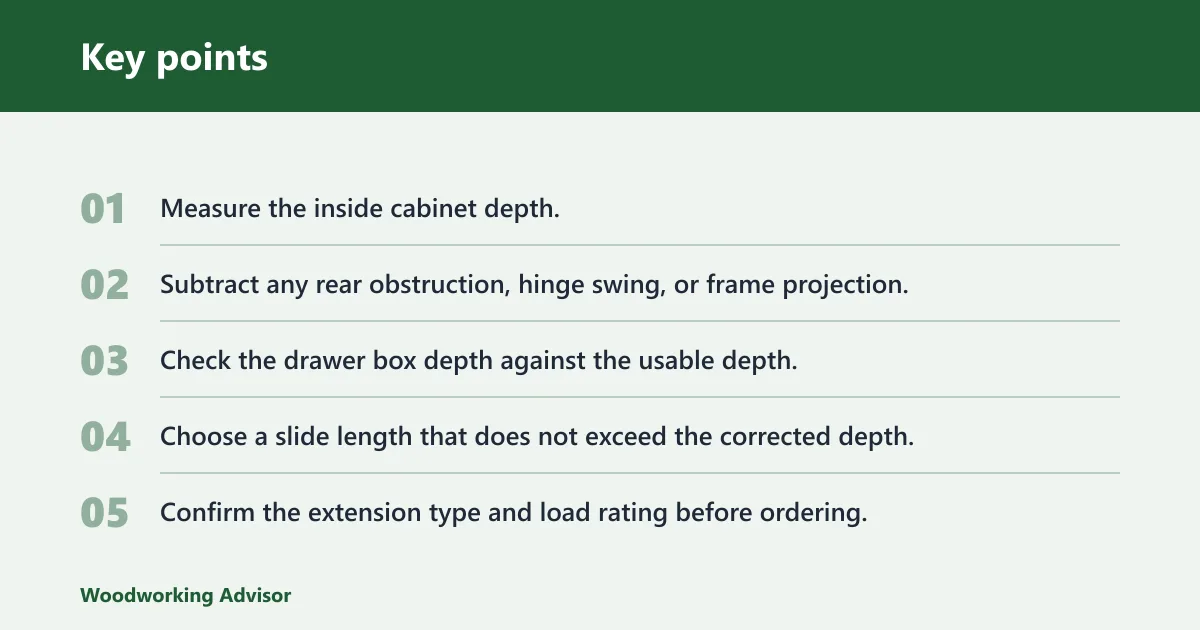
- Measure the inside cabinet depth.
- Subtract any rear obstruction, hinge swing, or frame projection.
- Check the drawer box depth against the usable depth.
- Choose a slide length that does not exceed the corrected depth.
- Confirm the extension type and load rating before ordering.
How do side-mount and center-mount slides size up?
Side-mount and center-mount slides still start with cabinet depth, but the fit changes because the hardware sits in different places. Side-mount slides are mounted on the sides of the drawer and cabinet. Center-mount slides are mounted on the center bottom of the drawer. That difference changes the clearance you need on each side and under the box.
Common side-clearance values
One side space listed is 9.5 mm for smaller slides. One side space listed is 12.7 mm for medium and light-duty slides. One side space listed is 19.1 mm for heavy-duty slides. Check the slide family, because the clearance is not universal.
| Slide family | Common side space listed | What to verify |
|---|---|---|
| Smaller slides | 9.5 mm | Cabinet width, drawer box width, and any face-frame interference |
| Medium and light-duty slides | 12.7 mm | Clearance on both sides and the drawer box thickness |
| Heavy-duty slides | 19.1 mm | Side space, load rating, and mounting room |
When a slide can be shorter than the cabinet depth
A slide can be shorter when a face frame, hinge, or rear bracket blocks the full depth. That choice is common in replacement work, where the existing drawer box depth is fixed. In those cases, the slide length must fit the cabinet and the box together, not just one measurement.
When a replacement must match the existing drawer box
If the drawer box already exists, start with the box depth and the current mounting pattern. A wrong-length slide may still fit the cabinet, but it can leave unused drawer depth or interfere with the old hole pattern. Replacement work should compare slide length, load rating, mounting style, side clearance, and rear clearance.
How do you size undermount drawer slides?
Undermount slides are mounted underneath the drawer and are not visible when opened. For these systems, drawer length matters more than cabinet depth alone. Many undermount systems also require a specific drilling pattern and locking-device position, so you cannot size them the same way as generic side-mount hardware.
Why drawer length matters more here
Undermount slides often depend on a matched drawer box depth, bottom clearance, and front-to-back drilling layout. The cabinet opening may accept the hardware, but the drawer box still has to match the manufacturer’s dimension chart. That is why cabinet depth alone is not enough for many undermount systems.
Why Blum Tandem and Movento need model-specific charts
Blum Tandem and Movento are examples of undermount systems that typically require model-specific checking. Confirm the exact slide family, drawer length chart, and drilling pattern before ordering. A cabinet-depth-only decision can lead to the wrong hardware even when the length number looks close.
Face-frame, rear bracket, and locking-device checks
Face-frame cabinets can reduce the usable opening because the stile and rail take up space at the front. Rear brackets may also change the effective depth at the back. Undermount locking devices add another layer of fit checking because their position must match the slide layout and drawer geometry.
Confirm drilling pattern before ordering
For undermount slides, compare the drawer box depth, drawer bottom position, and locking-device location against the brand chart. If the pattern does not match, the slide may not lock in place even if the length appears correct. Check the manufacturer’s listing for your model before drilling any holes.
Drawer slide worksheet
Use this worksheet to turn measurements into a size decision. It gives a quick cabinet-depth-to-slide-length lookup for common sizes, plus a replacement checklist for hidden deductions. Keep the slide family separate in your notes; the same cabinet can lead to different answers for side-mount and undermount hardware.
Common cabinet-depth to slide-length table
| Measured cabinet opening depth | Common slide length to check first | Notes |
|---|---|---|
| 12 inches | 12 inches or shorter | Confirm rear clearance before ordering |
| 14 inches | 14 inches or shorter | Check face-frame and hinge interference |
| 16 inches | 16 inches or shorter | Common replacement size in smaller cabinets |
| 18 inches | 18 inches | Common imperial size; verify usable depth |
| 20 inches | 20 inches | Common imperial size; confirm rear brackets |
| 450 mm | 450 mm | Common metric size; compare to drawer depth |
| 500 mm | 500 mm | Common metric size; check extension and load rating |
- Face-frame stiles that reduce the opening width or depth.
- Door hinges that project into the cabinet opening.
- Rear brackets or cleats that shorten usable depth.
- Undermount locking devices that need a specific rear position.
- Existing screw holes that lock you into a shorter slide.
- Drawer box depth that cannot change on a finished drawer.
Metric and inch size cross-check
Match inch sizes to metric sizes carefully. Common metric lengths include 450 mm and 500 mm. Common imperial lengths include 18 inches and 20 inches. If the cabinet depth is near a standard size, confirm the actual usable depth and the manufacturer’s listed closed length before buying.
Common mistakes
The most common errors come from mixing up length terms, ignoring clearance, or using one rule for every slide family. A drawer can fit the cabinet and still fail at the rear if a bracket or hinge steals space. A replacement can also fail when the drawer box depth does not match the new hardware.
Mixing up closed length and travel length
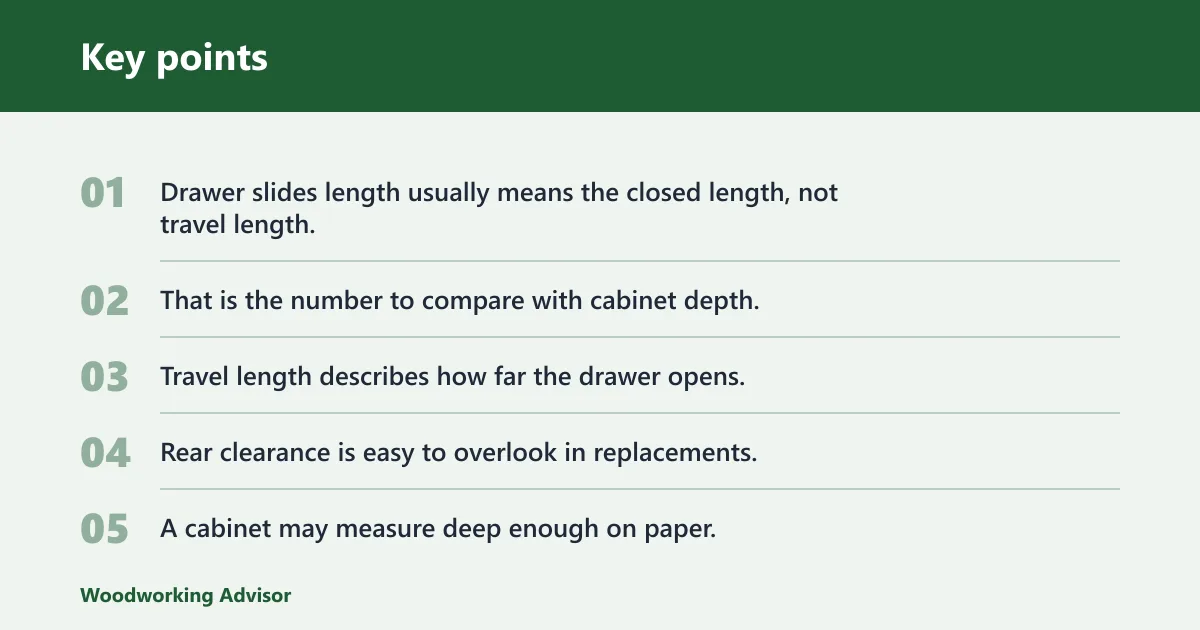
Drawer slides length usually means the closed length, not travel length. That is the number to compare with cabinet depth. Travel length describes how far the drawer opens, which affects access but does not tell you whether the slide will fit.
Ignoring rear clearance
Rear clearance is easy to overlook in replacements. A cabinet may measure deep enough on paper, but a rear bracket or back panel can reduce the usable length. If there is any back hardware in the way, measure the exact usable depth again before ordering.
Assuming one rule fits every slide family
Side-mount, center-mount, and undermount slides follow different fit rules. Side-mount hardware depends heavily on side clearance. Undermount hardware often depends on drawer length, drilling pattern, and locking-device position. Do not buy by cabinet depth alone when the slide family changes.
Overlooking face-frame stiles and hinges
Face-frame cabinets often lose usable space to the front frame and hinge hardware. That can shorten the effective opening even when the cabinet shell looks deep enough. If the cabinet has a face frame, measure the opening and the obstructions together.
Say your cabinet opening measures 20 inches deep, but a rear bracket takes up 1/2 inch. The usable depth drops below 20 inches, so a 20-inch slide may no longer fit cleanly. In that case, a shorter standard size can be the correct choice.
Suppose an existing drawer box is 18 inches deep and the original slide failed. Even if the cabinet can accept a longer slide, the replacement usually needs to respect the fixed box depth and the old mounting pattern. That is especially important for undermount systems.
Frequently asked questions
What size drawer slides do I need for kitchen cabinets?
Measure the usable opening first. Then confirm side clearance, load rating, and whether the cabinet is face-frame or frameless.
What size drawer slides do I need for a 24-inch cabinet?
A 24-inch cabinet does not automatically mean a 24-inch slide. Measure the usable inside depth, then subtract rear obstructions and any front-frame interference. If the corrected depth is less than 24 inches, choose the next shorter length that still matches the drawer box.
What size undermount drawer slides do I need?
Use the slide family’s drawer-length chart, not cabinet depth alone. Confirm the drawer box depth, drilling pattern, and locking-device position. Blum Tandem and Movento are model-specific examples, so check the exact listing before drilling or buying replacement hardware.
How much clearance do side-mount drawer slides need?
One side space listed is 9.5 mm for smaller slides, 12.7 mm for medium and light-duty slides, and 19.1 mm for heavy-duty slides. Measure both sides of the drawer opening, then compare the value to the manufacturer’s requirement for the exact slide family.
What drawer slides do I need for an existing drawer?
Match the existing drawer box depth, mounting style, side clearance, and rear clearance first. If the old slide was wrong, keep the box fixed and choose a replacement that fits the current geometry. Confirm the load rating and extension type before reusing old holes.
Can drawer slides be longer than the cabinet depth?
No. The slide length should not be longer than cabinet depth. If a longer size appears close, remeasure the usable depth after subtracting rear brackets, hinges, and other obstructions. Choose the next shorter standard length if the fit is tight.
What size soft-close drawer slides do I need?
Soft-close is a feature, not a size by itself. Choose the slide length the same way you would for any other drawer slide, then confirm the soft-close model’s load rating, side clearance, and extension. Check the manufacturer’s listing for the exact part number and size.
Sponsored / affiliate links. As an Amazon Associate I earn from qualifying purchases. I may earn additional commission from eligible campaigns.