Hand Saw vs Table Saw for Joinery: Which Is Better?
For joinery, a Table Saw is better for repeatable straight cuts and joints sized to exact thickness. A Hand Saw is better for quiet work, low setup, and fitting individual joints. Poor cut geometry leads to loose tenons, racked shoulders, and gaps that take time to fix. This guide compares cut accuracy, repeatability, setup, and workspace limits so you can choose the right saw for each joint.
Joinery saw comparison: key factors
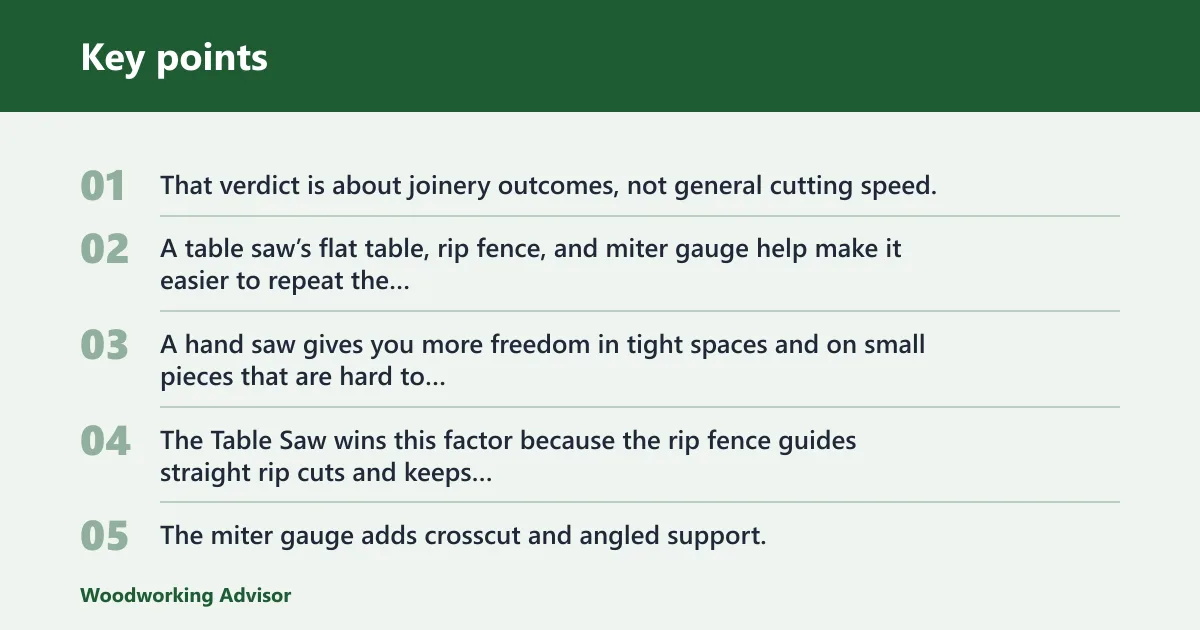
That verdict is about joinery outcomes, not general cutting speed. A table saw’s flat table, rip fence, and miter gauge help make it easier to repeat the same width and angle. A hand saw gives you more freedom in tight spaces and on small pieces that are hard to support.
| Decision factor | Hand Saw | Table Saw | Winner |
|---|---|---|---|
| Repeatability for joinery cuts | Depends on layout and technique | High when fence and gauge are set correctly | Table Saw |
| Cut geometry for dados, tenons, and box joints | Good for fitted work, but slower to keep identical | Better for straight, square, repeatable geometry | Table Saw |
| Small-part handling and tight spaces | Stronger fit for compact work | Harder to support safely on tiny stock | Hand Saw |
| Setup complexity | Low | Higher, especially for repeatable joinery | Hand Saw |
| Safety exposure during the cut | Hidden blade when not in use | Higher blade exposure at the table | Hand Saw |
| Stock capacity for larger work | Limited cutting capacity | Handles larger pieces of wood | Table Saw |
Repeatability for joinery cuts
The Table Saw wins this factor because the rip fence guides straight rip cuts and keeps widths consistent from board to board. The miter gauge adds crosscut and angled support, which helps keep the same cut angle across repeated parts. A Hand Saw can make accurate cuts, but it depends more on your layout and stroke control.
For joinery, repeatability matters when you need matching tenons, repeated dado spacing, or a box joint pattern that fits without hand correction. The table saw is built for that kind of control. A hand saw can still do the work, but each cut carries more risk of drift, especially on longer kerfs.
Cut geometry for dados, tenons, and box joints
The Table Saw is usually the better choice for straight, square joinery cuts because it keeps the work registered against a fence or gauge. That consistency helps with shoulder lines, slot width, and joint depth. A Hand Saw can make the same joints, but you have to control alignment from start to finish.
Failure shows up fast here. A wandering kerf can make a tenon too loose, and a shoulder that is a little off square can leave a visible gap. Tearout can also weaken the edge of a dado or make a box joint fit feel sloppy, especially in brittle stock.
Small-part handling and tight spaces
The Hand Saw wins when the workpiece is too small, too awkward, or too close to other material for a table saw setup. Handheld saws are much more portable than table saws and fit tight spaces where a table saw would be hard to use. That makes them a strong choice for trim work, patch repairs, and joinery in cramped locations.
Suppose you are fitting a short rail in a hallway with little room for infeed and outfeed. A hand saw lets you work without dragging a stationary machine into the space, and it avoids trying to support a small part near an exposed blade.
Which saw makes cleaner joinery cuts?
The Table Saw usually makes cleaner joinery cuts when the goal is repeatable width, straight edges, and square shoulders. Its accuracy comes from a stable table, a rip fence for straight cuts, and a miter gauge for consistent crosscut or angled work. A Hand Saw can cut cleanly too, but the result depends more on marking accuracy and your skill.
Clean joinery is not only about smooth walls. It also means the cut lands where the joint needs it, with shoulders that close and mating parts that sit flush. If the cut geometry is off, the joint may look clean at first and still fail during assembly.
Tearout, wandering kerfs, and shoulder quality
Table Saw cuts are often cleaner on joinery because the blade path is fixed by the fence or miter gauge, which reduces wandering. That said, tearout can still happen, especially on fragile grain or when the blade exits thin stock. Good setup matters as much as the tool.
A Hand Saw is more likely to drift if the line is hard to see or the stroke changes angle. That can create shoulder cuts that are not square enough for flush assembly. On short joinery cuts, though, a sharp hand saw can give you precise results with less setup than a machine.
How the rip fence and miter gauge affect results
The rip fence is one reason a table saw can repeat joinery widths well. It guides straight rip cuts, so the same tenon cheek or dado width can be reproduced without resetting by eye. The miter gauge does the same for crosscuts and angled cuts by helping keep the cut angle consistent.
That guidance matters more than raw power for joinery. If the fence is not aligned, or if the work lifts away from the table, accuracy falls apart quickly. A hand saw avoids machine setup problems, but it asks you to provide all of the control yourself.
Can you cut dados and tenons with a hand saw?
Yes, you can cut dados and tenons with a hand saw, but the method fits smaller work, careful layout, and slower production. It works best when you need one or two fitted joints and have room to mark, test, and adjust. For batch work, a Table Saw is usually the better choice because it keeps those cuts more repeatable.
Dados and groove cuts
A Hand Saw can cut dados and grooves when the marks are clear and the stock is supported well, but it is slower to make a slot that stays the same width all the way through. On short runs, that may be fine. On longer or repeated cuts, the risk of a wandering kerf rises.
A table saw can be a good choice for dado cuts because the fence helps fix the cut location and the blade follows a uniform path. That reduces the need for cleanup with chisels. If the board is narrow or awkwardly shaped, though, the hand saw may be the safer fallback.
Tenons and shoulder cuts
Tenons are possible with either saw, but a Table Saw is usually better for the cheeks and shoulders because it keeps each face square and repeatable. Shoulder cuts matter a lot in joinery; even a small angle error can leave gaps that are hard to hide later. A miter gauge helps keep those crosscuts consistent.
A Hand Saw can cut tenon shoulders well if the line is clear and the piece is easy to hold. It becomes less practical on long runs of identical parts. If you need several matching tenons, the machine setup usually pays off fast.
Where hand layout beats machine setup
Hand layout wins when the part is tiny, the cut is partial, or the workpiece is already fitted into a larger assembly. In those cases, setting up a table saw can take longer than making the cut itself. A hand saw also gives you a better fallback when the joint needs a slight correction rather than a perfectly repeated dimension.
A common first-timer mistake is to reach for the table saw for every joinery cut, even when the part is too small to guide safely. If the stock cannot sit flat and stay registered, the machine does not solve the problem. It only moves the risk to the blade.
Joinery decision table
| Joinery task | Safer, more repeatable choice | Setup difficulty | Accuracy risk | Hand saw fallback |
|---|---|---|---|---|
| Dados | Table Saw | Medium to high, depending on fence alignment and stop setup | Low once set, but tearout can occur | Good for one-off grooves in small stock or cramped spaces |
| Tenons | Table Saw | Medium, with fence and miter gauge setup | Moderate if shoulders drift or stock shifts | Good for custom fit and final trimming |
| Box joints | Table Saw | High, because spacing must be set very carefully | High if indexing is inconsistent | Possible for small runs, but slower and more layout-heavy |
| Shoulder cuts | Table Saw | Medium | Moderate if the part lifts or the gauge is off | Better for spot correction and small parts |
| Small-part trimming | Hand Saw | Low | Moderate if the piece is not clamped well | Often the first choice |
| Breakdown of rough stock | Table Saw | Medium | Low on supported boards, higher on large or warped stock | Useful when the stock is too large or the space is too tight |
This table separates joinery by task because the best tool changes with the cut, not just the project size. A Table Saw is strongest where repeatable precision matters most. A Hand Saw is the better fallback when the stock is short, the space is tight, or the joint needs local adjustment rather than batch consistency.
Which saw is safer for joinery?
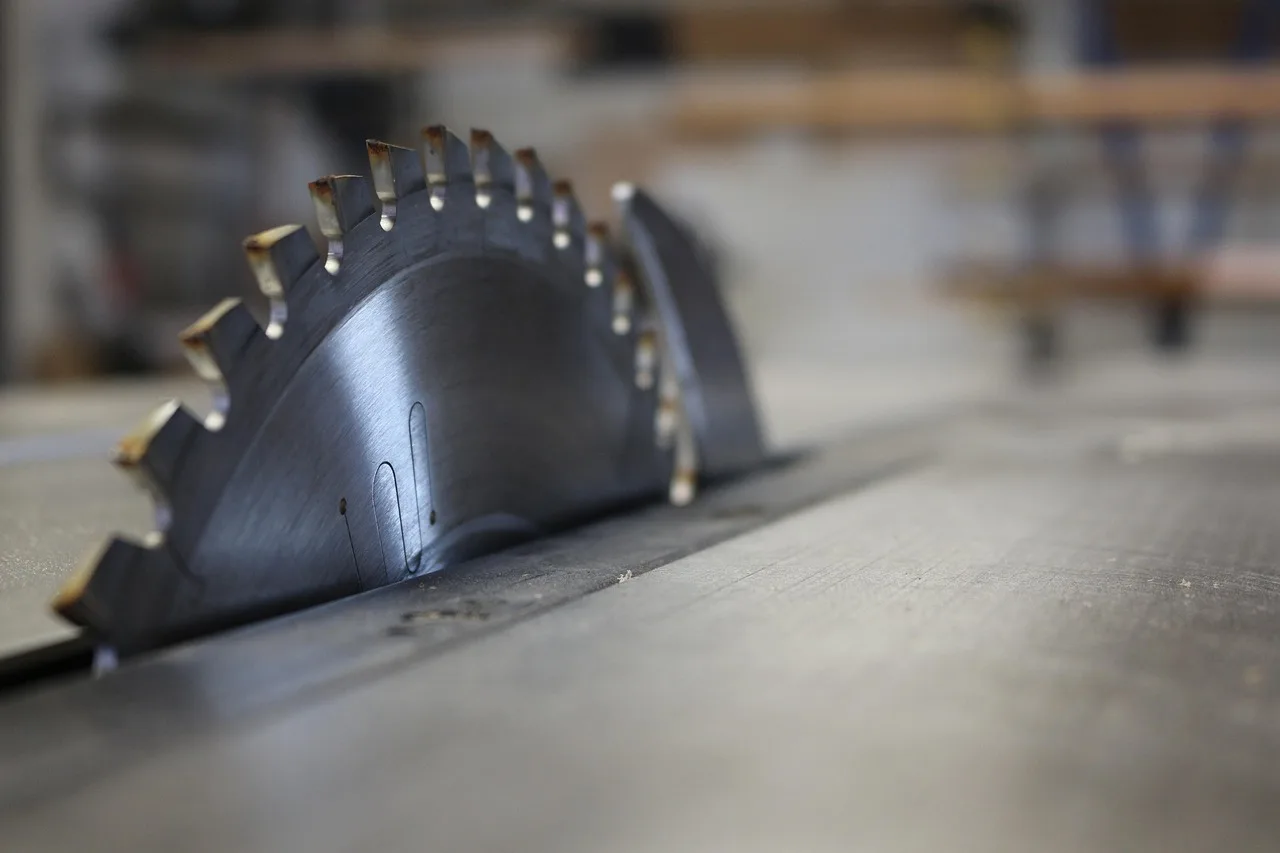
For joinery, the Hand Saw is generally safer because the blade is hidden when not in use and there is no exposed rotating blade at the table. A Table Saw has higher injury risk because blade exposure is part of normal operation, and that risk rises when the stock is small, narrow, or hard to support. Safety still depends on setup and handling, not just the tool type.
Blade exposure and handling risk
Table Saw safety starts with blade exposure. The blade remains part of the working surface, so your hands stay closer to the cutting zone than they do with a hand saw. That does not make the tool unusable for joinery, but it does mean your technique and stock support matter at every step.
A Hand Saw keeps the cutting edge away from a fixed table-mounted blade, which lowers the chance of a sudden contact event. The trade-off is that your offhand often has to control the workpiece more directly. Clamping and a stable bench matter a lot here.
Kickback and stock support
Kickback is a table saw concern when a board twists, binds, or leaves the fence path. Joinery work often uses narrower stock, which can increase that risk if the piece is not supported correctly. The safer approach is to keep the cut straight, keep the fence aligned, and avoid forcing the stock through the blade.
Hand saws do not create kickback in the same way, but they can still produce control problems if the work shifts or the blade binds in a tight kerf. In practice, the safer tool is the one that matches the size and shape of the piece you are cutting.
Why small parts change the risk picture
Small parts change the risk picture because they are harder to hold flat and harder to keep away from the blade. A tiny rail or short tenon blank may be easier to trim by hand than to guide through a table saw. The machine is still useful, but only if the part can be supported without reaching near the blade.
Picture a 3-inch-wide strip that may need a shoulder cleaned up by about 1/32 inch. A table saw can do the cut, but only if the jig or fence setup keeps your hands clear and the part stable. A hand saw may be the simpler and safer finish-cut option.
Which saw fits small workshop spaces?
The Hand Saw fits small workshop spaces better because handheld saws are much more portable than table saws and fit tight spaces where a table saw would be challenging. That matters in apartments, shared garages, and temporary setups where floor space and storage are limited. A Table Saw can still work there, but only if you can place and support it safely.
Apartment and garage setups
In an apartment or shared garage, the main issue is not only footprint but also setup time and cleanup. A hand saw lets you work at a bench, on folding supports, or even in a narrow corner without bringing in a stationary machine. It is a practical way to do small joinery when noise and storage are limited.
A Table Saw is a stronger choice if the space can hold a stable machine with enough infeed and outfeed area. Since table saws are stationary tools with a large, flat surface, they reward a dedicated layout. Without that space, the machine can create more workflow friction than it solves.
Portable saw workflows favor the Hand Saw when the jobsite changes every day or the work is mixed with other trades. You can fit a joint, trim a shoulder, or adjust a tenon without setting up a full cutting station. That flexibility matters more than raw capacity in many small-site jobs.
The Table Saw is still useful on a jobsite when repeatability and batch cuts matter, especially for trim packages or repeated joinery parts. But transporting and setting up a stationary saw takes time, and the blade exposure risk remains the same once it is running.
Storage, transport, and setup time
Hand saws are lower cost than table saws and easier to store, which makes them a practical first tool for many small shops. They also remove the need to level a machine or align a fence before every session. For short joinery tasks, that difference can matter more than cutting speed.
Table saws ask for more space, more setup, and more care with accessories. In exchange, they offer higher accuracy for joinery and better cutting capacity. If your shop can support that workflow, the tool pays back in consistency.
Choose Hand Saw if… / Choose Table Saw if…
Choose a Hand Saw if you need tight-space control, quiet work, small-part trimming, or a fallback for fitting an individual joint. Choose a table saw if you need repeatable joints, batch cuts, larger stock handling, or quicker setup for straight, square joinery. The right answer depends on the cut you need to control, not the tool’s reputation alone.
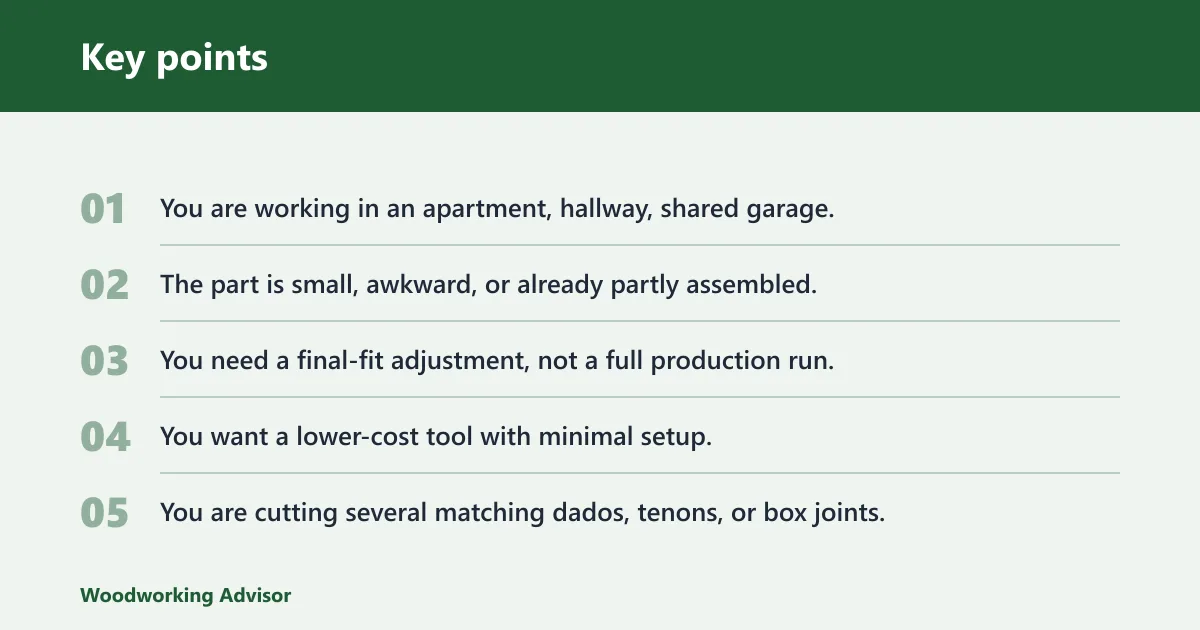
Choose Hand Saw if you need tight-space control or small-part trimming
- You are working in an apartment, hallway, shared garage, or other space where a stationary machine is hard to place.
- The part is small, awkward, or already partly assembled.
- You need a final-fit adjustment, not a full production run.
- You want a lower-cost tool with minimal setup.
Choose Table Saw if you need repeatable joints and faster batch cuts
- The stock is large enough to ride safely on the table.
- You can use a rip fence for straight cuts or a miter gauge for consistent crosscuts and angled cuts.
- You want the same geometry across multiple parts with less hand fitting.
Beginner guidance for starting with one tool
A beginner can do joinery with only a Hand Saw, especially for simple shelves, small boxes, and one-off repairs. The trade-off is more layout work and more test fitting. That path is slower, but it teaches shoulder lines, saw tracking, and joint fit in a direct way.
If the first goal is repeatable furniture parts, a Table Saw is the stronger single-tool choice. It reduces the difficulty of straight dados, tenons, and repeated rips, but it also asks for more setup discipline and more respect for blade exposure. For many beginners, the deciding factor is whether the shop space can support a stationary saw safely.

Frequently asked questions
Is a hand saw or table saw better for joinery?
For most repeatable joinery, a Table Saw is better because it makes straight, square cuts easier to repeat with a rip fence and miter gauge. A Hand Saw is better when the work is small, the space is tight, or the joint needs careful final fitting rather than batch production.
Which saw makes more accurate joinery cuts?
The Table Saw usually makes more accurate joinery cuts because it is a stationary tool with a large, flat surface and consistent guides. That accuracy shows up most clearly in dados, tenons, and repeated shoulders. A Hand Saw can be accurate too, but the result depends more on layout and technique.
When is a hand saw better than a table saw?
A Hand Saw is better when you need portable work, tight-space maneuverability, or careful trimming of a small part. It is also the better fallback when a table saw setup would be awkward or unsafe because the stock is too short, too narrow, or already installed in place.
Is a table saw safer than a hand saw for joinery?
Not usually. A Hand Saw has less blade exposure because the blade is hidden when not in use, while a Table Saw keeps the blade at the work surface. The table saw can still be used safely, but joinery with small parts or poor support raises the risk quickly.
Which saw is better for small workshop spaces?
A Hand Saw is better for small workshop spaces because it is much more portable and can be used in tight spaces where a table saw would be challenging. A Table Saw can still work in a small shop, but only if you have enough room for the machine, the stock, and safe infeed and outfeed support.
What joinery tasks are easiest on a table saw?
Dados, tenons, box joints, and repeatable shoulder cuts are the easiest joinery tasks on a Table Saw. Those cuts benefit from the rip fence, the miter gauge, and the machine’s high cutting capacity. The more often you need the same part, the more the table saw’s consistency matters.
Sponsored / affiliate links. As an Amazon Associate I earn from qualifying purchases. I may earn additional commission from eligible campaigns.