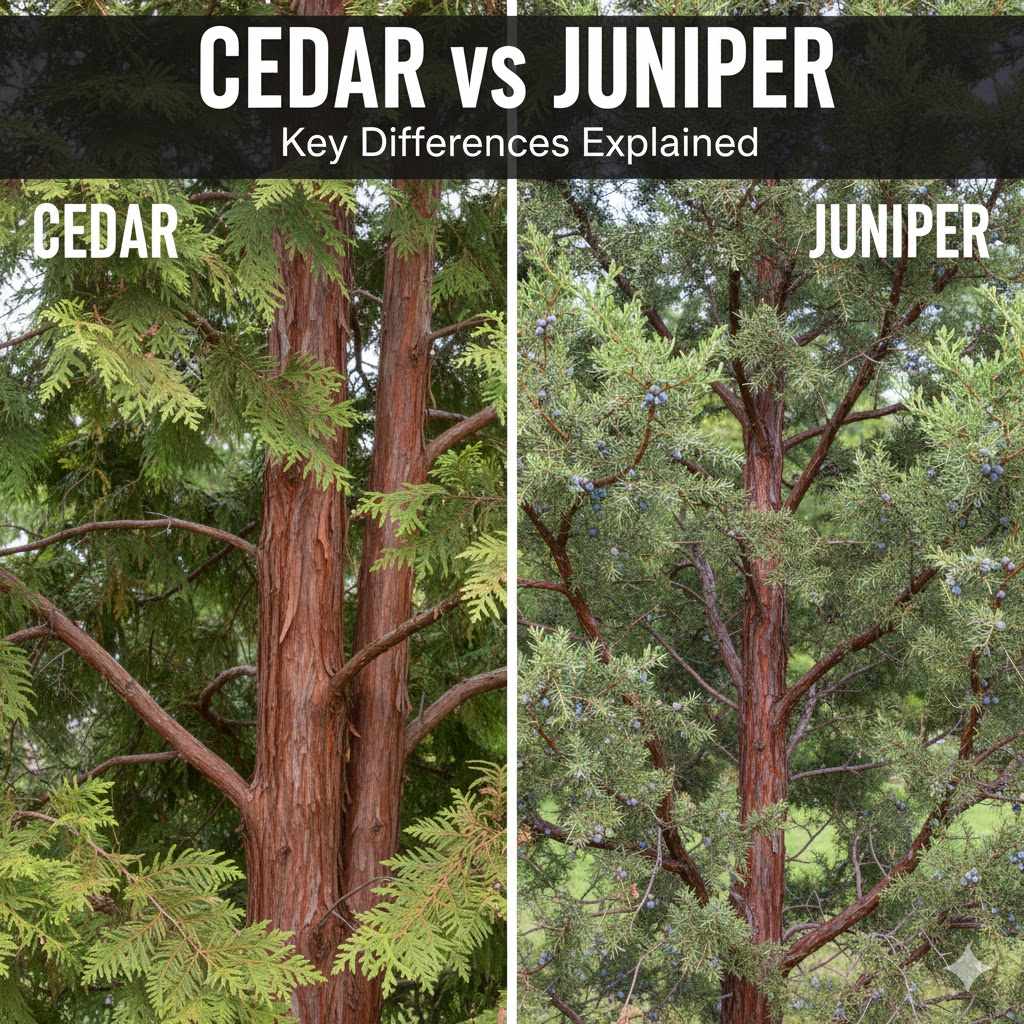
Cedar vs Juniper: Key Differences Explained
Many people get confused between cedar and juniper trees. They look quite similar at first glance, which makes the Cedar vs Juniper: Key Differences Explained topic a bit tricky for beginners. You might wonder how to tell them apart or why it matters.
Don’t worry, it’s actually quite simple once you know what to look for. We will break down their unique features step-by-step. Let’s get started by looking at what makes each tree special.
Understanding Cedar vs Juniper: Key Differences Explained
Cedar and juniper trees, though often mistaken for one another due to their evergreen nature and scale-like or needle-like foliage, belong to different plant families and possess distinct characteristics. This distinction is important for gardeners, woodworkers, and nature enthusiasts alike. Understanding these differences helps in proper identification, selection for landscaping, and appreciating their unique properties.
This section will explore the fundamental distinctions that set these two popular conifer groups apart, making Cedar vs Juniper: Key Differences Explained a helpful guide.
Botanical Classification and Family Ties
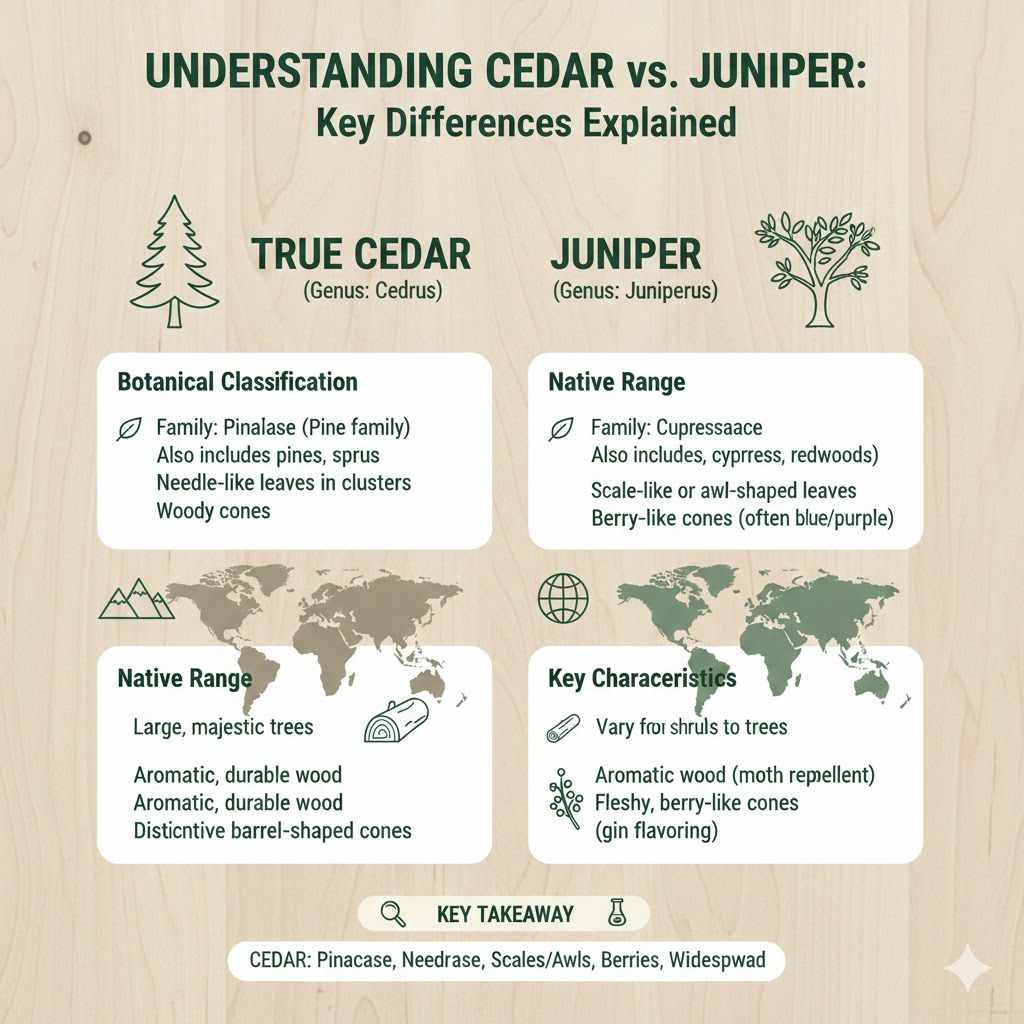
Cedar trees, scientifically known as Cedrus, are true cedars. They belong to the Pinaceae family, which also includes pines and spruces. This family is known for its cones and needle-like leaves.
True cedars are native to the mountains of the Himalayas and the Mediterranean region.
Juniper trees, on the other hand, are part of the Cupressaceae family, which is the cypress family. This family includes cypresses, junipers, and redwoods. Junipers are found across the Northern Hemisphere, from the Arctic regions to tropical mountains.
Their cones are often berry-like, not woody like true cedars.
True Cedars (Cedrus)
True cedars are majestic evergreen trees. They are characterized by their distinctive cones and foliage. Their needles are typically found in clusters or whorls along the branches, giving them a unique appearance.
These trees often have a broad, spreading habit as they mature.
- Needle Arrangement: True cedar needles are short and grow in dense clusters on short shoots. They are usually about 1 to 2 inches long. This gives the branches a feathery look.
- Cones: Cedar cones are upright and barrel-shaped. They mature and disintegrate on the branch, scattering their seeds. They are quite woody and don’t resemble berries at all.
- Bark: The bark of mature cedar trees is typically grayish-brown and develops deep furrows as the tree ages. This gives it a rugged texture.
- Native Habitats: True cedars are found in specific regions like the Atlas Mountains in North Africa, the eastern Mediterranean, and the Himalayas. They prefer well-drained soil and thrive in mountainous areas.
Junipers (Juniperus)
Junipers are a diverse group of conifers. They can range from low-growing shrubs to tall trees. Their appearance can vary significantly depending on the species.
Many junipers are known for their adaptability to different climates and soil conditions.
- Needle/Scale Arrangement: Juniper foliage is either sharp, awl-shaped needles (especially on young plants) or scale-like leaves that overlap on the twigs. Many junipers have both types of foliage on the same plant.
- Cones: Juniper “cones” are often fleshy and berry-like. They are typically bluish or purplish when ripe and are often used in gin flavoring. These are technically modified cones, not true berries.
- Bark: Juniper bark is usually reddish-brown and fibrous, often peeling in strips. This gives it a stringy or shaggy appearance.
- Native Habitats: Junipers are widespread across the Northern Hemisphere. They are found in a variety of environments, from arid deserts to rocky hillsides and forests.
Leaf and Needle Comparison
The most obvious way to tell cedar and juniper apart is by looking closely at their leaves or needles. This is a key aspect of Cedar vs Juniper: Key Differences Explained.
Cedar Foliage
True cedar needles are typically soft to the touch and grow in bundles or rosettes on the branch. Imagine a small bouquet of needles bundled together. These clusters are often dense, creating a full appearance on the branches.
- Length: Needles are usually 1 to 2 inches long.
- Shape: They are somewhat triangular in cross-section and can be sharp or blunt at the tip depending on the species.
- Color: The color varies from dark green to silvery-blue.
- Arrangement: The needles emerge from short, stubby side shoots in whorls or fascicles, appearing like little pom-poms on the branches.
Juniper Foliage
Juniper foliage is more varied. Younger plants and new growth often have sharp, pointed needles. As the plant matures, many junipers develop scale-like leaves that hug the stem.
Some species retain both needle-like and scale-like leaves on the same plant.
- Needle-like: These are sharp, stiff, and usually only about half an inch long. They radiate from the twig.
- Scale-like: These are small, triangular, and overlap each other along the twig, giving it a flattened or stringy appearance.
- Color: Juniper foliage can range from bright green to blue-green and even yellow-green.
- Arrangement: Needles are typically opposite or in whorls of three. Scale-like leaves are arranged in opposite pairs.
This difference in foliage is a crucial point when you are trying to distinguish between them. It’s a visual cue that’s always present on the tree.
Cone and Berry Characteristics
The reproductive structures of cedar and juniper trees offer another significant way to differentiate them. This aspect is vital for a complete Cedar vs Juniper: Key Differences Explained.
Cedar Cones
True cedar cones are a defining feature. They are quite distinct and do not resemble berries in any way. These woody structures are a clear indicator of a true cedar.
- Appearance: Cedar cones are typically barrel-shaped or oblong and stand upright on the branches. They are hard and woody.
- Size: They can range from 2 to 5 inches in length, depending on the species.
- Maturation: Cedar cones mature over one to two years. When they are ripe, they fall apart on the tree, releasing their winged seeds. You rarely find whole cedar cones on the ground.
- Texture: The scales of the cone are tightly packed and have a rough texture.
Juniper Cones (Berries)
Juniper “cones” are very different. They are fleshy and berry-like, which is where much of the confusion with other plants arises. These are not true berries but modified cones with fused, fleshy scales.
- Appearance: Juniper cones are small, round, and fleshy. They are often described as berries.
- Color: They start green and ripen to shades of blue, purple, or sometimes red or brown. The most common color is a waxy blue.
- Size: Juniper berries are usually small, ranging from 0.2 to 0.5 inches in diameter.
- Texture: They have a soft, pulpy texture, and usually contain 1 to 10 seeds inside.
The presence of woody, disintegrating cones versus fleshy, berry-like cones is a primary distinguishing factor.
Bark and Growth Habit
The bark and the overall shape or growth habit of cedar and juniper trees also provide clues for identification.
Cedar Bark and Habit
True cedars are generally large, stately trees. Their bark and shape reflect their mature stature.
- Bark: The bark of mature cedar trees is typically grayish-brown and develops deep, irregular fissures. It can become quite rugged and textured over time. Younger trees have smoother bark.
- Growth Habit: True cedars are usually single-trunked trees that develop a broad, spreading crown with age. They can grow quite tall, reaching heights of 100 feet or more.
- Branching: Branches often grow horizontally, contributing to the tree’s majestic, layered appearance.
Juniper Bark and Habit
Junipers exhibit a much wider range of growth habits and bark characteristics, reflecting their diversity.
- Bark: Juniper bark is commonly reddish-brown and fibrous. It often peels in long, narrow strips, giving it a stringy or shreddy appearance.
- Growth Habit: Junipers can be shrubs, groundcovers, or trees. Their shapes vary from upright and columnar to spreading, bushy, or prostrate. Many are much smaller than true cedars.
- Branching: Branching patterns are highly variable, often appearing more dense and twiggy than those of true cedars.
The fibrous, shredding bark of junipers is a noticeable difference from the furrowed bark of cedars.
Aromatic Qualities and Wood Uses
Both cedar and juniper are known for their distinct aromas, and their wood has specific uses, further aiding in Cedar vs Juniper: Key Differences Explained.
Cedar Aroma and Wood
Cedar wood is famous for its pleasant, distinct fragrance. This aroma is often associated with cedar chests and closets because it is known to repel moths.
- Aroma: The scent of cedar is generally described as fresh, woody, and slightly sweet. It’s a very pleasant and widely recognized aroma.
- Wood Properties: Cedar wood is lightweight, resistant to decay, and aromatic. It is also relatively soft and easy to work with.
- Common Uses: Because of its durability and insect-repellent properties, cedar is often used for making chests, closet linings, fence posts, shingles, and outdoor furniture. It’s also used in making pencils and some musical instruments.
Juniper Aroma and Wood
Juniper also has a distinct scent, though it can be different from that of cedar. Its wood is used in various applications, often for its unique qualities.
- Aroma: Juniper aroma is often described as spicy, piney, or slightly camphorous. It is less sweet than cedar and can be more pungent.
- Wood Properties: Juniper wood is generally fine-grained, aromatic, and resistant to decay. It is also quite durable, though often more brittle than cedar.
- Common Uses: Juniper wood has been historically used for making small decorative items, chests, and sometimes for smoking foods to impart flavor. Its aromatic nature makes it a favorite for potpourri and incense. The “berries” are famously used to flavor gin.
The distinctive smells are a sensory clue that can help you identify them, especially if you can get close enough to smell the foliage or bark.
Ecological Roles and Habitat Preferences
Understanding where these trees naturally grow and their role in ecosystems can also provide valuable differentiating information.
Cedar Habitat and Role
True cedars thrive in specific mountainous environments and play a role in their native ecosystems.
- Preferred Habitats: They are typically found at high altitudes in mountainous regions, often on slopes with well-drained soil. They prefer cooler climates.
- Ecological Significance: Cedar forests can provide important habitat and food sources for wildlife in their native ranges. Their robust root systems also help prevent soil erosion on steep slopes.
- Water Needs: They generally prefer consistent moisture but can tolerate dry periods once established.
Juniper Habitat and Role
Junipers are incredibly adaptable and are found in a wide array of environments.
- Preferred Habitats: Junipers are highly tolerant of drought and can grow in poor, rocky, or sandy soils. They are common in arid and semi-arid regions, but also found in forests and alpine areas.
- Ecological Significance: Their berries are a crucial food source for many birds and mammals, especially in winter when other food is scarce. They help stabilize soil in dryland ecosystems and can be pioneers in colonizing disturbed or barren ground.
- Water Needs: They are exceptionally drought-tolerant and require very little water once established.
The adaptability of junipers to harsh, dry conditions is a significant contrast to the more specific habitat requirements of true cedars.
Common Examples and Identification Scenarios
Let’s look at some real-world examples to solidify the Cedar vs Juniper: Key Differences Explained.
True Cedar Examples
When you see a grand, ancient tree with layered branches and a majestic presence in a Mediterranean or Himalayan landscape, it might be a true cedar.
- Atlas Cedar (Cedrus atlantica): Native to the Atlas Mountains of Algeria and Morocco. It has silvery-blue needles and a pyramidal shape when young, becoming more flat-topped with age.
- Deodar Cedar (Cedrus deodara): Found in the western Himalayas. It has drooping branches and soft, bluish-green needles. It’s often planted as an ornamental tree in parks and gardens.
- Cedar of Lebanon (Cedrus libani): One of the most famous, from the mountains of Lebanon. It has a broad, flat-topped crown in old age and stout branches.
Juniper Examples
You’ll see junipers in a much wider variety of settings, from rocky outcrops to desert landscapes and formal gardens.
- Common Juniper (Juniperus communis): This is the most widespread juniper species, found across the Northern Hemisphere. It often grows as a shrub or small tree with sharp needles.
- Rocky Mountain Juniper (Juniperus scopulorum): A tree common in the western United States and Canada. It can be columnar or pyramidal and has scale-like foliage.
- Eastern Redcedar (Juniperus virginiana): Despite its name, this is actually a juniper, not a true cedar. It’s a common tree in eastern North America, often found in open fields and on poor soils. It has scale-like foliage and blue berry-like cones.
The name “redcedar” is a common point of confusion and highlights why understanding the scientific classification is important.
Table of Key Differences
Here’s a quick reference to summarize the main points of Cedar vs Juniper: Key Differences Explained.
| Feature | True Cedar (Cedrus) | Juniper (Juniperus) |
|---|---|---|
| Family | Pinaceae (Pine Family) | Cupressaceae (Cypress Family) |
| Needle Type | Short needles in dense clusters (rosettes) | Sharp, awl-shaped needles or scale-like leaves |
| Cone Type | Woody, barrel-shaped cones that disintegrate on the branch | Fleshy, berry-like cones (usually blue or purple) |
| Bark | Grayish-brown, deeply furrowed on mature trees | Reddish-brown, fibrous, often peeling in strips |
| Growth Habit | Large, stately trees with broad crowns | Shrubs, groundcovers, or trees with variable shapes |
| Native Range | Mediterranean, Himalayas | Widespread Northern Hemisphere |
| Aroma | Pleasant, sweet, woody | Spicy, piney, camphorous |
Statistical Insights on Conifer Distribution
Data on conifer species distribution can offer a broader perspective on where cedars and junipers are typically found. While specific statistics solely on cedar vs. juniper are rare, we can infer their prevalence from broader conifer studies.
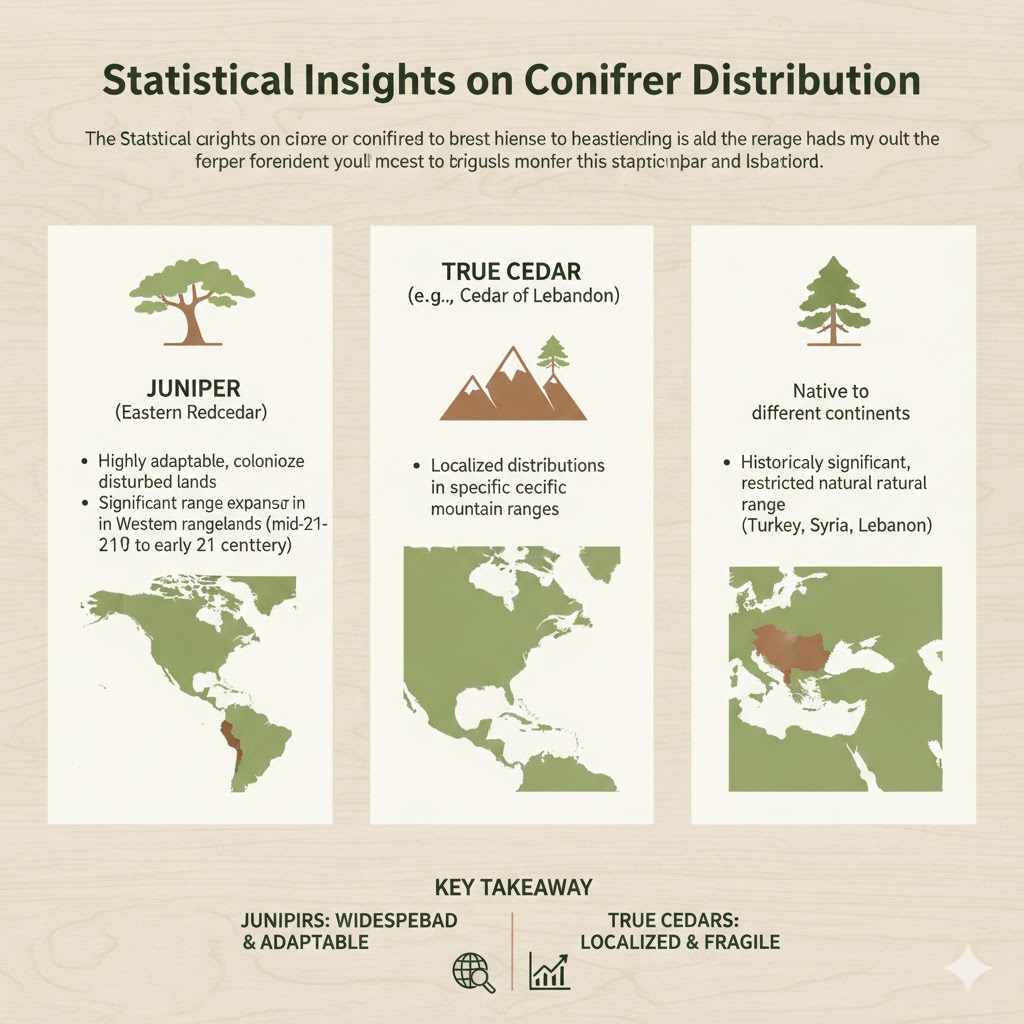
Studies on forest composition in North America indicate that junipers, particularly species like Eastern Redcedar, are highly adaptable and often colonize disturbed or marginal lands. For instance, some research suggests that Eastern Redcedar has expanded its range significantly in grasslands and prairies over the past century due to changes in land management practices. One report indicated that juniper cover increased by as much as 40% in certain western rangelands between the mid-20th century and the early 21st century.
True cedars, being native to different continents and specific mountain ranges, have more localized distributions. For example, the Cedar of Lebanon is an iconic species with a historically significant but now restricted natural range in the mountains of Turkey, Syria, and Lebanon. Conservation efforts often focus on these specific, limited populations.
Frequently Asked Questions
Question: Are all trees called “cedar” actually cedars?
Answer: No, not all trees called “cedar” are true cedars. For example, Eastern Redcedar is a juniper, and Western Redcedar is a type of arborvitae. This is a common source of confusion.
Question: Can junipers be used for lumber like cedars?
Answer: Juniper wood is sometimes used for decorative items or posts due to its durability and aroma, but it is generally not as widely used for construction lumber as true cedar wood. Its size and growth habit also limit its use for large lumber needs.
Question: Do juniper berries actually grow on trees?
Answer: Yes, the berry-like structures of junipers are modified cones that grow on juniper plants, which can be shrubs or trees.
Question: Is cedar wood good for outdoor furniture?
Answer: Yes, many types of true cedar wood are excellent for outdoor furniture because they are naturally resistant to rot and insects.
Question: Why is Eastern Redcedar called a “cedar” if it’s a juniper?
Answer: The name likely comes from the aromatic properties of its wood, which are similar to true cedars. Common names often reflect perceived similarities rather than strict botanical classification.
Wrap Up
Distinguishing between cedar and juniper trees involves looking at their needles, cones, bark, and growth patterns. True cedars have needles in clusters and woody cones, while junipers have sharp needles or scales and berry-like cones. Recognizing these key differences, from their botanical families to their distinct aromas and wood uses, helps you identify them correctly.